
Aroids and other genera in the Collection
Take the Tour Now?
Orchids
The
Exotic Rainforest
Plants in
the Exotic Rainforest Collection
Images on this website are copyright protected. Contact us before attempting to reuse.
In depth information, how to grow
Philodendron
species, Click this Link
Within our collection we have many species of
Philodendron.
If you are seeking other photos,
click this link
Philodendron
bipinnatifidum
Schott ex Endl
Does climb trees!
Note:
Looking for
Philodendron xanadu?
click this link
http://www.exoticrainforest.com/Philodendron%20xanadu%20pc.html
Several search engines are directing
searches to this page if searching for
information on
Philodendron xanadu. Although both
species are members of Philodendron subgenus Meconostigma, P. xanadu is a
unique species and no longer considered a hybrid.
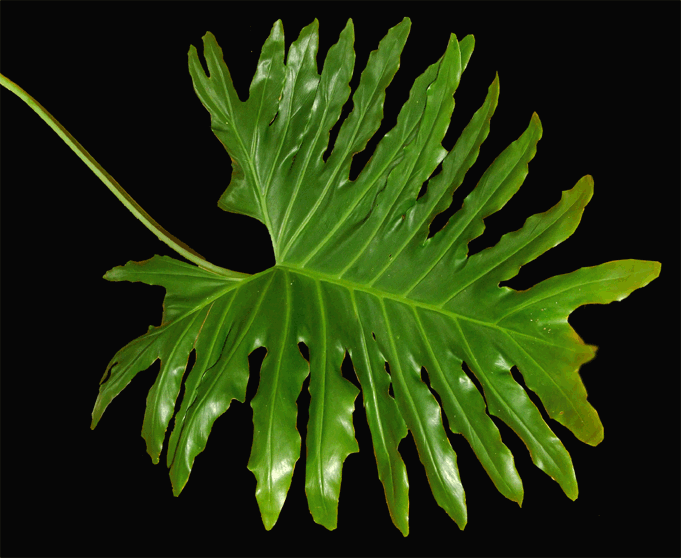
Often sold as Philodendron selloum which is now a synonym
Common names:
Split Leaf Philodendron, Tree Philodendron, Lacy Tree Philodendron,
Selloum, Elephant Ear Philodendron, Cut Leaf Philodendron,
Philodendron selloum, Self heading Philodendron
Common names used in Brazil:
Banana-de-imbê, Banana-de-macaco, Banana-de-morcego, Banana-do-brejo
Banana-do-mato, Cipó-imbé, Imbê, Guaimbê
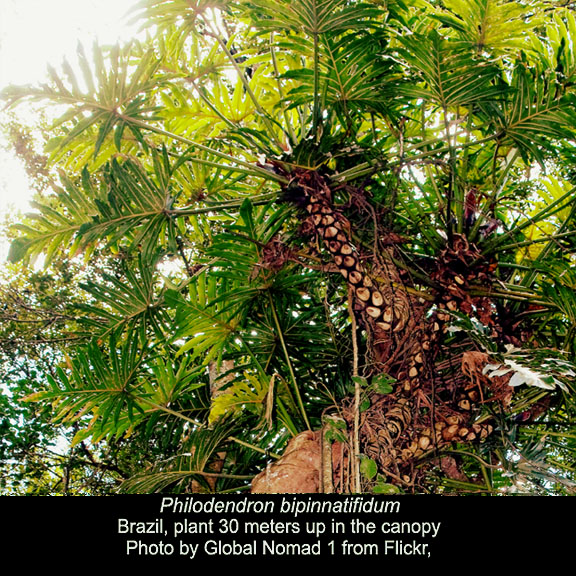 Philodendron bipinnatifidum
can be found as a landscape plant in virtually every community but
almost everyone knows it by the name
Philodendron selloum
rather than its accepted scientific name.
Philodendron bipinnatifidum
can be found as a landscape plant in virtually every community but
almost everyone knows it by the name
Philodendron selloum
rather than its accepted scientific name.
 Found in Brazil,
Argentina, Bolivia and Paraguay, although quite a few websites claim Philodendron
bipinnatifidum does not climb according to one of the world's
best known aroid botanists their information is inaccurate.
In his scientific paper A Revision of Philodendron Subgenus
Meconostigma (Araceae) Dr. Simon Mayo describes the species as
being hemiepiphitic. A hemiepiphyte (hemi-EPI-fit) is a plant
that begins life in the ground and the climbs a supporting tree.
Again, in the scientific text The Genera of Araceae by by
Mayo, Bogner and P.C. Boyce when discussing the roots of climbing
aroids the text states,
"Roots in Araceae are
always
and dimorphic roots are often found in climbing
hcmiepiphytes, e.g. Monstera deliciosa, Philodendron
bipinnatifidum."
Adventitious roots
form from shoot tissues, not from another root while dimorphic indicates the roots grow in two distinct
forms. Dr. Mayo explains further later in this article.
(see photo right (above) taken in Brazil),
Found in Brazil,
Argentina, Bolivia and Paraguay, although quite a few websites claim Philodendron
bipinnatifidum does not climb according to one of the world's
best known aroid botanists their information is inaccurate.
In his scientific paper A Revision of Philodendron Subgenus
Meconostigma (Araceae) Dr. Simon Mayo describes the species as
being hemiepiphitic. A hemiepiphyte (hemi-EPI-fit) is a plant
that begins life in the ground and the climbs a supporting tree.
Again, in the scientific text The Genera of Araceae by by
Mayo, Bogner and P.C. Boyce when discussing the roots of climbing
aroids the text states,
"Roots in Araceae are
always
and dimorphic roots are often found in climbing
hcmiepiphytes, e.g. Monstera deliciosa, Philodendron
bipinnatifidum."
Adventitious roots
form from shoot tissues, not from another root while dimorphic indicates the roots grow in two distinct
forms. Dr. Mayo explains further later in this article.
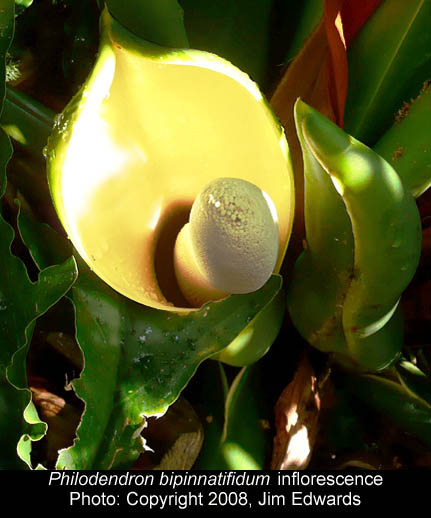
(see photo right (above) taken in Brazil),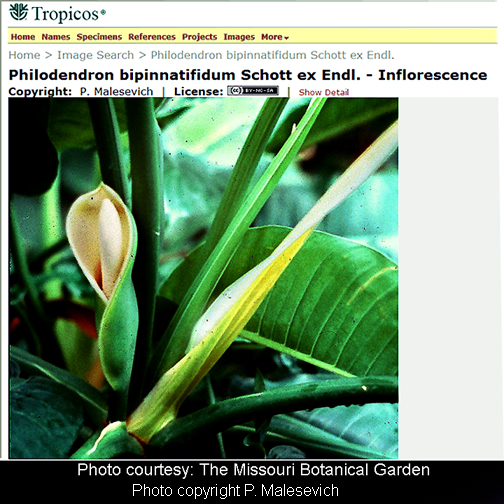 modified leaf whose purpose
is to protect the spadix at its center. If you
explore the inflorescence with a strong magnifying glass when it
first reaches female anthesis (sexual reproduction) and is beginning to open
you
will find very tiny flowers (male, sterile male, and female) on the spadix
at the spathe's center.
These will not open all at once and open progressively beginning
with the female flowers along with the sterile male flowers followed
a day or two later by the male flowers.
modified leaf whose purpose
is to protect the spadix at its center. If you
explore the inflorescence with a strong magnifying glass when it
first reaches female anthesis (sexual reproduction) and is beginning to open
you
will find very tiny flowers (male, sterile male, and female) on the spadix
at the spathe's center.
These will not open all at once and open progressively beginning
with the female flowers along with the sterile male flowers followed
a day or two later by the male flowers. 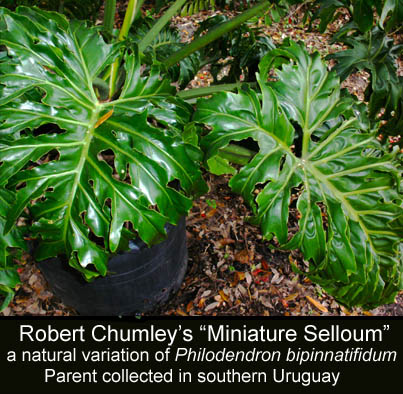 be the
basionym or base species. The final determination is
concluded due to the structure of the spathe and spadix rather
than a leaf shape determining the species. The final
scientific determination is made by a careful dissection and
comparison of the sexual characteristics found within the
inflorescence considered along with the structure of the stem,
petiole, cataphylls, veins and other principal characteristics.
When all the characteristics are compared the taxonomist goes back
to the very first occurrence of the species being published to
science. Quite simply, the first name wins and all others
which attempt to describe the same species become synonyms.
The scientific name Philodendron bipinnatifidum was published
in 1832 and the name Philodendron selloum was not published
until 1852. Regrettably, there is a
great deal of both incorrect and non-scientific information on the internet regarding
the species
Philodendron bipinnatifidum. A botanist simply does not "change" a name
instead they
follow the rules of botany and track the species back to the
original published name.
be the
basionym or base species. The final determination is
concluded due to the structure of the spathe and spadix rather
than a leaf shape determining the species. The final
scientific determination is made by a careful dissection and
comparison of the sexual characteristics found within the
inflorescence considered along with the structure of the stem,
petiole, cataphylls, veins and other principal characteristics.
When all the characteristics are compared the taxonomist goes back
to the very first occurrence of the species being published to
science. Quite simply, the first name wins and all others
which attempt to describe the same species become synonyms.
The scientific name Philodendron bipinnatifidum was published
in 1832 and the name Philodendron selloum was not published
until 1852. Regrettably, there is a
great deal of both incorrect and non-scientific information on the internet regarding
the species
Philodendron bipinnatifidum. A botanist simply does not "change" a name
instead they
follow the rules of botany and track the species back to the
original published name. 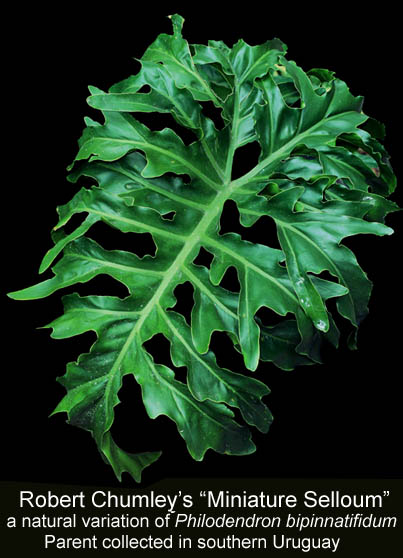 Within
aroid species every leaf does not need to look alike.
To a scientist those differences are known as natural variation. Just
because the leaves in the photo above do not exactly match the
photos on other websites does not mean they are not this species.
Within
aroid species every leaf does not need to look alike.
To a scientist those differences are known as natural variation. Just
because the leaves in the photo above do not exactly match the
photos on other websites does not mean they are not this species.
At least one Texas garden site included this quote on their site which I suspect they chose to use as a result of one of these articles, "This is one of the few philodendrons that are not climbers. Instead it grows as a woody shrub. It has huge
 leaves and one stem that does
not
branch.
The branch falls over when the top gets too heavy.
leaves and one stem that does
not
branch.
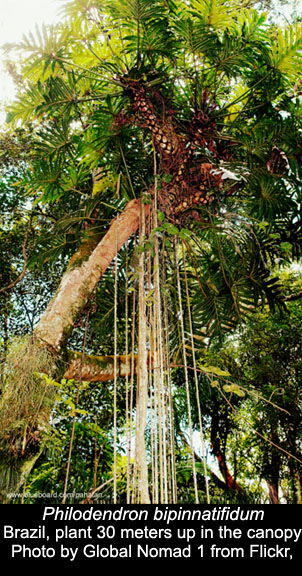
The branch falls over when the top gets too heavy. I brought these errors to the attention of aroid botanist Dr. Simon Mayo of the Royal Botanic Garden Kew in London who is the leading authority on the Philodendron subgenus Meconostigma. Simon is the author of A Revision of Philodendron Subgenus Meconostigma (Araceae) and his paper is considered the most authoritative in the field. Simon responded, "Yes Philodendron bipinnatifidum certainly does climb but from what I've seen the way it does it is different from Subgenus Philodendron and subgenus Pteromischum species which emit relatively fine anchor roots at or near the nodes. In P. bipinnatifidum and other members of Subgenus Meconostigma the anchor roots are pretty thick and can wrap themselves around small tree stems like ropes. It is almost as if the plant hauls itself into the canopy. I've seen plants suspended between neighboring small trees by these roots. They do have a very adaptable kind of growth habit, which I suppose goes along with their natural ecology, preferring rather higher light intensity situations than "normal" Philodendrons." As a result, any information on garden websites claiming Philodendron subgenus Meconostigma species do not climb does not match the observations of more than a few qualified botanists.
 support for a single leaf the "stem" the
structure that supports any leaf is correctly known as the petiole. This
link explains the difference in a stem and a petiole.
support for a single leaf the "stem" the
structure that supports any leaf is correctly known as the petiole. This
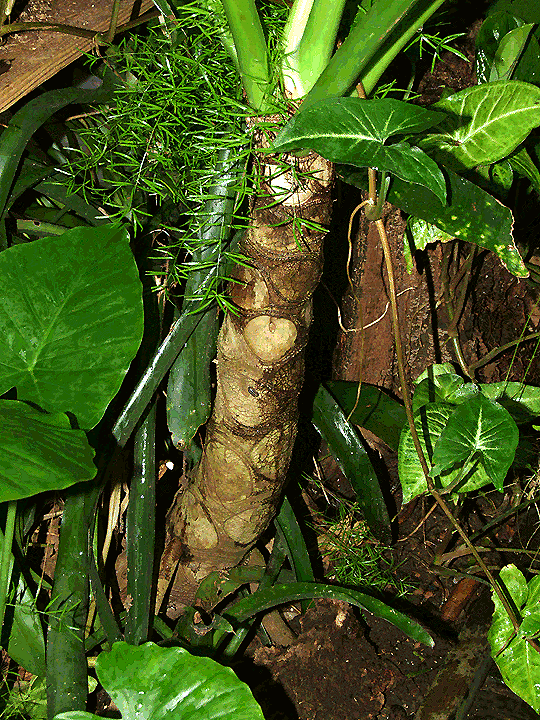
link explains the difference in a stem and a petiole.Members of subgenus Meconostigma are perfectly capable of supporting themselves to massive heights, sometimes 7 meters (almost 20 feet) or more. In time, they actually produce a "tree-like" base as can be seen in my photo to the right but they are also capable of climbing trees or growing as hemiepiphytic species attached to a tree limb with their roots extending up to 30 meters (close to 100 feet) to the soil below. The photos to the left and right (below) taken by a Flickr photographer that prefers to be known as Global Nomad 1 (used with permission) included the following information, "Philodendron sp. with long roots reaching for the soil 30 m below. The Atlantic Forest of tropical South America is one of the most biologically diverse forests but less than 10 percent of the original forest remains due to extensive clearing for agriculture and urbanization. If protected and encouraged to regenerate, the forest could come back in several areas as shown in this photo of a 70 year old secondary forest that regenerated on a previously cleared and degraded patch of land in Sao Paulo city." http://www.flickr.com/photos/global_nomad1/
I have personally observed countless specimens in South Florida climbing tall trees reaching great heights. Growers in the Homestead area of South Florida often have enormous specimens climbing in their yards. As any tree may eventually fall from its own weight a Meconostigma may also fall. But more often they simply grow at an angle with their roots still keeping them firmly upright. Even the State of Florida website FLORIDATA says, "Philodendron bipinnatifidum, which begins life as vines and then transform into epiphytes". An epiphyte (ep-a-FIT) is simply a plant that grows attached to another plant while a hemiepiphyte (hem-a-EPA-fit) is a plant that may begin life in soil and climb a host tree or begin life as a seed placed on the branch of a tree and extend its roots down to the soil.
Since more than individuals appear to believe Meconostigma species don't climb I also asked aroid experts Julius Boos and Joep Moonen to comment. Joep lives and works in the rain forest of French Guiana.
Julius commented, "Concerning some of the so-called ground-growing species such as P. bipinnatifidum and P. stenolobum, these will grow their stems/rhizomes vertically for a while, but as they age and fall over they grow horizontally along the ground If they encounter a palm or tree trunk they will eagerly grasp on to the support and climb upwards. The height (and health/survival) of the supporting palm or tree would be the only limitations as to how high they eventually would grow! I have seen P. bipinnatifidum clasping a tall Queen Palm in Wellington, the Philodendron had its huge ''head'' (8' X 8'?) about 20 feet up the palm!"
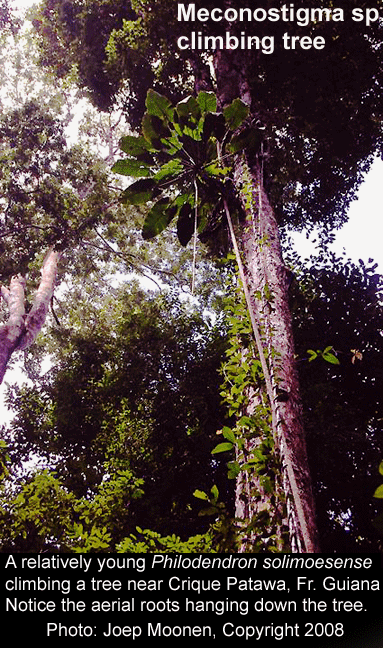 Joep shared
this information explaining how Meconostigma grow in the forest,
"There may still be
some
confusion how Meconostigma grow in nature. Terrestrial species do
indeed grow in the ground. The species I'm most familiar with, P.
solimoesense and P. goeldii, grow high in the canopy and are true epiphytes.
The fruit or seed is deposited high on a branch and from there the plant
develop. Very old plants fall from their erect position and curl around the
tree branch while the roots, (with a typically strong odor), go straight
down to the humus layer 40 meters (120 feet) down. If the host tree
falls the Philodendron carry on at the bottom since there is an open spot
with enough light and in that how they grow along roads in the jungle.
But they started in the canopy so it is logical the only P. Marijke I saw in
the wild was growing on a tree."
Joep shared
this information explaining how Meconostigma grow in the forest,
"There may still be
some
confusion how Meconostigma grow in nature. Terrestrial species do
indeed grow in the ground. The species I'm most familiar with, P.
solimoesense and P. goeldii, grow high in the canopy and are true epiphytes.
The fruit or seed is deposited high on a branch and from there the plant
develop. Very old plants fall from their erect position and curl around the
tree branch while the roots, (with a typically strong odor), go straight
down to the humus layer 40 meters (120 feet) down. If the host tree
falls the Philodendron carry on at the bottom since there is an open spot
with enough light and in that how they grow along roads in the jungle.
But they started in the canopy so it is logical the only P. Marijke I saw in
the wild was growing on a tree."
PhilodendronXanadu

or
Brian's Botanicals http://www.briansbotanicals.net/

Join the International Aroid Society: http://www.exoticrainforest.com/Join%20IAS.html