
Aroids and other genera in the Collection
Take the Tour Now?
Orchids
The
Exotic Rainforest
Plants in
the Exotic Rainforest Collection
Images on this website are copyright protected. Contact
us before any reuse.
In depth information on how to grow Philodendron species, Click this Link
Within our collection we have many species of Philodendron.
If you are seeking other photos,
click this link
Our apologies if you've read this page before and were led to
believe this plant originated in Australia!
A clever hacker managed to change some of the info on this page to indicate
the plant was found in Australia!
It is not an Australian native!
Philodendron xanadu
Croat, Mayo &
Boos 2002
Known as
Philodendron 'Xanadu', Philodendron 'Winterbourn', Philodendron 'Aussie'
Incorrectly spelled Philodendron Zanadu, Philodendron Zanadoo,
Philodendron Xanadue
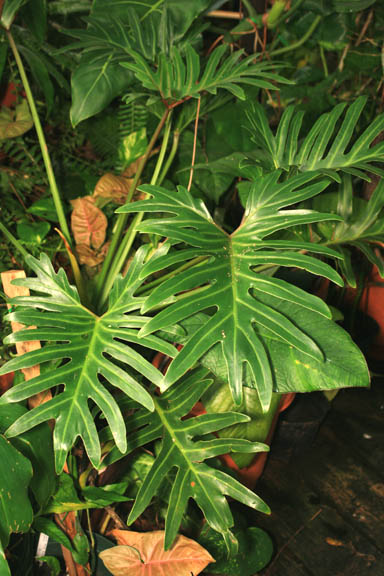
Known as Philodendron 'Xanadu', Philodendron 'Winterbourn', Philodendron 'Aussie', Philodendron Xanadue
and is not the offspring of Philodendron bipinnatifidum
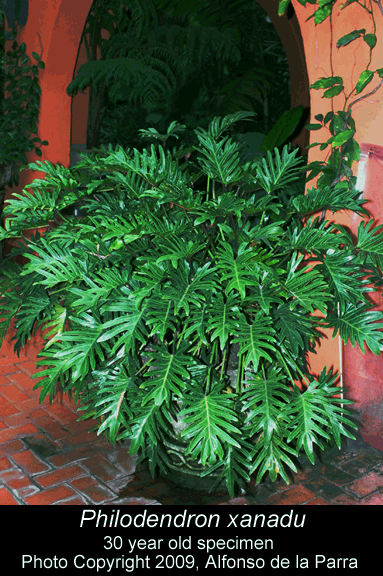 Based
upon recently published scientific study by Julius Boos which can be read in the
International Aroid Society journal Aroideana (volume 31, 2008) ,
Philodendron xanadu is thought to have originated in southeastern
Brazil and is capable of growing much larger than the tissue cultured
specimens commonly available all over the world. Some evidence now
indicates the chemical process used to tissue culture (clone) the species appears to cause
a specimen not
to reach its full potential and size. As a member of
Philodendron section Meconostigma the species is also easily "stunted" by
overcrowding and does not grow as well as possible when numerous
specimens are crowded into a single pot.
Based
upon recently published scientific study by Julius Boos which can be read in the
International Aroid Society journal Aroideana (volume 31, 2008) ,
Philodendron xanadu is thought to have originated in southeastern
Brazil and is capable of growing much larger than the tissue cultured
specimens commonly available all over the world. Some evidence now
indicates the chemical process used to tissue culture (clone) the species appears to cause
a specimen not
to reach its full potential and size. As a member of
Philodendron section Meconostigma the species is also easily "stunted" by
overcrowding and does not grow as well as possible when numerous
specimens are crowded into a single pot.
Philodendron xanadu has a somewhat "murky" history. In the past numerous websites have claimed this species was "discovered" in the the rain forests of Australia. Scientifically, that is not possible since all Philodendron are Neotropical and grow naturally only in South and Central America as well as the Caribbean. Not one Philodendron species grows naturally in the forests of Australia even though many have been set free in that country.
Other information on
the internet states it is a man-made hybrid and still others suggest it to be a cultivar created
from Philodendron bipinnatifidum. I can speak
personally to the man-made hybrid and cultivar issues since I have a
friend who has been growing several specimens for many years grown from seeds well before
 the plant became popular as a house
plant.
the plant became popular as a house
plant.
Despite the claims of many that Philodendron xanadu is nothing more that a natural "sport" of Philodendron bipinnatifidum my friend Alfonso de la Parra in Cuernavaca, Mexico (photo above, right), who collects rare and exotic plants, has been growing this plant for over 18 years. His plants were grown from the seeds of a wild collected plant in Brazil. As a result it is obvious the species Philodendron xanadu exists in nature and has been around much longer than some on the internet would have you believe and was being grown well before the popularization of the plant via tissue culture.
Some websites actually refer to Philodendron xanadu as "mini" Philodendron selloum. Philodendron selloum is a commonly used name (no longer used scientifically) for Philodendron bipinnatifidum . There is a completely different plant also called miniature Philodendron selloum which is in fact a unique natural variation of Philodendron bipinnatifidum but that plant is rare and currently known only from the collection of grower Robert Chumley in Florida although seedlings have now been shared with a variety of collectors including the Exotic Rainforest. Mr. Chumley's specimen originated in Paraguay and is not the same plant as shown on this page.
 The two Philodendron species are related as
members of the Philodendron
section Meconostigma but they
are not the same species nor is one a hybrid of the other. The
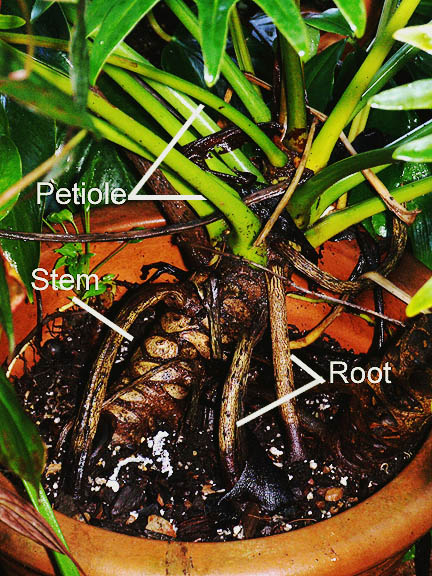
base of a Meconostigma specimen is very distinctive (see photo above left)
since members of this section are often known as "tree Philodendron"
and are capable of standing alone. Philodendron xanadu is
considered a self header and not a climber due to the "tree-like" stem
at the base of the plant.
The two Philodendron species are related as
members of the Philodendron
section Meconostigma but they
are not the same species nor is one a hybrid of the other. The
base of a Meconostigma specimen is very distinctive (see photo above left)
since members of this section are often known as "tree Philodendron"
and are capable of standing alone. Philodendron xanadu is
considered a self header and not a climber due to the "tree-like" stem
at the base of the plant.
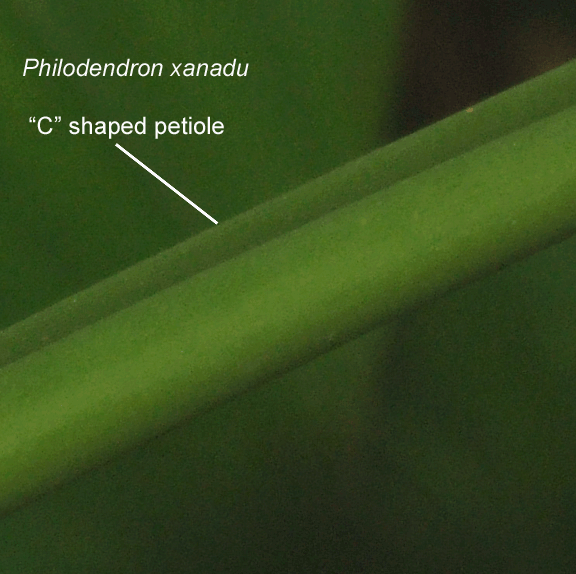
The petioles of P. xanadu possess a canal ("C" shaped) along the upper surface of the petiole while Philodendron bipinnatifidum often has a flat upper surface to the petiole ("D" shaped as well as being "C" shaped. The petiole is the stalk that connects the leaf blade to the stem which is the base of the plant. The stem is the part of the plant that forms buds, petioles (thus leaves), roots, and the peduncles that support an inflorescence (thus flowers). A peduncle is the internode between the spathe and the last foliage leaf. The stem is the main axis of the plant and provides support. Although the majority of the stem grows above ground portions may also exist beneath the surface. The purpose of the stem is to collect and store water and nutrients which are absorbed by the specimen's roots. The roots grow (along with the petioles) from the nodes along the stem's length.
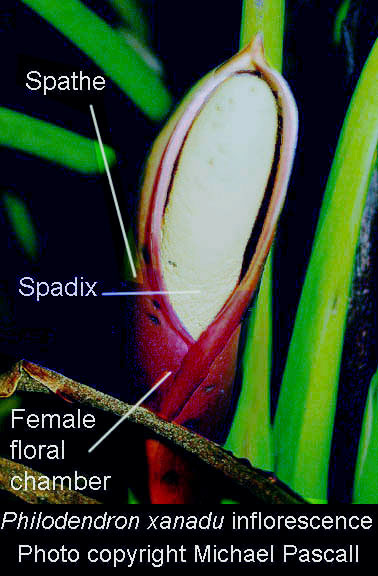
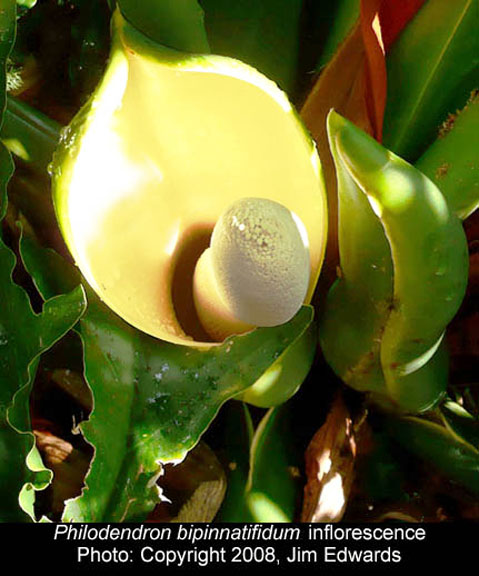
In addition, examination of the spathe and spadix by a botanical scientist quickly disproves any assumption Philodendron xanadu and Philodendron bipinnatifidum are the same species. As you can see by comparing Michael Pascall's photo (left, below) of the inflorescence of Philodendron xanadu to the photo at the bottom of this page by Jim Edwards of the spathe and spadix of Philodendron bipinnatifidum, the two are distinct species.
 My
friends Julius Boos and Dr. Tom Croat of the Missouri Botanical Garden
are two of the authors of the scientifically published
description of Philodendron xanadu. Philodendron xanadu
is a good species which evidence indicates originated in Brazil.
The species is listed on the botanical databases of the
International Plant Names Index (IPNI)
International Plant Names Index and TROPICOS, a service of the Missouri
Botanical Garden. If you go to TROPICOS at this link then click on
"distribution" the site clearly states the species is from Brazil:
Tropicos.org/Philodendron xanadu
Additional photos of the type specimen can be seen on the the
site. Please also note there is no indication Philodendron xanadu
is closely related to Philodendron bipinnatifidum.
My
friends Julius Boos and Dr. Tom Croat of the Missouri Botanical Garden
are two of the authors of the scientifically published
description of Philodendron xanadu. Philodendron xanadu
is a good species which evidence indicates originated in Brazil.
The species is listed on the botanical databases of the
International Plant Names Index (IPNI)
International Plant Names Index and TROPICOS, a service of the Missouri
Botanical Garden. If you go to TROPICOS at this link then click on
"distribution" the site clearly states the species is from Brazil:
Tropicos.org/Philodendron xanadu
Additional photos of the type specimen can be seen on the the
site. Please also note there is no indication Philodendron xanadu
is closely related to Philodendron bipinnatifidum.
Julius studied a specimen of Philodendron xanadu in Florida (P. xanadu is not native to Florida) and was joined by noted aroid botanists Dr. Croat and botanist Dr. Simon Mayo who is an expert on Brazilian Philodendron species associated with the Royal Botanic Gardens, Kew in London. Julius is a well known aroid researcher and both Dr. Croat and Dr. Mayo are among the world's leading aroid scientists. The three collaborated in describing the species scientifically. As a species Philodendron xanadu was originally published in the International Aroid Society journal Aroideana, volume 25, in 2002. At the very top of the scientific description of the species you can find this heading, "A New Species of Brazilian Philodendron subgenus Meconostigma (Araceae)." Julius and I have revised this page to reflect the majority of the current findings of these aroid experts.
Even the Australian government does not consider
Philodendron xanadu to be from their country. If you check the Australian National Botanic
Gardens website, Australian Plant Names Index, you will not find this
species
listed. Certainly, the Australian government would know if
P. xanadu was truly an
Australian species.
http://www.anbg.gov.au/cpbr/databases/apni-search-full.html
 Purportedly, according to information
still posted on the internet, Philodendron xanadu was discovered in
Western Australia in 1983.
Any speculation Philodendron xanadu occurs naturally in Australia would
therefore be both inaccurate and impossible. The only way it could
have been "found" in Australia is if someone planted seeds of
the specimen which have been available for sale by a reputable seed
dealer in Brazil.
The planting any specimen in a non-native country does
not make it
native. Much of the information on the internet regarding
Philodendron xanadu does track back to plant nurseries in
Australia.
Purportedly, according to information
still posted on the internet, Philodendron xanadu was discovered in
Western Australia in 1983.
Any speculation Philodendron xanadu occurs naturally in Australia would
therefore be both inaccurate and impossible. The only way it could
have been "found" in Australia is if someone planted seeds of
the specimen which have been available for sale by a reputable seed
dealer in Brazil.
The planting any specimen in a non-native country does
not make it
native. Much of the information on the internet regarding
Philodendron xanadu does track back to plant nurseries in
Australia.
Philodendron xanadu has been cloned heavily in the United States through tissue culture but the specimen was to create the clone was in fact imported from a nursery in Australia which is likely the source of the confusion. The original attempts at tissue culture resulted in failure and some labs turned down production of the species.
The original U.S. patent request for Philodendron 'Xanadu' is quite vague on the subject of the plant's true origin. That text appears to claim the original specimen came from a seed found in a collection of seed from Philodendron selloum (now known to science as Philodendron bipinnatifidum ). There appears to be no mention of how or where the seed was obtained but it is likely the seeds were d from Brazil. There is no claim in the patent application the plant is native to Australia.
After repeated tissue culture attempts, the production of the species as a cloned specimen has become highly successful and millions of plants have been produced and sold. Growers in Europe and Australia also report Philodendron xanadu is commonly sold and grown in their countries.
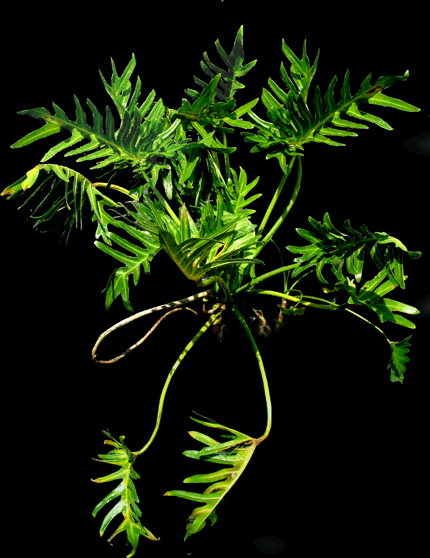
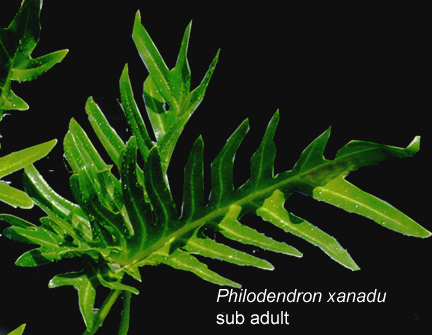 A terrestrial species, Philodendron xanadu has a very
tropical appearance due to it's multi-lobed blades.
P. xanadu is used as a landscape plant
in some tropical climates such as South Florida. Many growers report great success with
the species. A strictly tropical species requiring
warmth and humidity to survive, the lobed foliage of Philodendron xanadu can grow to 1.6 meters (5 feet) in width and 1 meter (3 feet) in
height. With sub-coriaceous (less than leathery) blades, the leaves can
grow very long in length and the present time it is unknown exactly how
large P. xanadu may grow if grown
from seed and not from tissue
culture. Some researchers believe it may be capable of growing
well over 1 meter in blade size.
The largest blade on our specimen is (August, 2008) over 40cm (16
inches) in length but each new blade grows
larger. You can clearly
see the lobes at the top of new blades developing.
A terrestrial species, Philodendron xanadu has a very
tropical appearance due to it's multi-lobed blades.
P. xanadu is used as a landscape plant
in some tropical climates such as South Florida. Many growers report great success with
the species. A strictly tropical species requiring
warmth and humidity to survive, the lobed foliage of Philodendron xanadu can grow to 1.6 meters (5 feet) in width and 1 meter (3 feet) in
height. With sub-coriaceous (less than leathery) blades, the leaves can
grow very long in length and the present time it is unknown exactly how
large P. xanadu may grow if grown
from seed and not from tissue
culture. Some researchers believe it may be capable of growing
well over 1 meter in blade size.
The largest blade on our specimen is (August, 2008) over 40cm (16
inches) in length but each new blade grows
larger. You can clearly
see the lobes at the top of new blades developing.
Philodendron xanadu
was exclusively cultured in a lab as a tissue cultured
(cloned) specimen. However, seeds from wild collected plants have become
available. For many years, the importer possessed a U.S. patent and copyright to
sell the plant as Philodendron 'Xanadu'. However, there is some speculation
the patent is no longer valid and other growers are
beginning to
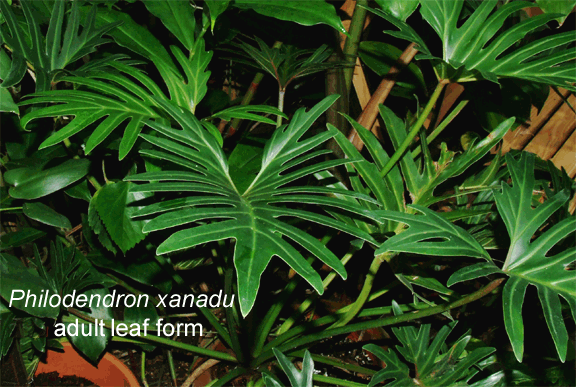
cultivate the species. The plant in our photos of the adult
form was grown by Julius and exhibits the adult
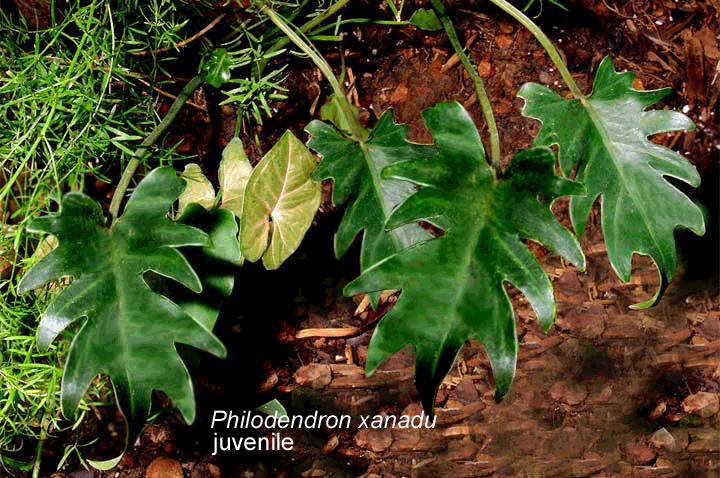 blade form.
Julius explains,
"your plant
shows all the characteristics of an 'adult' plant of P. xanadu. My
article in the latest Aroideana volume 31 explains the 'why'. It and the plants
pictured in my article---by the way your plant is one of the two I
photographed for the article, were grown not crowded in a pot".
blade form.
Julius explains,
"your plant
shows all the characteristics of an 'adult' plant of P. xanadu. My
article in the latest Aroideana volume 31 explains the 'why'. It and the plants
pictured in my article---by the way your plant is one of the two I
photographed for the article, were grown not crowded in a pot".
All Philodendron species are aroids. An aroid is a plant that reproduces via the production of an inflorescence known to science as a spathe and spadix. Most believe the spathe is a "flower", it is not. The spathe is simply a specially modified leaf appearing to be a hood whose purpose is to protect the spadix at the center. The spadix is a spike on a thickened fleshy axis which is capable of producing tiny flowers. On the spadix there can be found very tiny flowers when the plant is at anthesis (sexual reproduction).
When ready to reproduce, the spadix produces
male, female and sterile flowers which if pollinated by an appropriate insect, normally a beetle, will produce berries
containing seeds
A key method used by
botanists to determine a new aroid species is to examine the
inflorescence (spathe and spadix). The spathe of Philodendron xanadu
is dark violet-purple bordering on red and the differences in the spathes of Philodendron xanadu and
Philodendron bipinnatifidum
indicate to a scientist this is positively a species and is
 not
a cultivar. The spathe of
Philodendron bipinnatifidum
is basically green with a white interior. However, due to tissue
culture chemicals plants sold as Philodendron xanadu often
produce a malformed inflorescence.
not
a cultivar. The spathe of
Philodendron bipinnatifidum
is basically green with a white interior. However, due to tissue
culture chemicals plants sold as Philodendron xanadu often
produce a malformed inflorescence.
The large specimen on this page was a gift from my close personal friend Julius Boos who is one of authors of the species' scientific description. That specimen easily stands well over one meter (3.5 feet) tall. My thanks to Julius for his input and editing of this description.
Philodendron
species are
known to be highly variable and not every leaf of every specimen
will always appear the same. Size is also not a determining
factor when it comes to determining the species.
This link explains natural variation and
morphogenesis due to ontogeny in aroid and other plant species.
Aroid Pollination!
As
it occurs in nature and by any horticulturist
Looking for a specimen? Contact
Brian's Botanicals at
http://www.briansbotanicals.net/

