
Aroids and other genera in the Collection
Take the Tour Now?
Orchids
The
Exotic Rainforest
Plants in
the Exotic Rainforest Collection
The images on this website are copyright protected. Please contact us before any reuse.
Detailed information on Growing Anthurium Species
Click this Link
Within our collection we have many species of Anthurium. If you are seeking other photos, click this link:
New: Understanding, pronouncing and using Botanical terminology, a Glossary
Anthurium crystallinum Linden and André
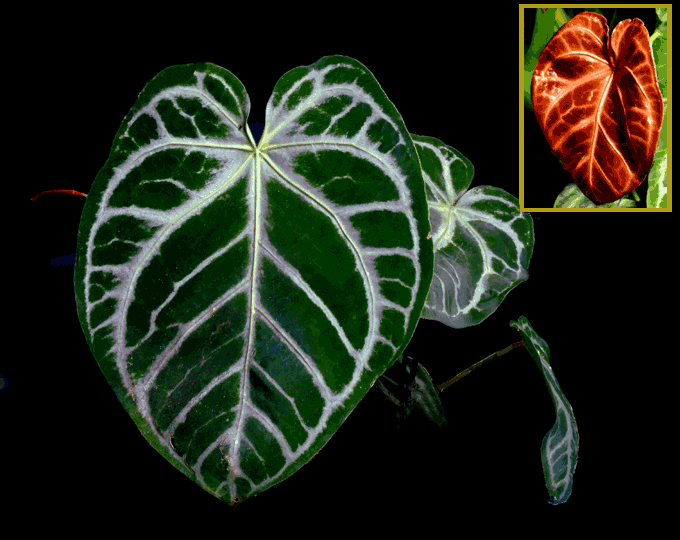
 have been seen that correspond well with the original illustration by
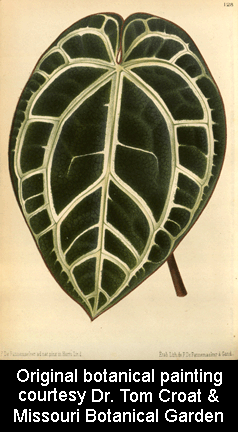
Linden and André done in 1873. Those botanists made a painting of
the type specimen
(see the original, left) that showed a closed sinus divided all the way to the petiole.
Specimens of Anthurium crystallinum matching that description have not been found to date.
have been seen that correspond well with the original illustration by
Linden and André done in 1873. Those botanists made a painting of
the type specimen
(see the original, left) that showed a closed sinus divided all the way to the petiole.
Specimens of Anthurium crystallinum matching that description have not been found to date.
Despite
the fact an A. crystallinum with a closed sinus is apparently uncommon
in cultivation today, it does sometimes exist. We recently had one
of our own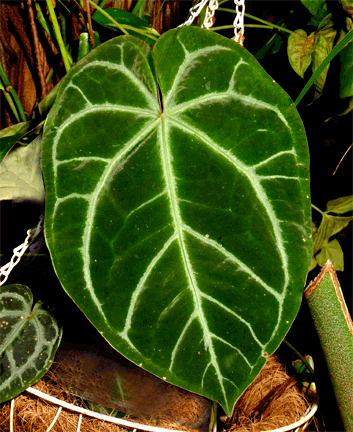 specimens begin to produce leaves with the closed sinus
almost identical to the original painting by
Linden and André.
When I sent the photo right to Dr. Croat he made the following comment,
"It looks to me that the image I saw on
your website is a good match for the type!"
We have since
learned of two other collectors that possess the same closed sinus
specimen.
specimens begin to produce leaves with the closed sinus
almost identical to the original painting by
Linden and André.
When I sent the photo right to Dr. Croat he made the following comment,
"It looks to me that the image I saw on
your website is a good match for the type!"
We have since
learned of two other collectors that possess the same closed sinus
specimen.
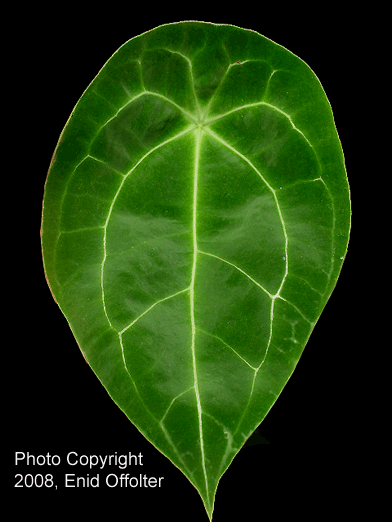
Some collectors may be tempted to believe they know the plant that was actually painted as the type specimen, Anthurium forgetii N.E. Br. which is also from Colombia. Anthurium forgetii, which can be seen in Windy Aubrey's photograph, has no lobes at the top of each leaf. You can read about Anthurium forgetii here: Anthurium forgetii
That
plant looks
similar to Anthurium crystallinum but has no
sinus opening at all! According to the Missouri
 Botanical Garden's aroid botanist Dr. Croat,
it is a separate species and is quite different than Anthurium crystallinum. Aroid expert Julius Boos explains the
differences when he wrote regarding Anthurium forgetii (photo,
left),
"It has a completely closed or absent
sinus. You say that A. crystallinum has a closed sinus divided all
the way down to the petiole. This would mean the two posterior lobes
touch each other. But there is a slit all the way down from the
top of the posterior lobes down to the petiole. It would not be a
sealed or absent sinus like as A. forgetii."
Anthurium species are known to
be highly variable and not every leaf of every specimen will always
appear the same. This link explains in non-technical language natural variation and morphogenesis
within aroids and other species.
Botanical Garden's aroid botanist Dr. Croat,
it is a separate species and is quite different than Anthurium crystallinum. Aroid expert Julius Boos explains the
differences when he wrote regarding Anthurium forgetii (photo,
left),
"It has a completely closed or absent
sinus. You say that A. crystallinum has a closed sinus divided all
the way down to the petiole. This would mean the two posterior lobes
touch each other. But there is a slit all the way down from the
top of the posterior lobes down to the petiole. It would not be a
sealed or absent sinus like as A. forgetii."
Anthurium species are known to
be highly variable and not every leaf of every specimen will always
appear the same. This link explains in non-technical language natural variation and morphogenesis
within aroids and other species.
Click here.
The species we now accept as Anthurium crystallinum was widely cultivated in Europe during the time of botanist Engler and his writings show he accepted as a part of A. crystallinum many specimens that have a relatively open sinus. The plant we now commonly accept, and grow, as Anthurium crystallinum is found in Colombia and portions of Panama. To add to the confusion regarding this commonly grown Anthurium the excellent text Aroids, Plants of the Arum Family indicates it is found from Panama through Peru. However, a check of the TROPICOS (Missouri Botanical Garden) database shows no collections have been made in Ecuador or Peru.
An aroid, all Anthurium species reproduce via the production an inflorescence. The stalk that supports the entire inflorescence is the peduncle. When an Anthurium is "in flower" the reference is to the tiny flowers containing both male and female sexual parts that grow on the spadix at the center of the inflorescence. Unlike plants in the genus Philodendron which contain imperfect flowers having only a single sex Anthurium possess perfect flowers containing both sexes. To help prevent self pollination nature has designed the female flowers to be receptive before the male portion of the flower produce their pollen so in most cases an insect must bring pollen from another plant.
Anthurium crystallinum is a member of section Cardiolonchium and the leaf blades of accepted specimens are sub-coriaceous (just less than leathery). They possess an attractive yet dark green coloration with a velutinous (velvety) appearance on the adaxial (upper) portion of the leaf blade. The leaf veins are pale green along the major veins with the abaxial (lower) surface a much paler green than the top of the blade. New leaf blades as well as the undersides of the adult leaf and petiole are sometimes tinged red-violet. Blades normally measure 25 to 39 cm long (10 to 11 1/2 inches. The largest leaf of our three specimens currently measures (December, 2006) 31cm (12 1/4 inches. The Anthurium produces a reddish tinged spathe with a yellow spadix. The spadix has a very faint yet pleasant aroma once the stamens emerge.
A. crystallinum is most closely related to Anthurium papillilaminum but bears some resemblance to A. clarinervium, thus the common confusion between the two species. I have even seen a few photos of Anthurium crystallinum noted as being Anthurium regale which is from Peru. Again, there is a resemblance, but Anthurium regale grows substantially larger and is even more beautiful. Anthurium crystallinum requires high humidity and grows well in a hanging basket provided the soil mixture is extremely fast draining. We use a mixture of good moisture control soil, peat, orchid potting media and Perlite™. The soil mixture should not be allowed to completely dry.
See also:
Join the International Aroid Society: http://www.exoticrainforest.com/Join%20IAS.html
Need more information on Anthurium species? Click this link.
