
Aroids and other genera in the Collection
Take the Tour Now?
Orchids
The
Exotic Rainforest
Plants in
the Exotic Rainforest Collection
The images on this website are copyright protected. Please contact us before any reuse.
Detailed information on Growing Anthurium Species
Click this Link
Within our collection we have many species of Anthurium.
If you are seeking other photos,
click this link
New: Understanding, pronouncing and using Botanical terminology, a Glossary
\
Anthurium clarinervium
Matuda
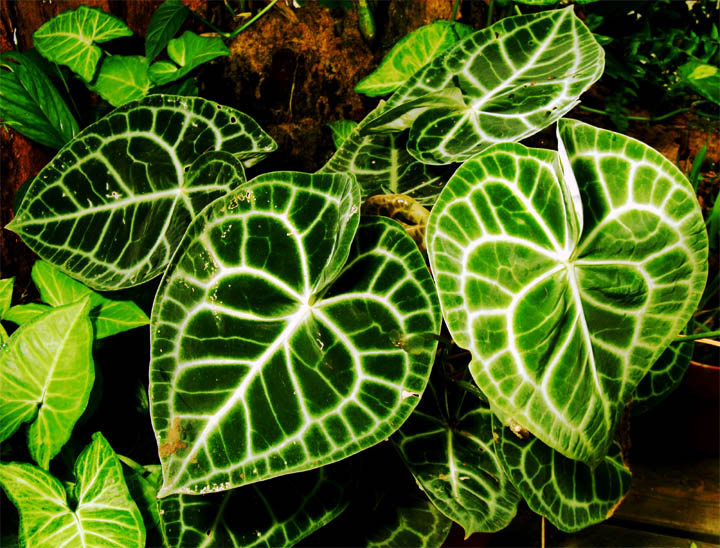
The Mexican "Velvet Cardboard" Anthurium
Commonly known in Mexico as Hoya de corazon
Anthurium clarinervium is an unusually interesting plant with a thick texture to the leaves. That leaf thickness is known botanically as being coriaceous, or "leather like". Anthurium clarinervium is one that has a relatively normal heart shape but feels almost like cardboard! A beauty with an unusual leaf pattern, it grows quickly and new plants can be easily begun by clipping and repotting the newer growths as they reach a size of a 10cm (3 or 4 inches) and are beginning to develop.
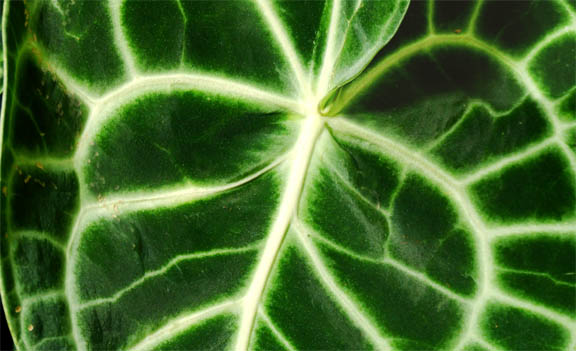 Anthurium clarinervium is
found in nature in the southern part of
Mexico in the state of Chiapas. The plant spreads and grows laterally
producing leaves with a deep, dark green that bs on green mixed
with black. Dr. Tom Croat of the Missouri Botanical Garden
says in his journal A Revision of the Genus Anthurium (Araceae) of
Mexico and Central America, the species is like endemic to
Mexico, or exclusively found in that country. Anthurium clarinervium is generally found only in a
well defined area at an elevation of 800 to 1200 meters (2500 to 3800
feet). The leaves are unusually thick and stiff as well as
decorated with silvery veins. Dr. Croat indicates this
species is likely related to Anthurium crystallinum.
Anthurium clarinervium is
found in nature in the southern part of
Mexico in the state of Chiapas. The plant spreads and grows laterally
producing leaves with a deep, dark green that bs on green mixed
with black. Dr. Tom Croat of the Missouri Botanical Garden
says in his journal A Revision of the Genus Anthurium (Araceae) of
Mexico and Central America, the species is like endemic to
Mexico, or exclusively found in that country. Anthurium clarinervium is generally found only in a
well defined area at an elevation of 800 to 1200 meters (2500 to 3800
feet). The leaves are unusually thick and stiff as well as
decorated with silvery veins. Dr. Croat indicates this
species is likely related to Anthurium crystallinum.
Despite possessing somewhat velvety (velutinous) leaves Anthurium clarinervium is not a member of Anthurium section Cardiolonchium which contains the velvet leaved Anthurium species. Dr. Croat explains, "These species will hybridize with other Mexican species including species in unrelated groups such as A. pedatoradiatum Schott but not with Cardiolonchium species in other areas. This again points out the isolated nature of the Mexican species of Anthurium . Indeed, Central American species of Anthurium in general are not closely related to those of South America."
An aroid, all Anthurium species reproduce via the production an inflorescence. The stalk that supports the entire inflorescence is the peduncle. When an Anthurium is "in flower" the reference is to the tiny flowers containing both male and female sexual parts that grow on the spadix at the center of the inflorescence. Unlike Philodendron species which contain imperfect flowers having only a single sex Anthurium possess perfect flowers containing both sexes. To help prevent self pollination nature has designed the female flowers to be receptive before the males flowers produce their pollen so in most cases an insect must bring pollen from another plant.
The spathe and spadix
make up the
reproductive portions of the plant known as an inflorescence and the spathe is sometimes incorrectly called a
"flower". Rather than a flower the spathe is a modified leaf
that surrounds
the spadix. The spadix is a spike on a
thickened fleshy axis which can produce the tiny flowers. Once the female
portions of the flowers on the spadix
have been fertilized by a Cyclocephala beetle it produces
berries. When "in fruit", those berries contain the seeds of
the aroid and the entire structure is known as an infructesence.
Learn more about aoid pollination at this link.
A. clarinervum prefers to stay damp, but never wet. The inflorescence is pink and not as attractive as those of many Anthurium sp. None the less, it is a handsome plant and is easy to grow. Plant in a good mixture of potting soil with Perlite™, lots of peat moss and some added sand for good drainage. We also add orchid potting bark, such as Schultz, for additional drainage and to artificially create a soil mixture similar to that found in a rain forest. In a collection the leaves of Anthurium clarinervium normally reach 20 to 25cm (8 to 10 inches) but in nature grow much larger. Our personal experience has shown the species prefers bright indirect light and will not prosper in dim household lighting. Much more on growing Anthurium can be found at this link.
Anthurium species are
known to be highly variable and not every leaf of every specimen will
always appear the same. This link explains in greater detail the
scientific principle of natural variation and morphogenesis.
This link explains the principle of natural
variation and morphogenic change due to ontogeny
This species is commonly confused with Anthurium crystallinum. See that species here: Anthurium crystallinum
Join the International Aroid Society: http://www.exoticrainforest.com/Join%20IAS.html