
Aroids and other genera in the Collection
Take the Tour Now?
Orchids
The
Exotic Rainforest
Plants in
the Exotic Rainforest Collection
The images on this website are copyright protected. Please contact us before any reuse.
Detailed information on Growing Anthurium Species
Click this Link
The Exotic Rainforest is a private botanical garden.
Within our collection we have many species of Anthurium. If you are seeking other photos, click this link
New: Understanding, pronouncing and using Botanical terminology, a Glossary
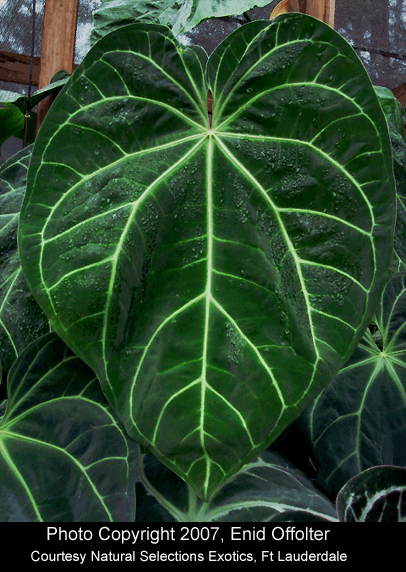
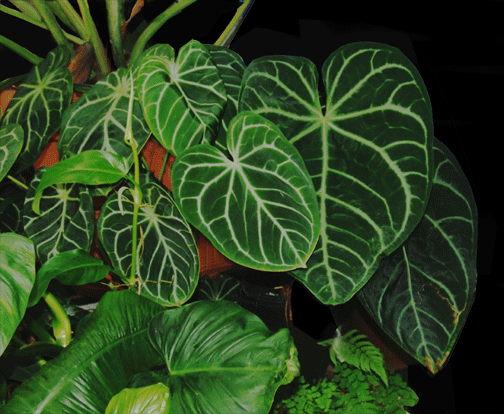
Anthurium magnificum
Linden

A
member of Anthurium section Cardiolonchium, Anthurium
magnificum was published to science in 1865. Information from
aroid expert Leland Miyano indicates section Cardiolonchium is a group
"usually characterized by
velvety leaf blades. It
 has quadrangular petioles which is the easiest
feature to distinguish it from similar species. It may be confused with
Anthurium clarinervium, but that is a smaller species with terete or
round petioles. The veins of Anthurium clarinervium are also lighter
and better defined against the velvety dark green of the leaf blades."
has quadrangular petioles which is the easiest
feature to distinguish it from similar species. It may be confused with
Anthurium clarinervium, but that is a smaller species with terete or
round petioles. The veins of Anthurium clarinervium are also lighter
and better defined against the velvety dark green of the leaf blades."
Anthurium
magnificum is exclusively found in (endemic to) Colombia in
NW South America. Based on the field collection notes of aroid botanist
Dr. Thomas B. Croat Ph.D., P.A. Schulze Curator of Botany of the
Missouri Botanical Garden in St. Louis, MO., the petioles of
Anthurium magnificum are roughly quadrangular (four sided) but may
also be C shaped. The petioles, which are the leaf blade's support are
often called a "stem" by collectors. The petioles are winged on
all corners and have four wings along both sides near the base. The
true stem is the base of the plant, not the leaf support.
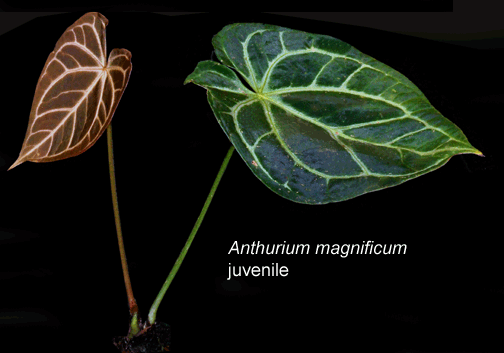
The velutinous (velvety) leaf blades of Anthurium magnificum are coriaceous (leathery) to moderately coriaceous and dark green but may be bi-colored with a light silver green along the major leaf veins. The leaf blades are weakly glossy. The blades are substantially paler on the underside which is also matte. The cataphylls (which are a modified leaf that surrounds any newly emerging blade) persist semi intact once a new leaf blade opens. New leaf blades are brownish burgundy when first unfurled.
 All
Anthurium species are aroids. An aroid is a plant that
reproduces by producing an inflorescence known to science as a
spathe and spadix. Most people believe the spathe is a "flower", it
is not. The spathe is simply another specially modified leaf. On
the spadix at the center of the inflorescence there can be found
very tiny flowers when the plant is at anthesis and ready to
reproduce. All
Anthurium species reproduce via the production an
inflorescence. The stalk that supports the entire inflorescence is
the peduncle. When an Anthurium is "in flower" the
reference is to the tiny flowers containing both male and female
sexual parts that grow on the spadix at the center of the
inflorescence. Unlike plants in the genus Philodendron which
contain imperfect flowers having only a single sex Anthurium
possess perfect flowers containing both sexes. To help prevent self
pollination nature has designed the female flowers to be receptive
before the male portion of the flower produce their pollen so in
most cases an insect must bring pollen from another plant.
The spadix produces the tiny
flowers which if pollinated will produce berries containing seeds.
The berries produced on the spadix (if pollinated) each contain 1 to
2 seeds.
All
Anthurium species are aroids. An aroid is a plant that
reproduces by producing an inflorescence known to science as a
spathe and spadix. Most people believe the spathe is a "flower", it
is not. The spathe is simply another specially modified leaf. On
the spadix at the center of the inflorescence there can be found
very tiny flowers when the plant is at anthesis and ready to
reproduce. All
Anthurium species reproduce via the production an
inflorescence. The stalk that supports the entire inflorescence is
the peduncle. When an Anthurium is "in flower" the
reference is to the tiny flowers containing both male and female
sexual parts that grow on the spadix at the center of the
inflorescence. Unlike plants in the genus Philodendron which
contain imperfect flowers having only a single sex Anthurium
possess perfect flowers containing both sexes. To help prevent self
pollination nature has designed the female flowers to be receptive
before the male portion of the flower produce their pollen so in
most cases an insect must bring pollen from another plant.
The spadix produces the tiny
flowers which if pollinated will produce berries containing seeds.
The berries produced on the spadix (if pollinated) each contain 1 to
2 seeds.
The spathe of Anthurium magnificum is green as well re-curved. The spadix is a dark or medium green to yellow-green before anthesis and becomes yellow as it ages near female anthesis. The inflorescence stands erect above the leaves. The peduncle which supports the inflorescence is sharply 9-ridged.
Like all Anthurium species, Anthurium magnificum changes as it grows. The juvenile leaf blades sometimes only vaguely resemble the adult blades. Morphogenesis within aroid species is common and is explained in non-technical language in this link. Click here
See also:
Anthurium crystallinum
Anthurium clarinervium
Enid Offolter's photo is courtesy Natural Selections Exotics,
Want to learn more
about aroids?
Join the International
Aroid Society:
http://www.exoticrainforest.com/Join%20IAS.html
As it occurs in nature and
by any horticulturist
Need more information on Anthurium species?
Click this link.