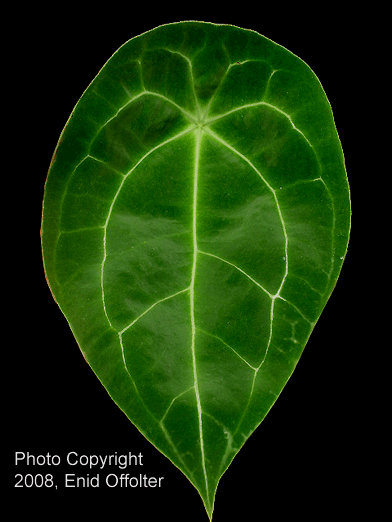
Described to horticulture in 1906, there is virtually no
scientific information available about this plant. The
International Plant Names Index (IPNI) which is a service of the
Royal Botanic Garden Kew in London does not even recognize the name
as a valid species. Apparently the plant was a horticultural
specimen and very little information about its collection in nature
is even known. As a result, I am uncertain whether or not to
even use italics for the name.
Anthurium forgetii is said to be found only in the
South American country of Colombia. Anthurium
forgetii is notable due to the lack of a sinus opening at the
top of the leaf blade. The majority of Anthurium
species have an opening between the upper lobes known as the sinus.
The species Anthurium forgetii lacks either lobes or such an
opening. As a result, a word of caution regarding images found
on sites such as Google Image
 Search,
Yahoo and MSN. Many photos claiming to illustrate Anthurium
forgetii show plants that possess a sinus at the top of the
blade. According to scientific sources, Anthurium
forgetii has no sinus. Try a photo search for yourself and
see what photos are displayed.
Search,
Yahoo and MSN. Many photos claiming to illustrate Anthurium
forgetii show plants that possess a sinus at the top of the
blade. According to scientific sources, Anthurium
forgetii has no sinus. Try a photo search for yourself and
see what photos are displayed.
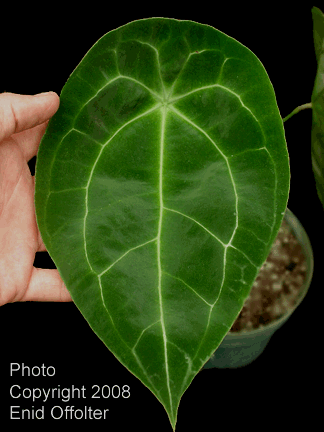
The leaves of Anthurium
forgetii are ovate (oval) and the blades are scientifically
described as glaucous (shiny). The blades possess a velutinous (velvet) appearance and are dark green with very
prominent white venation (markings) marking the leave's veins.
The adaxial surface (upper) has glistening flecks especially just
above the center of the leaf blade. The
underside of the adult leaf is a lighter green than the upper
surface and is semi-glossy.
The petioles (commonly called
stems) which support each leaf blade are subterete (less than round)
and are sometimes slightly flattened.
Some collectors confuse
Anthurium forgetii with Anthurium crystallinum.
Aroid expert Julius Boos explains the differences when he wrote
regarding Anthurium forgetii,
"It has a completely closed or absent
sinus. You say that A. crystallinum has a closed sinus divided all
the way down to the petiole. This would mean the two posterior lobes
touch each other. But there is a slit all the way down from the
top of the posterior lobes down to the petiole. It would not be a
sealed or absent sinus like as A. forgetii."
An aroid, all
Anthurium species reproduce via the production an
inflorescence composed of a spathe and a spadix. The
stalk that supports the entire inflorescence is the peduncle. When an
Anthurium is
"in flower" the reference is to the tiny flowers
containing both male and female sexual parts that grow on the spadix at the center of the inflorescence.
Unlike plants in the genus Philodendron which contain imperfect flowers
having only a single sex Anthurium possess perfect flowers
containing both sexes. To help prevent self pollination nature has
designed the female flowers to be receptive before the male portion of
the flower
produce their pollen so in most cases an insect must bring pollen from
another plant.
Most people believe the spathe is a
"flower" which is incorrect. The spathe is a modified leaf
whose purpose is to protect the spadix at the center of the
inflorescence. On the spadix there can be found those very tiny
flowers when the plant is ready to be pollinated and is at female
anthesis (sexual reproduction). If the
female portion of flowers are pollinated by an appropriate insect (normally a
beetle) which carries pollen from another specimen at male anthesis,
the spadix will begin to grow berries. The berries produced on
the spadix are dark purple and inside the berries can be found 1 to
2 seeds.
The inflorescence
of Anthurium forgetii stands erect and the spathe is glossy
on both sides and is green in
 color. The
spathe may also have purple along the edge. The spadix is light
green to yellow green in color but may turn reddish with age.
color. The
spathe may also have purple along the edge. The spadix is light
green to yellow green in color but may turn reddish with age.
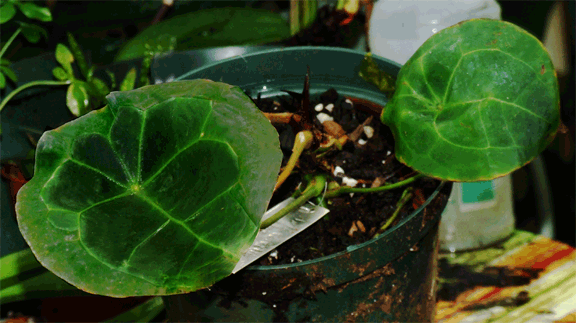
Like all Anthurium
species, Anthurium forgetii morphs as it grows. The
juvenile leaf blades often look little like the adult blades
seen in our photographs. A juvenile leaf can be seen in
the photo at the right. Morphogenesis within aroid species
is explained in non-technical language in this link.
Click here.