
Aroids and other genera in the Collection
Take the Tour Now?
Orchids
The
Exotic Rainforest
Plants in
the Exotic Rainforest Collection
Images on this website are copyright protected. Contact us before attempting to reuse.
Within our collection we have many species of Philodendron. If you are seeking other photos, click this link
Philodendron erubescens K. Koch & Augustin
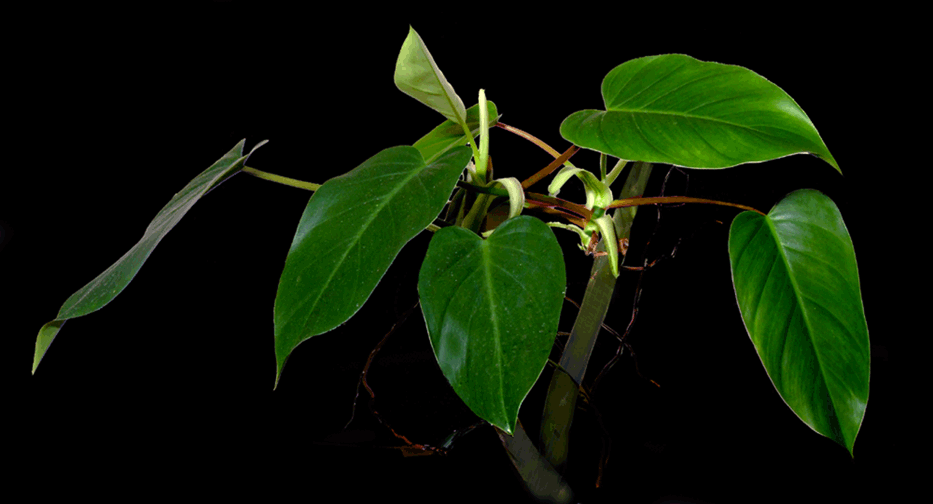
Red leaf Philodendron, Blushing Philodendron, Red Emerald Philodendron
Burgundy Philodendron and other hybrid names
 Philodendron
erubescens is a Central and South American species true to its scientific name.
The word Philo-dendron comes from the Greek words "phileo"
meaning love, and "dendron"
, indicating a tree. Together, they describe a plant that loves to climb
any tree. If you grow Philodendron you'll realize the
name Philodendron combined
with erubescens very
accurately describes this species. The
base word from the Greek from which erubescens
was taken, indicates something that blushes or
turns red. In the case of the species Philodendron erubescens,
both the leaves, the petioles and the inflorescence (spathe) exhibit the ability
to "blush".
Philodendron
erubescens is a Central and South American species true to its scientific name.
The word Philo-dendron comes from the Greek words "phileo"
meaning love, and "dendron"
, indicating a tree. Together, they describe a plant that loves to climb
any tree. If you grow Philodendron you'll realize the
name Philodendron combined
with erubescens very
accurately describes this species. The
base word from the Greek from which erubescens
was taken, indicates something that blushes or
turns red. In the case of the species Philodendron erubescens,
both the leaves, the petioles and the inflorescence (spathe) exhibit the ability
to "blush".
Identified to science in 1854, Philodendron erubescens is a climbing vine. Some sources credit this species to botanical author Linden, but the earliest published date of 1854 is credited to K. Koch & Augustin. Within the Linnaean rules for botanical science, the first published paper describing a species becomes the base name and its authors are credited. Swedish botanist Carl Linnaeus (1707 to 1778) is the father of botanical taxonomy as well as modern ecology. Linnaeus established the rules of botany as they are taught today.
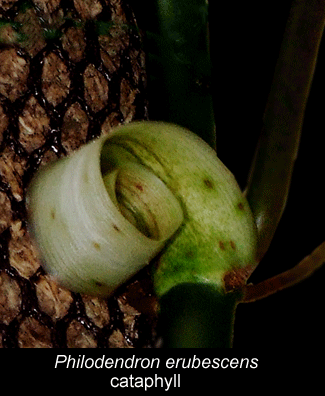
The leaf blades of Philodendron erubescens are typically 20-40 cm (9 to 18 inches) in length, and the deep green leaves are shiny on the upper surface but often exhibit a copper coloration on the underside. Since the species is variable every leaf does not always exhibit the "blush". New leaves emerge from a sheath-like covering known as a cataphyll (see below).
The petioles,
which are the support for each leaf, are commonly incorrectly called a
"stem" and are
frequently purple-red and measure approximately the same
length
as the leaf blades. The stem of any aroid is actually the
central axis of the
 plant,
not the support of a single leaf blade.
Read this link for a better explanation.
plant,
not the support of a single leaf blade.
Read this link for a better explanation.
Since Philodendron erubescens is variable it may also be found with green blade undersides possessing only a hint of red. Variablity in Philodendron species is common and is a result of either natural variation or morphogenesis (ontogeny). The shape and color of the blades can easily vary from specimen to specimen.
All Philodendron are aroids.
An
aroid is a plant that reproduces via an inflorescence and in
all aroids that inflorescence is known
as a spathe
appearing to be a hood
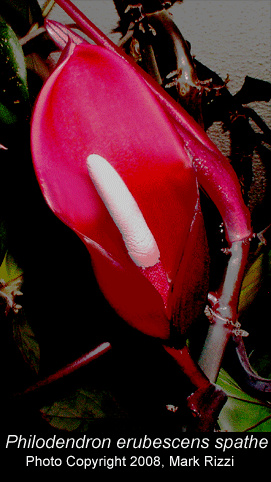
and spadix. The photo above right was taken by
Mark Rizzi of a beautiful red spathe produced on a hybrid specimen
he has grown for years. Most think the spathe is a "flower"
but it is not. The
spathe is nothing more than a specially modified leaf whose purpose
is to protect the spadix. If you
explore the inflorescence with a strong magnifying glass during the
period the plant is reproducing there are very tiny flowers (both
male and female) found on the spadix at the center of the
inflorescence. The spadix inside the inflorescence is
where seeds will also form if pollinated. For a more complete
explanation of pollination in aroid species, please read this link:
Aroid Pollination!
Collectors often select only
the specimens they consider to have the most beautiful leaf
and as a result many of the leaf shapes and colors seen in the rain
forest are rarely, if ever, found in a collection. Numerous
man-made hybrid forms are also sold commercially under
a variety of trade names.
For a more complete explanation in non-technical language explaining natural variation and
morphogenesis within species please read the following link.
Natural variation.
Philodendron erubescens is common in Costa Rica but has also been collected in Colombia and portions of Brazil. P. erubescens has also become "wild" in the Hawaiian islands and is commonly seen climbing native trees. However P. erubescens is not native to the Hawaiian islands.
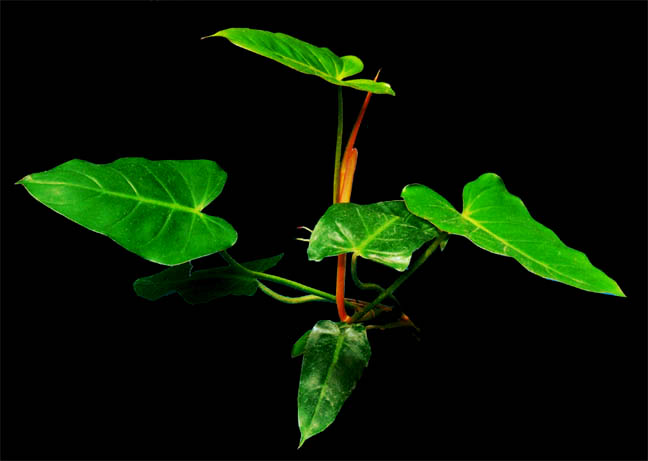 Philodendron erubescens is reported
to climb to
18 meters (60 feet) in its native wet rain forest habitat. However,
many collector/growers report an average
climbing height of only 3.6
meters (12 feet).
This aroid tends to prefer to climb in shady locations and does not
often appreciate strong sunlight.
Philodendron erubescens is reported
to climb to
18 meters (60 feet) in its native wet rain forest habitat. However,
many collector/growers report an average
climbing height of only 3.6
meters (12 feet).
This aroid tends to prefer to climb in shady locations and does not
often appreciate strong sunlight.
According to the notes of aroid botanist Dr. Thomas B. Croat Ph.D., P.A. Schulze Curator of Botany of the Missouri Botanical Garden in St. Louis, MO, the species is characterized by the blushing reddish coloration on its new leaves. P. erubescens is a tropical rain forest species and will not survive winters much below 10 C (50 degrees F) for any extended period of time. However, growers in South Florida report Philodendron erubescens recovers quickly after short periods with lower temperatures. Some growers in Zone 9 have reported difficulty making the species prosper.
Philodendron species love high humidity and require well draining soil and should be watered often during the hot growing season but less during the winter months. We prefer a mixture of good soil, peat, Perlite, and orchid potting bark containing both charcoal and gravel. If you are new to growing Philodendron, click on the link at the very top of this page for more detailed growing information.
Our original specimen was a gift from aroid collector Russ Hammer in Florida. The specimen at the top of this page came from a collector in Hawaii.
In depth information on how to grow Philodendron species, Click this Link
Specimens may be available
from Brian's Botanicals
http://www.briansbotanicals.net/

Looking for a specimen? Contact
http:///
Natural Selections Exotics at

Want to learn more
about aroids?
Join the
International Aroid Society:
http://www.exoticrainforest.com/Join%20IAS.html