
Aroids and other genera in the Collection
Take the Tour Now?
Orchids
The
Exotic Rainforest
Plants in
the Exotic Rainforest Collection
The images on this website are copyright protected. Please contact us before any reuse.
In depth information on how to grow Philodendron species, Click this Link
Within our collection we have many species of Philodendron. If you are seeking other photos, click this link:
Philodendron tripartitum (Jacq.) Schott Wiener Z. Kunst
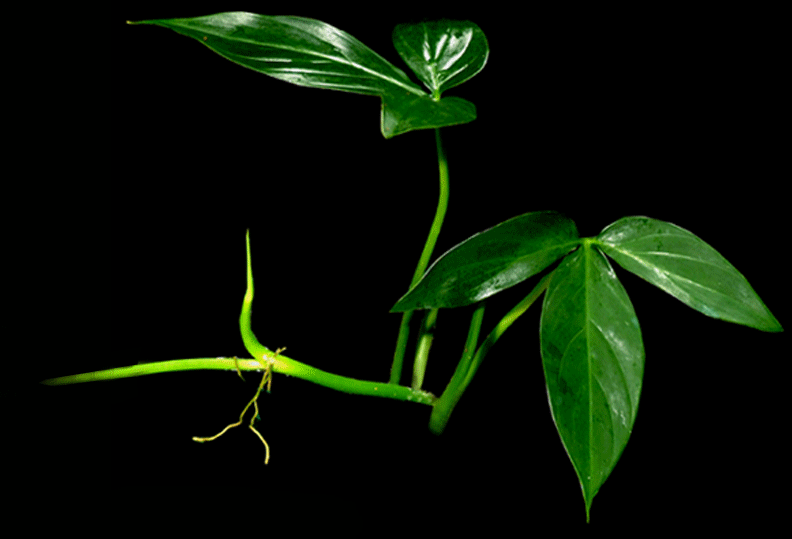
Philodendron tripartitum var. tricuspidatum
Caladium tripartitium
Described to science in 1829, Philodendron tripartitum is sometimes known by the botanical name Philodendron fenzlii but is correctly Philodendron tripartitum. You can easily find the species on the internet under either name but botanists have determined the earliest name, thus the accepted name, to be P. tripartitum. It was first identified in 1829 and named Philodendron tripartitum due to the structure of its tri-lobed leaves. In 1878 Botanist England attempted to rename the species Philodendron fenzlii, but under the rules of botanical nomenclature the earliest name prevails.
Philodendron tripartitum ranges from Mexico, throughout Central America to Ecuador from near sea level to 4000 feet (1300 meters) in elevation. In almost all of Central America, the species can also be found in the Caribbean including the island of Jamaica, in Mexico in the states of Veracruz to Tabasco, and then throughout the balance of Central America well into South America. It occurs on both sides of Costa Rica and Panama and as far south as Colombia, Ecuador, Bolivia and parts of Brazil. Primarily found in Mexico, Philodendron tripartitum occurs in Selva Alta Perennifolia and its rain forests to Bosque Caducifolia. In Costa Rica and Panama, the species is found primarily in tropical wet rain forests to pre-mountainous wet rain forests. In most other countries of its wide range it is found in tropical wet rain forests.
A very aggressive aroid, the Philodendron has three shiny lobes to each leaf on a vigorously growing vine. If you grow this one out doors in a semi-tropical climate you should monitor it closely or you'll soon find it covering every plant and anything it can cover in your garden. P. tripartitum is a very quick growing vine that is almost too easily grown. You may find it interesting to grow along with and under the same conditions as Syngonium species. This species spreads and climbs very quickly if kept wet.
A member of Philodendron section Tritomophyllum Philodendron tripartitium is a hemiepiphytic appressed climber. A hemiepiphyte (hem-a-EPA-fit) is a plant that can either begin life as a seed placed on a tree branch by a bird in its droppings, which eventually grows roots down into the soil, or it may begin as a seed in the soil which climbs a host tree. An appressed climbing vine is one that tends to hug closely to the host. The adult blades grow much larger than is typically seen in private collections.
The stems of Philodendron tripartitum and often several meters long with a pleasant aroma. The stem is not the support for any single leaf as is often thought by collector/growers, but instead the stem is the base of the plant and is the plant organ from which the petioles which support the leaves emerge. The leaves are tri lobed and can be green to dark green sometimes appearing almost gray-green. The adaxial surface of the leaf blades are semi-glossy and are normally less than 20 cm (8 inches) long. The leaf blade contains three lobes of roughly equal size. The blades are thinly coriaceous ( just less than leathery) and the undersides (abaxial surfaces) are sometimes heavily tinged with purple or red. The petioles of Philodendron tripartitum can range from 20 to 61 cm long (8 inches to 24 inches). A petiole is the stalk which connects the leaf blade to the stem at the base of the plant.
The inflorescence of the species is normally a solitary spathe but sometimes the plant is capable of producing two to three spathes per axil. Spathes are typically 13 to 21 cm (5 to 8 inches) long and are usually medium green to yellow green in coloration. Spathes have rarely been observed to be a creamy white with dark purple dots on the tube. Flowering in Philodendron tripartitum normally occurs throughout the dry season and the first half of the rainy season which is usually May through July. However, flowering has been observed as late as August to November.
Philodendron species, especially hybrid forms, are known to be highly variable and not every leaf of every specimen will always appear the same. This link explains in easily understood language natural variation and morphogenesis within aroids and other species. Click here.
We use a very fast draining soil mixture of good soil, peat, Perlite™, and orchid bark. Keep the soil evenly moist at all times.
Looking for a specimen? Contact
http:///

Want to learn more
about aroids?
Join the
International Aroid Society:
http://www.exoticrainforest.com/Join%20IAS.html