
Aroids and other genera in the Collection
Take the Tour Now?
Orchids
The
Exotic Rainforest
The images on this website are copyright protected. Please contact us before any reuse.
In depth information on how to grow Philodendron species, Click this Link
Within our collection we have many species of Philodendron. If you are seeking other photos, click this link:
This page is currently being
edited.
More information on the species will soon be added.
Please excuse typos and
duplicated material in this article.
Philodendron spiritus-sancti
G.S. Bunting

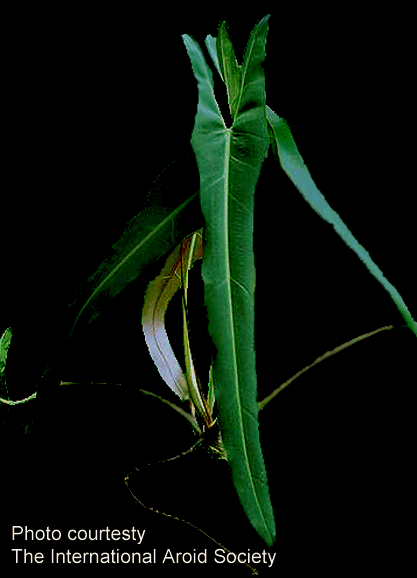
Philodendron spiritus-sancti
G.S. Bunting
Known by some as "Philodendron Santa Leopoldina"
The curse of a common name. Should more than one plant
share the same name?
Published to science i 1987 by George Bunting in Phytologia 61(7),
Philodendron spiritus-sancti is found only in Brazil
in
the state of Espirito Santo near the town of Domingos Martins. The
species is found at an elevation of approximately
 800 meters above sea
level. Domingos Martins is near the Atlantic coast northeast of
Rio de Janeiro. Almost all
serious aroid collectors know of an extremely rare Philodendron
found only in southeastern Brazil. Dr. Eduardo Gonçalves and Emerson Salviani published
an article in the 2001 edition of Aroideana, volume 24
regarding the species. Aroideana is the journal of the
International Aroid Society.
If you are not an IAS member you can
find a link to join here:
Join the International Aroid Society
800 meters above sea
level. Domingos Martins is near the Atlantic coast northeast of
Rio de Janeiro. Almost all
serious aroid collectors know of an extremely rare Philodendron
found only in southeastern Brazil. Dr. Eduardo Gonçalves and Emerson Salviani published
an article in the 2001 edition of Aroideana, volume 24
regarding the species. Aroideana is the journal of the
International Aroid Society.
If you are not an IAS member you can
find a link to join here:
Join the International Aroid Society
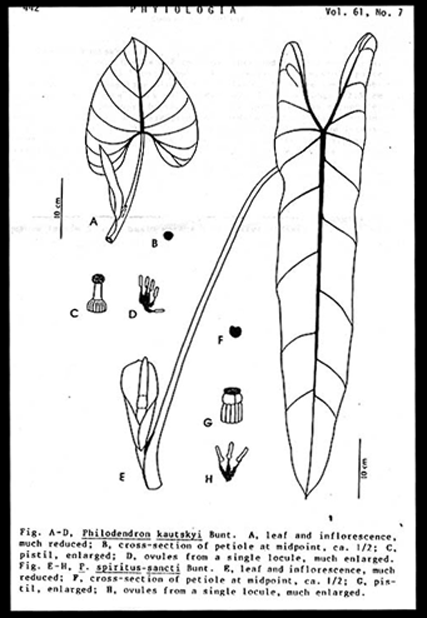
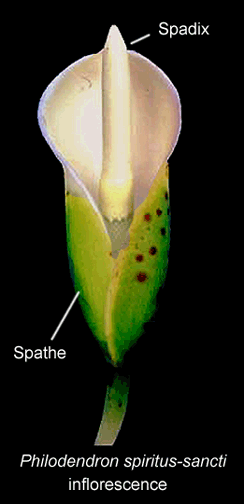
Philodendron spiritus-sancti is a hemiepiphytic vine. Hemiepiphytes are species that may either begin life as a seed which has fallen to the ground which proceeds to climb a tree or a species that begins life as an epiphyte and then climbs downward to set root in the soil. The leaf blades of P. spiritus-sancti are supported on petioles ranging in length from 35 to 60 cm (12.75 to 23.6 inches). The blades are dark dull green and typically measure 57 to 63 cm (22.5 to 28.75 inches) long by 11 to 12.5 cm (4.5 to 4.9 inches wide. Cultivated specimens are often shorter as well as broader in size. The blades are roughly an elongated triangle (cordate-sagittate) with an acute apex. The abaxial surface (underside) is markedly paler in color while the leaf margins (edges) are known scientifically as being vinaceous which indicates the purple coloration of a grape. The blades are somewhat thin (chartaceous to subcoriaceous) with four primary lateral veins per side along with one to four basal veins in the upper lobes (see scientific drawing below).
Specimens grow best as epiphytes but can be grown in extremely porous soil that drains very quickly. Growers in Brazil recommend the use of primarily dried leaves, shredded mosses (such as sphagnum) combined with minimal soil, bark and other amendments such as orchid bark and charcoal that will hold moisture but not remain soggy.
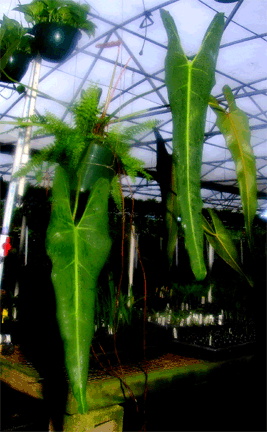
According to Dr. Gonçalves and Emerson Salviani there are now only six known specimens of the very rare and endangered species left wild (see photo right and below). According to personal communication with Dr. Gonçalves Philodendron spiritus-sancti is endangered and near extinction due to the excessive clearing of habitat. The remaining six specimens in Brazil is a private farm that is closely guarded. There are now more plants (still very few) in the hands of private collectors than in the wild. The Kautsky family owns the farm where all the remaining specimens of Philodendron spiritus-sancti remain in the wild.
 In Brazil, Philodendron
spiritus-sancti is known by some as "Philodendron Santa
Leopoldina". In the
opening of the article described above Dr. Gonçalves writes,
"One of the most
aesthetically desirable species in the genus Philodendron (P.
spiritus-sancti G.S. Bunting), commonly known as Philodendron Santa
Leopoldina has been rediscovered in the wild in the forests of
southeastern Espirito Santo State, close to the town of Domingo
Martins."
In Brazil, Philodendron
spiritus-sancti is known by some as "Philodendron Santa
Leopoldina". In the
opening of the article described above Dr. Gonçalves writes,
"One of the most
aesthetically desirable species in the genus Philodendron (P.
spiritus-sancti G.S. Bunting), commonly known as Philodendron Santa
Leopoldina has been rediscovered in the wild in the forests of
southeastern Espirito Santo State, close to the town of Domingo
Martins."
The name Santa Leopoldina
is associated by Brazilians with the town and region where Philodendron
spiritus-sancti was first located. The name "Philodendron Santa
Leopoldina" was first introduced to the majority of plant enthusiasts in
a 1983 International Aroid Society article (Aroideana, volume 6) by Bette Waterbury who
was one of the founders of the International Aroid Society (IAS) regarding
her search for the species Philodendron spiritus-sancti along
with a few other similar plants. The name Philodendron Santa
Leopoldina is a common name also used by sellers for many plants other
than
P. spiritus-sancti and is not
scientific.
Bette pointed out there were several plants known as Santa Leopoldina in the wild but
none of these are the same species as the true Philodendron
spiritus-sancti and many are simply juvenile forms of known
Philodendron species. The debate over which plant should or
should not be truly known by the common name Philodendron Santa Leopoldina
 was apparently begun by Better
herself when she wrote, "Luis
and Roberto Kautsky are of the opinion that there are four
distinct
variations of P. "Santa Leopoldina": Two forms have the very long
sagittate leaf — the first type is deep red on the underside, and the
second type is completely green. The third type is more hastate and
almost entirely silvery green. The fourth type is also hastate but is
reddish on the underside. Apparently P. "Santa Leopoldina" is not
proliferous in any form or found in any quantity in the wild, as
wherever we went, we would see one or two at the most in any private
collection or nursery. Even Roberto Burle-Marx had only two of type one,
though he had several of type three, it appears to be a treasure even
down there."
The term sagittate in botany indicates a leaf that is arrow shaped.
Hastate means to have the shape of an arrowhead but with the basal lobes
pointing outward at right angles.
was apparently begun by Better
herself when she wrote, "Luis
and Roberto Kautsky are of the opinion that there are four
distinct
variations of P. "Santa Leopoldina": Two forms have the very long
sagittate leaf — the first type is deep red on the underside, and the
second type is completely green. The third type is more hastate and
almost entirely silvery green. The fourth type is also hastate but is
reddish on the underside. Apparently P. "Santa Leopoldina" is not
proliferous in any form or found in any quantity in the wild, as
wherever we went, we would see one or two at the most in any private
collection or nursery. Even Roberto Burle-Marx had only two of type one,
though he had several of type three, it appears to be a treasure even
down there."
The term sagittate in botany indicates a leaf that is arrow shaped.
Hastate means to have the shape of an arrowhead but with the basal lobes
pointing outward at right angles.
Bette
was unable to collect "type 4" as she referred to it and it is unclear which plant that may
have been. Since her original publication there have been various plants
sharing the single common name "Philodendron Santa Leopoldina" which has
caused a great deal of confusion among plant collectors. All too
often any plant that has an elongated leaf blade that is unknown to the
seller ends up being sold as a "form" of "Philodendron Santa Leopoldina"
and plants originally collected a thousand or more miles away from the
region of Brazil where Philodendron spiritus-sancti was
originally found are often given the same common name.
Her observation
appears to have been taken to
excess by many anxious to sell plants that are far less rare as a "type"
of Philodendron spiritus-sancti when in fact none have any direct
relationship. Members of the International Aroid
Society have clearly identified two of Bette's "variations" and one is not
clearly understood and it is debated if the plant even exists. IAS
member
Don Bittel pointed out in an email to the entire Aroid l
discussion group the following,
"The second major confusion
about Santa Leopoldina came from Bette Waterbury's article. The picture
on page 8 shows a long leafed form, and the
caption says that this is
type 3, which is more hastate and silvery green. THIS IS A TYPO.
It was never corrected in a future
 Aroideana. In Bette's letters, she
makes note of the typo, but does not say what the correct type is. It is
clearly type 1 or type 2, which are spiritus-sancti. If the photo was in
color we could tell if it was the red form or the green form. We may
never know since the original photos are lost."
Aroideana. In Bette's letters, she
makes note of the typo, but does not say what the correct type is. It is
clearly type 1 or type 2, which are spiritus-sancti. If the photo was in
color we could tell if it was the red form or the green form. We may
never know since the original photos are lost."
Bette's article appears to imply the primary
difference is only the color on the reverse of the leaf, red or green.
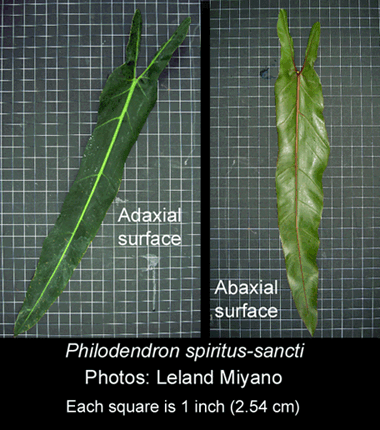
IAS members have both seen and verified these color variations
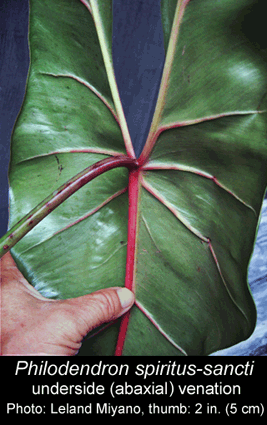
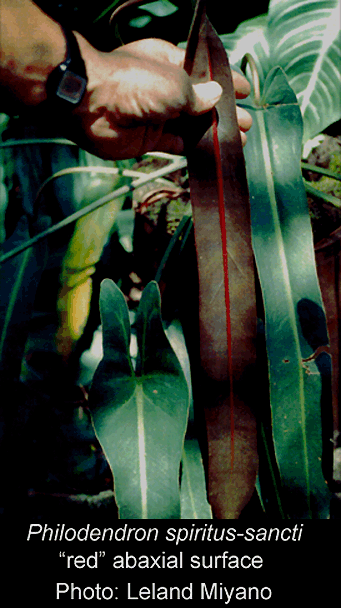
and as can be seen in Leland Miyano's photo. The photo (right)
shows the reverse of the
leaf having a matte green abaxial surface (underside) with a
reddish midrib, portions of the petiole and some of the venation while
the photo below (left) shows the reddish abaxial (underside) surface.
The name "Philodendron Santa Leopoldina" is not a registered cultivar and as a result the name cannot be used with single quotes (Philodendron 'Santa Leopoldina') as it sometimes is used. Registered cultivars of aroid species require registration with the International Aroid Society and no such registration has been made. It is also improper to publish the name "Philodendron Santa Leopoldina" in italics since it has never been published as a scientific name.
Due to the use of the name
"Philodendron Santa Leopoldina" in relation to the very rare
species Philodendron spiritus-sancti there has arisen a minor controversy over the use of the common name for
many far less rare species.
Specimens of Philodendron spiritus-sancti have frequently sold for
amounts in the thousands of dollars.
 Common names are simply "made-up"
and cannot be claimed by any single plant and have no
scientific significance. Anyone can use any name they choose for
any plant unless that name is registered. At the same time scientific
names cannot be registered for private use. Since the term
"Philodendron Santa Leopoldina" is not a scientific name anyone can use the name for
any plant! But the question has arisen, should plant sellers use the
common name of an extremely rare plant to sell apparently common plants
in a way that may
lead an unwary buyer to believe they are buying something truly
rare? In that case, "buyer-beware" is certainly worth
considering!
Common names are simply "made-up"
and cannot be claimed by any single plant and have no
scientific significance. Anyone can use any name they choose for
any plant unless that name is registered. At the same time scientific
names cannot be registered for private use. Since the term
"Philodendron Santa Leopoldina" is not a scientific name anyone can use the name for
any plant! But the question has arisen, should plant sellers use the
common name of an extremely rare plant to sell apparently common plants
in a way that may
lead an unwary buyer to believe they are buying something truly
rare? In that case, "buyer-beware" is certainly worth
considering!
For some time plant sellers have
been selling a fair number of vaguely similar
species and hybrids using
Philodendron spiritus-sancti's Brazilian common name,
"Philodendron Santa Leopoldina". Some similar long blade
species do originate from the same area but they not the same
species. Some have elected to use the
terms
"Philodendron Santa Leopoldina II", or "Philodendron Santa Leopoldina III"
apparently attempting to capitalize on Bette Waterbury's article.
If you possess a specimen
acquired with the common name "Philodendron Santa Leopoldina and it does
not look like the photos of Philodendron spiritus-sancti on this
page it isn't Philodendron spiritus-sancti and may not have
even originated in Brazil.
 One
of the species sometimes sold with the name "Philodendron Santa Leopoldina"
is currently being studied for for scientific publication. Work on
the plant is being completed by Dr. Gonçalves in Brazil and is
now being called Philodendron superbum. The species has not been
scientifically published. In an email Australian
collector Michael Pascal made these comments,
"Eduardo ID’d
this for me , it came into Australia many years ago as a Santa
Leopoldina. It has flowered a few times and has been spread around
Queensland a fair bit, it grows very well in sub-tropics. Easily
spotted with the d shaped very flat topped petiole with fine grooves and
its tiny internodes." Michael elected to call
the plant
pseudo-Santa
Leopoldina. In the photos below, this plant along with the spathe is
noted as specimen number 2.
One
of the species sometimes sold with the name "Philodendron Santa Leopoldina"
is currently being studied for for scientific publication. Work on
the plant is being completed by Dr. Gonçalves in Brazil and is
now being called Philodendron superbum. The species has not been
scientifically published. In an email Australian
collector Michael Pascal made these comments,
"Eduardo ID’d
this for me , it came into Australia many years ago as a Santa
Leopoldina. It has flowered a few times and has been spread around
Queensland a fair bit, it grows very well in sub-tropics. Easily
spotted with the d shaped very flat topped petiole with fine grooves and
its tiny internodes." Michael elected to call
the plant
pseudo-Santa
Leopoldina. In the photos below, this plant along with the spathe is
noted as specimen number 2.
Please note: Even though the plant
originates in the same area as Philodendron spiritus-sancti and
is sometimes call "Philodendron Santa Leopoldina" it is
not a form of P. spiritus-sancti and is an entirely
different species.
John Criswick from
the island of Grenada provided photos of a
plant he too has known as "Philodendron Santa Leopoldina". That specimen has
distinctly burgundy undersides but does not have the sharply pointed
upper lobes of Philodendron spiritus-sancti. Some
growers know this and one other plant as Philodendron 'Roberto' but no
such registration can be found. Those plants are seen on the
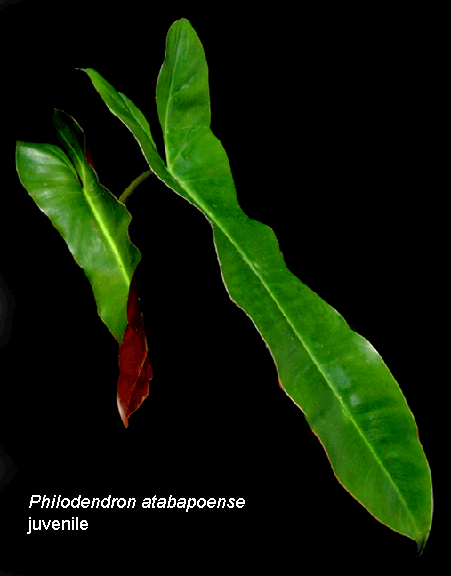
illustration below as numbers 4 and 6. One is the
juvenile form of Philodendron atabapoense but neither are forms of Philodendron spiritus-sancti.
 Another
form as "Philodendron Santa Leopoldina" was identified by Dr. Tom Croat of the Missouri
Botanical Garden as either Philodendron angustilobum or Philodendron
Philodendron mexicanum. Even though the plants are often sold
on sites such as eBay as "Philodendron Santa Leopoldina" neither species
is not found in Brazil! Those species are from Mexico and Central America
and there is no purpose other than to try to pump up the price to call
them "Santa Leopoldina". See number 5
below. Neither is a form of Philodendron spiritus-sancti.
Another
form as "Philodendron Santa Leopoldina" was identified by Dr. Tom Croat of the Missouri
Botanical Garden as either Philodendron angustilobum or Philodendron
Philodendron mexicanum. Even though the plants are often sold
on sites such as eBay as "Philodendron Santa Leopoldina" neither species
is not found in Brazil! Those species are from Mexico and Central America
and there is no purpose other than to try to pump up the price to call
them "Santa Leopoldina". See number 5
below. Neither is a form of Philodendron spiritus-sancti.
As is obvious, the
use of the common name "Philodendron Santa Leopoldina" serves no purpose
other than to confuse buyers. I have always had a
dislike for common names as a result of the confusion they cause. How can anyone possibly know what plant you
are speaking about if all you have is a common name and many
plants share the same common name?
A good example is the common name "elephant ear". Plants from six different genera have managed to acquire that single common name! As far as Philodendron species are concerned, many of these pseudo-names apparently came from the books Tropica and Exotica. Serious collectors are aware of numerous errors in both books since the author was not a botanist or taxonomist. The author did a wonderful thing by making so many species known to collectors, but the pseudo-names created in those books create a large number of problems since few are botanically verified. The author was more interested in making the world aware of the vast variety of tropical species rather than in using accurate scientific names. Many of the names used in those texts are simply incorrect.
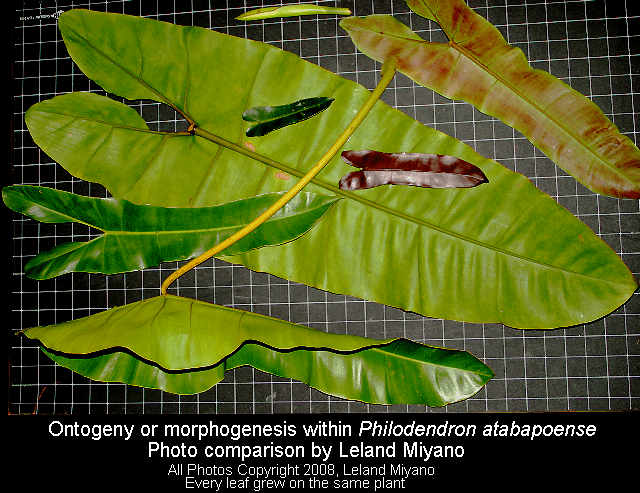 Collector Leland Miyano from
Hawaii made an interesting observation regarding the photos posted below.
Leland
was a personal friend of Roberto Burle-Marx and is well acquainted
with many of the plants in the Burle-Marx collection and has spent a great
deal of time
working with those plants. Roberto Burle=Marx was a famous Brazilian
plant collector, artist, and landscape designer. Bette Waterbury located her original
specimens of Philodendron spiritus-sancti
with Roberto's assistance. Leland commented,
"If any
Philodendron sold as P. spiritus-sancti has long internodes or grows fast
it is an imposter. Even very small plants of Philodendron spiritus-sancti
have the short internodes. Philodendron billietiae as a youngster is the
easiest to pass as spiritus-sancti. Growth in Philodendron spiritus-sancti
is very slow...I have seen plants sit there for years without gaining much
length in the stem."
If you have a plant you
know as "Philodendron Santa Leopoldina" the chances are remote it
is the rare Philodendron
spiritus-sancti.
Collector Leland Miyano from
Hawaii made an interesting observation regarding the photos posted below.
Leland
was a personal friend of Roberto Burle-Marx and is well acquainted
with many of the plants in the Burle-Marx collection and has spent a great
deal of time
working with those plants. Roberto Burle=Marx was a famous Brazilian
plant collector, artist, and landscape designer. Bette Waterbury located her original
specimens of Philodendron spiritus-sancti
with Roberto's assistance. Leland commented,
"If any
Philodendron sold as P. spiritus-sancti has long internodes or grows fast
it is an imposter. Even very small plants of Philodendron spiritus-sancti
have the short internodes. Philodendron billietiae as a youngster is the
easiest to pass as spiritus-sancti. Growth in Philodendron spiritus-sancti
is very slow...I have seen plants sit there for years without gaining much
length in the stem."
If you have a plant you
know as "Philodendron Santa Leopoldina" the chances are remote it
is the rare Philodendron
spiritus-sancti.
 I was asked recently why I want
to preserve a common name. If the truth was known, I don't! Leland summed my
feelings well when he said, "Philodendron
'Santa Leopoldina' should be dropped from common usage. It is of no help
and other scientific names should be used for the sundry imposters."
I was asked recently why I want
to preserve a common name. If the truth was known, I don't! Leland summed my
feelings well when he said, "Philodendron
'Santa Leopoldina' should be dropped from common usage. It is of no help
and other scientific names should be used for the sundry imposters."
Certainly, horticulturists who are rarely botanists can call any plant in their collection by any common name they choose but should plant sellers knowingly use the name "Philodendron Santa Leopoldina" for any long bladed plant without a known name? Some argue since A.B. Graf in his books the plant he identifies should take precedence. Mr. Graf was not a botanist and had no standing in the scientific world of plants but was a horticulturist and collector. Even though his books are often considered a "bible" to plant collectors, they have no standing in science. However Brazilian authority Dr. Gonçalves states "Philodendron spiritus-sancti is the closer choice!!!!"
Julius Boos then made this
observation regarding Philodendron spiritus-sancti,
"this species has been recognized for many
years as being 'special', and plants from the original area have been in
collections for a long time (60 years??). Bear in mind that these plants
are suspected of living for hundreds of years. The material used by
Dr. Gonçalves in his description is certainly of this species. The
reports of the small number of these plants surviving in 'the wild' are very
accurate, as difficult as it is to even comprehend, almost the entire area
of what used to be jungle is now cow pastures, a very small remnant of
patches small of jungle remain, and the land and these priceless patches
(and the remaining plants) are owned by a man (a friend of Dr. Gonçalves)
who recognizes this unique plant. Read Dr. Gonçalves' description of
the width-to-length ratio of the leaf, look at the photos and drawings, and
you will and can have NO doubt if you have or do not have or are dealing
with a legit. specimen of P. s. sancti."
Can any plant with a
long blade be sold as "Philodendron Santa Leopoldina"? Does it really matter? Jonathan Ertlet may have summed it up best in an email to
the Aroid l discussion group,
"Basically
what you have run into is the curse of the common name. It is a
challenge compounded here for several reasons, the first being financial,
since at least some are going to equate the common name 'Santa Leopoldina'
with the extremely rare and therefore extremely valuable Philodendron
spiritus-sancti."
Jonathan then continued,
"The whole idea of
which plant takes precedence for holding this common name is almost implying
some sort of pseudo-scientific status for the common name, of which there is
none.
It
doesn't really matter which plant Graf assigned that common name to - the
fact that it has become more widespread is just the way it is. Some
will argue a "rightful owner" for the common name, but since it is a common
name the argument doesn't have much substance."
The person who may explain all of this best is Dr. Gonçalves. Eduardo sent this
extremely informative response to the Aroid l group,
"Santa Leopoldina is a
city in Espirito Santo state (Southeastern Brazil) where the material was
supposed to be collected long time ago. For a weird reason, it seems that
plants from that area are proned to have long leaves. (Remember P.
stenolobum was also collected nearby). Since than, people have mentioned an
outstanding long leaf P. "Santa Leopoldina', but since you have many
species around with long leaves, the name started to be disputed.
Philodendron spiritus-sancti was collected originally in Domingos Martins
county (that is the just at the southwestern corner of Santa Leopoldina
county). George Bunting never mentioned the name Santa Leopoldina when
describing P. spiritus-sancti, but both names were associated further by
.......... . When I re-described wild specimens of P. spiritus-sancti, I
reinforced that the only Philodendron "Santa Leopoldina" formally described
was this one. To me (as a taxonomist), only formally published names are
real names. It is true that other morpho-species (to be named P. superbum as
fast as we can obtain wild-collected material of this) has been also
associated with the toponym Santa Leopoldina, maybe before any other
material. However,
 Graf's books are great for the horticulturist, but they
are very far from being formal in a taxonomic point of view. Since taxonomy
is the only official scientific
way to deal with the plant diversity, Graf's
opinion on nomenclature is completely useless. I won't resist to cite that
the Amazonian Philodendron billietae and P. atabapoense, and even the
southern P. curvilobum have been named P. "Santa Leopoldina" too. This is
the funny side of life...A new law simply appeared: since most philos from
Santa Leopoldina have long
leaves so every plant with long leaf should be
from Santa Leopoldina!!! Pretty smart! (LOL)"
Eduardo continues,
"My final word? Learn with your experiences and use one of the mottos:
1. Discussing popular names is funny, but worthless. If you want something
that comes closer to unambiguous nomenclature, ask you friend taxonomist to
make a type specimen and describe your new plant formally.
2. If you think Horticultural names should be free from "official" taxonomy,
follow the horticultural rules and register your cultivar.
3. If you don't like official rules (horticultural or taxonomic), call your
plants as you want, but don't bother to discuss it.
4. If you are a plant collector and like to have names in your plants, keep
geographical information with them. All the pain could be avoided if plants
of the "old" P. Santa Leopoldina had a geographical label on it. Right now,
we are not 100% sure that the old P. Santa Leopoldina came in fact from
Santa Leopoldina. Philodendron spiritus-sancti is the closer choice!!!!"
Graf's books are great for the horticulturist, but they
are very far from being formal in a taxonomic point of view. Since taxonomy
is the only official scientific
way to deal with the plant diversity, Graf's
opinion on nomenclature is completely useless. I won't resist to cite that
the Amazonian Philodendron billietae and P. atabapoense, and even the
southern P. curvilobum have been named P. "Santa Leopoldina" too. This is
the funny side of life...A new law simply appeared: since most philos from
Santa Leopoldina have long
leaves so every plant with long leaf should be
from Santa Leopoldina!!! Pretty smart! (LOL)"
Eduardo continues,
"My final word? Learn with your experiences and use one of the mottos:
1. Discussing popular names is funny, but worthless. If you want something
that comes closer to unambiguous nomenclature, ask you friend taxonomist to
make a type specimen and describe your new plant formally.
2. If you think Horticultural names should be free from "official" taxonomy,
follow the horticultural rules and register your cultivar.
3. If you don't like official rules (horticultural or taxonomic), call your
plants as you want, but don't bother to discuss it.
4. If you are a plant collector and like to have names in your plants, keep
geographical information with them. All the pain could be avoided if plants
of the "old" P. Santa Leopoldina had a geographical label on it. Right now,
we are not 100% sure that the old P. Santa Leopoldina came in fact from
Santa Leopoldina. Philodendron spiritus-sancti is the closer choice!!!!"
Dr. Gonçalves added
this final comment in regard to a question posted on Aroid l:
"We visited
Robert Kautsky, the original collector of the nomenclatural type of P.
spiritus-sancti. He gave the plant George Bunting described. We observed
the cultivated specimen he still keeps on his farm (from which dry specimens
were prepared) and we spotted similar material around. We have been
collecting in Espirito Santo state for years and we could only found this
species in Kautsky's farm. Obviously we used classic taxonomic characters to
ID it, including sections on flowers. That was not that hard because there
is no other species that could be REALLY confused with P. spiritus-sancti,
although you can confuse many species under the popular "loose" definition
of "Santa Leopoldina". Right now we are using clones of the type specimen
to make a profile based on the "DNA barcode" concept, in to make
identifications of P. spiritus-sancti more reliable. Unfortunately,
the "real" identity of P. "Santa Leopoldina" will be hard to find out,
mainly because you can't extract DNA from an horticultural legend!"
If you plan on
purchasing a plant simply because it is called
"Philodendron Santa Leopoldina" and you think it may be rare please keep Dr.
Gonçalves
comments, along with one of Julius' thoughts in mind, "As
discussed (read Eduardo`s article) Santa Leopoldina does not seem to be a
legitimate name, so basically anyone can call any Philodendron P. Santa
Leopoldina and do with it what they want, so let the er beware."
Below are the
plants we have gathered to date using the same common name. If you look up
"Philodendron Santa Leopoldina" on the internet you'll find even more!
Only plant #1 appears to be the Philodendron Santa Leopoldina known by Brazilian plant
enthusiasts. Much of the confusion over the
name "Philodendron Santa Leopoldina" obviously dates back to the original article
published by Bette Waterbury. Remember, Philodendron species are known to be variable!
Not every leaf of every specimen
will always appear the same. This link explains in
non-technical language the science of natural variation and
morphogenesis.
Click
here.
Plants Often Sold As Santa Leopoldina
Photo descriptions can be found
beneath this photo set.
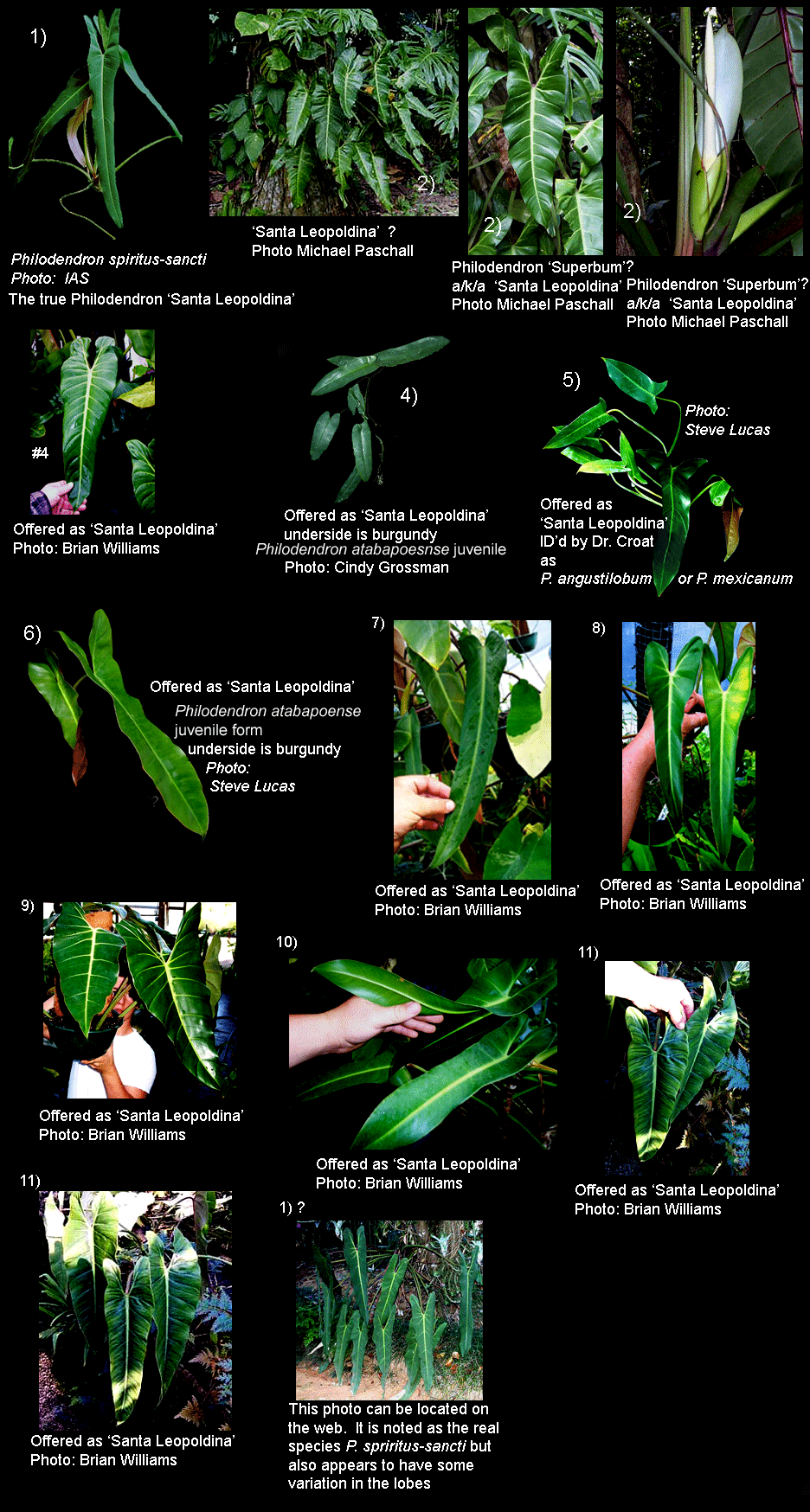
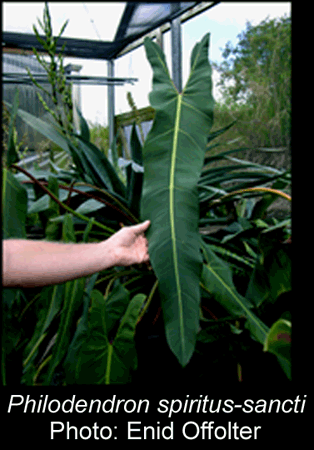
Plant #1 This is the
real Philodendron spiritus-sancti,
known in Brazil by some as Santa Leopoldina.
The first photo came from an International Aroid Society auction. But look at the second photo,
also as #1. That photo belongs to Brazilian Mauro Piexoto. Mauro
is very familiar with the plant. His photo can be found on the internet as
an official photo of P. spiritus-sancti. Look at the lobes,
it too appears to show variation.
The
second to last photo was
furnished by Enid Offolter of a plant in Hawaii. That photo is of the
real P. spirtus-sancti. And the final photo is from Leland Miyano.
Note the unusually narrow leaf blades and pointed lobes of the true
Philodendron spiritus-sancti.
Plant #2 is a plant belonging to Michael Pascall. It too is known as Santa Leopoldina. We believe this to be superbum.
Plant #3 is a plant belonging to Brian Williams. It is known as Santa Leopoldina.
Plant #4 This plant belongs to collector Cindy Grossman and is nothing more than a juvenile form of Philodendron atabapoense. It is also known as Santa Leopoldina but may have the common name 'Roberto' in Australia. A fuller explanation can be found in #6 below.
Plant #5 This is one of my own plants and was d by one of my daughters on eBay as Santa Leopoldina. Dr. Croat ID'd this specimen as either P. angustilobum or P. mexicanum. It is simply too young to be certain at this time. Brian commented, "Your #5 I also have and I believe it is a hybrid of mexicanum it does not get as near a long a leaf and much wider back lobes."
Plant #6 A juvenile form of Philodendron atabapoense, this specimen is sometimes sold as the "red backed" form of Santa Leopoldina originally collected by Bette Waterbury in Brazil. Our specimen came from collector Russ Hammer. He d the plant as Santa Leopoldina. This plant has very distinctive blade undersides that are burgundy. This one is also known by some as 'Roberto'. Both #4 and #6 have been identified as possible variations of P. atabapoense, however that information is unverified. Brian again commented, "Your #6 is the most commonly called Santa form. Dewey Fisk gave me a botanical name on this a few years back. I have sense lost it."
Plant #7 Plant belonging to Brian Williams known as Santa Leopoldina.
Plant #8 and Plant #9 belonging to Brian Williams known as Santa Leopoldina. Brian commented, "Number 8 and 9 are the same plant one is juvenile and grown in a drier area the other photo is more mature. I believe this is the form that will soon be named Superbum."
Plant #9 Plant belonging to Brian Williams known as Santa Leopoldina.
Plant #10 Plant belonging to Brian Williams known as Santa Leopoldina. This one is very similar to # 6 with the exception the blade underside is green instead of burgundy. Brian commented, "10 is a collected species unknown from Brazil." Michael commented it could possibly be a form of P. atabapoense.
Plant #11 Plant belonging to Brian Williams known as Santa Leopoldina. Brian commented, "an unknown species similar in look to the Santa forms, it has a bluish look to the leaf very shinny looking also." I'm not going to tell you what Michael said we should call it at first but then commented it could possibly be P. billietiae.
