
Aroids and other genera in the Collection
Take the Tour Now?
Orchids
The
Exotic Rainforest
Plants in
the Exotic Rainforest Collection
Images on this website are copyright protected. Contact us before attempting to reuse.
In depth information on how to grow Philodendron species, Click this Link
Within our collection we have many species of Philodendron. If you are seeking other photos, click this link
Philodendron atabapoense
G.S. Bunting

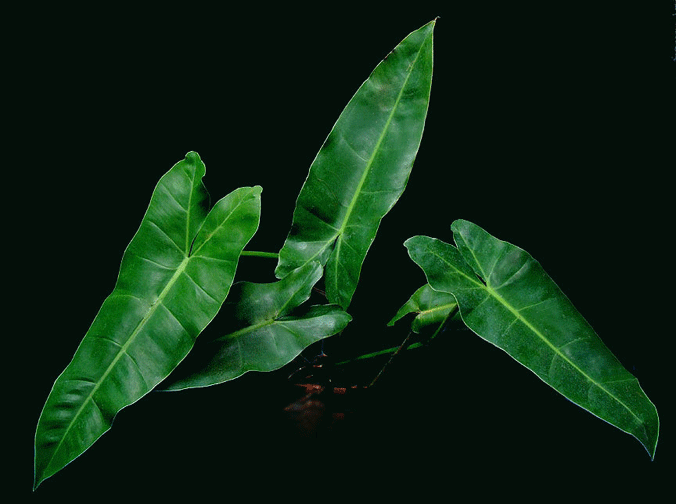
 When I first received this plant
species I was told the scientific name was unknown
but the seller often referred to the plant as the "Big Philo". Fortunately, there
is an aroid discussion forum on the internet known as Aroid l sponsored by
the International Aroid Society. Once I obtained a good photo of the plant
I posted it on Aroid l to see if anyone recognized the species. Someone
did! And that someone is very well known to Philodendron collectors, Dr.
Eduardo Gonçalves (gon-ZAL-vas)
of the Universidade Catolica de Brasilia in Brazil.
Philodendron species, and
especially hybrid forms, are
known to be highly variable and not every leaf of every specimen
will always appear the same.
When I first received this plant
species I was told the scientific name was unknown
but the seller often referred to the plant as the "Big Philo". Fortunately, there
is an aroid discussion forum on the internet known as Aroid l sponsored by
the International Aroid Society. Once I obtained a good photo of the plant
I posted it on Aroid l to see if anyone recognized the species. Someone
did! And that someone is very well known to Philodendron collectors, Dr.
Eduardo Gonçalves (gon-ZAL-vas)
of the Universidade Catolica de Brasilia in Brazil.
Philodendron species, and
especially hybrid forms, are
known to be highly variable and not every leaf of every specimen
will always appear the same.
Dr. Gonçalves has often been very kind to assist in the identification of unusual specimens in our collection and almost immediately sent an email to the Aroid l forum telling me the plant was P. atabapoense and was found in Brazil and Venezuela. At this point I have been unable to learn much about the species but am attempting to locate a copy of the original botanical description of the plant. But within hours of that email arriving I received a note via Aroid l the plant may be Philpdendron curvilobum. That possible identification came from a knowledgeable source at the Instituto de Pesquisas Jardim Botanico in Rio de Janeiro. So for awhile I was uncertain which identification was correct, but I certainly trusted the opinion of Dr. Gonçalves. Fortunately, Dr. Gonçalves is very quick to respond. In a second email sent only a few hours later he wrote, "IIt is P. atabapoense for sure. Philodendron curvilobum, despite having a similar leaf shape, is not burgundy on the lower surface like P. atabapoense. I have just checked my plants and they look exactly the same as yours." So the identification can be made with certainty, the specimen is Philodendron atabapoense. As can be observed in the photo to the left which is a juvenile specimen. Compare these photo to the Missouri Botanical Gardken Tropicos website: http://www.tropicos.org/Image/41659
Philodendron atabapoense is known to produce variable leaf blades as a result of ontogeny. commonly known as morphogenesis. Variation within species does not always require the plant to present the same leaf shape and color. See Leland Miyano's photo comparison of morphogenesis within the species Philodendron atabapoense near the bottom of this page. Please note that every square on the grid is approximately 2.54cm (one inch) and every leaf in the comparison grew on the same plant. Aroid expert Leland Miyano also explained, "the juvenile leaves of Philodendron atabapoense can be very glaucous or grey-green on the adaxial or upper surface,of the blade in the right light....it often has this feature in shade or sun, but with increased light, it is even more pronounced." The following link explains in non-technical language natural variation and morphogenesis. Click here.
Identified to science in 1975,
Philodendron
atabapoense is
found primarily in the
Amazonia region of Brazil and the southern portion of
Venezuela. Typically, the species is found at an elevation of
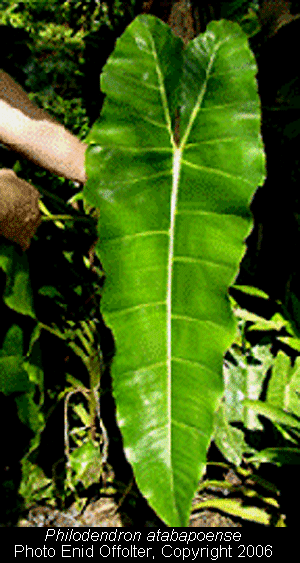
approximately 100 meters (300 feet) above sea level. When received, our specimen's leaves
measured 33cm (13 inches) but the adult leaf shown in the inset photo from
Enid Offolter of Natural
Selections
Exotics shows the blade at close to one meter (3 feet). The large leaf
in Leland Miyano's photo comparison below easily measures in excess of .75
meters (30 inches). A photograph of the mature
Philodendron atabapoense on
TROPICOS
(Missouri Botanical Garden) shows the leaves to be wider
once the plant matures.
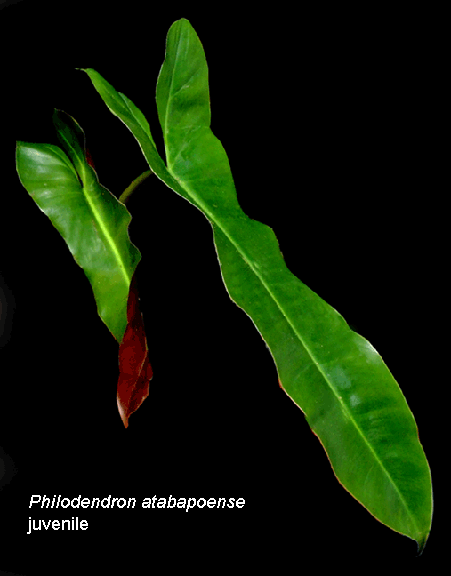 When
asked In late July, 2008 to confirm the photo to the left,
Dr. Gonçalves responded
"it is P. atabapoense. Long
leaves in juvenile plants and a burgundy lower surface. Probably from
lowland Amazonia. Only two plants have leaves like that in Amazonia:
P. atabapoense and P. billietiae. However, young plants in P. atabapoense
have burgundy lower surfaces, whereas they are regular green in P.
billietiae. Adults plants of P. billietiae have regular green or slightly
rose lower surfaces and petioles, whereas they are strongly yellowish (and
even orange) in P. billietiae."
When
asked In late July, 2008 to confirm the photo to the left,
Dr. Gonçalves responded
"it is P. atabapoense. Long
leaves in juvenile plants and a burgundy lower surface. Probably from
lowland Amazonia. Only two plants have leaves like that in Amazonia:
P. atabapoense and P. billietiae. However, young plants in P. atabapoense
have burgundy lower surfaces, whereas they are regular green in P.
billietiae. Adults plants of P. billietiae have regular green or slightly
rose lower surfaces and petioles, whereas they are strongly yellowish (and
even orange) in P. billietiae."
We have two specimens. each a climber. However, Dr. Tom Croat of the Missouri Botanical Garden reports juvenile specimens of Philodendron atabapoense are often found creeping across the ground. The underside of the blade is a very pale burgundy once the leaves mature.
The inflorescence of Philodendron atabapoense are solitary while the spathe is green throughout the outside with purplish-brown on the inside. The young fruits are pale greenish-white.
Like most rain forest tropical plants we have Philodendron atabapoense planted in moderately bright light in a well draining mixture of good potting soil, peat moss, orchid potting medium and Perlite™. Our original specimen (top of the page) came from Natural Selections Exotics in Fort Lauderdale. The inset photo (rop right) is courtesy of Enid Offolter at Natural Selections. The juvenile specimen in the lower left photo was a gift from collector Russ Hammer in Central Florida.
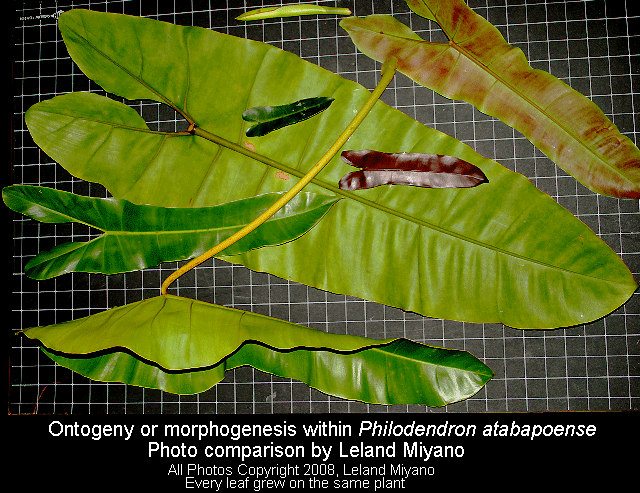
Specimens may be available
from Natural Selections Exotics

or Brian's Botanicals
http://www.briansbotanicals.net/

If you are seeking information on
other rare species, click on "Aroids and other genera in the Collection" at the top and look
for the

Want to learn more
about aroids?
Join the
International Aroid Society:
http://www.exoticrainforest.com/Join%20IAS.html