
Aroids and other genera in the Collection
Take the Tour Now?
Orchids
The
Exotic Rainforest
Plants in
the Exotic Rainforest Collection
Images on this website are copyright protected. Contact
us before any reuse.
In depth information on how to grow Philodendron species, Click this Link
Within our collection we have many species of Philodendron. If you are seeking other photos, click this link
Philodendron
rugosum Bogner & G.S. Bunting
Commonly called
Naugahyde Philodendron or "Pig Skin" Philodendron
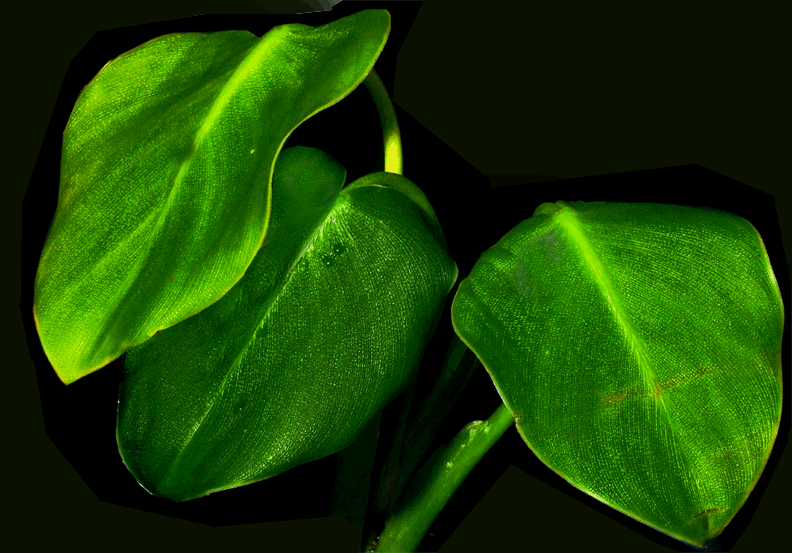
Philodendron rugosum
Bogner & G.S. Bunting
Common names: Naugahyde Philodendron, "Pig Skin" Philodendron
Common names: Naugahyde Philodendron, "Pig Skin" Philodendron
Not described to science until 1983,
Philodendron rugosum is now officially designated as a "near
threatened" species. A member of section Oligospermum, the
species is found only in the pre-mountainous rain forests of Ecuador and
is most commonly found in the province of Pastaza..
This unusual Philodendron grows in the Andes Mountains at an
elevation of 1,000 to 1,700 meters (3,000 to 5,000 feet). Dr. Tom Croat
of the Missouri Botanical Garden in St. Louis originally examined the
species in the wild in 1979 and has collected Philodendron rugosum
in the Morona-Santiago vicinity of southeastern Ecuador. Dr.
Croat published a treatment of the species in Aroideana, Volume 7, #1 in
1984. Aroideana is the journal of the International Aroid Society.
Philodendron species are
known to be highly variable and not every leaf of every specimen
will always appear the same. This link explains in greater
detail the scientific principle of natural variation and
morphogenesis.
Click
here.
Philodendron rugosum normally
grows as an epiphyte (ep-a-FIT) or hemiepiphyte (hem-a-EPA-fit) on a rain forest tree. Hemipiphytes are similar to
epiphytes in they grow attached to a tree but may also begin life in the ground
and climb the host. Hemipiphytes may also begin life as a seed in a bird's dropping on a
tree branch and then send roots down to the soil. However, in his
article appearing in Aroideana,
Dr. Croat described the species as sometimes being epipetric. Epipetric
species are plants capable of growing on rocks. Grower Leland
Miyano in Hawaii reports the species will even grow as a terrestrial
plant in mud (see photo below, right). The species is reported
by collectors to be adaptable, yet care should be given to insure the
species is well cared for since it is, according TROPICOS, a service of
the Missouri Botanical Garden in St. Louis, now a "red lined"
species and
is very near being classified as endangered.
The leaf blades are moderately
coriaceous
(thick and leathery) and heavily textured with the look of leather. The
leather appearance is seen as "grain" on the surface of
the leaf blade and is composed of countless fine veins or veinlets that serve to produce the appearance of a pig's skin, or naugahyde.
Thus the common names "Naugahyde Philodendron"
or "Pigskin
Philodendron". The texture, along with the bright green color,
often gives Philodendron rugosum the look of plastic rather
than a living specimen. Some growers have reported
specimens with much darker green leaf blades, especially in the wild.
All Philodendron species are aroids. An aroid is a plant
that reproduces by growing an inflorescence known to science
as a spathe and spadix. Some believe the spathe is a
"flower" which is incorrect. The spathe is a
modified leaf that appears as a hood. The spadix
is a spike on a thickened fleshy axis which can produce tiny flowers. When an aroid is referred to as "flowering" the
reference is to the very small flowers found on the spadix
when the plant is ready to reproduce and has nothing to do with the spathe. Within the
inflorescence there are extremely small flowers found on the
spadix during anthesis (sexual reproduction). The
spadix is found at the center of the inflorescence and
appears somewhat like a rough rod.
When ready to be pollinated the spadix produces both male,
female and sterile flowers and if the female flowers
are pollinated with pollen brought by an appropriate
Cyclocephala beetle from another plant which is at male anthesis the
plant will be pollinated. Once pollinated, the spadix will
produce berries containing seeds. The female flowers of
Philodendron species are hidden from view within a closed area of
the spathe known as the floral chamber while the male flowers may be
found along the upper portion of the spadix. The species normally has two inflorescences per axil but
is capable of producing up to six inflorescences at one time. The spathe
tube is maroon to red on the outside and typically measures 8 to 12cm
(3.15 to 4.7 inches) in length. The spadix is up to 10cm (3.95
inches) in length.
Considered relatively easy to grow, Philodendron
rugosum can be maintained as a houseplant if you are fortunate enough to
locate a specimen. Large specimens often bring a handsome price.
Some growers indicate P. rugosum is slow growing but that is
likely due to inadequate light. Our specimens grows at a relatively rapid
rate. Experienced
growers often recommend collectors keep the species well away from air-conditioning
and insure the potting medium is both well draining and constantly moist. We
prefer a soil mixture composed of good soil, extra peat moss, Perlite™,
and hard wood orchid potting media containing charcoal, bark
and gravel. The orchid media gives the roots
something to which they can attach as would be natural in the wild. For some
reason, Philodendron
rugosum is not often divided and offered for sale. However, at
times in the past, the species has been tissue cultured making some
specimens more readily available.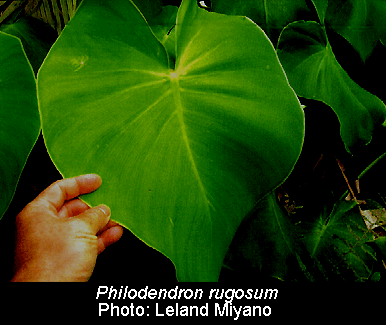
The blades of our specimen were approximately 23cm (9 inches) when acquired in the summer of 2007. A second specimen in the same pot has leaves of less than 8cm (3 inches). However, since both were put in a single pot, each specimens has grown at least 15cm (six inches). No scientific literature can be located with an average petiole length but the longest petiole on our specimens measure approximately 40.5cm (16 inches). The petioles of the species are medium green. There is no noticeable reason for the extra growth with the exception the increased rate occurred in the hottest portion of the year. I hesitant to suggest increasing the heat surrounding any Ecuadorian species but the specimens show little growth during the cool of the year. In Ecuador, leaves measuring 60cm (2 feet) have been reported. The internodes of Philodendron rugosum are 6cm long (2.35 inches) and 2.2cm (.96 inches) in diameter. The blades are semi-glossy.
Philodendron rugosum
needs bright, slightly diffused light for best growth best. Aroid
expert Leland Miyano who lives on the island of Oahu offered these
growing suggestions, "The
cultural requirements of Philodendron rugosum are easy in Hawaiian
conditions. I grow it both in deep shade and full sun with copious
rainfall. If grown in shade, it grows very slowly. It increases
growth rates as the light levels intensify. Remember that I am on the
cloudy, wet windward side of Oahu so our full sun levels are not as
intense as the lee of the island where the hotter sun would probably
burn the leaves. I would say that a light shade with long
photoperiods would be optimum for this species along with adequate
watering. I am growing it only as a terrestrial so I do not have
to water. I do not have an irrigation system and I rely on natural
rainfall, 60-100 inches depending on the year."
Hawaiian grower Windy Aubrey, who has
also had good success with
the species states, "I have found them to grow a little faster when
I grow them in a New Zealand moss mix and they like to be really moist
unlike a lot of other Philodendron".
We have given both specimens
significantly more water during the summer heat. The increased
moisture may have contributed to the increased growth. As a result
of Leland's suggestion we have moved our specimens to significantly
brighter light.

If you are seeking information on other
rare species, click on "Aroids and other genera in the Collection" at the top and look
for the

Want to learn more
about aroids?
To join the
International Aroid Society click here:
http://www.exoticrainforest.com/Join%20IAS.html
Out of print copies of Aroideana can often be ordered directly from the International Aroid Society:
http://www.aroid.org/