
Aroids and other genera in the Collection
Take the Tour Now?
Orchids
The
Exotic Rainforest
Plants in
the Exotic Rainforest Collection
Images on this website are copyright protected. Contact
us before attempting to reuse.
In depth information on how to grow Philodendron species, Click this Link
Within our collection we have many species of Philodendron. If you are seeking other photos, click this link
Philodendron pedatum
(Hook.) Kunth
A question posed on a garden
website led to an answer that will surprise many!
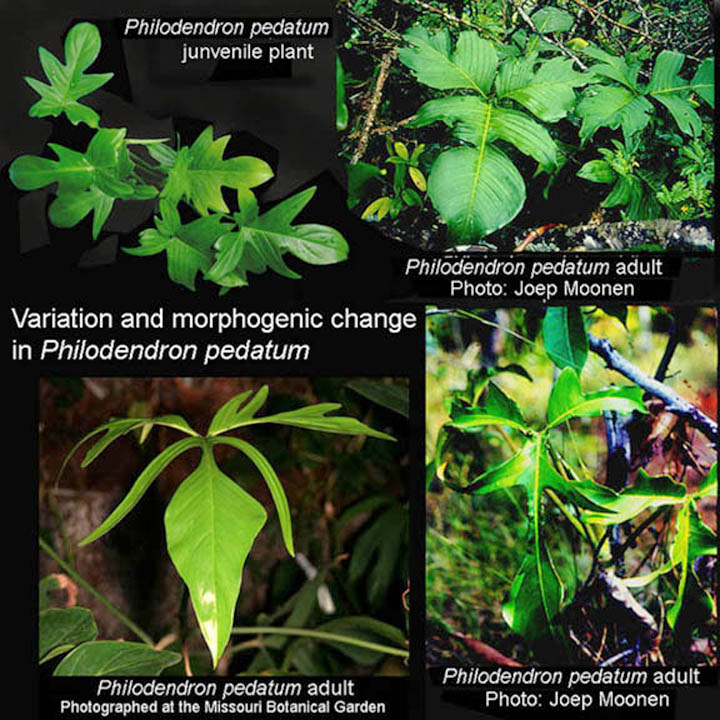
Not every leaf of a species has to look just alike.
Synonyms: Philodendron quericifolium, Philodendron laciniatum,
Philodendron amazonicum and others
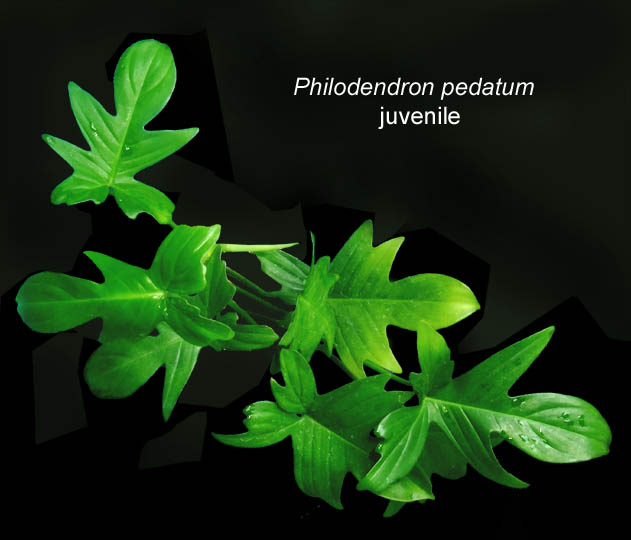
Synonyms: Philodendron quericifolium, Philodendron laciniatum, Philodendron amazonicum
Philodendron laciniosum, Caladium pedatum, Dracontium laciniatum
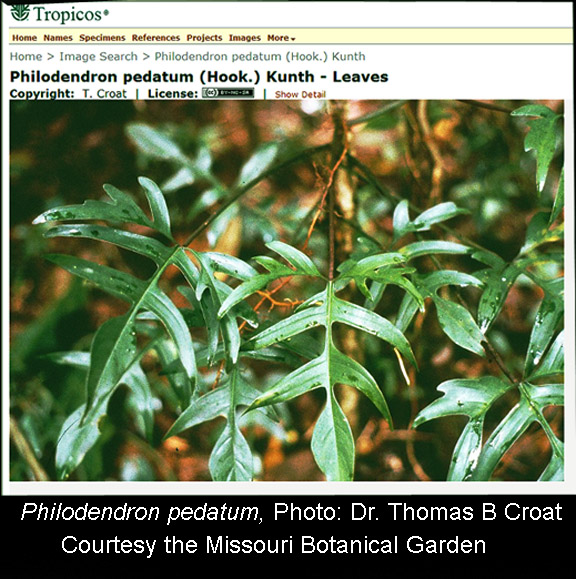
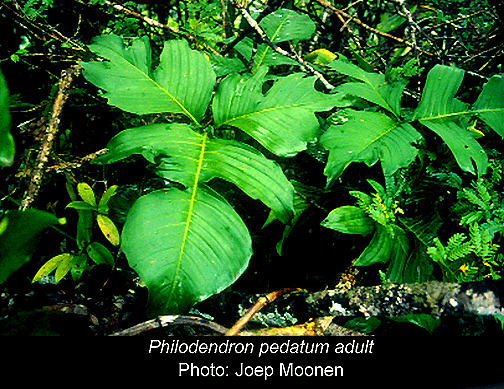 Described in 1841, as an adult Philodendron pedatum
is an unusual multi-lobed Philodendron that has received many
scientific names due to the myriad of leaf shapes the species naturally
produces. Botanists have mistaken Philodendron pedatum for a
plant that is
yet to be named as a result of its extremely variable growth forms. At one time
botanist Joseph Dalton Hooker thought Philodendron pedatum was a
Caladium and
many data bases still list the specie's basionym (true scientific name) as
Caladium pedatum. The basionym is the original name applied
to the taxon: "basio-" from the Latin: "basis" from the Greek "bainein",
meaning "step", and "-nym" from the Latin "nomen" meaning "name". It is the
first step in the naming process. In many instances the name was found to be
synonymous but had the incorrect genus placement.
Described in 1841, as an adult Philodendron pedatum
is an unusual multi-lobed Philodendron that has received many
scientific names due to the myriad of leaf shapes the species naturally
produces. Botanists have mistaken Philodendron pedatum for a
plant that is
yet to be named as a result of its extremely variable growth forms. At one time
botanist Joseph Dalton Hooker thought Philodendron pedatum was a
Caladium and
many data bases still list the specie's basionym (true scientific name) as
Caladium pedatum. The basionym is the original name applied
to the taxon: "basio-" from the Latin: "basis" from the Greek "bainein",
meaning "step", and "-nym" from the Latin "nomen" meaning "name". It is the
first step in the naming process. In many instances the name was found to be
synonymous but had the incorrect genus placement.
 All Philodendron sp.
are aroids. An aroid is a plant that reproduces via the production of
an inflorescence known to science as a spathe and spadix. Most people
think the spathe is a "flower" but instead it includes many
very tiny flowers that grow along the spadix. Despite it's appearance
the spathe is not a "flower" but is simply a
modified leaf
appearing to be a hood
. If you explore the inflorescence with a magnifying
glass when it is ready to be pollinated at sexual anthesis there are very tiny flowers
that can be found on the spadix at the center of the inflorescence. The
inflorescence, which is sometimes shaped like a tube, is made of several
parts. The portion that appears to be the "flower" is the spathe and
inside that is the spadix which somewhat resembles an elongated pine
cone. The
spadix is a spike on a thickened fleshy axis which can produce tiny
flowers.
All Philodendron sp.
are aroids. An aroid is a plant that reproduces via the production of
an inflorescence known to science as a spathe and spadix. Most people
think the spathe is a "flower" but instead it includes many
very tiny flowers that grow along the spadix. Despite it's appearance
the spathe is not a "flower" but is simply a
modified leaf
appearing to be a hood
. If you explore the inflorescence with a magnifying
glass when it is ready to be pollinated at sexual anthesis there are very tiny flowers
that can be found on the spadix at the center of the inflorescence. The
inflorescence, which is sometimes shaped like a tube, is made of several
parts. The portion that appears to be the "flower" is the spathe and
inside that is the spadix which somewhat resembles an elongated pine
cone. The
spadix is a spike on a thickened fleshy axis which can produce tiny
flowers. 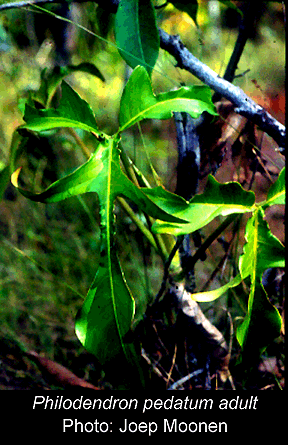 Philodendron
species are cleverly divided
by nature into zones to keep the plant from being self pollinated. Nature's
preferred method is to have insects (Scarab beetles from the genus
Cyclocephala) pick up the pollen from
the male flowers on one plant and carry it to another plant at female
anthesis in order to keep the species strong. The peduncle
(which supports the inflorescence of Philodendron pedatum) as well as
the spathe are described as being medium green as well as densely lineate on
the peduncle and back side of spathe.
A peduncle is the internode between the spathe and the last foliage
leaf. Lineate
is defined as being marked longitudinally with depressed parallel lines.
The spathe blade's margins
(edges) are purple and the inner surface is a greenish white which is tinged
with a dark maroon at bottom of the spathe tube on the inside.
Philodendron
species are cleverly divided
by nature into zones to keep the plant from being self pollinated. Nature's
preferred method is to have insects (Scarab beetles from the genus
Cyclocephala) pick up the pollen from
the male flowers on one plant and carry it to another plant at female
anthesis in order to keep the species strong. The peduncle
(which supports the inflorescence of Philodendron pedatum) as well as
the spathe are described as being medium green as well as densely lineate on
the peduncle and back side of spathe.
A peduncle is the internode between the spathe and the last foliage
leaf. Lineate
is defined as being marked longitudinally with depressed parallel lines.
The spathe blade's margins
(edges) are purple and the inner surface is a greenish white which is tinged
with a dark maroon at bottom of the spathe tube on the inside.
 Until collectors begin to understand
and accept the science of natural variation such a discussions will likely go
on without end and collectors just won't learn the names of the species they
have in their collection, especially if the plants are midway though the
process of ontogeny (natural changes in growth). If you haven't already, Look at the photos
just on this page and take the time to read our link discussion of natural
variation within species.
Click
here.
Until collectors begin to understand
and accept the science of natural variation such a discussions will likely go
on without end and collectors just won't learn the names of the species they
have in their collection, especially if the plants are midway though the
process of ontogeny (natural changes in growth). If you haven't already, Look at the photos
just on this page and take the time to read our link discussion of natural
variation within species.
Click
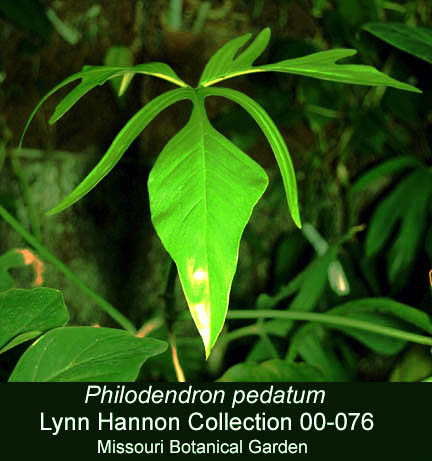
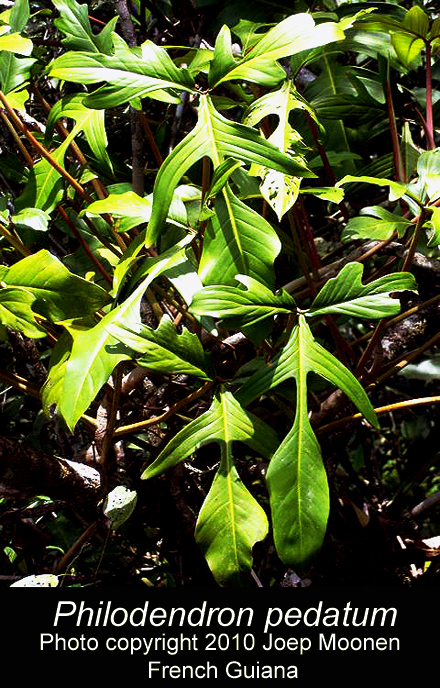
here. The inset photos, provided by Dutch
naturalist Joep Moonen (pronounced yupe), show a fully mature specimen in the jungles of
French Guiana. Joep believes this species was one of the parents of the
very odd Philodendron he discovered in the jungles of the Guiana Shield
currently known as Philodendron 'joepii' (see that plant on this website).
All you need do is look closely at the adult form of P. pedatum as
compared to P. 'joepii' to see the resemblance.
The inset photos, provided by Dutch
naturalist Joep Moonen (pronounced yupe), show a fully mature specimen in the jungles of
French Guiana. Joep believes this species was one of the parents of the
very odd Philodendron he discovered in the jungles of the Guiana Shield
currently known as Philodendron 'joepii' (see that plant on this website).
All you need do is look closely at the adult form of P. pedatum as
compared to P. 'joepii' to see the resemblance.If you actually wish to see this species, and many more, in the jungles of French Guiana, our friend Joep Moonen (pronounced yupe) introduces people to those exotic rain forests almost daily. For an Emerald Jungle Village eco-tour brochure contact Joep at EmeraldJungleVillage@wanadoo.fr
Looking for a specimen? Contact
http:///

Want to learn more
about aroids?
Join the
International Aroid Society:
http://www.exoticrainforest.com/Join%20IAS.html