
Aroids and other genera in the Collection
Take the Tour Now?
Orchids
The
Exotic Rainforest
Plants in
the Exotic Rainforest Collection
Images on this website are copyright protected. Contact
us before attempting to reuse.
In depth information on how to grow Philodendron species, Click this Link
Within our collection we have many species of Philodendron. If you are seeking other photos, click this link
Philodendron panduriforme
(Kunth) Kunth
Synonym: Philodendron latilobum, Pothos panduriformis
Sometimes incorrectly confused with
Philodendron bipennifolium
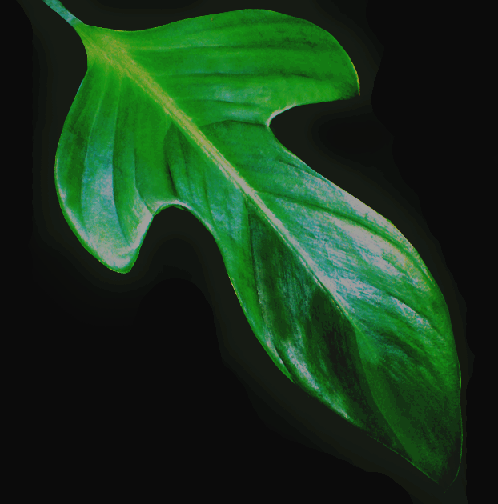
Philodendron
panduriforme
(Kunth) Kunth
Synonym: Philodendron latilobum, Pothos panduriformis
Sometimes incorrectly associated with Philodendron bipennifolium
Looking for Philodendron bipennifolium?
Go here: Philodendron bipennifolium
Synonym: Philodendron latilobum, Pothos panduriformis
Sometimes incorrectly associated with Philodendron bipennifolium
Looking for Philodendron bipennifolium?
Go here: Philodendron bipennifolium
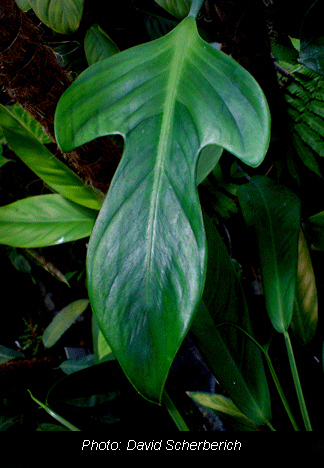 Philodedendron panduriforme ranges
throughout the northern and western areas of the Amazon basin.
Information from aroid botanist Dr. Tom Croat of the Missouri Botanical
Garden in St. Louis indicates Philodendron panduriforme occurs
in Peru, Ecuador, Brazil, Colombia, and portions of Venezuela, but is
limited in Venezuela to the region of Cerro Yapacana. Dr. Croat
writes, "I do not have it in my Flora of Guianas checklist", indicating
the species is not found within the northeastern portion of South
America known as the Guiana Shield. I found that
observation valuable since one French government website
apparently incorrectly
indicates the species is found in French Guiana. As a
result, I contacted Dutch naturalist Joep Moonen (pronounced yupe) who lives and works in
the rain forests of French Guiana for a confirmation. Joep assured
me the species is not found in the rain forests of that country.
Philodedendron panduriforme ranges
throughout the northern and western areas of the Amazon basin.
Information from aroid botanist Dr. Tom Croat of the Missouri Botanical
Garden in St. Louis indicates Philodendron panduriforme occurs
in Peru, Ecuador, Brazil, Colombia, and portions of Venezuela, but is
limited in Venezuela to the region of Cerro Yapacana. Dr. Croat
writes, "I do not have it in my Flora of Guianas checklist", indicating
the species is not found within the northeastern portion of South
America known as the Guiana Shield. I found that
observation valuable since one French government website
apparently incorrectly
indicates the species is found in French Guiana. As a
result, I contacted Dutch naturalist Joep Moonen (pronounced yupe) who lives and works in
the rain forests of French Guiana for a confirmation. Joep assured
me the species is not found in the rain forests of that country.
Philodendron species are
known to be highly variable and not every leaf of every specimen
will always appear the same. This link explains in greater
detail the scientific principle of natural variation and
morphogenesis.
Natural variation in aroids.
With
the upper lobes curving outwards and downwards, the species is known
to botany as a scandent (climbing) vine. The low climbing hemiepiphytic
Philodendron panduriforme is typically found at elevations
between 120 to 150
 meters (350 to 480 feet) above sea level but
may occasionally be found up to 500 (1600 feet) meters in elevation. Hemiepiphytic
species are plants that grow upon other plants but may begin life as a
seed placed on a tree's branch by a bird or grow upwards from the soil,
climbing a tree, as
a seed dropped on the ground. Birds commonly eat the fruit berries
of numerous Philodendron sp. and then deposit the seeds on the
tree in their droppings. Growers typically assume all plants
grow in soil, but in the rain forest that is far from true. Many
more species grow climbing and clinging to the trees than in the soil.
meters (350 to 480 feet) above sea level but
may occasionally be found up to 500 (1600 feet) meters in elevation. Hemiepiphytic
species are plants that grow upon other plants but may begin life as a
seed placed on a tree's branch by a bird or grow upwards from the soil,
climbing a tree, as
a seed dropped on the ground. Birds commonly eat the fruit berries
of numerous Philodendron sp. and then deposit the seeds on the
tree in their droppings. Growers typically assume all plants
grow in soil, but in the rain forest that is far from true. Many
more species grow climbing and clinging to the trees than in the soil.
meters (350 to 480 feet) above sea level but
may occasionally be found up to 500 (1600 feet) meters in elevation. Hemiepiphytic
species are plants that grow upon other plants but may begin life as a
seed placed on a tree's branch by a bird or grow upwards from the soil,
climbing a tree, as
a seed dropped on the ground. Birds commonly eat the fruit berries
of numerous Philodendron sp. and then deposit the seeds on the
tree in their droppings. Growers typically assume all plants
grow in soil, but in the rain forest that is far from true. Many
more species grow climbing and clinging to the trees than in the soil.
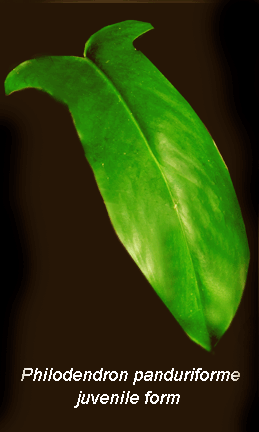
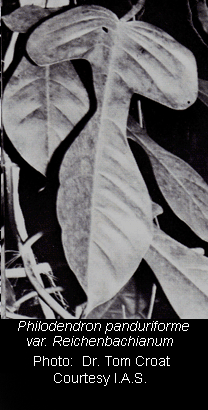
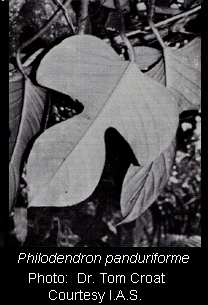
Please note: all
color photos on this page are of juvenile or sub-adult specimens.
Only the black and white photos of Dr. Tom Croat show an adult specimen. When fully
grown, the three lobes are normally of similar size. However, within
the species, there are two variations, the more common Philodendron
panduriforme var. panduriforme and Philodendron panduriforme
var. reichenbachianum. Although numerous collectors would rather
believe any plant with a form that does not perfectly match the norm must be a separate,
or new, species, in reality numerous species, especially
aroids, have
multiple forms. Plants are not unlike humans who may have many
body shapes (tall, short, fat, skinny) and skin colorations but are
still all the same species. Those additional forms are however sometimes distinctive enough
to be granted a "variation" name.
With leaf blades that are generally coriacious
(leathery), the normal form of Philodendron panduriforme is
distinguished from Philodendron panduriforme var. reichenbachianum since
the latter
possesses proportionally broader blades ranging from 1.1 to 1.9 times
longer than broad with an average blade of 1.3 times longer than broad.
The lateral lobes of Philodendron panduriforme var. reichenbachianum are
proportionally much shorter.
All
Philodendron species are aroids. An aroid is a plant that
reproduces by producing an inflorescence known to science as a
spathe and spadix. Many believe the spathe is a "flower" but it is
not. The spathe is simply a modified leaf
appearing to be a hood
. When an aroid is
referred to as "flowering" the reference is to the very small
female, male and sterile flowers found on the spadix. The reference
to "flowering" has nothing to do
with the spathe. The inflorescence, which is sometimes shaped like a
tube is the spathe and
inside that is the spadix. When ready to reproduce, the spadix
produces both male, female and sterile flowers which if pollinated
will produce the berries containing seeds.
The spathes of Philodendron panduriforme
grow in pairs and are pale green tinged with red containing a creamy
inside.
Philodendron panduriforme is often
confused with a totally different species, Philodendron
bipennifolium. Many collectors believe P. bipennifolium
is actually P. panduriforme. If you do an internet search for Philodendron
 panduriforme you will almost certainly find websites which direct
you to Philodendron bipennifolium or include "panduriforme" in
parenthesis at the end of the name. Sellers, especially on eBay, often
sell Philodendron bipennifolium and call it Philodendron
panduriforme. They also often sell many species and wrongly
try to pass them as Philodendron panduriforme. The confusing factor appears to be P.
bipennifolium has more than one growth form, especially when young. I've had several collectors try to
insist the main
difference in the two species is P. panduriforme has rounded upper
pointing lobes while P. bipennifolium has pointed upper lobes.
That is only partially correct since the species look nothing alike. According to Dr. Croat that notion is simply incorrect.
panduriforme you will almost certainly find websites which direct
you to Philodendron bipennifolium or include "panduriforme" in
parenthesis at the end of the name. Sellers, especially on eBay, often
sell Philodendron bipennifolium and call it Philodendron
panduriforme. They also often sell many species and wrongly
try to pass them as Philodendron panduriforme. The confusing factor appears to be P.
bipennifolium has more than one growth form, especially when young. I've had several collectors try to
insist the main
difference in the two species is P. panduriforme has rounded upper
pointing lobes while P. bipennifolium has pointed upper lobes.
That is only partially correct since the species look nothing alike. According to Dr. Croat that notion is simply incorrect.
panduriforme you will almost certainly find websites which direct
you to Philodendron bipennifolium or include "panduriforme" in
parenthesis at the end of the name. Sellers, especially on eBay, often
sell Philodendron bipennifolium and call it Philodendron
panduriforme. They also often sell many species and wrongly
try to pass them as Philodendron panduriforme. The confusing factor appears to be P.
bipennifolium has more than one growth form, especially when young. I've had several collectors try to
insist the main
difference in the two species is P. panduriforme has rounded upper
pointing lobes while P. bipennifolium has pointed upper lobes.
That is only partially correct since the species look nothing alike. According to Dr. Croat that notion is simply incorrect.
Many aroid collectors believe Philodendron
panduriforme is nothing more than an old name for Philodendron
bipennifolium. But if you do a check of the major botanical
databases such as IPNI (the International Plant Names Index) or TROPICOS
(a service of the Missouri Botanical Garden), or any major botanical
data base in the world that belief
is unsupported. Unfortunately, if you attempt to look up Philodendron
panduriforme in the noted aroid text Aroids, Plants of
the Arum Family by author Deni Bown you will also be
redirected to the description of Philodendron bipennifolium.
That appears to be simply an error in the original manuscript. According to Dr. Croat, the two species are not one and the same
and are distinctly different.
 Dr. Croat and I often exchange email regarding a variety of aroid
species. In an exchange in June, 2007, Dr. Croat wrote,
"Philodendron panduriforme is a distinct species which is merely
3-lobed. See Aroideana volume 9, I believe where I published the
Araceae of Venezuela. Philodendron bipennifolium does not resemble P.
panduriforme at all and is surely unrelated."
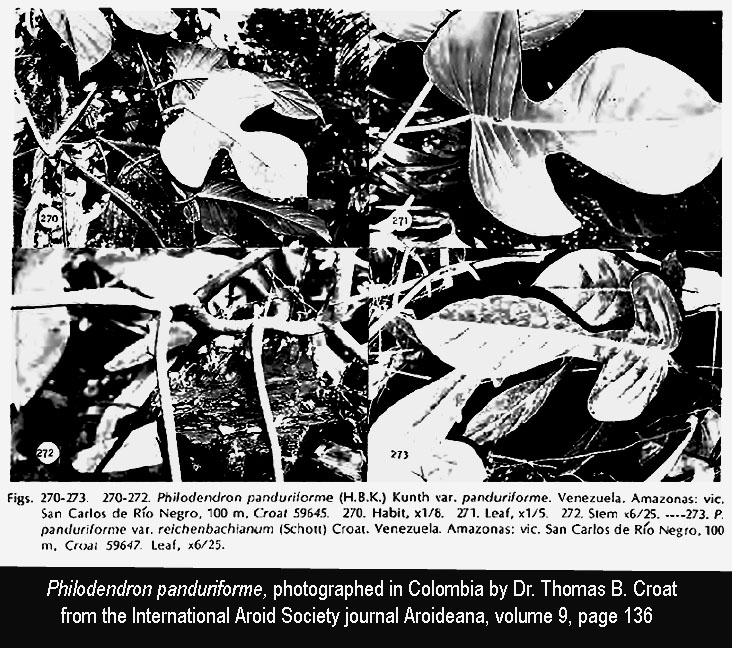
The black
and white photos shown here are from that journal. Regardless of common
beliefs among plant collectors, the species are neither similar, nor
related.
Dr. Croat and I often exchange email regarding a variety of aroid
species. In an exchange in June, 2007, Dr. Croat wrote,
"Philodendron panduriforme is a distinct species which is merely
3-lobed. See Aroideana volume 9, I believe where I published the
Araceae of Venezuela. Philodendron bipennifolium does not resemble P.
panduriforme at all and is surely unrelated."
The black
and white photos shown here are from that journal. Regardless of common
beliefs among plant collectors, the species are neither similar, nor
related.
With the assistance of aroid expert Julius Boos and the treasurer of the International Aroid Society, Tricia Frank, I was able to obtain a copy of the IAS journal Aroideana, Volume 9 which was printed in 1986. Out of print copies of Aroideana can often be ordered directly from the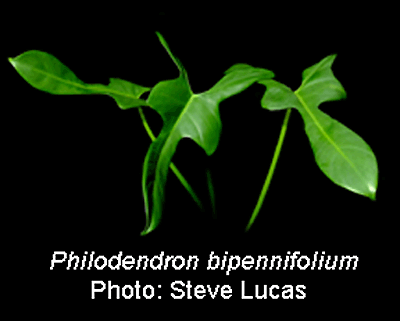 International Aroid Society:
http://www.aroid.org/
As is obvious from Dr. Croat's photos, reprinted here with
permission, the photos published in that journal bears no resemblance to
Philodendron bipennifolium.
International Aroid Society:
http://www.aroid.org/
As is obvious from Dr. Croat's photos, reprinted here with
permission, the photos published in that journal bears no resemblance to
Philodendron bipennifolium.
Dr. Croat and I often exchange email regarding a variety of aroid
species. In an exchange in June, 2007, Dr. Croat wrote,
"Philodendron panduriforme is a distinct species which is merely
3-lobed. See Aroideana volume 9, I believe where I published the
Araceae of Venezuela. Philodendron bipennifolium does not resemble P.
panduriforme at all and is surely unrelated."
The black
and white photos shown here are from that journal. Regardless of common
beliefs among plant collectors, the species are neither similar, nor
related.With the assistance of aroid expert Julius Boos and the treasurer of the International Aroid Society, Tricia Frank, I was able to obtain a copy of the IAS journal Aroideana, Volume 9 which was printed in 1986. Out of print copies of Aroideana can often be ordered directly from the
International Aroid Society:
http://www.aroid.org/
As is obvious from Dr. Croat's photos, reprinted here with
permission, the photos published in that journal bears no resemblance to
Philodendron bipennifolium. My friend Julius, who is an expert in aroid species, provided a description of P. panduriforme which helps to clarify the differences. Julius wrote, "They look nothing alike, and could never be confused as the same species. P. panduriforme has a shallow lobed blade w/ three shallow lobes, rounded tips to the lobes, and no more then scallops that do not go deep or anywhere near the main veins, while in the photo of P. bipennifolium the divisions in the blade seem deeply cut with pointed sections, and 'cuts' almost or to the main veins."
Read the description of Philodendron
bipennifolium here:
Philodendron bipennifolium

Want to learn more
about aroids?
To join the
International Aroid Society click here:
http://www.exoticrainforest.com/Join%20IAS.html
Out of print copies of Aroideana can often be ordered directly from the International Aroid Society:
http://www.aroid.org/