
Aroids and other genera in the Collection
Take the Tour Now?
Orchids
The
Exotic Rainforest
Plants in
the Exotic Rainforest Collection
The images on this website are copyright protected. Please contact us before any reuse.
In depth information on how to grow Philodendron species, Click this Link
Within our collection we have many species of Philodendron. If you are seeking other photos, click this link:
Philodendron hastatum
K. Koch & Sellow
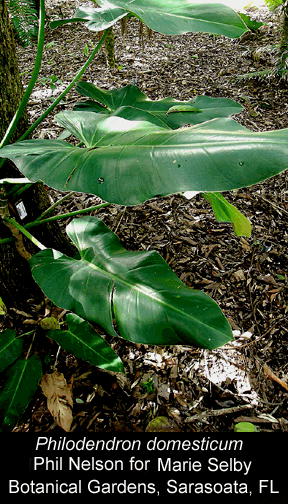
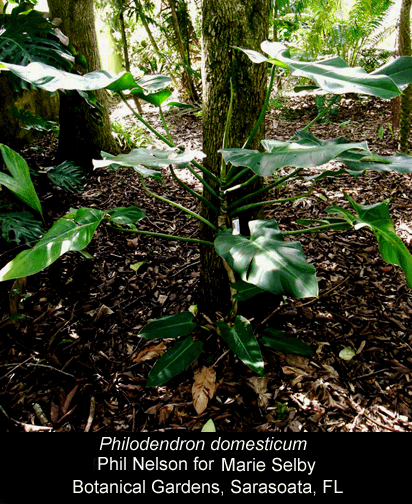
This species is not Philodendron domesticum
and the name P. hastatum has never been changed
Sometimes published as Philodendron hastatum Engler
Common name: Silver Sword Philodendron
The name Philodendron hastatum was never scientifically changed to Philodendron domesticum!
That internet myth is nothing more than a misconception.
 Philodendron
domesticum, A New Name for P. hastatum Hort.
Philodendron
domesticum, A New Name for P. hastatum Hort.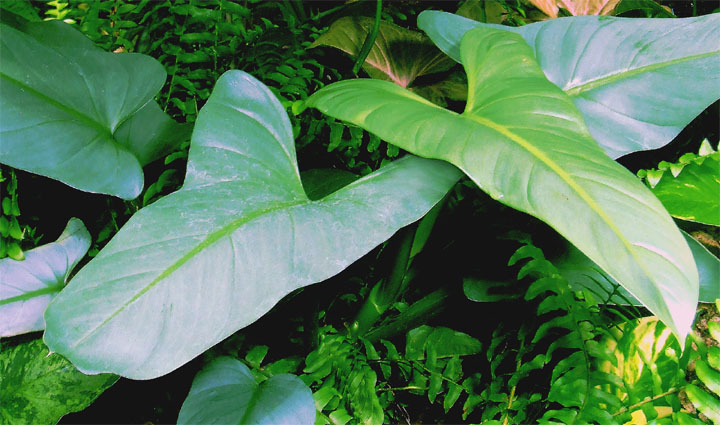 name published that is correct to genus and species becomes the
accepted name in science.
name published that is correct to genus and species becomes the
accepted name in science.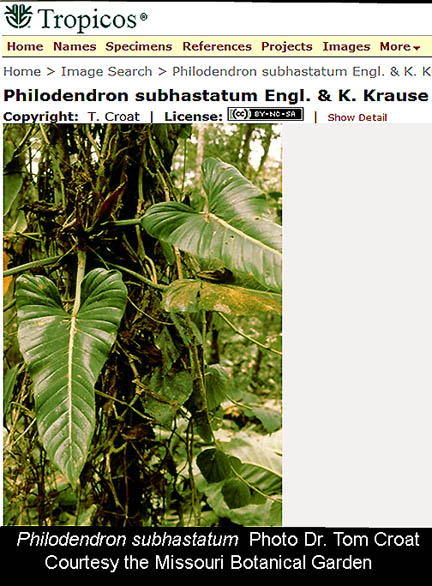 A basionym is the first valid name applied
to a taxon which may or may not have been accepted by later workers as a
result of their research.
A basionym is the first valid name applied
to a taxon which may or may not have been accepted by later workers as a
result of their research.Since a major part of this discussion is the explanation of why the name Philodendron hastatum has never been changed, the first date of the publication of Philodendron hastatum is important (1855). More than a few websites attempt to claim the scientific name Philodendron hastatum has been changed to Philodendron domesticum Hort. a plant described by Dr. George Bunting only as a horticultural species since he indicated the name Philodendron domesticum is only a horticultural name (Hort.). Some sources try to indicate USDA/GRIN accepts the name Philodenron domesticum as a synonym of Philodendron hastatum K Koch and Sellow but that is not correct. Just read the details: http://www.ars-grin.gov/cgi-bin/npgs/html/taxon.pl?452372
In fact, the name originally used (the one Bunting elected to change) was an improperly used common name for a plant the majority of aroid botanists as well as Bunting understand to be a man-made hybrid. No one is certain why, but during the 1960's someone decided to give that hybrid a common name and the name they chose was "Philodendron hastatum". Only the name of the hybrid was changed to a horticultural name. The name of the true species Philodendron hastatum K Koch & Sellow was never changed. Documentation of this fact in Dr. Bunting's own words can be found later in this article.
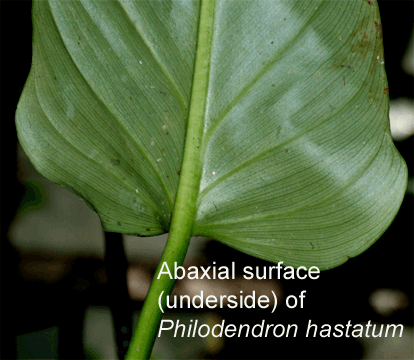 The scientific name Philodendron hastatum has
never been changed and the two plants are not one and the same. The importance of the first date of publication will later be explained.
The scientific name Philodendron hastatum has
never been changed and the two plants are not one and the same. The importance of the first date of publication will later be explained.
A primary hemiepiphytes begins life as a seed in the droppings of a rain forest inhabitant which germinate on the trunk or limbs of a tree as do an epiphyte but then develop long roots which eventually reach the ground. In this way they attain height in the forest as quickly as possible in order to reach brighter light.
Secondary
hemiepiphytes start their lives in the soil or on a tree trunk near the
ground with roots to the ground to gather
 additional nutrients then
climb the host where they morph into the adult form and sometimes
completely lose their connection to the ground. An appressed epiphyte is a species that grows closely pressed to the host
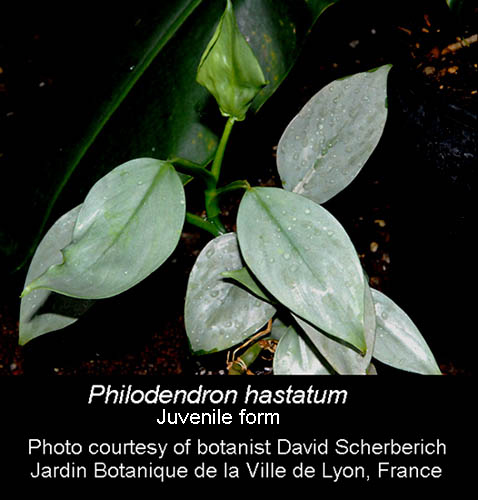
tree. The specimens shown in our photos of the blue-green Philodendron
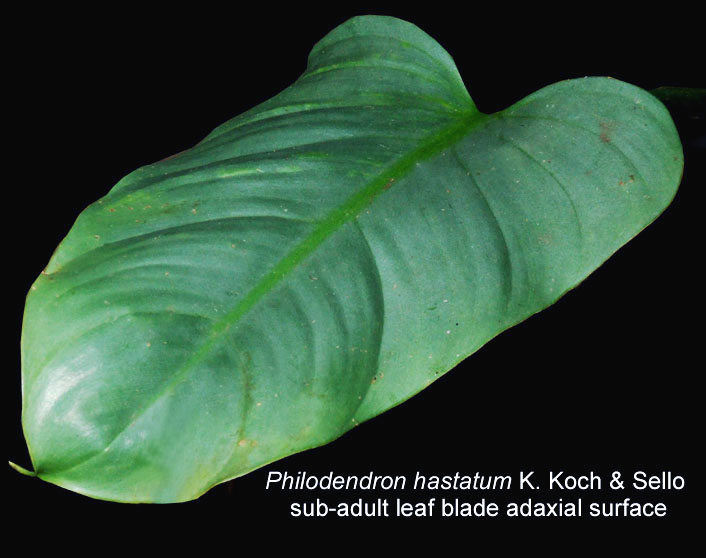
hastatum illustrate only the sub-adult form.
additional nutrients then
climb the host where they morph into the adult form and sometimes
completely lose their connection to the ground. An appressed epiphyte is a species that grows closely pressed to the host
tree. The specimens shown in our photos of the blue-green Philodendron
hastatum illustrate only the sub-adult form.
Although commonly grown by collectors in North America and Europe there is evidence Philodendron hastatum may be somewhat endangered in its native Brazil and the species is currently found on the Red List of endangered species. I sent a question asking if Philodendron hastatum was common or rare in southeastern Brazil to Brazilian aroid authority Dr. Eduardo Gonçalves (gon-ZAL-vas) formerly with the Universidade Catolica de Brasilia. In a personal response Eduardo made these comments: "Philodendron hastatum is not a common species here in Brazil. I have seen it only a few times in many years (of) collecting aroids, comparing with other Southeastern Brazilian species. I have to confess that our knowledge is not as good to say that it is endangered, but this is in fact a rare species and would be endangered in a few years if forest clearings continue as it is right now."
Despite
information posted on the internet, the scientific name Philodendron hastatum
was never changed, collectors
 have simply
chosen not to read beyond the
title
of the published paper which is in and of itself misleading.
have simply
chosen not to read beyond the
title
of the published paper which is in and of itself misleading.
This is the exact quote written by botanist George S. Bunting (formerly of Cornell University) in his 1966 published paper entitled Philodendron domesticum, A New Name for P. hastatum Hort. "The spade-leaf philodendron is a popular foliage plant with glossy bright green leaf blades to about 6 dm. long borne on equally long petioles. Its spathes are pale green outside but beautifully colored inside with cherry-red on the blade and wine-red on the tube. This taxon is commonly designated as Philodendron hastatum. Such usage, however, is untenable, for the name properly belongs to a very different species. Philodendron hastatum C. Koch & Sellow was first published in 1854" Please read once again what Dr. Bunting was attempting to explain in his paper!
Dr. Bunting clearly stated he was not attempting to change the name of a scientifically known species. Bunting also stated the common usage of a published scientific name for a non-related hybrid is "untenable" since the name Philodendron hastatum "properly belongs to a very different species. Philodendron hastatum C. Koch & Sello" which was first published in 1854". The "C. Koch" is taken directly from Bunting's paper (apparently published in error) since the name is correctly K. Koch.
Horticulturalists and plant collectors simply misunderstood what Dr. Bunting was attempting to explain in his description, especially the title. What he was saying was he was giving a horticultural name to a plant that had only the common name "Philodendron hastatum" but further explained that name should have never been in use.
Plant and garden discussion websites have also stated the name Philodendron hastatum is a synonym of Philodendron domesticum, but scientifically that is also incorrect. In the horticultural sense the two names may be "synonymous" but they are not synonyms in the scientific form.
 In all published
scientific material
Philodendron hastatum K. Koch and Sellow is not listed as a synonym of
any plant species
known to science and is certainly not a synonym of
Philodendron domesticum. You may
check the sources yourself to verify there are no synonyms for
Philodendron domesticum on the
The International Plant Names Index - Philodendron
domesticum or the
Missouri Botanical Garden's TROPICOS
In all published
scientific material
Philodendron hastatum K. Koch and Sellow is not listed as a synonym of
any plant species
known to science and is certainly not a synonym of
Philodendron domesticum. You may
check the sources yourself to verify there are no synonyms for
Philodendron domesticum on the
The International Plant Names Index - Philodendron
domesticum or the
Missouri Botanical Garden's TROPICOS
In fact, no site indicates where Philodendron domesticum has ever been observed in the wild. Most indicate it is a hybrid rather than a species and none reference it to be the same species or even closely related to the hybrid now known as Philodendron domesticum. If you would like to check for yourself here are the direct links to all the major sources: International Plant Names Index World Index of Selected Plant Families CATE Araceae TROPICOS
Based on the Linnean rules of nomenclature used by science such a name change would not possible due to the original date of publication. Carl Linnaeus (1707– 1778) was a Swedish physician, zoologist and botanist who established the foundations for the scheme of binomial nomenclature used by science. Linnaeus is considered the father of modern taxonomy, the system which defines the kingdom, phylum, class, genus, and species of any living organism.
One of the most basic rules of taxonomy is the earliest published scientific name correct to genus becomes the accepted name. Attempts to rename a species at a later date become invalid unless a major error can be demonstrated in the original publication. No such error can be found in the publication of the species Philodendron hastatum.
There are beliefs posted on internet plant discussion groups that botanists are perpetually changing the scientific names of species. The fact is if a name change is required that change will be done in accordance with the rules of science and botany as outlined by Linnaeus as a result of a demonstrated error. Sometimes a factual error in the naming of a plant species may be discovered by a qualified botanist which requires that error to be corrected. However, botanists do not simply grant new names to plant species to increase their own stature in science ot publish another paper.
According to personal email exchanges with botanist Dr. Thomas B. Croat Ph.D., P.A. Schulze Curator of Botany of the Missouri Botanical Garden in St. Louis, MO. as well as with aroid botanist Dr. Eduardo Gonçalves science knows exactly where Philodendron hastatum originated in nature Brazil. However no scientist can tell you where Philodendron domesticum can be found in the wild since it has never been observed! To be a species a plant should have been observed in its native habitat.
To the Aroid l
discussion group sponsored by the International Aroid Society Dr. Croat
also stated, "I am not familiar with what Bunting
was calling Philodendron elongatum (and commonly referred to as P. hastatum
in horticulture) but P. elongatum
was described in 1966 many years after
Engler described P. hastatum so P. hastatum cannot be a synonym of P.
domesticum."
 Please
refer back up a few paragraphs to the explanation of the use of
"Engler".
Please
refer back up a few paragraphs to the explanation of the use of
"Engler".
In a personal email from Dr. Croat received March 3, 2007, Tom wrote, ""I have never seen the type of P. domesticum and doubt if I would know any more if I had seen it. Just looking at the illustration I could imagine that it could be a dozen different species. The reason why it is confused with P. hastatum K. Koch is that the plant he described had commonly been called P. hastatum. Naturally it had nothing to do with P. hastatum. It was just another cultivated plant of unknown origin. He accomplished nothing by describing it and instead just created another plant likely never to be understood. The paper by Sakuragui listed below just deals with the real P. hastatum and has nothing to do with the plant that Bunting described."
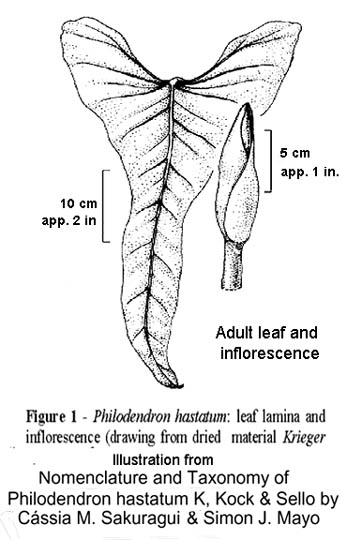
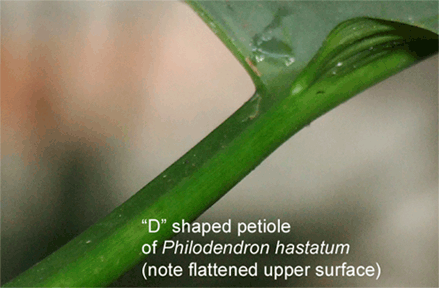
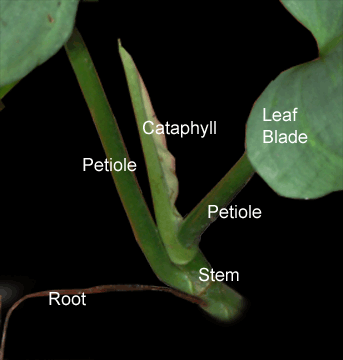
Every leaf of a Philodendron is supported by a petiole (photo, above right). The petiole extends outward from a node on the stem to the point where it joins with the leaf blade. Despite a tendency for collectors to prefer to call a petiole "the stem", that is scientifically inaccurate. The stem and petiole are completely different parts of a plant since the stem is the main support of a plant, often called the "cane" by a collector. The stem is the base, central axis and support of a plant normally divided into nodes and internodes. The nodes often produce a complete leaf with a blade and petiole in the axil of which they also produce roots and hold buds which may grow into shoots of various forms. The stem's roots anchor the plant either to the ground, a tree or to a rock. A stem may even spread as a repent rhizome creeping across the soil.
 The petioles of Philodendron hastatum are firm and flexible and
if cut as a cross section may be observed to be bluntly
"D" shaped
in that cross section. Such features as the shape of
the petiole, the structure of the leaf veins along with other
characteristics are important since they are used to positively identify
a species.
The petioles of Philodendron hastatum are firm and flexible and
if cut as a cross section may be observed to be bluntly
"D" shaped
in that cross section. Such features as the shape of
the petiole, the structure of the leaf veins along with other
characteristics are important since they are used to positively identify
a species.
The leaf blades of Philodendron hastatum are less than leathery to the touch (sub-coriaceous) and are semi-glossy on the upper (adaxial) surface. Rather than having dark green as the primary blade color Philodendron hastatum is often a mixture of gray/green and blue gray with elongated (somewhat lanceolate) leaf blades. Each newly emerging leaf blade is protected by a cataphyll. The cataphyll is a bract like modified leaf that surrounds any newly emerging blade and whose purpose is to protect that new leaf.
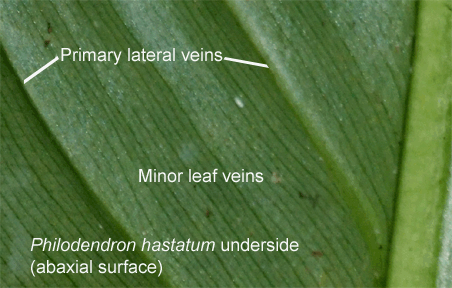
 The primary lateral leaf veins are slightly sunken
on the upper surface but are convex on the
abaxial (lower) side.
The minor leaf veins are fine in appearance when compared to the primary
veins, are closely spaced and only slightly distinct.
The primary lateral leaf veins are slightly sunken
on the upper surface but are convex on the
abaxial (lower) side.
The minor leaf veins are fine in appearance when compared to the primary
veins, are closely spaced and only slightly distinct.
Philodendron and aroid species are extremely variable and as can be seen in the photos on this page may take on different blade shapes. Those differences in blade shapes from the juvenile form to the fully adult form are in part the reasons Philodendron hastatum has been granted more than one scientific name (now synonyms). This quote is taken from the scientific paper Nomenclature and Taxonomy of Philodendron hastatum K. Koch and Sellow and Taxonomy of the species Philodendron hastatum by Cássia M. Sakuragui & Simon J. Mayo, "The morphological variation of the leaves, from juvenile to adult stages, makes specimens identification difficult, especially sterile ones. The major problem, however, seems to be the confusion among the different names that may appear on the labels indiscriminately, such P. hastifolium (of various authors) and P. elongatum Engler. The present paper aims to clarify some of the problems linked to the name P. hastatum C. Koch & Sello and to suggest a specimen for the neotypification of this name."
Philodendron hastatum is a variable species This link explains both variation and why the leaves change as they grow
Plant collectors often incorrectly use the name "Philodendron glaucophyllum"
in place of the scientific name Philodendron
 hastatum.
The name "Philodendron glaucophyllum"
is a fictitious name and is one some unknown person simply
made up to sound as if it were scientific!
The
name "Philodendron glaucophyllum" appears to be sourced in the plant
collector's guide Tropica by A. B. Graf but has no basis in science and
cannot be found on any of the scientific sources given earlier in this
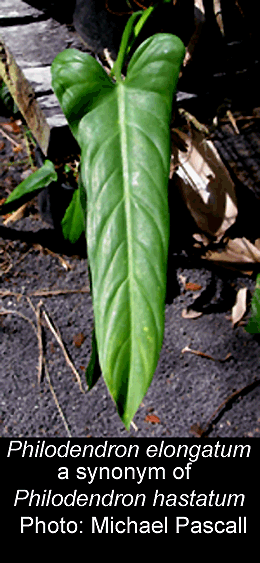
article. The name Philodendron elongatum
is also used in place of
Philodendron hastatum but that name
has been determined to be only a synonym of the species (same species,
other name) that was published after the original name.
hastatum.
The name "Philodendron glaucophyllum"
is a fictitious name and is one some unknown person simply
made up to sound as if it were scientific!
The
name "Philodendron glaucophyllum" appears to be sourced in the plant
collector's guide Tropica by A. B. Graf but has no basis in science and
cannot be found on any of the scientific sources given earlier in this
article. The name Philodendron elongatum
is also used in place of
Philodendron hastatum but that name
has been determined to be only a synonym of the species (same species,
other name) that was published after the original name.
America's top aroid botanist Dr. Tom Croat responded with this information while answering a question regarding the name "glaucophyllum" posted on the forum Aroid l, "That was a made up but unpublished name for P. hastatum Engler, a species from the area of Rio de Janeiro". He went on to add, "According to my records P. elongatum is a synonym of P. hastatum Engler and the images I have look identical to those of P. hastatum."
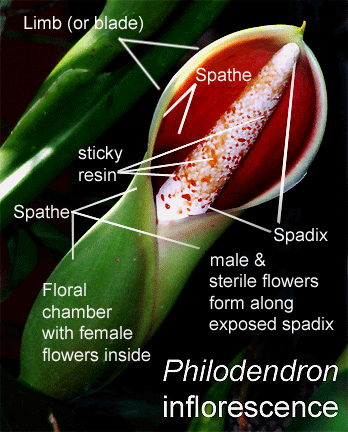
All Philodendron species
are aroids.
An aroid is a plant
that reproduces by producing an inflorescence known to science as a spathe and spadix.
Many people assume the
spathe is a "flower". which is
not correct,
the
spathe is nothing more than a modified leaf
appearing to be a hood
. Within
the inflorescence at sexual anthesis there are very tiny flowers on the spadix at
the center of the inflorescence.
(see the photo at right for an
explanation of the parts of a
Philodendron inflorescence.
The spathe of
Philodendron hastatum is a
cream white on the interior with a greenish exterior. Based on
George Bunting's description of Philodendron domesticum,
the spathe is
" pale green outside but beautifully colored inside with cherry-red on
the blade and wine-red on the tube"
The
photo of the inflorescence of Philodendron hastatum
K. Koch &
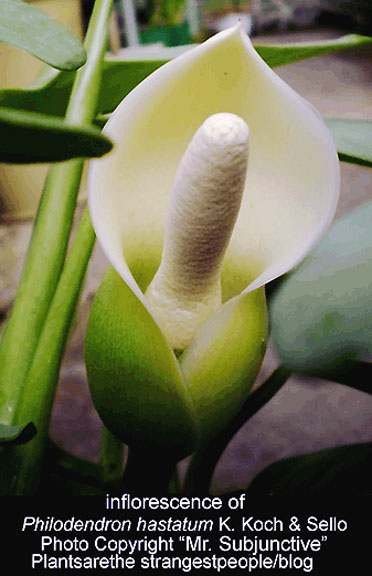 Sellow is courtesy of "Mr. Subjunctive",
Plants are the strangest people
Sellow is courtesy of "Mr. Subjunctive",
Plants are the strangest people
Once an aroid enters anthesis the spadix produces tiny flowers, both male, female as well as sterile male flowers. The male flowers produce pollen at male anthesis and the female flowers, which are hidden from view inside the lower portion of the spathe known as the floral chamber, are receptive to that pollen when they become sexually mature.
Despite the fact many plant growers believe the spathe is a "flower", that assumption is incorrect. The flowers of an aroid are very small and can be found on the spadix at the center of the inflorescence when the plant is ready to reproduce.
In nature an aroid's inflorescence
signals it is ready to enter sexual anthesis by emitting a perfume-like odor
known scientifically as a pheromone. The pheromone is propelled as a
result of thermogenesis (heat-birth) when the aroid is at sexual anthesis.
The perfume is attractive to the natural insect pollinator and can be
detected at distances of at least 200 meters (650 feet) by a beetle found in
the genus Cyclocephala known as a Scarab
beetle. The pollinators of aroids are primarily beetles from that genus which fly in a
zigzag pattern back and forth through the rain forest in to follow
the pheromone to its source. The pheromone cannot travel in a
straight line due to the variable wind flow through the rain forest
trees.
At the bottom of this page you
will find an illustration
of the parts of a Philodendron
inflorescence.
This link offers additional information on the reproductive cycle of an
aroid,
My personal thanks to Dr.
Tom Croat and Dr. Eduardo
Gonçalves for their personal
responses to my questions regarding Philodendron hastatum. My
additional thanks to botanist David Scherberich, Phil Nelson and Harry Luther of the Marie Selby
Botanical Garden in
Sarasota, FL for providing photos of Philodendron domesticum and to Australian collector Michael Pascall for the use of
his photo of Philodendron elongatum (synonym of Philodendron
hastatum) as well as "Mr. Subjunctive" for the use of his photo of the
inflorescence of Philodendron hastatum.
George Bunting's paper explaining why his intent was never to change the
scientific name of the recognized species Philodendron hastatum K
Koch & Sellow. Somehow, most people fail to read past the opening
headline.
Philodendron domesticum,
A New Name for P,
hastatum Hort. [Araceae]
George S, Bunting*
The spade-leaf philodendron is a popular foliage plant with glossy bright
green leaf blades to about 6 dm. long borne on equally long petioles. Its
spathes are pale green outside but beautifully colored inside with
cherry-red on the blade and wine-red on the tube. This taxon is commonly
designated as Philodendron hastatum. Such usage, however, is untenable, for
the name properly belongs to a very different species. Philodendron hastatum
C. Koch & Sellows first published in 1855 I Index Seminum Hort,1 Berpl. App.
7). Adult growth of this taxon was originally described as having
hastate-elongate leaf blades to 1 1/2 feet (4. 5 dm* ) long, with an
anterior lobe about 3 inches (7.5 cm. ) wide, and oblong, divergent basal
lobes. The ovaries were stated to be multilocular, with six to eight ovules
in each locule. This species appears to be native in the vicinity of Rio de
Janeiro, Brazil, and is not known to be in the horticultural trade in the
United States.
On the other hand, the plant commonly cultivated in this country as P,
hastatum has ovate-lanceolate leaf blades decidedly sagittate at the base,
and six to seven-locular ovaries with one to two ovules in each locule. The
leaf blade may be as much as 3 dm. wide, and toward the base of the anterior
lobe the margins are somewhat convex (i. e. , they bow outward slightly).
Origin of this material is unknown.
Since the name P. hastatum must be applied to that taxon with which it was
originally associated, a new name must be found for the cultivated species.
A search of the literature has revealed no available name, and a new one is
here proposed. Philodendron domesticum Bunt. , nom. nov.
HOLOTYPE: Bunting 1454. Growing at Fairchild Tropical Garden on wall at foot
of south steps beside small lily pool in the L. H. Bailey Palmglade, 13
April 1962
Leaf blades of P. domesticum are widest at a point well above the petiole
attachment, being widest about 12 cm. above it in the largest leaves. Each
basal lobe has about three strong lateral veins arising on the inner (upper)
side of the basal rib. ln leaves subtending inflorescences, the vaginate
part of the petiole is cherry-red within. Birdsey (he Cultivated Aroids. 82.
1951) stated that "there are two species sold in the trade under this name
hastatum," but that they can be distinguished vegetatively only by a very
slight difference in size, shape, and coloration. " Not withstanding, he left
the problem unresolved, and described only one of the taxa, under the name
P. "hastaturn." That taxon differs from P. domesticum in having much longer
peduncles to 23 cm. long, and smaller spathes only 13.5 crm. long, with the
blade light green inside. The number of ovules in each locule of that taxon
was not noted. The plant illustrated in Birdsey‘s photograph (op. cit., 83)
is certainly indistinguishable from P. domesticum.
Whatever taxon Birdsey was describing, it is unfamilar to me, and may still
lack a valid name. On the other hand, the plant here described as P.
dlomesticum is the spade-leaf philodendron that I have commonly encountered
in the horticultural trade, and the one included by A. B. Graf in his
Exotica 3, pages 115, 203, and 204
(1963).
.
The specific epithet domesticum, meaning " of the home," was suggested by
the wide use of plants of this taxon for decorative purposes indoors.
described only one of the taxa, under have commonly encountered in the
horticultural trade for decorative purposes indoors.
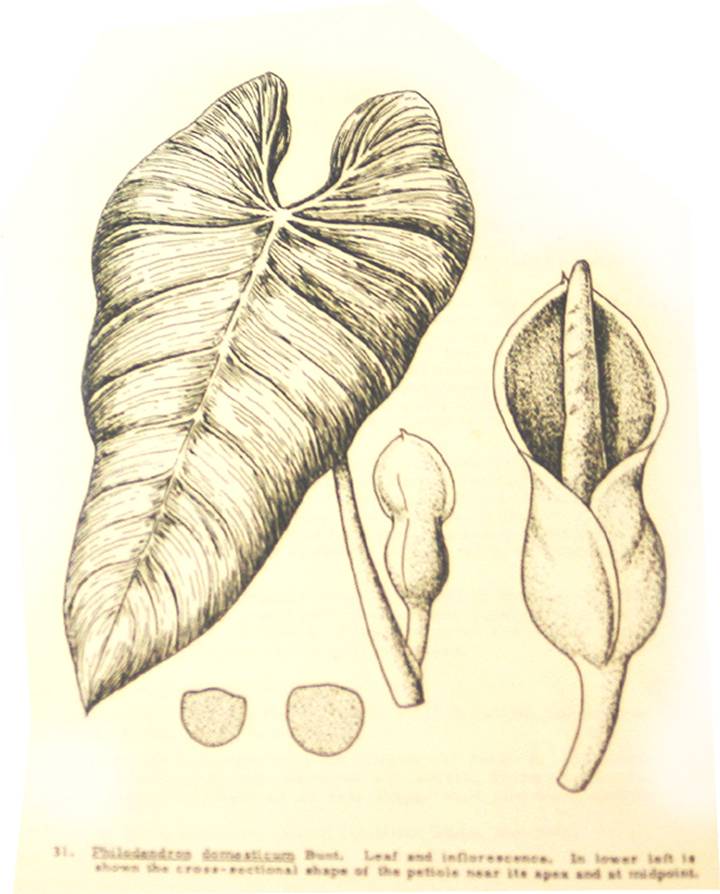
The drawing included with George Buntings original description of Philodnendron domesticum Hort.
All photos on this page, unless otherwise
credited, are the property of Steve Lucas,
www.ExoticRainforest.com
Photos Copyright 2006, 2007, 2008 Steve Lucas
Want to learn more
about aroids?
Join the
International Aroid Society:
http://www.exoticrainforest.com/Join%20IAS.html
Specimens may be available from
Brian's Botanicals
http://www.briansbotanicals.net/

