
Aroids and other genera in the Collection
Take the Tour Now?
Orchids
The
Exotic Rainforest
Plants in
the Exotic Rainforest Collection
Images on this website are copyright protected. Contact us before attempting to reuse.
In depth information on how to grow Philodendron species, Click this Link
Within our collection we have many species of Philodendron. If you are seeking other photos, click this link
Philodendron elegans K. Krause
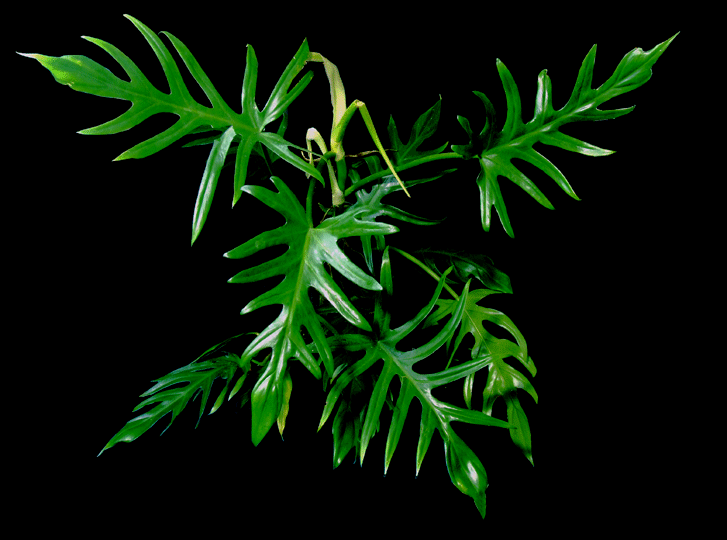
Philodendron elegans K. Krause
Incorrectly Philodendron angustisectum
Incorrectly Philodendron angustisectum
Common name:
Skeleton Key Aroid, Skeleton Key Philodendron
A multi-lobed Philodendron from Colombia and Brazil, Philodendron elegans was described to science in 1913 and is a member of Philodendron section Polytomium. Philodendron elegans is an epiphytic vine that sprawls across the ground or may grow erect to climb the nearest tree.
Philodendron elegans is an unusual epiphytic
 species (a plant
that grows upon another plant) due to the shape of the leaf
which some collectors refer to as a "skeleton key". However,
there are other Philodendron species with a similar growth
form including Philodendron radiatum and Philodendron
tortum. Some collectors appear to believe
Philodendron radiatum is one and the same as Philodendron
elegans however aroid botanist Dr. Thomas B. Croat Ph.D., P.A.
Schulze Curator of Botany at the Missouri
Botanical Garden in St. Louis, MO responded to such a question on
the International Aroid Society forum Aroid l in 2002 with this
quote,
"Philodendron radiatum and P. elegans are distinct species but
admittedly they are similar, with the later being smaller, having
fewer divisions and drying darker."
Dr. Croat's reference to "drying
darker" is a result of the examination of the dried specimens
botanists store in a herbarium since a dried specimen reveals much
greater detail than a living specimen and are always used as the
basis for the final determination of a species.
species (a plant
that grows upon another plant) due to the shape of the leaf
which some collectors refer to as a "skeleton key". However,
there are other Philodendron species with a similar growth
form including Philodendron radiatum and Philodendron
tortum. Some collectors appear to believe
Philodendron radiatum is one and the same as Philodendron
elegans however aroid botanist Dr. Thomas B. Croat Ph.D., P.A.
Schulze Curator of Botany at the Missouri
Botanical Garden in St. Louis, MO responded to such a question on
the International Aroid Society forum Aroid l in 2002 with this
quote,
"Philodendron radiatum and P. elegans are distinct species but
admittedly they are similar, with the later being smaller, having
fewer divisions and drying darker."
Dr. Croat's reference to "drying
darker" is a result of the examination of the dried specimens
botanists store in a herbarium since a dried specimen reveals much
greater detail than a living specimen and are always used as the
basis for the final determination of a species.
species (a plant
that grows upon another plant) due to the shape of the leaf
which some collectors refer to as a "skeleton key". However,
there are other Philodendron species with a similar growth
form including Philodendron radiatum and Philodendron
tortum. Some collectors appear to believe
Philodendron radiatum is one and the same as Philodendron
elegans however aroid botanist Dr. Thomas B. Croat Ph.D., P.A.
Schulze Curator of Botany at the Missouri
Botanical Garden in St. Louis, MO responded to such a question on
the International Aroid Society forum Aroid l in 2002 with this
quote,
"Philodendron radiatum and P. elegans are distinct species but
admittedly they are similar, with the later being smaller, having
fewer divisions and drying darker."
Dr. Croat's reference to "drying
darker" is a result of the examination of the dried specimens
botanists store in a herbarium since a dried specimen reveals much
greater detail than a living specimen and are always used as the
basis for the final determination of a species.
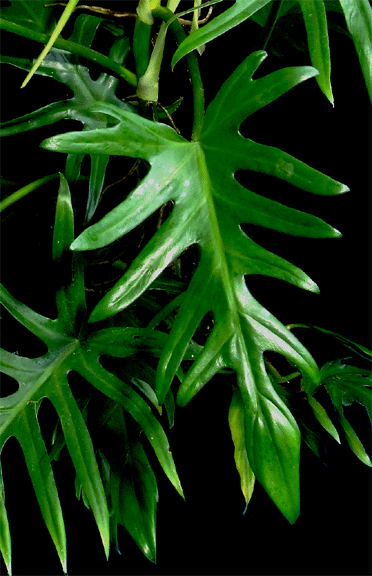
The blade of
Philodendron elegans are subcoriaceous (just less than leathery
to the touch) and moderately glossy in sheen. The blades grow to approximately 53cm (21 inches) in length
and may also be bicolorous having two shades of green on the adaxial
(upper) surface. The primary leaf veins (major veins) are
bluntly sunken as well as concolorous (only a single color) on the
adaxial surface but may be roundly raised and darker on the abaxial
(lower) leaf surface. The minor veins are fine in appearance
while only moderately visible. Although very young
juvenile blades are shaped differently from the adult form ,mid
adult
leaves are almost identical to the adult. The lobed leaf is pinnatified
(cut to the mid rib) similar in structure to that of a palm frond. As a
result, Philodendron elegans is sometimes called the Skeleton Aroid
or a Skelton Key Philodendron.
The petioles which support the
leaves are spongy to the touch and grow from nodes along the stem's
length. The petiole is scientifically a stalk to which the lamina of
the leaf blade is attached and is not a "stem" as is commonly
suggested by collector/growers. The petiole is the support
that connects the leaf blade to the stem. The petioles of
Philodendron elegans are terete (round) and medium green in
color and have a purple ring at apex (top). The petioles which
support the leaves grow from nodes along the stem's length. The stem of an
aroid is at the base of the plant.
Along the stem can be observed
nodes from which both the roots and petioles extend. The
sections between the nodes are known as the internodes but are
simply the stem segments between two nodes and may measure up to 15
cm (6 inches) in length. New leaf blades grow from cataphylls
which are produced by the nodes. A cataphyll is a
bract-like modified leaf that surrounds any newly emerging leaf and
whose purpose is to protect the new leaves as they emerge and
develop. The cataphylls are deciduous and fall from the plant
once the leaf is formed.
All Philodendron species
are members of the larger plant family Araceae and
are commonly known as aroids. An aroid is a plant that reproduces via the production of
an inflorescence known to science as a spathe and spadix. Most people
assume the spathe is a "flower" which is incorrect since the spathe is simply a
modified leaf
appearing to be
a hood . If you explore the inflorescence with a magnifying
glass when it is at sexual anthesis and is ready to be pollinated there are very tiny
female, male and sterile male flowers that can be found on the
spadix at the center of the inflorescence. When ready to reproduce these are normally separated by
a sterile zone.
The tiny male flowers produce pollen and the tiny female flowers are
designed to be receptive to pollen. The pollen is carried from
another plant already at male anthesis by an insect that is normally
a beetle found within the genus Cyclocephala. The
beetles enter the inflorescence of the first plant since the spathe
produces a pheromone or fragrance which attracts them to fly to the
inflorescence in order to find a place of warmth where they breed as
well as a source of food. The sterile male flowers are rich in
lipid proteins which the beetles eat. As a result they are
covered with pollen and then fly to the next inflorescence of the
same species that is beginning female anthesis thus pollinating the
second spadix.
Philodendron elegance
normally produces two inflorescence per axil and the spathe is
medium green throughout outside while maroon on the inside.
The spadix is pale green on male portion. Once pollinated the
female flowers will produce berries which contain seeds. Those
berries are eaten by rain forest animals which spread the seeds
through their droppings in the rain forest.
For more on aroid reproduction
please read this link:
Aroid Pollination
Some sources, especially horticultural websites, indicate that
Philodendron elegans is actually Philodendron angustisectum.
According to Dr. Croat Philodendron angustisectum is the same
as Philodendron radiatum. In Dr. Croat's Annals of the
Missouri Botanical Garden 1997, Volume 84 Number 3, he
indicates they are not the same species. In a note on Aroid l
Dr. Croat states, "I have
seen the type of P. angustisectum and it is definitely P. radiatum.
Before I saw the type of P. angustisectum I did for a time determine
some specimens of P. tortum as P. angustisectum."
Several similarly shaped
species including Philodendron tortum are sometimes misidentified as
Philodendron elegans.
The majority of those that are misidentified have much finer lobes
than Philodendron elegans.
Philodendron species,
and especially hybrid forms, are
known to be highly variable and not every leaf of every specimen
will always appear the same. This link explains in greater
detail the scientific principle of natural variation and
morphogenesis.
Click
here.
Since Philodendron elegans best
displays its attributes when allowed to climb you will wish to give
this species as tall a totem as possible. Our specimen of
Philodendron elegans was acquired from
the Arenal Botanical
Garden in Costa Rica as a very small seedling in the summer of 2005.
Want to learn more
about aroids?
Join the International Aroid Society: http://www.exoticrainforest.com/Join%20IAS.html
Join the International Aroid Society: http://www.exoticrainforest.com/Join%20IAS.html
Specimens may be available
from Natural Selections Exotics

or Brian's Botanicals
http://www.briansbotanicals.net/
