
Aroids and other genera in the Collection
Take the Tour Now?
Orchids
The
Exotic Rainforest
Plants in
the Exotic Rainforest Collection
Images on this website are copyright protected. Contact us before attempting to reuse.
In depth information on how to grow Philodendron species, Click this Link
Within our collection we have many species of Philodendron. If you are seeking other photos, click this link
Philodendron
brandtianum
K. Krause
often confused with and sold as
Philodendron variifolium
Schott
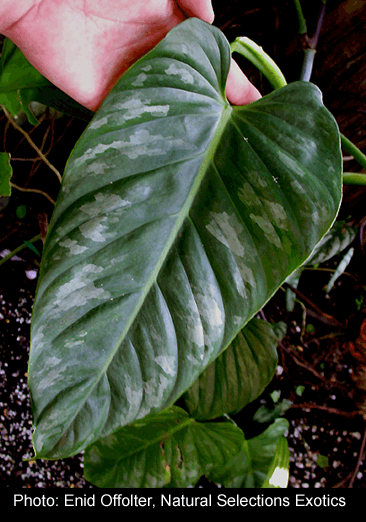
Often sold as
Philodendron variifolium Schott
Philodendron brandtianum is found in Peru, Bolivia, Brazil, Ecuador and portions of Colombia. The species is an appressed climbing vine growing close to the host tree. Philodendron brandtianum is often confused with Philodendron variifolium but the true Philodendron variifolium is found almost exclusively in Peru with one scientific collection recorded in Bolivia. Based on information received from aroid botanist Dr. Thomas B. Croat Ph.D., P.A. Schulze Curator of Botany of the Missouri Botanical Garden in St. Louis (the world's leading aroid scientist), Philodendron brandtianum and Philodendron variifolium are botanically two completely different and dissimilar species despite information found on the internet.
According to the scientific description of the species
Philodendron variifolium possesses elongated leaves that are
thinly
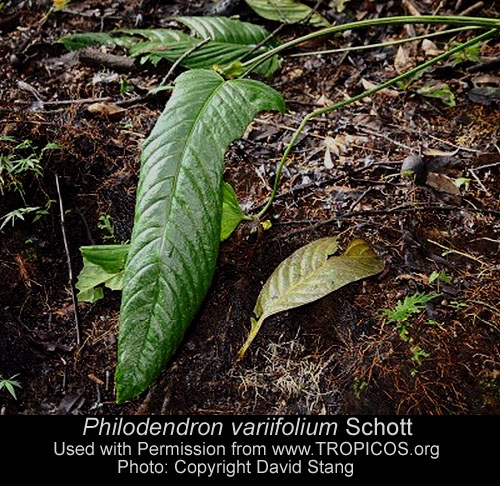 coriaceous. That description indicates the leaves have the
feel of thin leather. The blade of P. variifolium grows in
many diversely varied shapes, thus the name "variifolium", and are
typically slightly heart shaped but display an oblong appearance.
The leaves may commonly be be arrow shaped but still somewhat
oblong. One principal distinction is Philodendron
variifolium has a very wide sinus that is more open than
Philodendron brandtianum. The sinus is the space between the
upper lobes of the leaf blade. The frontal ribs in some leaves may
be very weakly obvious as well as horizontal while curving upwards
in a sigmoid-curve (a tilted S-shaped curve that is variable in
shape). The lateral leaf veins are also all of less than equal size.
Philodendron variifolium often
grows terrestrially instead of climbing while Philodendron
brandtianum is a known climbing species. While
Philodendron brandtianum is common in collections as a result of
tissue culture (cloning) the species Philodendron variifolium
is almost never seen in a private collection outside of those of
major botanical gardens. If you bought the plant on eBay or at
a local garden center the chances of it truly being Philodendron
variifolium are virtually zero!
coriaceous. That description indicates the leaves have the
feel of thin leather. The blade of P. variifolium grows in
many diversely varied shapes, thus the name "variifolium", and are
typically slightly heart shaped but display an oblong appearance.
The leaves may commonly be be arrow shaped but still somewhat
oblong. One principal distinction is Philodendron
variifolium has a very wide sinus that is more open than
Philodendron brandtianum. The sinus is the space between the
upper lobes of the leaf blade. The frontal ribs in some leaves may
be very weakly obvious as well as horizontal while curving upwards
in a sigmoid-curve (a tilted S-shaped curve that is variable in
shape). The lateral leaf veins are also all of less than equal size.
Philodendron variifolium often
grows terrestrially instead of climbing while Philodendron
brandtianum is a known climbing species. While
Philodendron brandtianum is common in collections as a result of
tissue culture (cloning) the species Philodendron variifolium
is almost never seen in a private collection outside of those of
major botanical gardens. If you bought the plant on eBay or at
a local garden center the chances of it truly being Philodendron
variifolium are virtually zero!
You can see photos of Philodendron variifolium at the Missouri Botanical Garden site TROPICOS: http://www.tropicos.org/Name/2103366
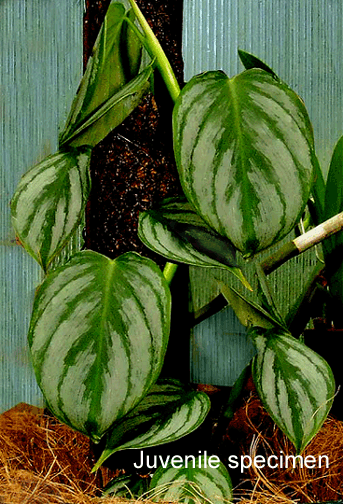 The
specimen in my photograph (left) has been thought by collectors
to be Philodendron variifolium fpr some time and is sold with that name
all over the world. Through an exchange of email with Dr. Croat I
learned in March, 2007 the photos on this page are of Philodendron
brandtianum even though the juvenile form (photo left) is
almost always identified by non-scientists as Philodendron
variifolium on garden websites. As you are about to read, Dr. Croat indicates the
plant botanists know as Philodendron variifolium is truly a
form of Philodendron deltoideum and is a tri-lobed species. Most collectors are not aware
that Philodendron species go through multiple stages of
morphogenesis as they grow to adulthood and often change their
physical appearance as they mature. The photos on this page
illustrate the juvenile and sub adult forms of Philodendron
brandtianum,
not the adult form.
The
specimen in my photograph (left) has been thought by collectors
to be Philodendron variifolium fpr some time and is sold with that name
all over the world. Through an exchange of email with Dr. Croat I
learned in March, 2007 the photos on this page are of Philodendron
brandtianum even though the juvenile form (photo left) is
almost always identified by non-scientists as Philodendron
variifolium on garden websites. As you are about to read, Dr. Croat indicates the
plant botanists know as Philodendron variifolium is truly a
form of Philodendron deltoideum and is a tri-lobed species. Most collectors are not aware
that Philodendron species go through multiple stages of
morphogenesis as they grow to adulthood and often change their
physical appearance as they mature. The photos on this page
illustrate the juvenile and sub adult forms of Philodendron
brandtianum,
not the adult form.
This is a part of my exchange with Dr. Croat: "I think that what most people are calling Philodendron variifolium Schott is really P. brandtianum K. Krause, an appressed-climbing hemiepiphyte which when juvenile has blades that are variously variegated with gray. Somehow Graf got a picture of this in Exotica 3 and labeled it P. variifolium. The type of P. variifolium is a more or less 3-lobed species which was collected at the same sight as P. deflexum and indeed was one of three competing plants all with the same number competing for the name P. deflexum Poeppig. It is actually possible, I believe, that the real P. variifolium is really P. deltoideum. Marcela Mora and I have a paper on this subject in press."
Dr. Croat then
sent this note after reviewing my photo (left). Hopefully this will
help correct the confusion caused as a result of Mr. Graf's error in
his book Exotica 3. Despite the popularity of Mr. A. B. Graf's
books, he was a horticulturist and did not have the
scientific training of a botanist. His texts have been found to
have multiple scientific name errors. Dr. Croat wrote
regarding the juvenile specimen shown on this page, "I
would say this is P. brandtianum. It ranges from Central Brazil to
lowland Ecuador, Peru and Bolivia. The variegation disappears in
the adult plants."
In a subsequent email (sent to Denis Rotolante of Silver Krome
Gardens in Miami, FL), Dr. Croat continued regarding the name
Philodendron variifolium,
"The adult plants are
rather large and have no variegation at all. I suspect that in pots
or even on a totem it would never turns into the adult form in the
same way that Philodendron hederaceum has remained juvenile in
cultivation for centuries owing to the lack of ideal conditions for
becoming adult. It must climb about 10 meters or so, climb out onto
branches, then becomes pendent for 3 or more meters then it
flowers."
Based on Dr. Croat's field notes published on the Missouri Botanical
Garden website TROPICOS, Philodendron brandtianum grows as
an epiphyte (ep-a-FIT), a hemiepiphyte (hem-a-EPA-fit), and a terrestrial form sometimes found
in nature sprawling across the ground. An epiphyte is a plant that
grows upon another plant and finds its way onto a tree branch as a
seed in the droppings of a rain forest bird or animal that has eaten
the fruit produced by the aroid's inflorescence. A hemiepiphyte is
similar but often begins life as a seed which has fallen to the
ground. Philodendron brandtianum grows as a climbing vine
pressed (appressed) tightly against the host tree.
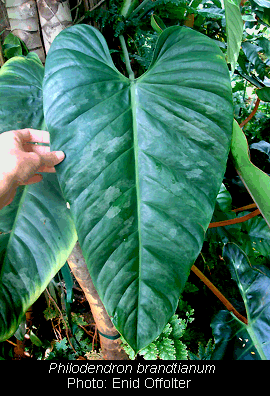
Very different when compared to the juvenile form, the leaf blades of the adult leaf of Philodendron brandtianum are subcoriaceous (less than leathery to the touch) and are a dark green as well as semi-glossy on the upper surface. The blades do not have the variegation of the juvenile. The underside of the leaf blade is semi-glossy but paler in color. The adult blade's underside is the same color throughout (concolorous). Juvenile plants are noticeably variegated with light and darker greens. In the wild, Philodendron brandtianum must climb to a substantial height in to develop the large leaves as well as produce an inflorescence.
The cataphylls which surround any newly emerging leaf blade are sharply single ribbed and a medium green in color. The cataphylls are deciduous and soon fall from the plant. The petioles which support the leaf blades are terete (round) and are a dark green in color.
The photos at the top of this page as well as to the right (below) are from the collection of Enid and Sam Offolter at Natural Selections Exotics in Fort Lauderdale. A similar specimen to the juvenile shown above was judged "Most Unusual Aroid" at the 2005 International Aroid Society Show and Sale at Fairchild Tropical Gardens in Miami, FL. It won that award using the name Philodendron variifolium.
 All
Philodendron species are aroids. An aroid is a plant that
reproduces by producing an inflorescence known to science as a
spathe and spadix. Many believe the spathe is a "flower" but it is
not. The spathe is simply a modified leaf. When an aroid is
referred to as "flowering" the reference is to the very small
flowers found on the spadix. The reference has nothing to do
with the spathe. Within the inflorescence there are extremely
small flowers found on the spadix at the center of the
inflorescence. The inflorescence, which is sometimes shaped like a
tube and often known by collectors as a "flower" is the spathe and
inside that is the spadix. When ready to reproduce, the spadix
produces both male, female and sterile flowers which if pollinated
will produce the berries containing seeds.
All
Philodendron species are aroids. An aroid is a plant that
reproduces by producing an inflorescence known to science as a
spathe and spadix. Many believe the spathe is a "flower" but it is
not. The spathe is simply a modified leaf. When an aroid is
referred to as "flowering" the reference is to the very small
flowers found on the spadix. The reference has nothing to do
with the spathe. Within the inflorescence there are extremely
small flowers found on the spadix at the center of the
inflorescence. The inflorescence, which is sometimes shaped like a
tube and often known by collectors as a "flower" is the spathe and
inside that is the spadix. When ready to reproduce, the spadix
produces both male, female and sterile flowers which if pollinated
will produce the berries containing seeds.
The spathe of Philodendron brandtianum is a medium to dark green and is a dark violet purple on the interior. An adult specimen produces a single spathe per axil. The spathe is semi-glossy and is supported on a short peduncle that is dark green. As pointed out by Dr. Croat the adult plant must climb approximately 10 meters (over 30 feet) and grow out onto the host tree's branches and become pendent (hang) for another 3 or more meters (10 feet) before it will produce an inflorescence. The spathe of Philodendron variifolium (which is not the same species as Philodendron brandtianum) is yellowish in color.
Philodendron brandtianum has proven it can become deciduous (drop its leaves) and does not enjoy excess water during the winter months even though it does enjoy damp and humid conditions during the hot growing season. As a result, we cut the water back from November through March.
Philodendron species are known to be highly variable and not every leaf of every specimen will always appear the same. This link explains natural variation and morphogenesis within aroid and other species. Click here
Want to learn more
about aroids?
Join the
International Aroid Society:
http://www.exoticrainforest.com/Join%20IAS.html
Specimens may be available from

Brian's Botanicals
http://www.briansbotanicals.net/

If you are seeking information on other rare
species, click on "Aroids and other genera in the Collection" at the top and look for
the
