
Aroids and other genera in the Collection
Take the Tour Now?
Orchids
The
Exotic Rainforest
Plants in
the Exotic Rainforest Collection
The images on this website are copyright protected. Please contact us before any reuse.
In depth information on how to grow Philodendron species, Click this Link
Within our collection we have many species of Philodendron. If you are seeking other photos, click this link:
Philodendron barrosoanum
G.S. Bunting

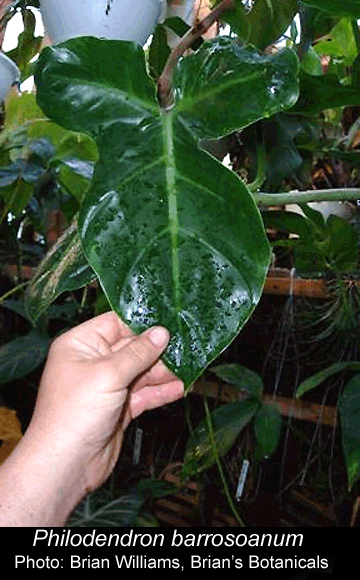
Philodendron barrosoanum
G.S. Bunting
Synonyms: Philodendron levelii, Philodendron milleri
Common name:
Cow Faced Philodendron
Philodendron barrosoanum was described to science in 1964. The Philodendron is found in Ecuador, Columbia, Venezuela, portions of the Guiana Shield, Peru and Brazil.
Philodendron
barrosoanum is a
hemiepiphytic climber which scientifically means it may either begin life
 as an
epiphyte (ep-a-FIT)
from a seed deposited on the branch of a tree by a bird or
rainforest animal in their droppings and grow its roots down to the ground.
A hemiepiphyte (hem-a-EPA-fit) may also begin life in the soil and grow up the side of a tree.
Philodendron barrosoanum is found at an elevation of
100 to 1000
meters (330 to 3300 feet) and is known for its large
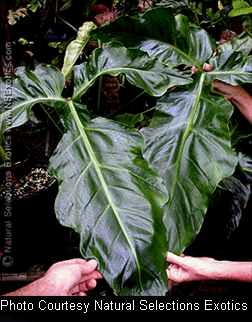
tri-lobed leaf blades and terete (roundl) petioles. The petiole
is the portion of the plant that supports the leaf blade and is
often referred to as a stem. The true stem is the base of the
plant.
as an
epiphyte (ep-a-FIT)
from a seed deposited on the branch of a tree by a bird or
rainforest animal in their droppings and grow its roots down to the ground.
A hemiepiphyte (hem-a-EPA-fit) may also begin life in the soil and grow up the side of a tree.
Philodendron barrosoanum is found at an elevation of
100 to 1000
meters (330 to 3300 feet) and is known for its large
tri-lobed leaf blades and terete (roundl) petioles. The petiole
is the portion of the plant that supports the leaf blade and is
often referred to as a stem. The true stem is the base of the
plant.
The
leaf blades of Philodendron barrosoanum are sub-coriaceous
(less than leather) and semi-glossy. Philodendron
barrosoanum is extremely variable
in appearance (see all photos for a comparison) and the leaf blade may take on a variety of forms.
Philodendron species
often take on more than one blade shape as a result of
morphogenesis and natural variation. One variation is capable of becoming
substantially larger with an
 elongated lower lobe.
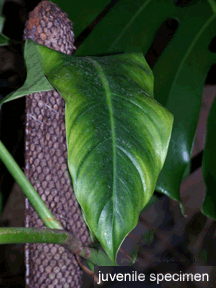
The tri-lobed leaf of P. barrosoanum
is reported to have a
spread up to approximately 46cm (18 inches), however juvenile specimens do not
have the large lobes until they mature (see photo left).
elongated lower lobe.
The tri-lobed leaf of P. barrosoanum
is reported to have a
spread up to approximately 46cm (18 inches), however juvenile specimens do not
have the large lobes until they mature (see photo left).
All Philodendron species are aroids. An aroid is a plant that reproduces by producing an inflorescence known to science as a spathe and spadix. Most people believe the spathe is a "flower", it is not. The spathe is simply a specially modified leaf whose purpose is to protect the spadix at the center. On the spadix there can be found very tiny flowers when the plant is at anthesis. When ready to reproduce, the spadix produces male, female and sterile flowers which if pollinated by an appropriate insect, normally a beetle, will produce berries containing seeds
The inflorescence of Philodendron barrosoanum is solitary (one per axil) and the spathe is both green and moderately glossy. The interior of the spathe is a pale green but is dark violet purple in the lower half. At female anthesis the spadix is yellow green. For an explanation of anthesis and pollination, click this link.
Philodendron species are known to be variable and not every leaf of every specimen will always appear the same. This link explains natural variation and morphogenesis within aroids and other species. Click here.
My thanks to Brian Williams of Brian's Botanicals and Enid Offolter of Natural Selections Exotics for the use of their photographs.
Want to learn more
about aroids?
Join the
International Aroid Society:
http://www.exoticrainforest.com/Join%20IAS.html
Seeking a
specimen?
Brian's Botanicals at
www.briansbotanicals.net/


If you are seeking information
on other rare species, click on "Aroids and other genera in the Collection" at the
top and look for the
