
Aroids and other genera in the Collection
Take the Tour Now?
Orchids
The
Exotic Rainforest
Plants in
the Exotic Rainforest Collection
Images on this website are copyright protected. Contact
us before attempting to reuse.
In depth information on how to grow Philodendron species, Click Here
Within our collection we have many species of Philodendron. If you are seeking other photos, click this link
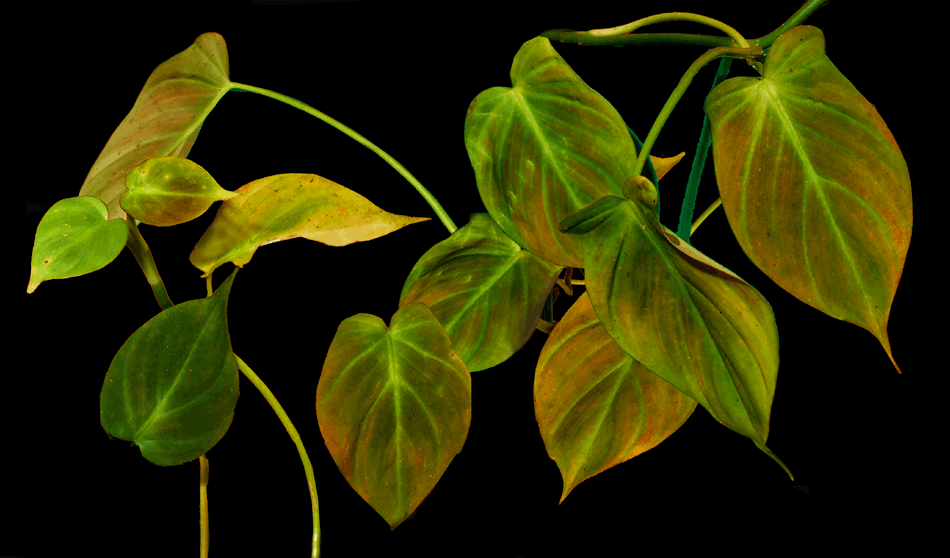
A member of Philodendron
subgenus Pteromischum, Philodendron camposportoanum was originally published in
Archivos do Jardim Botânico do Rio de Janeiro in 1956.
With a slight velutinous (velvet) appearance to the leaves,
Philodendron camposportoanum is primarily found in western
Brazil. The unusual tri-lobed Philodendron species
has also been observed by botanists and collectors in Bolivia,
Colombia and in the southern portion of Venezuela as well as the extreme south
of Guiana bing the country of Brazil.
 Little published
data is available on the species, however in Bolivia collections
were made at elevations as low as 150 to 190 meters above sea level
(490
Little published
data is available on the species, however in Bolivia collections
were made at elevations as low as 150 to 190 meters above sea level
(490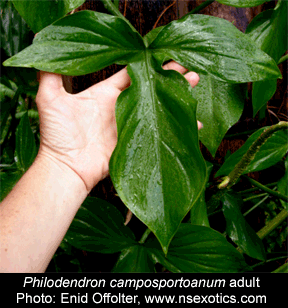 to 625 feet). Aroid botanist Dr. Tom Croat of the
Missouri Botanical Garden in St. Louis
who provided the scientific
information used to write this page indicated P.
camposportoanum (cam-POS-por-toe-AH-num) is one of the smaller
species in the genus. Dr. Croat explained,
"basically
the leaves never get very large, perhaps 20 cm long and equally wide
since they are deeply 3-lobed." A 20cm leaf would be
approximately 7.85 inches in length. One note on the New York
Botanical Garden website indicates the specimen can attain leaves
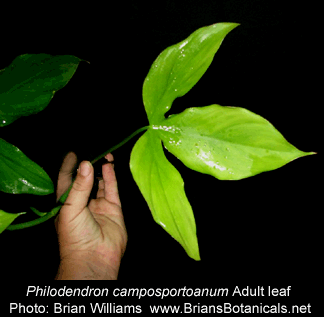
approaching 30cm (1 foot). The leaves of the
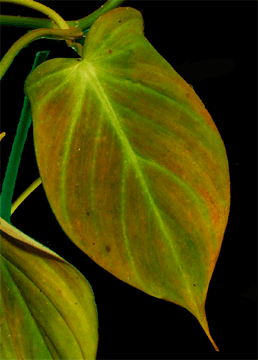
specimen shown in our photo are still juvenile and have not fully
developed the wide upper lobes (see photo, right).
to 625 feet). Aroid botanist Dr. Tom Croat of the
Missouri Botanical Garden in St. Louis
who provided the scientific
information used to write this page indicated P.
camposportoanum (cam-POS-por-toe-AH-num) is one of the smaller
species in the genus. Dr. Croat explained,
"basically
the leaves never get very large, perhaps 20 cm long and equally wide
since they are deeply 3-lobed." A 20cm leaf would be
approximately 7.85 inches in length. One note on the New York
Botanical Garden website indicates the specimen can attain leaves
approaching 30cm (1 foot). The leaves of the
specimen shown in our photo are still juvenile and have not fully
developed the wide upper lobes (see photo, right).
Considered primarily a terrestrial vine that
runs across the ground, Philodendron camposportoanum is
also capable of climbing. The
 vine's internodes measure 4 to 6mm in
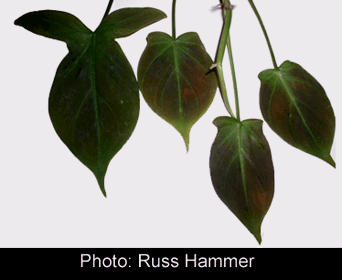
diameter while the leaves are often a dark green and may be bicolorous mixed with a reddish brown. The leaf blades of Philodendron camposportoanum
are considered to be subcoriaceous which
indicates they are quite thin to the touch. Botanically the
leaves are weakly glossy and the primary lateral veins are only
slightly sunken. The petioles which support the
leaves are terete (cylindrical) in shape.
vine's internodes measure 4 to 6mm in
diameter while the leaves are often a dark green and may be bicolorous mixed with a reddish brown. The leaf blades of Philodendron camposportoanum
are considered to be subcoriaceous which
indicates they are quite thin to the touch. Botanically the
leaves are weakly glossy and the primary lateral veins are only
slightly sunken. The petioles which support the
leaves are terete (cylindrical) in shape.
Published information on the
species is quite sparse, however aroid, palm and cycad expert
Leland Miyano from Hawaii responded to my request by
saying,
"I
did find out that it is from Acre, Brazil and Santa Cruz, Bolivia. I
saw some photos of it and it is in the subgenus Pteromischum.
 I am
familiar with the work of the author, Barroso...but many of the
publications are from Brazil and very difficult to get copies...or
are expensive."
I am
familiar with the work of the author, Barroso...but many of the
publications are from Brazil and very difficult to get copies...or
are expensive."
Philodendron species, and especially hybrid forms, are known to be highly variable and not every leaf of every specimen will always appear the same. This link explains in greater detail the scientific principle of natural variation and morphogenesis. Click here.
Philodendron camposportoanum was described by noted female botanist Graziela Maciel Barroso (1912-2003). Barroso worked primarily on species of Araceae found in Brazil and her scientific description of this species was done as her first publication. According to information published on the International Aroid Society website, her first published species "was followed by a series of papers describing other new species (Barroso, 1957, 1959, 1965, 1970). All but one, Anthurium wendlingeri G. M. Barroso from Costa Rica, represented Brazilian species. Barroso published 15 species in all."
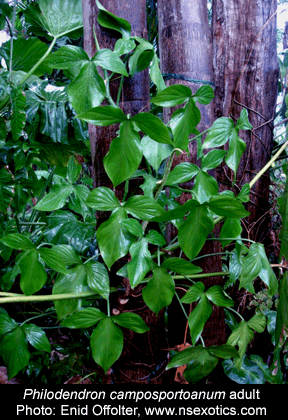
The leaves of our specimen (shown at the top and top right are still immature and the largest presently measures 14cm (5.5 inches). Third photo to the right shows the size and shape of an adult specimen commonly seen in nature. The photo by Russ Hammer shows the range of shapes the blade acquires as it grows and the final two specimens by Brian Williams of Brian's Botanicals in Kentucky www.BriansBotanicals.net and by Enid Offolter of Natural Selections Exotics ( ) in Fort Lauderdale, FL illustrate specimens that are fully mature as well as have been trained to climb. As can be seen, the upper lobes on the adult specimens are substantially larger and better developed.
 We have the plant in very loose soil which
is kept evenly moist. The specimen is grown in filtered yet
bring light
and allowed to climb a totem.
We have the plant in very loose soil which
is kept evenly moist. The specimen is grown in filtered yet
bring light
and allowed to climb a totem.
Specimens may be available
from
Brian's Botanicals
http://www.briansbotanicals.net/


If
you are seeking information on other rare species, click on "Aroids and other genera in the Collection" at the top and look for the

Want to learn more
about aroids?
Join the
International Aroid Society:
http://www.exoticrainforest.com/Join%20IAS.html