
Aroids and other genera in the Collection
Take the Tour Now?
Orchids
The
Exotic Rainforest
Plants in
the Exotic Rainforest Collection
Images on this website are copyright protected. Contact
us before attempting to reuse.
Within our collection we have many species of Philodendron. If you are seeking other photos, click this link
In depth information on how to grow Philodendron species, Click this Link
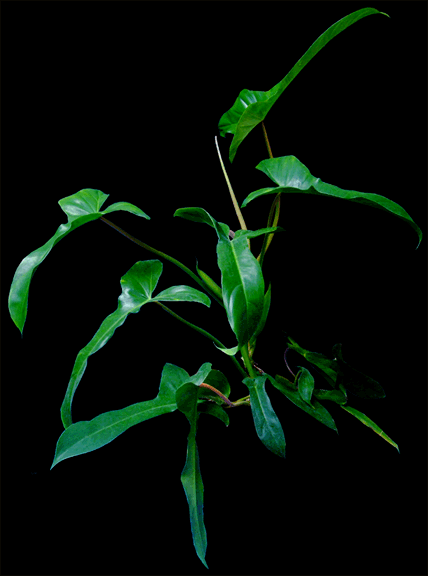
Philodendron 69686
Likely
a natural Philodendron hybrid from Brazil

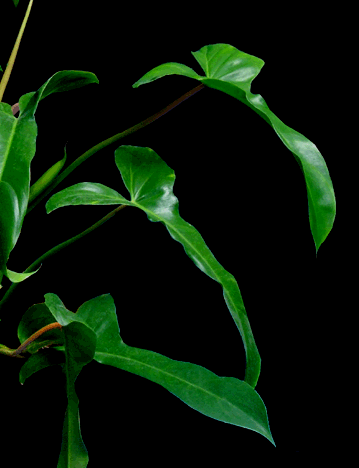
Philodendron
69686
Sometimes
sold
Philodendron 69686a
Some believe incorrectly this plant is the natural hybrid from Fench
Guiana known as
Philodendron Joepii.
Click Here for information regarding
Philodendron Joepii and
Philodendron moonenii
and
 When
I first acquired this natural Philodendron hybrid n early 2006
I had been caused to believe P69686 was the same plant as another
natural hybrid from French Guiana known as Philodendron Joepii. That
incorrect information was due to the fact I had been assured by
collectors that Dutch naturalist and conservationist Joep Moonen (pronounced yupe) had discovered
P69686 in the jungles of French Guiana near the northern b between
French Guiana and Brazil. He did not.
When
I first acquired this natural Philodendron hybrid n early 2006
I had been caused to believe P69686 was the same plant as another
natural hybrid from French Guiana known as Philodendron Joepii. That
incorrect information was due to the fact I had been assured by
collectors that Dutch naturalist and conservationist Joep Moonen (pronounced yupe) had discovered
P69686 in the jungles of French Guiana near the northern b between
French Guiana and Brazil. He did not.
Joep, along with his wife Marijke and son Bernie have been living in French Guiana for many years and he guides botanists, entomologists and zoologists into the rain forest to search for unknown plant, insect and animal species. Botanists know Joep as their "eyes and ears" in the rain forest. I had also been incorrectly told Philodendron P69686 was being scientifically named in Joep's honor as "Philodendron joepii". But when I'd go to TROPICOS (a service of the Missouri Botanical Garden) http://www.tropicos.org/ or the International Plant Names Index (a service of the Royal Botanic Gardens Kew) http://www.ipni.org/index.html to verify that information no such plant know to science as "Philodendron joepii" or Philodendron P69686 ever showed up! These services are the primary locations scientifically published plant names can be verified.
Joep and I have become very good friends since 2006 and my first contact with him was regarding the plant shown on this page which is correctly known as Philodendron P69686. As you will soon read, this specimen is very likely not a species, but instead a natural hybrid from Brazil and takes on more than one form. Joep and I now exchange several email messages almost every single day and he provides many photos as well as scientifically accurate information for many of the aroid species found on this website.
As
Joep confirmed in September 2006 in a series of personal emails, Philodendron Joepii
is a totally different
plant form than the one shown here. In addition, Philodendron
Joepii is almost certainly also a natural hybrid and as a result will
likely not be published to science with that name but attempts are
underway in 2008 to register the name as a registered cultivar. I later learned the confusion
over the names Philodendron P69686 and Philodendron Joepii arose in 2005 at the
 International Aroid Society
Show and Sale in
Miami, FL when Joep was asked if the two specimens were the same.
Either Joep misunderstood the question Joep speaks several languages
fluently) or the person who asked
misunderstood his answer along with his Dutch/French accent. The
to specimens are not the same.
International Aroid Society
Show and Sale in
Miami, FL when Joep was asked if the two specimens were the same.
Either Joep misunderstood the question Joep speaks several languages
fluently) or the person who asked
misunderstood his answer along with his Dutch/French accent. The
to specimens are not the same.
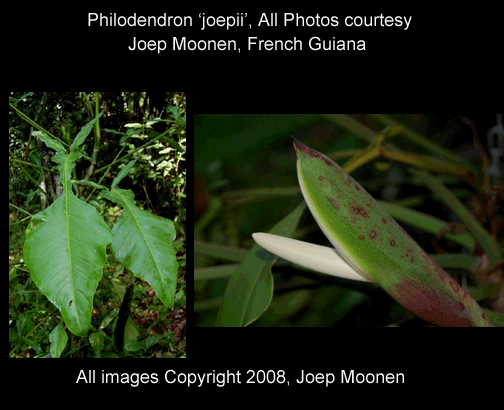
The plant nicknamed Philodendron Joepii by a botanist friend of Joep in his honor is a tri-lobed species with two smaller lobes at the top aiming upwards and outwards at roughly a 45 degree angle. Although similar to P69686 the upper lobes of the hybrid are much narrow and the lower portion of the main lobe is substantially wider. Joep then provided his own original transparencies of the plant known as Philodendron Joepii and I have since posted a page explaining that plant as well as Philodendron moonenii. Click this link to read that page. You can see one of Joep's photos of Philodendron Joepii along with a photo of the inflorescence to the left.
While attempting to unravel the misconceptions regarding both natural Philodendron hybrids I began asking questions regarding both specimens with aroid botanist Dr. Thomas B. Croat Ph.D., P.A. Schulze Curator of Botany of the Missouri Botanical Garden in St. Louis that explained the plant known as Philodendron P69686 originally came to his attention via Bette Waterbury (now deceased) and came from the plant collection of famous Brazilian artist and plant collection Roberto Burle-Marx (1909-1994).
Dr. Croat then explained the source of the number 69686. Each time Dr. Croat begins a scientific study of any specimen he assigns that plant an accession number. P69686 is the accession number given the specimen for research purposes by Dr. Croat. it is his belief P69686 likely originated in the rain forests of Brazil since many of Roberto Burle-Marx's plants came from the forests of Brazil. Dr. Croat explained in another personal message P69686 does not have a "known origin and I am not even sure that it is not a hybrid". Since the plant has no collection history (no known location where it may have been originally collected) and nothing can be found to verify where it was first found it may or may not be a species. A photo of a large group of Philodendron P69686 specimens taken at the collection of Roberto Burle Marx (now owned and protected by the Brazilian government) shows a near identical leaf form to the photos of P69686 found on this page, However, since Philodendron P69686 is known to be variable and takes on multiple leaf forms, little can be scientifically confirmed. For an explanation of natural variation within aroid and other species please read this link: Click here.
We have observed leaves on our own specimen having leaf blades approximately 60cm (2 feet) long. The leaf blades change shapes as they mature as can be seen by comparing the different leaf forms on our specimen. A collector in Florida, whose specimen was purported to be fully mature had a plant with rounded lobe ends. Another knowledgeable collector believes the rounded lobes are common only to immature plants.
Roberto Burle-Marx was one of the best
known landscape and garden designers of the 20th century. His personal
collection was the envy of many collectors and his gardens were and are both fabulous and famous.
Roberto had many hybrid plants in his collection which he used to beautify his
garden. As a result some collectors have come to
the conclusion he had little concern for the correct botanical name for
his plants. My very good friend Leland Miyano from
 Hawaii knew Roberto personally, and for
some time lived on Roberto's property. in 2006 Leland provided pertinent
information in a personal letter. I feel it is important to
include one of Leland's quotes to address this perception,
"I wish to clarify
something about Roberto. He was very much concerned about taxonomy and
the correct identification of his collections. That is specifically why
he loved it when the brightest and the best botanists visited. He
always said he was not a botanist...but that is why he depended on their
knowledge. Simon Mayo was studying the Meconostigma of Brazil while I
was there and we used to walk through the collection with him...picking
his brain. There were so many botanists through the years...specialists
in so many families. He (Roberto) has many hybrids and plants that look
good in landscape because he was a lover of all plants. He would
have grown it all if he could. The genius of Roberto is that he was so
much more than just plants...art, music,and literature...he could
discuss or perform with equal flair...in several languages!"
Hawaii knew Roberto personally, and for
some time lived on Roberto's property. in 2006 Leland provided pertinent
information in a personal letter. I feel it is important to
include one of Leland's quotes to address this perception,
"I wish to clarify
something about Roberto. He was very much concerned about taxonomy and
the correct identification of his collections. That is specifically why
he loved it when the brightest and the best botanists visited. He
always said he was not a botanist...but that is why he depended on their
knowledge. Simon Mayo was studying the Meconostigma of Brazil while I
was there and we used to walk through the collection with him...picking
his brain. There were so many botanists through the years...specialists
in so many families. He (Roberto) has many hybrids and plants that look
good in landscape because he was a lover of all plants. He would
have grown it all if he could. The genius of Roberto is that he was so
much more than just plants...art, music,and literature...he could
discuss or perform with equal flair...in several languages!"
Our specimen is mature enough to produce an inflorescence. Two spathes can be seen forming in the second photo above on either side of the center leaf. While visiting in Dr. Croat's office in October 2006 I told him about my 69686 spathes and how they had not opened. He reached to the corner of his desk and picked up a bag with several spathes identical to mine. They too were unopened. Dr. Croat then peeled one open and explained these were mature and had fallen from the Philodendron P69686. He further explained the Philodendron requires a particular scarab beetle (species Cyclocephala) to pollinate the plant. The spathe opens, but only briefly. If you are not present at the exact moment it opens you will miss the event entirely. The beetle and its mate enter the spathe and do their courtship dance while feasting on the pollen growing from the male flowers on the spadix. The beetles then pick up pollen on their bodies as a result of a reddish resin also found on the spadix and carry the pollen to another plant thus insuring further plant pollination. I just didn't see either open. For more information how beetles pollinate Philodendron and other aroids please read these two pages: Natural pollination and Philodendron 'Marijke'.
Philodendron 69686 is now confirmed as the correct accession number but this plant is often sold as P69686a. P69686a is also one of Dr. Croat's accession numbers but is a slightly different variation of the same plant.
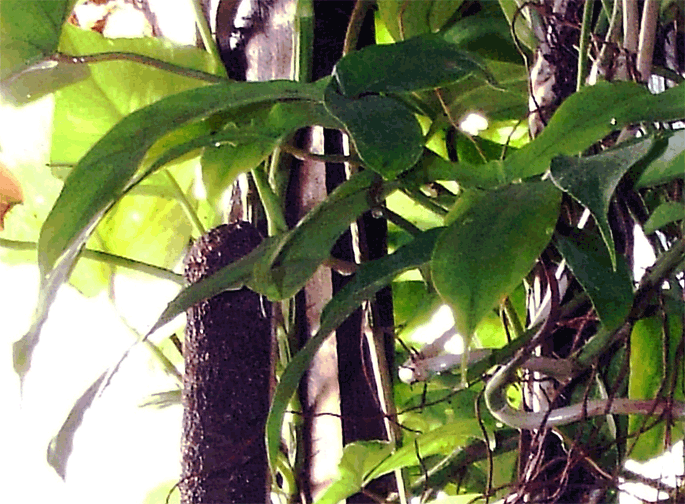
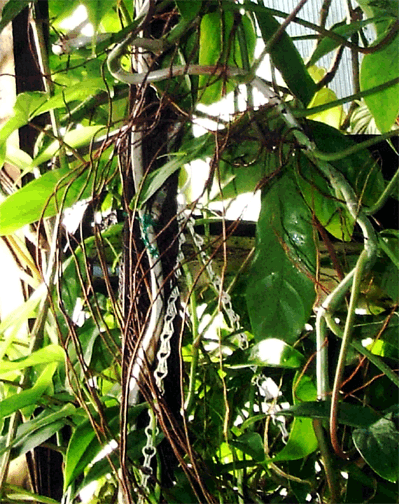
Our specimen has developed a reasonably thick
stem (cane) with air roots and has become a climbing epiphytic vine (see
above, right). It
now stands over 4 feet (120cm) tall and regularly adds new
leaves. Philodendron 69686 has proven to prefer very
high humidity, semi-bright light and otherwise typical rain forest
conditions. We have Philodendron P69686
 planted in a well draining
mixture of good potting soil, orchid potting media, Perlite™, peat
moss, cypress mulch, finely shredded sphagnum moss and hard wood orchid
charcoal. The
plant is watered daily in the summer and at least 2 days a week in the
winter. The soil is a very porous mixture that is never allowed to completely dry.
planted in a well draining
mixture of good potting soil, orchid potting media, Perlite™, peat
moss, cypress mulch, finely shredded sphagnum moss and hard wood orchid
charcoal. The
plant is watered daily in the summer and at least 2 days a week in the
winter. The soil is a very porous mixture that is never allowed to completely dry.
For information on Joep's eco-tours
to the rain forests of South America contact Joep Moonen at
EmeraldJungleVillage@wanadoo.fr
Specimens may be available
from
Brian's Botanicals
http://www.briansbotanicals.net/


If you are seeking information on other
rare species, click on "Aroids and other genera in the Collection" at the top and look
for the

Ready to learn more about Philodendron Joepii and Philodendron moonenii? Follow this link.
Want to learn more
about aroids?
Join the
International Aroid Society:
http://www.exoticrainforest.com/Join%20IAS.html