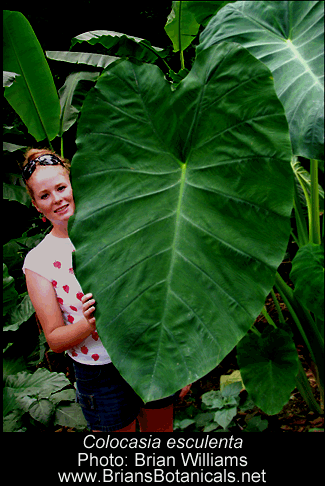
Before you stop at the
first photo and say this isn't the plant you are seeking, scroll down!
Colocasia
esculenta has many faces. some quite
large!
Colocasia species
are known to be highly variable and not every leaf of every specimen
will always appear the same.
This link explains in greater
detail the scientific principle of natural variation and
morphogenesis. Click
here.
Colocasia esculenta
(L.) Schott
Colocasia esculenta
(L.) Schott
Synonyms:
Alocasia dussii, Alocasia illustris,
Arum chinense, Arum colocasia, Arum colocasioides, Arum esculentum,
Arum nymphaeifolium, Arum peltatum, Caladium acre, Caladium
colocasia, Caladium
esculentum,
Caladium nymphaeaefolium, Caladium violaceum hort., Calla
gaby, Colocasia acris, Colocasia antiquorum,
Colocasia antiquorum
var. acris, Colocasia antiquorum var. aquatilis,
Colocasia antiquorum var. esculenta,
Colocasia antiquorum
var. euchlora, Colocasia antiquorum var. fontanesii,
Colocasia antiquorum var. globulifera,
Colocasia antiquorum
var. illustris, Colocasia antiquorum var. nymphaeifolia,
Colocasia antiquorum var. typica,
Colocasia esculenta
var. acris, Colocasia esculenta var. antiquorum,
Colocasia esculenta var. aquatilis,
Colocasia esculenta var. euchlora, Colocasia esculenta
var. fontanesii, Colocasia esculenta var. globulifera,
Colocasia esculenta
var. illustris, Colocasia esculenta var. typica,
Colocasia euchlora, Colocasia fontanesii,
Colocasia himalensis, Colocasia nymphaeifolia, Colocasia peregrina,
Colocasia vulgaris
A new paper is now in the process of being published that
will establish that
Colocasia antiquorum is a unique
species.
Common
names:
Giant Elephant Ear, Elephant Ear,
Elepaio, Black Magic, Taro, Wild Taro, Dasheen, Dachine, Black Taro, Dalo,
Eddo, Eddoe, Edda, Eddy Root, Green Taro,
Coco Yam, Kalo,
Callaloo,
Poi, Katchu,
Potato of the Tropics, in Australia
Djamandarr and
in Ecuador Papachina
Often incorrectly spelled Colocasia esculentum
An aroid with many faces!
The chances are high you've at
least admired this plant. Although I very much dislike the
common name "Elephant Ear", Colocasia esculenta is sold and
grown in many parts of North America using that overly used nomer.
But it is known around the globe by a variety of names including
Black Magic, Taro, Wild
Taro, Black Taro, Dalo, Dasheen, Calaloo, Eddy and Potato of the
Tropics. Why Potato of the Tropics? Because it is one of
the most popular food sources in many tropical cultures!
But few people realize
Colocasia
(colo-CAH-see-ah) esculenta is not a single plant. It is a
single species, but a plant with many "faces"!
Colocasia esculenta is a common aroid grown all over the world
both as an ornamental plant and as a food source. Highly
variable, the species can produce many leaf forms and sizes.
The species is so variable it has acquired a long list of scientific
names (see partial list of synonyms above). But there is only
one basionym, a single base species name: Colocasia esculenta.
As both an agricultural and an ornamental species, there are well
over 200 known cultivars of
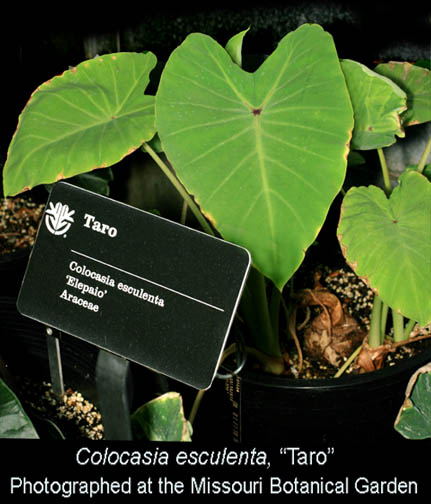 Colocasia esculenta. Many are
preferred for their edible tubers (often incorrectly called a corm
or bulb) and leaves while others are
grown strictly for
their foliage. For those that have learned to use the term
"corm", aroid botanist Dr. Tom Croat insists no aroid with an
underground stem grows from anything other than a tuber. The
species has so many variations that many different forms are
currently being grown in Hawaii alone. Colocasia esculenta. Many are
preferred for their edible tubers (often incorrectly called a corm
or bulb) and leaves while others are
grown strictly for
their foliage. For those that have learned to use the term
"corm", aroid botanist Dr. Tom Croat insists no aroid with an
underground stem grows from anything other than a tuber. The
species has so many variations that many different forms are
currently being grown in Hawaii alone.
Hawaiian aroid,
palm and cycad expert Leland Miyano who serves on the board of a
variety of public gardens and is a famed landscape designer explains about
the large number of variations found in the Hawaiian islands,
"There
are about 300 Hawaiian varietal names recorded. Of these, perhaps
150-175 types were recognized as distinct by the ancient Hawaiians,
in 25 groups. Today, only 8 groups are known to survive. Perhaps 70
or so native forms persist, but, no one has large collections of
these. Amy Greenwell Garden has a good collection, but, the high
maintenance of these plants require that only a fraction can be
grown out. There are other types that are not considered to be of
Hawaiian origin as well. I am planting dryland varieties in the
Bishop Museum Garden...but, only as a small demonstration of the significance
of the species in his islands,"
The numbers used by Leland do not
include the variations found in Southeast Asia, the Caribbean, as
well as Central and South America.
In Hawaii the plant is commonly
known as Kalo. Leland continues,
"Kalo, in Hawaii, is considered a sacred plant. In fact, the
Hawaiian people believe it is their ancestral older brother. The
term for the keiki (propagules), literally children, is oha.
Ohana means, "family". There are many such references to kalo in
Hawaiian culture. In fact, there is so much written about kalo in
Hawaii, that it is impossible to summarize in a short article. I can
highly recommend a few books for those that want to learn more.
TARO VARIETIES IN HAWAII, Bulletin no. 84. L.D. Whitney,
F.A.I. Bowers, M. Takahashi. CTAHR, University of Hawaii at Manoa,
December 1939, Reprinted June 1997; TARO, MAUKA TO MAKAI. CTAHR,
University of Hawaii at Manoa, 1997."
This link better
explains natural variation which is a known scientific subject:
Natural variation
Despite all that has been written
about the plant, as a result of all the known variations and the
plant's ability to morph it is not well understood and is often the
source of confusion among botanists, collectors, gardeners and
growers.
Jason
 Hernandez offers an explanation,
"the problem is not just in the
nursery trade! I have seen photos of Alocasia and Xanthosoma
being used interchangeably even in what are supposed to be
identification guides. In fact, I had to make note of
this
fact in both my Aroideana articles. In one of my sources, a
photo of Xanthosoma was used to illustrate a species account of
Schismatoglottis!" Hernandez offers an explanation,
"the problem is not just in the
nursery trade! I have seen photos of Alocasia and Xanthosoma
being used interchangeably even in what are supposed to be
identification guides. In fact, I had to make note of
this
fact in both my Aroideana articles. In one of my sources, a
photo of Xanthosoma was used to illustrate a species account of
Schismatoglottis!"
Originating in the swampy
regions of southeastern Asia, Colocasia esculenta has been
cultivated as a food crop for thousands of years. On
page 247 of Deni Bown's excellent book, Aroids Plants of the Arum
Family, you'll find this passage,
"The oldest cultivated crop in the
world is an aroid: taro (Colocasia esculenta). It has been
grown in parts of
tropical
and subtropical Asia for more than 10,000 years (Cable 1984). The
ancient irrigation systems of terrace paddies seen today may
well have been constructed originally for taro long before rice came
on the scene, and rice may have first come to notice as a weed in
the the flooded taro patches (Plucknett 1976)."
Some sources indicate the species has
long been grown in India as a food source as well.
If you look up
the species on Floridata (a service of the State of Florida),
you'll find this quote,
"Colocasia esculenta, wild taro, is an invasive exotic in much of
peninsular Florida. It is listed by the Florida Exotic Pest Plant
Council as a Category I Species, known to be disrupting native plant
communities and displacing native plant species. Taro forms dense
stands along lakes and rivers where it completely eliminates native
plant species. Taro should not be cultivated outdoors in the
vicinity of wetlands where it could escape and establish a self
sustaining population that would eliminate native species."
The species is considered an invasive species in
the State of Florida.
So why do I dislike the common
name "Elephant Ear"? Simply because people use it for
almost any plant that has a large leaf. It no longer matters
if the leaf is stiff and leathery (coriacious) or floppy. If
it is big, people call the plant an "Elephant Ear"! If you
visit any garden discussion website you'll find people asking
questions about "Elephant Ear" plants without regard to the species.
And those plants may be one of several thousand species!
Members of the genera Alocasia,
 Colocasia, Anthurium,
Philodendron, Caladium, Monstera, and Xanthosoma
have all been called "Elephant Ears". If you study
plants you'll soon learn those seven genera contain over 3000
species! So if someone asks for advice how to grow an
"Elephant Ear", which one of those thousands of plant species are
they asking about? Some species love sun. Some love
shade. Some love water. Some will die in water.
Some will grow dry. Some are epiphytes and grow up in the
trees! It would take a very good mind reader to instantly be
able to give accurate advice without seeing the plant. And
most of the time, when people ask about an "Elephant Ear", they do
not post a photograph! As you'll learn, even seeing the actual
specimen is no guarantee you'll quickly be able to discern the
species! But there are those who love to defend the use of the
name for any plant with a large leaf. Colocasia, Anthurium,
Philodendron, Caladium, Monstera, and Xanthosoma
have all been called "Elephant Ears". If you study
plants you'll soon learn those seven genera contain over 3000
species! So if someone asks for advice how to grow an
"Elephant Ear", which one of those thousands of plant species are
they asking about? Some species love sun. Some love
shade. Some love water. Some will die in water.
Some will grow dry. Some are epiphytes and grow up in the
trees! It would take a very good mind reader to instantly be
able to give accurate advice without seeing the plant. And
most of the time, when people ask about an "Elephant Ear", they do
not post a photograph! As you'll learn, even seeing the actual
specimen is no guarantee you'll quickly be able to discern the
species! But there are those who love to defend the use of the
name for any plant with a large leaf.
Although
vaguely descriptive, as a common name, "Elephant Ear" is a near
useless term. Grower Brian Williams tells a good story about
the very vague common name,
"Usually most uneducated people on aroids will call anything with
this type of leaf an Elephant ear. I don't like it so I try to
educate them about the plants. One guy came into the
nursery and we were surrounded by Colocasia and Alocasia on the path
and he asked me if I grew any Elephant ears. My answer was a
absolutely not! I then told him of the different forms
and how they all seem to be called Elephant ears."
Standing in the center of a large group of
specimens that are often called "Elephant Ear" plants, the gentleman
had no idea what he was asking about!
Colocasia esculenta is
an aroid and a stately Alocasia relative that is extremely
variable. But it is not an Alocasia even though
botanists have tried to place it in that genus! Variability is
a term that is well known among aroid botanists and serious plant
growers. In the simplest terms, a variable species is one that
may present many shapes or "faces". Impossible you say?
Well, the scientific fact is variability is both well known and
common. Variability is best known within the larger plant
family known as Araceae which contains all aroid species.
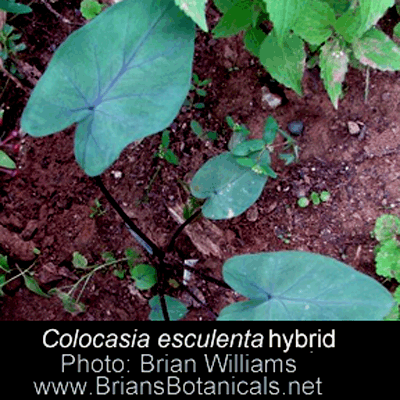
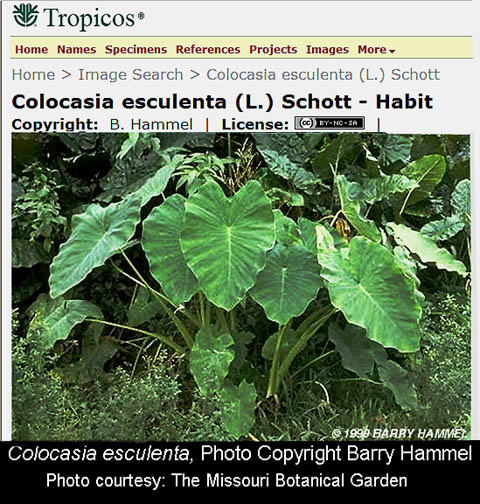
Colocasia esculenta can present leaves that are very large or
relatively small. The leaf color can be green, deep black,
slightly purple or even blue/black. The blade shape can be
sagittate (arrow shaped) or more ovate. And as you can see
from the long list above, Colocasia esculenta has managed
to fool a large number of botanical scientists! Variation
within the species has been misunderstood for many years.
This species has at least 68
synonym scientific names. A synonym is a scientific name which
has been used to describe another species already known to science,
i.e.: same species, other name. However, in science, the first name
given to the species that is found accurate to the correct genus
becomes the basionym. And in this case, that basionym is
Colocasia esculenta. Although many botanists have thought
(incorrectly) this species was a Caladium, scientifically it is a
member of the genus Colocasia. You can find
several websites that incorrectly claim all large "Elephant Ear"
plants are Caladium or Alocasia species. If you
examine the long list of synonyms at the top of this
page,
you'll find this plant has in the past been considered by scientists
(in error) to be a Caladium,
an Alocasia and an
Arum.
 Aroid expert Julius Boos offers an explanation about Caladium
species as an Elephant Ear plant,
"The two largest
plants I know of are Caladium bicolor var. The Thing which has a
spotted leaf with red and white on green. It might have a
blade 24" long by 18" wide. The other is what is presently being
called in error C. bicolor 'rubicundum which is about as large but
with a wider more rounded leaf and translucent purple/lilac spots on
a purplish-green leaf. It is being worked on by Josef Bogner
and Willbert Hetterschied at the moment. None are plain green,
and I have never heard them referred to as Elephant ears. None
which I have seen sold as Elephant ears have been Caladium.
They are either Colocasia or Xanthosoma."
A leaf blade 24 inches by 18
inches would measure approximately 60 x 45cm. Aroid expert Julius Boos offers an explanation about Caladium
species as an Elephant Ear plant,
"The two largest
plants I know of are Caladium bicolor var. The Thing which has a
spotted leaf with red and white on green. It might have a
blade 24" long by 18" wide. The other is what is presently being
called in error C. bicolor 'rubicundum which is about as large but
with a wider more rounded leaf and translucent purple/lilac spots on
a purplish-green leaf. It is being worked on by Josef Bogner
and Willbert Hetterschied at the moment. None are plain green,
and I have never heard them referred to as Elephant ears. None
which I have seen sold as Elephant ears have been Caladium.
They are either Colocasia or Xanthosoma."
A leaf blade 24 inches by 18
inches would measure approximately 60 x 45cm.
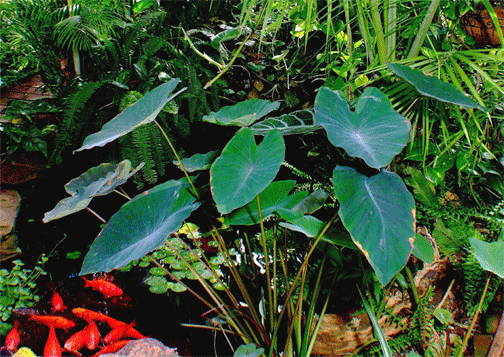
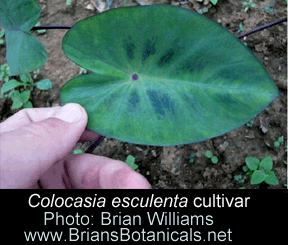
One of our favorite forms of
Colocasia esculenta, known to many as Black Magic
(photo right, above), can easily produce black, green or even blue/black
leaves within the same plant group! In a single season it
often loses the dark black leaves and simply turns green.
The larger variations of this plant species found in Florida and
tropical regions grow from a tuber which is truly a
subterranean round to elongated as well as fleshy
strongly
condensed rhizome or underground stem. Although the term
"stem" is often used by collectors to indicate the support of a
leaf that plant part is correctly known as a petiole.
Many of the "bulb" type plants are
the ones you at major nursery centers and department stores as
the giant "Elephant Ear" but in most cases they are just a form
of Colocasia esculenta. To save money just buy one
at an ethnic food store using one of the names in the common
name list above.
For a further explanation please read this
link.
Colocasia esculenta
was first identified to science in 1832 but due to the species'
ability to produce so many variable forms it has managed to
confuse botanical scientists for almost 180 years. As a
result, many botanists thought they were investigating a new
species which later turned out to be one already known to
science. Colocasia esculenta not only takes on many leaf
forms, it can actually change its appearance in a single season.
Although a few species of Alocasia and Xanthosoma
are also sold in discount centers and nurseries using the common
name "Elephant Ear", many of the plants you in the spring with that
common name are nothing more than Colocasia esculenta.
Aroid grower Brian Williams of Brian's Botanicals
(Brian's Botanicals)
explains,
"I find that just about all plants
labeled commercially as Elephant ear are Colocasia esculenta. The
Xanthosoma sp. are a bit harder to find and I have rarely seen them
commercially available. Yet many times I have seen photos of
Xanthosoma sp. being used to sell Colocasia as well as Alocasia.
Caladium sp. are usually marked a bit better. The Colocasia in
question though is very interesting. It maybe a tetraploid, possibly
a triploid, as it grows much larger and very rarely produces
flowers. I have only seen flowers one time. The tubers can grow
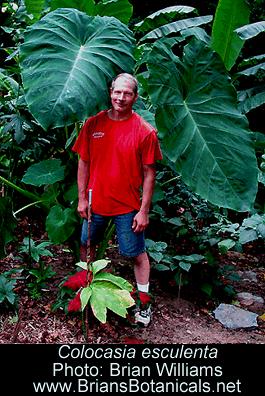
extremely large, 1 foot long or more and 6 to 8 inches across. I
have seen a few photos of the plant grown to 10 feet tall or more. I
am not sure if this form is used in any taro production, it would be
interesting to find more on it's origins. I have some good
photos of one around 8 feet tall."
A tetraploid has four times the haploid number of chromosomes and a
triploid has three times the haploid number of chromosomes in the
plant's cell nucleus. As a result, it grows larger.
Brian continues,
"The large rounded tubers commonly
sold are almost always Colocasia esculenta. In most cases the
Xanthosoma are elongated and usually have pink colorations in or on
the tubers. I have rarely seen Xanthosoma sold commercially, but
more often they are sold as food in ethnic stores as Malanga.
Colocasia is usually sold as Taro or Dalo. One of the best ways to
tell if it is a Xanthosoma is to see the color of the sap.
Xanthosoma usually have white sap along with pink to white spathes.
There is only one Colocasia I know of with a white spathe and that
is Colocasia gigantea."
As
a result of Brian's comments, a further explanation of aroid species is
necessary. Within aroids, and many other plant families, botanists do
not determine the species by the shape of the leaf. Instead, the
final determination is made by microscopically examining the sexual
portions of the plant's inflorescence known in aroids as the spathe and
spadix. But to complicate matters, even the spathe and spadix of
Colocasia esculenta (and other species) can be
variable! It
is not uncommon for the spathe of one specimen to be a different color
when compared to that of another specimen of the same species.
Even the shape of the spathe can be variable.
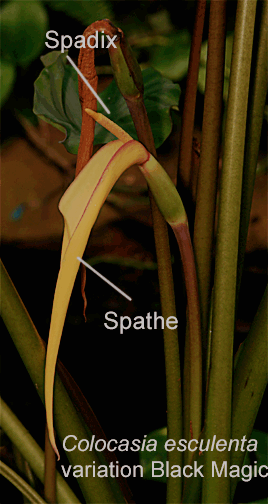 The inflorescences of Colocasia
esculenta should have a spathe tube that is green but the blade
should be orange on both sides. The spathe will reflex (bend) at
anthesis to expose spadix. When pollinated the fruit (berries)
will be orange. The inflorescences of Colocasia
esculenta should have a spathe tube that is green but the blade
should be orange on both sides. The spathe will reflex (bend) at
anthesis to expose spadix. When pollinated the fruit (berries)
will be orange.
When I asked botanist Alistair Hay about the
differences in both color and shape of the spathe of different specimens
of
Colocasia esculenta he responded, "What
you seem to be wrestling with is the general concept of a species. This
is extremely difficult and there have long been widely different views
about what species are! An evolutionary definition is that it is a
unique lineage, and that lineage may or may not embody great
variation. There is no in-principle reason why any feature, be it
inflorescence or leaves or pollen grains etc, shouldn't be variable
within a species. What one first looks for in defining where a species
begins and ends in relation to other species is breaks in variation
which one thinks are significant. To take your pic, a different
colored spathe may not be significant in defining a species, unless
correlated with breaks in variation of other feature(s) as well. It is
just a color form of the same thing ."
Sound complicated? To
those who believe that every leaf of any species must be identical to
those of all others within the same species, it is! But to a
botanist who has studied and understands the concept of plant
variability, it is simply a natural part of botany. Plants vary a
great deal within the same species just as humans vary within our own
species. Just because humans don't all have identical faces, have
different color skin, different color hair, as well as some are short
and some are tall, does not mean we are different species. Plants
are the same.
Colocasia esculenta is known to freely morph and can change its
appearance in just a single season. The photo of the yellow/red
spathe to the right is of the Black Magic variation seen at the top of the page
and does not necessarily resemble the spathe and spadix of other
variations shown on this page.
The major parts of an aroid's
inflorescence are known as the spathe and spadix. If
you've ever grown a Peace Lily (Spathiphyllum), you've seen one.
But the chances are you called that beautiful white growth a
"flower". Sorry, it isn't a flower. Instead, the
spathe is simply a specially modified leaf which looks like a
hood that is produced as a part of the plant's reproductive
organ. The true flowers are very small and are found along
the spadix at spathe's center. Those flowers include
different sexes, both male and female. The male flowers
produce pollen and the female flowers may be receptive to that
pollen.
In some aroid species the female
flowers are not receptive to the male flowers from the same
specimen since they are produced at periods when either the
flower is past receptivity before the pollen is produced.
As a result, an insect is required to transfer pollen from one
plant to another. When an insect travels up the length of
the spadix and gathers the pollen grains on its legs and body
it carries that pollen to the female flowers of either the same
inflorescence or another specimen of the same species.
Nature has designed a very unique method to cause insects to
move pollen only to plants of the same, or a very similar
species. During the reproductive cycle the spadix emits a
pheromone which to the male insect of the species is thought in
some cases to be similar
to the "perfume" produced by the female of his own species when
she is ready to mate. As a result, the male of that
"assigned" insect species is deceived into landing on the spadix
of a plant species where he gathers pollen and then carries it
to another spadix of a receptive specimen. The plant is
then pollinated and eventually seeds are produced. In the
case of aroids, the seeds are found in colorful and unique
berries that are often eaten by birds and dispersed throughout
the forest. Nature has again succeeded in assuring the
continuation of the species. According to botanist Pete
Boyce the pollinators in Southeast Asia are
"Pomace flies of the genus Colocasiomyia (Diptera:
Drosophilidae). Various species, but in the main C. stamenicola.
In the past the pollinator has been referred to as Drosophilella.
Drospophilella is a junior syn. Of Colocasiomyia."
The
plant may also reproduce by producing additional tubers
(sometimes known as mammies) beneath the soil or by sending
off long runners called stolens which attempt to root in the
soil or in any nearby body of water. Colocasia esculenta
is naturally drawn to bodies of water and is frequently
found
growing in and along the edges of streams and ponds.
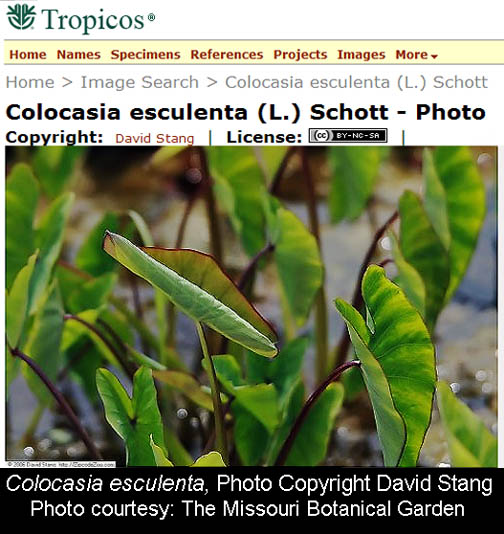 Almost all specimens of
Colocasia esculenta also love to reach for the sun and
will tend to grow from shady areas towards areas of brighter
light. However, many variations grow very well in slightly
diffused or even shady light zones. Colocasia
esculenta is frequently found growing in direct sunlight
but may grow slightly taller in light shade as it stretches
for the light. Almost all specimens of
Colocasia esculenta also love to reach for the sun and
will tend to grow from shady areas towards areas of brighter
light. However, many variations grow very well in slightly
diffused or even shady light zones. Colocasia
esculenta is frequently found growing in direct sunlight
but may grow slightly taller in light shade as it stretches
for the light.
On many tropical islands, as well
as in South America and Asia, the leaves, stems, tuber and roots
are all boiled and eaten. The leaves are cooked like
spinach or other "greens" and used to wrap pork and chicken
while it is being cooked in a fire pit. Although not all, many
variations grow a large tuber which is also eaten. The species
is commonly
grown as a food source in virtually all the Caribbean, Central
America, South America, Polynesia, and SE Asia. In
Polynesia the food form is known as "poi", in Hawaii as Kalo,
while in the Caribbean it is more commonly known as dasheen.
During the late 1970's we lived on the island of Jamaica and a
favorite food on that island is Callaloo. Although I knew
Callaloo was a vegetable I did not know until I researched this
article the Jamaican delicacy is truly Colocasia esculenta.
Despite the fact
you'll find many websites claiming the species is "deadly
poisonous", this species is commonly eaten as a staple food
source. In South Florida you can find the tubers sold in
the vegetable aisle of almost any major food store. The
leaves, roots and stalks are all consumed and cooking apparently
has only minimal to do with the ability to eat the species other
than flavor. Known by many names the species is obviously
not the "deadly poison" many would have you believe!
However, eating a specimen raw can be very distasteful as well
as uncomfortable to the throat and mouth. Even the garden
form shown at the top of the page (Black Magic) is used as a
food source. If you have been to Hawaii and enjoyed a luau
or vacationed on any island in the southeastern Caribbean you
have almost certainly eaten the plant!Since Hawaiians eat Kalo,
a local name for Colocasia esculenta, this explanation
from Leland Miyano, who was born and raised in Hawaii may help,
"Kalo
cultivation varies according to types. There are two basic
groups; Dryland kalo and Wetland alo...self-explanatory. Wetland
kalo requires fresh, flowing, cool water for best performance.
There are so many details, but in old Hawaii, the cultivation of
kalo was raised to a high art."
All forms of
Colocasia esculenta contain calcium oxalate crystals just
like all other aroid genera including Philodendron.
If
 you read many child care and pet sites on the internet you'll
often find this plant product is claimed to be a "deadly
poison". It is possible for calcium oxalate crystals to
burn your lips and throat but someone better explain that it is
a "deadly poison" to the people of the Caribbean, South America,
Central America, Hawaii, Polynesia and Asia since they eat it
daily! Scientific sources say cooking has nothing to do
with destroying the "poison". (Read our detailed
explanation with scientific references from the link below this
article.) Leland explains further,
"Kalo
has two types of calcium oxalate crystals, or idioblasts,....needle-like
raphides and club-like druses. It is believed that the
raphides cause the mucous membrane irritations and skin
dermatitis. I can speak from personal experience that
eating raw kalo, leaves or tubers, is not recommended. It is as
if one ate fiberglass. Another warning is Agave species
have these raphides and I can attest to the extreme skin
dermatitis from the sap of these...it manifests in intense
itching and burning...it is a torture, that can last for many
days in some people. In short, although spinach has calcium
oxalate crystals, there is no comparison between them. I
eat raw spinach often, but raw kalo, never. Cooked kalo is one
of my favorite foods, both leaves and tubers. Poi is the
mashed tuber and is delicious in my mind. It has been compared to
library paste but some luaus cut their poi with flour and it
does taste bad. The variety of kalo also determines the taste." you read many child care and pet sites on the internet you'll
often find this plant product is claimed to be a "deadly
poison". It is possible for calcium oxalate crystals to
burn your lips and throat but someone better explain that it is
a "deadly poison" to the people of the Caribbean, South America,
Central America, Hawaii, Polynesia and Asia since they eat it
daily! Scientific sources say cooking has nothing to do
with destroying the "poison". (Read our detailed
explanation with scientific references from the link below this
article.) Leland explains further,
"Kalo
has two types of calcium oxalate crystals, or idioblasts,....needle-like
raphides and club-like druses. It is believed that the
raphides cause the mucous membrane irritations and skin
dermatitis. I can speak from personal experience that
eating raw kalo, leaves or tubers, is not recommended. It is as
if one ate fiberglass. Another warning is Agave species
have these raphides and I can attest to the extreme skin
dermatitis from the sap of these...it manifests in intense
itching and burning...it is a torture, that can last for many
days in some people. In short, although spinach has calcium
oxalate crystals, there is no comparison between them. I
eat raw spinach often, but raw kalo, never. Cooked kalo is one
of my favorite foods, both leaves and tubers. Poi is the
mashed tuber and is delicious in my mind. It has been compared to
library paste but some luaus cut their poi with flour and it
does taste bad. The variety of kalo also determines the taste."
Although I don't
recommend you go around chewing on Philodendron and
other aroid leaves (they often taste bad) I suspect it is more a
matter of an acquired taste as Leland suggested. However,
some people do react badly to the compound. One genus
within the aroid family, Dieffenbachia,
is especially notorious at being potentially harmful and can
easily cause the loss of the use of your vocal cords.
In a very few cases, consumption of Dieffenbachia has
proven fatal. But if you've ever eaten spinach,
you've already eaten calcium oxalate crystals. Some people
don't like spinach and the main reason is likely the vegetable
contains one form of those crystals in a very high quantity.
To some, vegetables containing calcium oxalate crystals has a
pungent flavor! But people eat spinach raw in salads all
the time and do not die. Still, eating any aroid raw
without the proper knowledge how to prepare it is not advisable.
Leland continues,
"I do
not think is is a matter of taste...it is a physical reaction
that has to do with the structure of the dioblasts...needle-like
raphides versus the club-like druses. I do not know about
spinach idioblasts so I can only comment on kalo. It is not the
taste of raw kalo that is disagreeable, it is the irritation of
the throat and mouth that would prevent a second sampling.
Calcium oxalate is not a poison...but the raphide form is
certainly a deterrent to ingestion. I do not know of anyone
dying from raphides, but if the dermatitis from Agave is any
indication, if one were to eat raw Agave in copius amounts, I
would imagine a very bad experience. I also believe the variety
and age and perhaps other variables determines the amounts of
the raphides in kalo."
Colocasia
esculenta can be grown not only in the semi-tropical parts of
the United States but also in many cold areas although it will go
dormant during winter months. It has been reported to grow
again after a frost or even light snow in
 Japan. Many growers have
reported excellent results leaving the plant in the ground all
winter including here in NW Arkansas. For best growth, we
recommend a good mix of potting soil along with peat and Perlite™ to
create an artificial "bog" that holds moisture. For ideal
growth, the species prefers a slightly acidic soil and should be
kept well watered. Japan. Many growers have
reported excellent results leaving the plant in the ground all
winter including here in NW Arkansas. For best growth, we
recommend a good mix of potting soil along with peat and Perlite™ to
create an artificial "bog" that holds moisture. For ideal
growth, the species prefers a slightly acidic soil and should be
kept well watered.
I often am asked how I
get the plants to appear "blue". I really don't know.
Not every photo and specimen has the blue cast. Sometimes they
are green, sometimes black, but they do sometimes show the beautiful
blue cast. Since the species changes color as it grows
(beginning normally as green) I suspect it has something to do with
the plant's age, light conditions, fertilizer and possibly the soil
pH.
Plant coloration can be a result of a
botanical phenomenon known as
anthocyanins, a condition where water
soluble pigments
appear red to blue depending on the soil pH.
If you still find it
difficult to understand how a single species can be so variable and
present so many "faces", you are not alone. Jonathan Ertelt of
Vanderbilt University in Nashville, TN sent one of the best possible
summations of the difficult concept of variability, "When
you think about it, in other genera within our own family here
(speaking of Araceae of course), the size or texture of a leaf
blade, appearance of the venation, or cross-section of petiole
showing different shapes can make the difference between species.
But if my understanding is correct here, this species concept is
plastic enough that leaf size, surface, appearance of venation,
(i.e. raised and rounded or angled, or flat), petiole appearance,
position of inflorescence, shape, size, color of inflorescence, and
of course habitat and resulting vegetative growth, and likely
pollinator differences as well between habitat extremes of wet and
dry - none of these things matter with this species. A most
interesting dilemma - it is no wonder that it has so many synonyms,
both scientific and common. When all the usual species defining
characteristics are thrown out, where do we go? With such incredibly
wide degrees of variation, whether one is using the common name or
the botanical, another could still have no earthly idea of the image
of plant being discussed. An interesting dilemma indeed."
After reviewing this
page, America's top aroid botanist Dr. Tom Croat of the Missouri
Botanical Garden in St. Louis offered this opinion,
"I quickly
read through your page on Colocasia esculenta and found it very
useful and thoughtful.
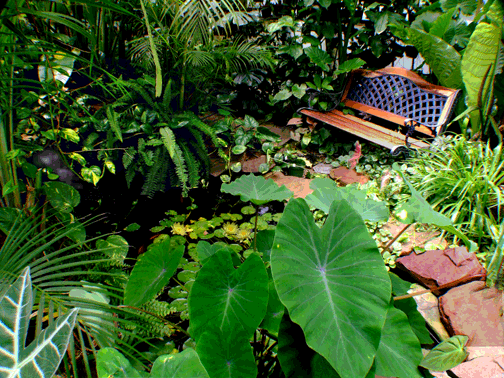 Certainly those elements that you have there
represent what falls in the parameters of C. esculenta but I am no
expert on this Asian genus. I have never seen the very large plants
grown by Brian Williams. They would appear to be twice as large as
any plant I have seen anywhere in cultivation. Perhaps he is correct
that it represents a tetraploid form. At least one of the two
smaller forms are what has been called Colocasia esculenta var.
antiquorum. Check the pictures in Exotica." Certainly those elements that you have there
represent what falls in the parameters of C. esculenta but I am no
expert on this Asian genus. I have never seen the very large plants
grown by Brian Williams. They would appear to be twice as large as
any plant I have seen anywhere in cultivation. Perhaps he is correct
that it represents a tetraploid form. At least one of the two
smaller forms are what has been called Colocasia esculenta var.
antiquorum. Check the pictures in Exotica."
You may find the name
incorrectly spelled as Colocasia esculentum on many "scientific"
and pseudo-scientific sites. That is likely due to someone
mixing an older scientific name
(Caladium esculentum)
with the correct name. However, if you go to a scientific
database, you wil not find the spelling "Colocasia esculentum".
Check TROPICOS (Missouri Botanical Garden)
http://mobot.mobot.org/W3T/Search/vast.html
or the International Plant Names Index (IPNI)
http://www.ipni.org/index.html
to verify the
correct scientific spelling which is Colocasia esculenta.
My thanks to Brian Williams for his input and the use of his
photographs.
(http://www.BriansBotanicals.net/)
and to botanist Alistair Hay for his assistance
as well as to Dr. Croat, Julius Boos, Leland Miyano and Russ Hammer
for their assiatance as well as checking the accuracy of the
information on this page.
Want to know more about
calcium oxalate crystals? Chances are, you've eaten it in
the past week! Click here:
Join the International
Aroid Society:
http://www.exoticrainforest.com/Join%20IAS.html
|