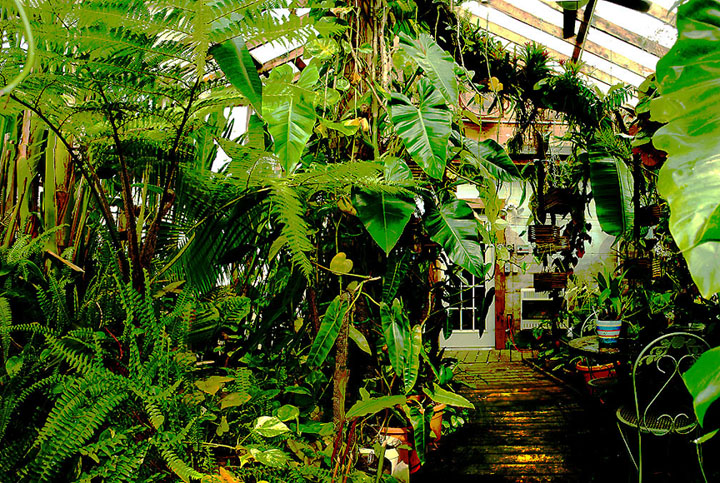
Aroids and other genera in the Collection
Take the Tour Now?
Orchids
The
Exotic Rainforest
The images on this website are copyright protected. Please contact us before any reuse.
Is what so many websites say about plants with
calcium oxalate crystals true?
Do you know you eat calcium oxalate
almost daily?
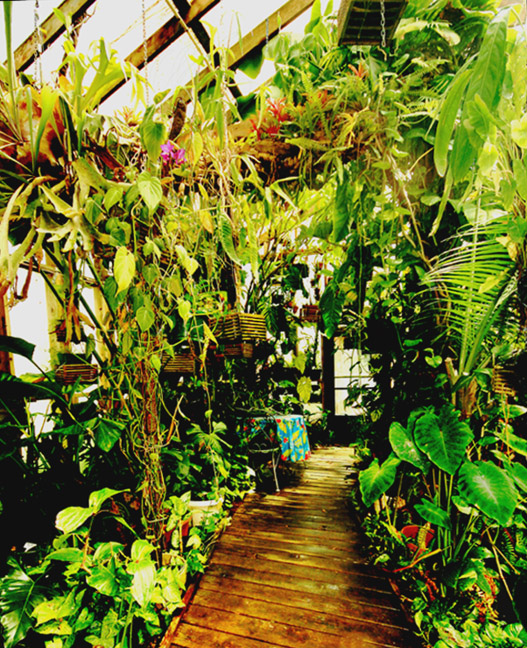
A portion of our personal aroid
collection
The chances of
poisoning from eating a plant is overblown and extremely low if it exists at
all,
especially a
Philodendron,
Anthurium, Alocasia, Colocasia,
Zamioculcas
zamiifolia
(the ZZ plant)
or other aroid species.
However, a few
individuals may be
sensitive to even touching these species.
If you are reading
this material due to a possible medical emergency
STOP RIGHT NOW!
Do Not Panic and call
a physician, poison control or a hospital immediately!
If you are
strictly seeking information, you may find this page useful!
Few plants are as dangerous as some websites would have you believe, but DO NOT take a chance!
Is it a
wise to eat the
leaves of a Philodendron, an
Anthurium, Colocasia
Zamioculcas
zamiifolia or other member of the aroid group of plants?
In most cases, probably not, but in some instances you've probably been
served an aroid and never knew you were eating one!
Did you know all these vegetables contain calcium oxalate crystals?
Parsley, Chives, Cassava, Spinach, Beet leaves,
Carrot, Radish, Collards,
Bean, Brussels sprouts, Garlic, Lettuce, Watercress, Sweet potato, Turnip,
Broccoli, Celery, Eggplant, Cauliflower, Asparagus, Cabbage, Tomato, Pea,
Turnip greens, Potato, Onion, Okra, Pepper, Squash,
Cucumbers, Corn and
other vegetables!
 If you type the words "Philodendron",
"Anthurium"
or
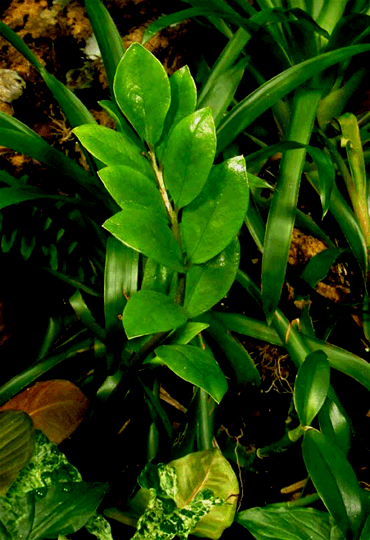
Zamioculcas
zamiifolia
or ZZ plant into almost any internet search engine
many of the top sites that pop up will immediately warn you the plant is
a "poisonous house plant"! Some will tell you the
plants shouldn't even be in your
home and more recent claims
attempt to hype you into believing the ZZ plant is so deadly poison you should not even tough the pot are
simply a major misrepresentation of science.
If you type the words "Philodendron",
"Anthurium"
or
Zamioculcas
zamiifolia
or ZZ plant into almost any internet search engine
many of the top sites that pop up will immediately warn you the plant is
a "poisonous house plant"! Some will tell you the
plants shouldn't even be in your
home and more recent claims
attempt to hype you into believing the ZZ plant is so deadly poison you should not even tough the pot are
simply a major misrepresentation of science.
This quote came from retired Research Chemist and aroid expert Ted Held, "Just a quick check on Google ("Zamioculcas" and "poison") did not find anything substantive. As far as I can tell, this appears to be hysteria." Noted aroid botanist Peter Boyce in Malaysia responded, "The best one circulating here in Malaysia is that the pollen alone is enough to cause death in adult humans. I know of NO science whatsoever to back-up these claims." If all these rumors are true why aren't the workers in the garden section at major stores and plant nurseries dropping dead? If you grow one, why are you still alive?
Philodendron species
and other aroids are among the most popular
of all house plants. How can it be possible some of the supposedly most "poisonous
plants" end up as the most popular plants? Is the claim
Philodendron sp, Anthurium sp. Colocasia sp.,
Alocasia sp. and other aroids
including the ZZ plant are
poisonous really true? Perhaps we need
to dig just a little deeper and read some verified science.
Have you ever been
to South America, Central America, the South Pacific, Polynesia, China, Hawaii,
Southeast Asia or the Caribbean?
Some aroid plants are eaten daily as a staple diet! But be
aware that a very few people may have an unpleasant reaction to simply
touching some plants in the larger family known as Araceae (aroids).
Even though the sometimes privately posted and unverified information on
Wikipepedia claims calcium oxalte is a poison on one well written page states clearly the chance of
serious harm is extremely low,
"The risk of
death, if even
possible, is extremely low if ingested by an average
adult although it is generally considered unhealthy to consume parts of
Philodendrons. In general, the calcium oxalate crystals have a very mild
effect on humans. Large quantities generally have to be consumed for
symptoms to even appear."
The key words are "large quantities"! Anyone would have to eat
almost the entire plants!
One
might have a very bad taste in their mouth but the chances of death is
are remote!
http://en.wikipedia.org/wiki/Philodendron
I
prefer to do my plant research in botanical journals and often avoid the
internet for several reasons. One principal reason is anyone can say
anything on the net and there is no resource or "net cop" to verify it is true! You
can post information that is absolutely false, yet there it sits for
anyone to read and accept as absolute truth. It used to be said
"people always
believe what they read in the newspaper". Now it appears people will
believe almost anything they read on the internet. Perhaps that's why
you get so many junk emails claiming canola oil will
kill you! Or the mail in your snail mail box can give you AIDS.
Or it's dangerous to pump gas because of hidden needles. Or
Saran Wrap™ will cause
 cancer! People tend to believe what they
read.
And that is especially true with information regarding plants! Unfortunately,
there is
simply a lot of bad information on the internet. But this one does
contain at least "some" truth.
cancer! People tend to believe what they
read.
And that is especially true with information regarding plants! Unfortunately,
there is
simply a lot of bad information on the internet. But this one does
contain at least "some" truth.
Almost every time I elect to type the name of a plant, especially a Philodendron, into a search engine more than a dozen websites will warn me the plant contains calcium oxalate crystals and is a "deadly poison"! They claim the plants will kill my children, birds, cats, dogs, rabbits and almost any other critter I allow to touch them! Especially if someone or some thing takes a bite of one. I've written and published hundreds of magazine articles. About a year ago I wrote an article questioning if it was wise to allow tropical birds to fly free in a tropical atrium like our Exotic Rainforest. One magazine editor went ballistic. She felt allowing birds to fly anywhere plants could be found was extremely dangerous because the bird might eat a plant! I agree! It is more dangerous for the plant, not the bird! Do you have any idea where tropical birds normally live? Do you know what grows on almost every jungle tree where they live? Philodendron species, Anthurium species and others that are closely related! And by the way, our birds don't fly free!
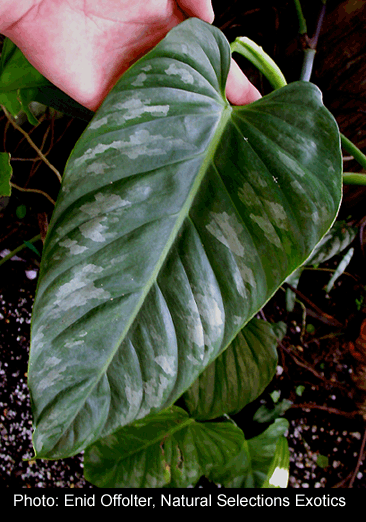 Sites that are created to
offer mothers information to protect their children, as well as pet
websites, pass along the information regarding calcium
oxalate crystals all the time almost always saying
Philodendron species and now the ZZ plant
(Zamioculcas
zamiifolia) are poisonous.
The myth that the pot can be so contaminated with a deadly poison you
should never touch one or allow your child to touch one have zero basis
in science. They are little more than figments of someone's wild
imagination. These people just read another website and embellish
what they have read without ever consulting a scientist or scientific
text.
Sites that are created to
offer mothers information to protect their children, as well as pet
websites, pass along the information regarding calcium
oxalate crystals all the time almost always saying
Philodendron species and now the ZZ plant
(Zamioculcas
zamiifolia) are poisonous.
The myth that the pot can be so contaminated with a deadly poison you
should never touch one or allow your child to touch one have zero basis
in science. They are little more than figments of someone's wild
imagination. These people just read another website and embellish
what they have read without ever consulting a scientist or scientific
text.
For some odd reason many people believe your Philodendron plants truly are a deadly danger and keep passing that information along! That's probably why you are reading this now. Someone or some site has warned you about the danger posed by your plants. But the fact is that bit of information is simply not completely scientifically accurate. And you can easily find many scientific textbooks, and some websites, which will explain why the warning is just not completely correct. All you have to do is do your homework. If you look at the best texts or sites you'll quickly discover the problems they describe are "symptomatic". That is not defined as "deadly". A good dictionary will tell you "symptomatic" is defined as something similar to: "Symptomatic treatment is the practice of treating a patient's symptoms, rather than the disease or injury itself." So what does that actually mean?
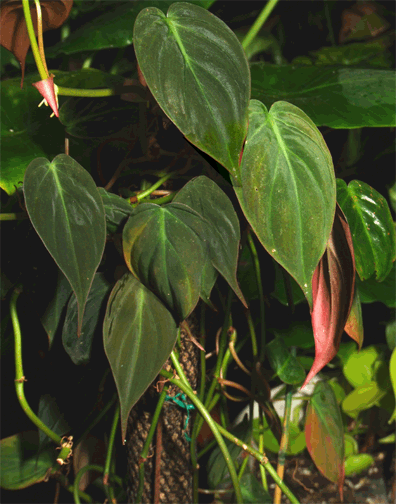
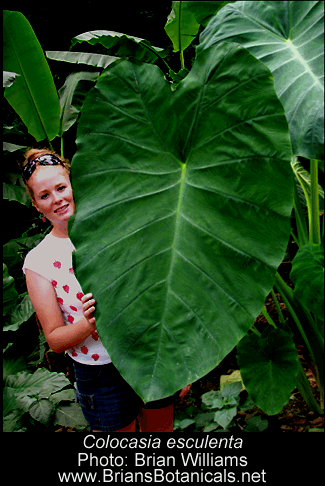 Philodendron sp,
Anthurium sp, Alocasia sp, Colocasia sp. and other members of the aroid family
normally taste bad if you try to eat
one! So just don't eat one! Unless of course you are going on vacation to
Hawaii! In that case, I promise, you'll eat one! In rare cases they can cause serious complications if
ingested. But if you read all the hype posted on internet sites
you'll believe they can kill you! That is both rare, and
a long term result of eating them in excess. As a result you are told you are not supposed
to grow them in your home if you have children. Or cats. Or rabbits.
Philodendron sp,
Anthurium sp, Alocasia sp, Colocasia sp. and other members of the aroid family
normally taste bad if you try to eat
one! So just don't eat one! Unless of course you are going on vacation to
Hawaii! In that case, I promise, you'll eat one! In rare cases they can cause serious complications if
ingested. But if you read all the hype posted on internet sites
you'll believe they can kill you! That is both rare, and
a long term result of eating them in excess. As a result you are told you are not supposed
to grow them in your home if you have children. Or cats. Or rabbits.
They truly do contain the chemical substance known to science as calcium oxalate crystals. If eaten, the leaves may possibly cause burning, swelling, and rarely choking. They will certainly burn your mouth if chewed in large enough quantity and can make the tissues of the mouth swell. But it is much more involved than what those sites would have you believe! The oxalate crystals alone may not be the culprit! You have only been told part of the story. A partial truth! The fact is, only 2 percent of all reported cases of "plant poisoning" require hospitalization. In real numbers, fewer than 500 cases end in a hospital each year. Still, if you grow these species, you need to know the facts. And the fact is, few, if any members of the aroid family are capable of doing the damage some sites wish you to believe if the person who ate them took only a single bite or two.
Plants that are aroids all contain
calcium oxalate crystals. But so do many other plants that are
commonly eaten and not used as ornamental species. What creates
the problem often referred to as a "poison" are the types of calcium
oxalate
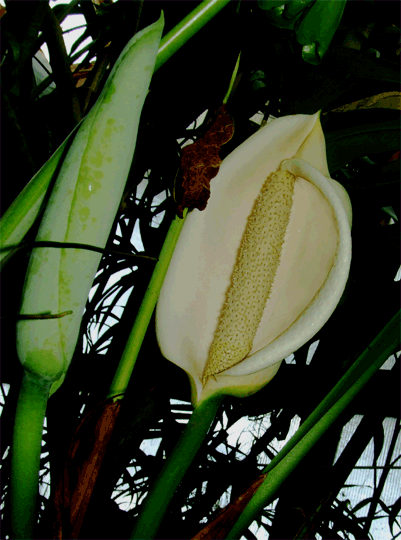 crystals contained in various species. In Hawaii, a
popular native food is known as Kalo. Kalo is made by cooking a
plant known as Colocasia esculenta which you likely know as an
"Elephant Ear". And Kalo contains calcium oxalate crystals in
amounts strong enough to be painful if eaten raw. But if properly
prepared, the plant is delicious.
crystals contained in various species. In Hawaii, a
popular native food is known as Kalo. Kalo is made by cooking a
plant known as Colocasia esculenta which you likely know as an
"Elephant Ear". And Kalo contains calcium oxalate crystals in
amounts strong enough to be painful if eaten raw. But if properly
prepared, the plant is delicious.
Aroid, palm and cycad expert Leland Miyano who is Hawaiian explains further, "Kalo has two types of calcium oxalate crystals, or idioblasts,....needle-like raphides and club-like druses. It is believed that the raphides cause the mucous membrane irritations and skin dermatitis. I can speak from personal experience that eating raw kalo, leaves or tubers, is not recommended. It is as if one ate fiberglass. Another warning is Agave species have these raphides and I can attest to the extreme skin dermatitis from the sap of these...it manifests in intense itching and burning...it is a torture, that can last for many days in some people. In short, although spinach has calcium oxalate crystals, there is no comparison between them. I eat raw spinach often, but raw kalo, never. Cooked kalo is one of my favorite foods, both leaves and tubers. Poi is the mashed tuber and is delicious in my mind. It has been compared to library paste but some luaus cut their poi with flour and it does taste bad. The variety of kalo also determines the taste."
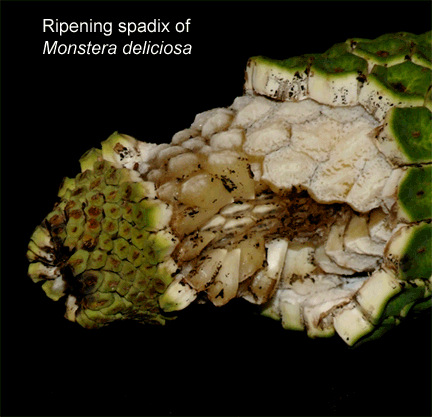 Another
aroid, Monstera deliciosa (delicious), is commonly
eaten in Florida, Mexico, Central and South America, but the plant is
not eaten! Instead, the fruit of the plant which is the spadix of
the mature inflorescence (seen above right) is delicious to the taste
and is very similar to a combination of strawberry and pieneapple.
Up can see the fruit left and we eat every single one our plants produce
including the one in this photo!
Another
aroid, Monstera deliciosa (delicious), is commonly
eaten in Florida, Mexico, Central and South America, but the plant is
not eaten! Instead, the fruit of the plant which is the spadix of
the mature inflorescence (seen above right) is delicious to the taste
and is very similar to a combination of strawberry and pieneapple.
Up can see the fruit left and we eat every single one our plants produce
including the one in this photo!
Monstera species are closely related to
Philodendron species. Look it up! You'll find many websites claiming "all parts
are poisonous" due to the calcium oxalate crystals. The plant
does
have calcium oxalate crystyls but the part about being "deadly poisonous" just isn't so!
We eat it raw! And according to
www.eFloras.org cooking the plant has nothing to do with their no longer
containing
"poison"! One scientific article says
"regular ingestion of "large quantities" of these plants can be
dangerous due to their high mineral content". The
important key words are "regular ingestion" and "large
quantities"!
There is one genus in this aroid group that needs to
be pointed out before this discussion continues. That
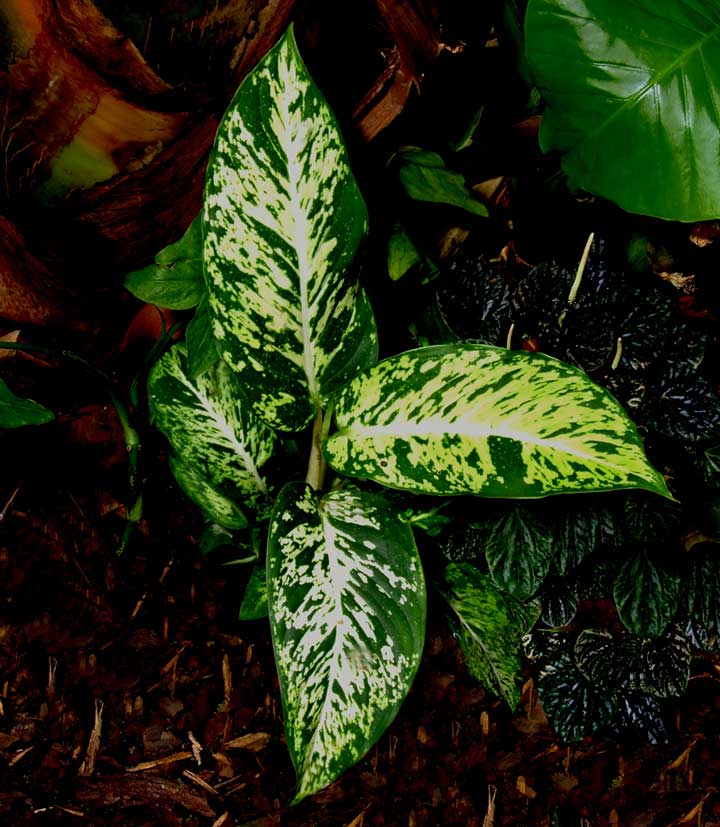
genus is the Dieffenbachia. Dieffenbachia has
an unusually strong form of calcium oxalate crystals combined
with other compounds which make it very unpleasant to taste!
It is certainly best to not eat the leaves of the Dieffenbachia,
however there are exceptions to that rule as well.
Dieffenbachia has been shown to literally make you loose the ability to
talk and is quite uncomfortable if eaten raw, that is why it is called "Dumb Cane".
At least one confirmed death,
 perhaps
two, has been documented, but the effects
of that genus are quite unique due to the combination of chemical
compounds. However, it is eaten on a regular basis in some South
American countries!
perhaps
two, has been documented, but the effects
of that genus are quite unique due to the combination of chemical
compounds. However, it is eaten on a regular basis in some South
American countries!
My friend Elizabeth Campbell
who spends a great deal of time studying rain forest plants
and is a resident of the country of Ecuador wrote the following on a
plant discussion website,
"Young steamed
Dieffenbachia leaves are actually very very tasty."
When asked about the the bad
effects often reported when the species is eaten she responded,
"If you eat it raw, sure. But cooked it's a vegetable similar to
spinach, although a bit higher in iron. And only young leaves, which
have a lower oxalate rating, are eaten."
Again, when asked what
native tribes in Ecuador eat the leaves of Dieffenbachia on a
regular basis, she responded,
"The Huao (Waorani),
mostly. I picked up the habit of eating them while I was in the
intangible zone. They boil the young leaves together with wild garlic
vines and shredded Pelma (Xanthosoma) root. Very tasty."
The Waorani
are native
Amerindians from the Napo and Pastaza Provinces in the Amazonian Region
of Ecuador. Their ancestral lands are found approximately 80 km (50
miles) south of El Coca between the Curaray and Napo rivers,
Although there is
some disagreement among scientists that calcium oxalate is seriously
modified when cooked, obviously it does work since plants containing the
substance are commonly eaten after cooking in many countries around the globe. Read further and you will begin to understand. Dieffenbachia is a relative of the
Philodendron, but it is not a Philodendron species.
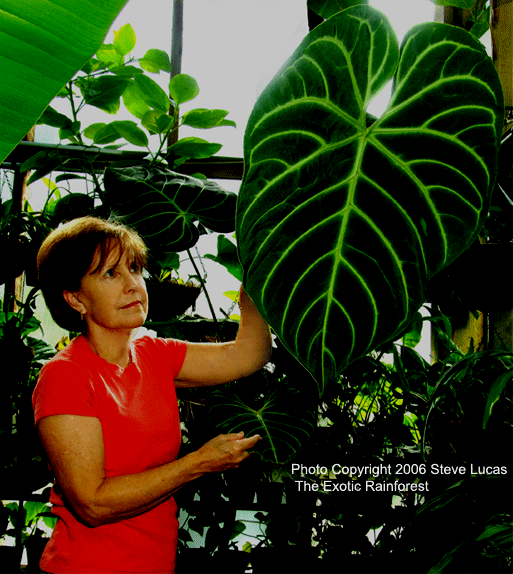
You can turn me in for "child abuse" if you want, but my grandchildren all visit my atrium regularly. And it is full of rare Philodendron, Alocasia, Colocasia, Anthurium and other species along with lizards, frogs, crickets, worms and critters kids love! Mine all know not to put leaves, of any kind, or frogs and worms for that matter, in their mouths! I'm all for taking good care of pet dogs, pet cats and even pet rabbits. And I'm certainly all for taking care of my grandkids. But we've got a pretty simple rule around our house. And that rule is "don't put the plants in your mouth"! Most of them taste bad. That's really all the kids need to know to leave them alone.
Perhaps, just perhaps, if
you ate enough of some of these plants they could be bad for your health.
Interestingly common vegetables women love to try to force
their kids to eat, since they are "good for them", have the same
exact
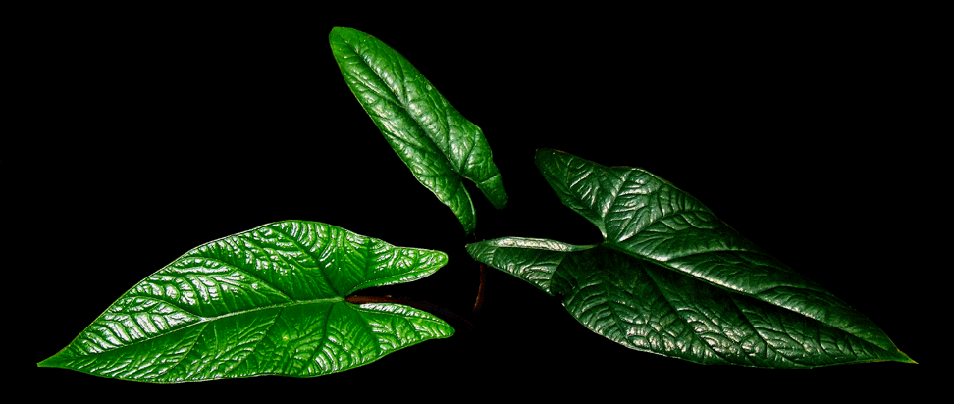
chemical in a relatively high concentrations. Spinach
is near the top of the list! Someone better tell Popeye spinach is
 high in
oxalate crystals
but I don't recall hearing of anyone dropping dead or
choking recently from eating their spinach! Well, not counting the
spinach E-coli scare.
high in
oxalate crystals
but I don't recall hearing of anyone dropping dead or
choking recently from eating their spinach! Well, not counting the
spinach E-coli scare.
Many of the same folks who write this stuff on the internet love to add spinach to their salads! Or make their salads almost totally of spinach! People often find the taste of spinach to be bad. Guess why? They don't like the taste of oxalate crystals. Some scientists equate it to eating small needles. It's bitter, and to some, it tastes bad!
I recently did some research on this
subject and found this information which is quoted directly from
www.eFloras.org
which is a scientific plant research site. So you can better understand the
discussion, "Araceae" is the family of plants that contains most of the
plants often condemned as "poisonous". The
www.eFloras.org
site says:
"Araceae contain crystals of calcium oxalate, which are often cited as
causing the intense irritation experienced when handling or consuming
the raw plant tissue of many genera in the family. This supposition is
contradicted by the fact that although irritation generally is not
produced by properly cooked plants, the crystals remain after heating.
Other compounds must therefore be involved with causing this reaction.
Studies of Dieffenbachia demonstrated that a proteolytic enzyme, as well
as other compounds, are responsible for the severe irritation caused by
this plant and that raphides of calcium oxalate do not play a major role
(J. Arditti and E. Rodriguez 1982). Whether irritation is caused by
enzymes or crystals, that aspect of Araceae has resulted in aroid genera
being included in many lists of poisonous plants (e.g., K. F. Lampe and
M. A. McCann 1985; G. A. Mulligan and D. B. Munro 1990; K. D. Perkins
and W. W. Payne 1978)."
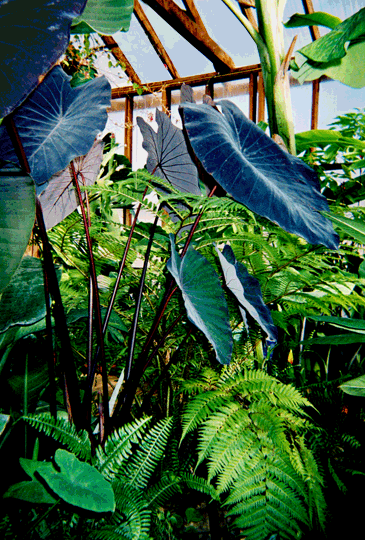 In
Hawaii and other parts of Polynesia, Central America, South America and
the Caribbean the Colocasia plant known as Poi, Taro and
many other names is used as a staple food source. These people grow it not as an ornamental as we
do, they grow it to eat! The leaves, stems and roots are all boiled and
eaten. The entire plant contains oxalate crystals and the leaves are cooked
just like spinach, or
greens, and used to wrap pork and chicken while it is being cooked in a
fire pit. The entire plant contains oxalate crystals just like
the purportedly "deadly" Philodendron.
In
Hawaii and other parts of Polynesia, Central America, South America and
the Caribbean the Colocasia plant known as Poi, Taro and
many other names is used as a staple food source. These people grow it not as an ornamental as we
do, they grow it to eat! The leaves, stems and roots are all boiled and
eaten. The entire plant contains oxalate crystals and the leaves are cooked
just like spinach, or
greens, and used to wrap pork and chicken while it is being cooked in a
fire pit. The entire plant contains oxalate crystals just like
the purportedly "deadly" Philodendron.
If you totally accept what many pet and children's protection sites on the web would have you believe this plant product should always be called a "deadly poison". And if you believe that you must also believe it is dangerous to your health to enjoy a Hawaiian feast. Perhaps someone should explain those plants contain a "deadly poison" to the people of Hawaii and Polynesia! They eat them all the time, sometimes daily! Some months ago we cooked some of our Colocasia esculenta for a dinner as a part of a Hawaiian cookout and I'm still alive and well to write this for you to read! No one got sick. No one had their mouth burn. But there may be at least anecdotal evidence eating too much of this plant over a long period of time can cause an increase in kidney stones.
So keep your pets out of the area where you grow your rare and unusual plants and even more important DON'T EAT your tropical plants, or let your kids eat them! But if you research this topic honestly you'll find these plants are not as dangerous as most internet articles, especially pet sites, would have you believe! Someone read "part" of a scientific article and took it to an extreme! They reported only half of the story.
And, just in case you're a
vegetarian, you might want to do some homework on eating your "veggies".
Those too may contain a higher concentration of oxalate crystals than
you expect. Dr. James W. Waddick of Kansas City, MO. recently
provided this link which I found of great interest:
http://www.vegsource.com/articles/harris_kidney_stones.htm
The information on this site may lead you to learn eating
vegetables can have similar less than desirable results for
your health
and cause kidney stones due to eating an excess of oxalate crystals. Perhaps all the
websites who make
 overly strong claims regarding oxalate crystals should
add we all should stop eating anything with a leaf! Please don't
panic. I eat more vegetables than meat myself.
overly strong claims regarding oxalate crystals should
add we all should stop eating anything with a leaf! Please don't
panic. I eat more vegetables than meat myself.
So how do these tales get all over the internet? Simple. One site says it, the next one copies and embellishes it, and it suddenly takes on a life all its own. The story becomes little more than internet gossip. So the next time you read something on the internet that raises a doubt in your mind, verify the information in a good scientific text. Don't instantly believe everything you read about plants on the net. Check out information posted on any website on a scientific source. Including this one! if your child just took a bite of your Philodendron you should consult your physician right now! Just don't panic. Chances are, the doctor will simply treat the symptoms.
Steve Lucas
www.ExoticRainforest.com
Want to see some of the rare species we grow? Click this link.