
Aroids and other genera in the Collection
Take the Tour Now?
Orchids
The
Exotic Rainforest
Plants in
the Exotic Rainforest Collection
The images on this website are copyright protected. Please contact us before any reuse.
Detailed information on Growing Anthurium
Species Click this Link
Within our collection we have many species of Anthurium. If you are seeking other photos, click this link:
New: Understanding, pronouncing and using Botanical terminology, a Glossary
Anthurium spectabile Schott

Formerly Anthurium longispatheum
A spectacular
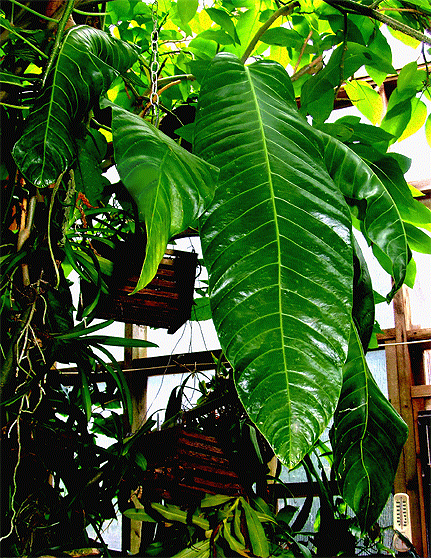
pendent leaf Anthurium from Costa Rica, Anthurium spectabile
(spec-TAB-i-lee)
has leaves that grow to 5 feet and hang dramatically from the host
tree. The plant is a large tree dwelling epiphyte (ep-a-FIT) with an unusually
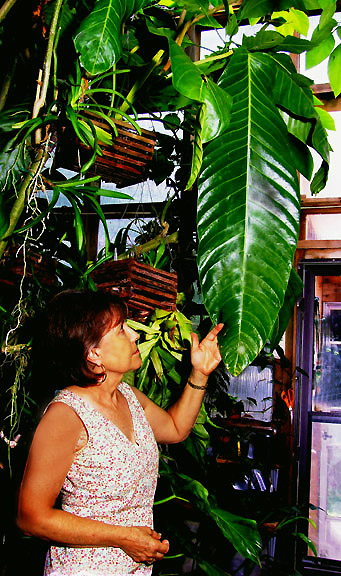 attractive leaf structure. A. spectabile is normally found in wet
pre-mountainous and tropical rain forests at an elevation of 300 to
1300 meters (approximately 1000 to 4000 feet). The
coriacious (thick and leathery) leaves
are oblong-triangular or "lanceolate", a botanical term meaning
"tapering from a rounded base toward an apex". They are adorned with
rows of easily seen raised silver-white primary lateral veins.
Anthurium species are known to be highly variable and not every
leaf of every specimen will always appear the same. This link
explains in greater detail the scientific principle of natural
variation and morphogenesis.
Click here.
attractive leaf structure. A. spectabile is normally found in wet
pre-mountainous and tropical rain forests at an elevation of 300 to
1300 meters (approximately 1000 to 4000 feet). The
coriacious (thick and leathery) leaves
are oblong-triangular or "lanceolate", a botanical term meaning
"tapering from a rounded base toward an apex". They are adorned with
rows of easily seen raised silver-white primary lateral veins.
Anthurium species are known to be highly variable and not every
leaf of every specimen will always appear the same. This link
explains in greater detail the scientific principle of natural
variation and morphogenesis.
Click here.
A member of Anthurium section Pachyneurium, this group includes species where both leaf margins are rolled when the plant is in bud. The upper surface of the leaves are semi-glossy to glossy while the lower surface is also somewhat glossy. This is one of the largest epiphytic Anthurium sp. in Central America.
Some information available on the internet says A. spectabile can have leaves that grow up to 20 feet long in the jungles of Costa Rica but no scientific information to support that claim is available in technical scientific texts. In cultivation the leaves rarely get larger than 150cm (five feet). The plant grows best in a hanging orchid basket packed with material such as orchid moss that will retain sufficient moisture for the plant's root system. Experienced growers do not recommend soil. Anthurium spectabile must be kept away from strong sun and wind to protect its somewhat fragile foliage, especially when leaves are young. The leaf's coloration can yellow in too bright light.
Our specimen is
eleven years old
as of the summer 2010. The
plant currently has leaf blades approaching 120cm (48 inches),
just under one meter but each season our A. spectabile tends to produce
several new leaves
approximately
The petioles which support each leaf are quadrangular which simply
means they are 4 sided. Out specimen was acquired from an avid collector in Florida and at
one time the specimen had a leaf over 120cm (four
 feet long) which was snapped
off in one of the 2006 Florida hurricanes. Since we acquired the
plant A. spectabile has added two new leaves each season.
feet long) which was snapped
off in one of the 2006 Florida hurricanes. Since we acquired the
plant A. spectabile has added two new leaves each season.
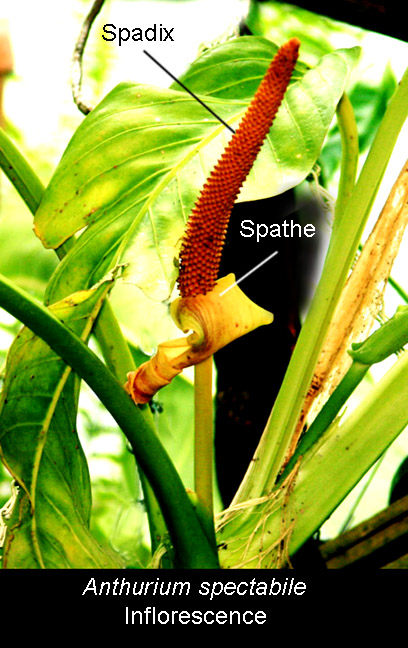
Anthurium differ from Philodendron species since all Anthurium produce perfect flowers containing both male and female organs while Philodendron produce imperfect flowers containing only a single sex. At sexual anthesis all Anthurium produce an inflorescence which contains both a spathe and a spadix. The spadix is only a modified leaf and not a flower which surrounds the fleshy spike known as the spadix.
When an Anthurium is "in flower" the reference is to the tiny flowers containing both male and female sexual parts that grow on the spadix at the center of the inflorescence. To help prevent self pollination nature has designed the female flowers to be receptive before the male portion of the flower produce their pollen so in most cases an insect must bring pollen from another plant. Bright orange berries develop after the plant produces an inflorescence that has been pollinated.
The peduncle that supports the inflorescence is normally 13 to 25 cm long, while the spathe is subcoriaceous or less than leathery. The spathe is green or violet-purple on the inside but green outside until it dries yellow as in our photograph. The spathe is wisted or coiled and strongly reflexed (turned backwards). The spadix yellow/ green, when viable and turns to a reddish coloration once spent. llen
This plant has a similar cousin from Panama known scientifically as A. pseudospectabile Croat. Our A. spectabile is growing in a large wooden orchid basket with the roots packed with sphagnum moss and very porous soil that drains quickly. This is one of the most spectacular plants in the Exotic Rainforest.
See Anthurium pseudospectabile
here
Aroid Pollination!
As
it occurs in nature and by any horticulturist
Looking for a specimen? Contact
http:///

Need more information on Anthurium species? Click this link.
Join the International Aroid Society: http://www.exoticrainforest.com/Join%20IAS.html
If you are seeking information on
other rare species, click on "Aroids and other genera in the Collection" at the top
and look for the
