
Aroids and other genera in the Collection
Take the Tour Now?
Orchids
The
Exotic Rainforest
Plants in
the Exotic Rainforest Collection
The images on this website are copyright protected. Please contact us before any reuse.
Detailed information on Growing Anthurium
Species Click this Link
Within our collection we have many species of Anthurium.
If you are seeking other photos,
click this link:
New: Understanding, pronouncing and using Botanical terminology, a Glossary
Anthurium
pseudospectabile
Croat

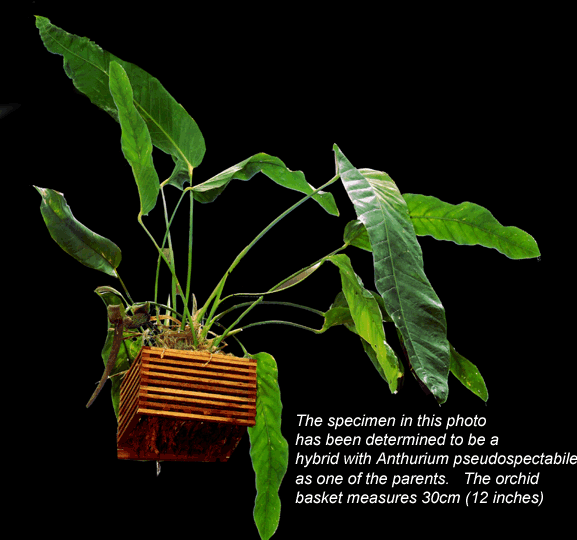
Sometimes mistaken for Anthurium spectabile
Some search engines will attempt to redirect you to "Anthurium pseudospectabilis" which is not
a scientifically accepted name!
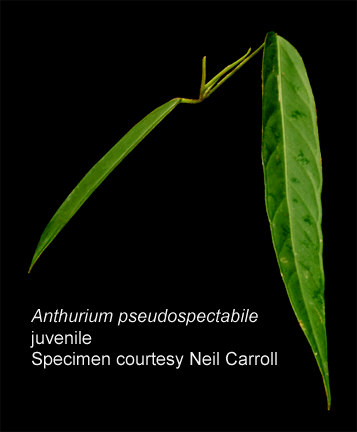 On April 21, 2008 I received
a personal phone call from noted Anthurium expert Neil Carroll.
The plant in my photo above is a hybrid and not the actual
species known to science as
Anthurium
pseudospectabile. The major difference is the petioles that
support the leaves stand upward while the leaf blades of the actual
species hang pendently. The text below explains these terms.
Neil has graciously forwarded a wild collected specimen for our collection and as soon
as the specimen grows I will photograph as a replacement for the photo
above.
On April 21, 2008 I received
a personal phone call from noted Anthurium expert Neil Carroll.
The plant in my photo above is a hybrid and not the actual
species known to science as
Anthurium
pseudospectabile. The major difference is the petioles that
support the leaves stand upward while the leaf blades of the actual
species hang pendently. The text below explains these terms.
Neil has graciously forwarded a wild collected specimen for our collection and as soon
as the specimen grows I will photograph as a replacement for the photo
above.Anthurium pseudospectabile (pseudo-spec-TAB-i-lee) is found only in northwestern Panama near the Fortuna Dam. Aroid botanist Dr. Thomas B. Croat Ph.D., P.A. Schulze Curator of Botany at the Missouri Botanical Garden in St. Louis is the botanical author of the species. The type specimen (first specimen collected and described by a botanist) of Anthurium pseudospectabile was discovered in April,1980 in the province of Chiriquí along a road between Gualaca and the Fortuna Dam approximately 13.36 kilometers (8.3 miles) northwest of Los Planes de Homito at an elevation of 1,260 meters (4,135 feet) in what Dr. Croat described as "virgin" rain forest. Although well inland, the area is closer to the Pacific coastline than the Atlantic side of Panama and is between the villages of Tierras Negras and Boca del Monte.
Specimens have been collected at elevations ranging from 590 to 1600 meters (1,935 to 5,250 feet). Anthurium pseudospectabile is more common at elevations between 1,250 to 1,500 meters (4,100 to 4,920 feet) in a region composed of pre-mountainous rain forest. A. pseudospectabile grows along the continental divide between the provinces of Bocas del Toro and Chiriqui.
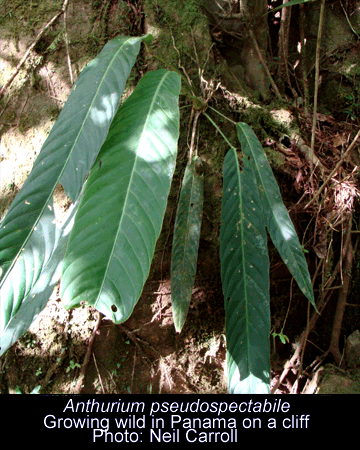 Dr. Croat describes Anthurium
pseudospectabile as a pendent epiphyte (ep-a-FIT). For those unfamiliar
with botanical terms,
a pendent epiphyte is one that grows from the branches of a tree with its leaves
hanging downward The term "pendent" is
sometimes found incorrectly as "pendant", but in
the botanical form is correctly pendent. The species is rarely, if ever,
found in soil.
Dr. Croat describes Anthurium
pseudospectabile as a pendent epiphyte (ep-a-FIT). For those unfamiliar
with botanical terms,
a pendent epiphyte is one that grows from the branches of a tree with its leaves
hanging downward The term "pendent" is
sometimes found incorrectly as "pendant", but in
the botanical form is correctly pendent. The species is rarely, if ever,
found in soil.
Anthurium
pseudospectabile is known to also grow on rock faces (see photo right,
below).
Aroid species (especially hybrids) are known to be highly
variable and not every leaf of every specimen will always appear the
same. This link explains in non-technical language natural variation and morphogenesis.
Click here.
Anthurium pseudospectabile is a member of Anthurium section Pachyneurium and the leaves can measure 2 meters (6.5 feet) or more in length by up to 50cm (19.7 inches) wide. In addition to the species' pendent growth habit, the leaf blades are elongated and possess multiple veins. Those long blades have a slight grayish cast and also have an undulated leaf margin. An undulate margin refers to the edge of a leaf having a wavy appearance.
The largest leaf on our hybrid specimen (top of page) measures 107cm (3.5 feet) in length. As a comparison, the wooden box measures 30cm (12 inches). That specimen has been determined to be a hybrid with Anthurium pseudospectabile as one of the parents.
Dr. Croat indicates
in his description Anthurium
pseudospectabile is closely
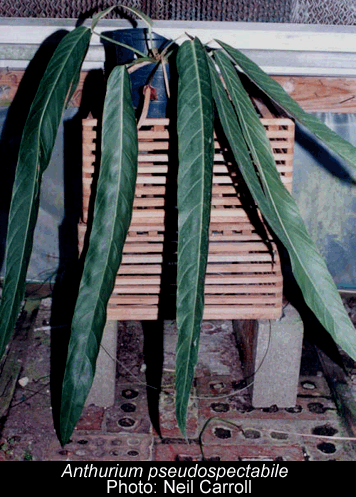 related to Anthurium spectabile (spec-TAB-a-lee) which
is found from central Costa Rica to Nicaragua. Anthurium
spectabile differs significantly by having broader leaf blades
which lack the undulated leaf margins.
related to Anthurium spectabile (spec-TAB-a-lee) which
is found from central Costa Rica to Nicaragua. Anthurium
spectabile differs significantly by having broader leaf blades
which lack the undulated leaf margins.
The cataphylls which are the plant sheaths that surround a newly emerging leaf are subcoriaceous (less than leathery) and measure 31 to 37cm (12.2 to 13.5 inches) in length. Once the leaf is developed, those cataphylls dry to be tan in color and split into fibers at the base.
The petioles which support the leaves (commonly called stems) are subterete (less than round) and are somewhat flattened in appearance but may be bluntly quadrangular (four sided) according to a personal note from Dr. Croat. The petioles measure from 14 to 60cm (5.5 to 23.5 inches) in length. The leaf blades are moderately thick (coriaceous) measuring up to 2 meters (6.5 feet) in length. They are broadest in the middle with the adaxial (upper) surface matte to semi-glossy. The abaxial (lower) surface of the leaf blade is semi-glossy. The true stem is at the base of the plant.
A principal difference a collector can use to determine if a specimen is Anthurium pseudospectabile or Anthurium spectabile is to closely examine the petioles. The latter are markedly quadrangular while the petioles of Anthurium pseudospectabile are almost always round (terete) but may also be slightly quadrangular according to Dr. Croat.
As with any aroid, the reproductive portion of Anthurium pseudospectabile is known as an inflorescence and is composed of a spathe and spadix. The inflorescence grows on a short support known as a peduncule which hangs pendently (downward) from the specimen. The spathe is thick and is green on the lower surface but is heavily tinged with purple on the upper surface. The spathe is considered lanceolate, or spear shaped, and typically measures 10 to 32cm (4 to 12.6 inches) in length. Normally twisted, the spathe is green to purple.
Anthurium differ from Philodendron species since all Anthurium produce perfect flowers containing both male and female organs while Philodendron produce imperfect flowers containing only a single sex. When an Anthurium is "in flower" the reference is to the tiny flowers containing both male and female sexual parts that grow on the spadix at the center of the inflorescence. To help prevent self pollination nature has designed the female flowers to be receptive before the male portion of the flower produce their pollen so in most cases an insect must bring pollen from another plant.
Once pollinated, the spadix will produce fruit in the form of berries that are a brilliant orange when ripe. Those berries are described by Dr. Croat as oblong to ellipsoid. Once fruit develops the inflorescence is known as an infructescence and the entire infructescence continues to hangs pendently. For more information regarding the pollination of any aroid see the pollination link below.
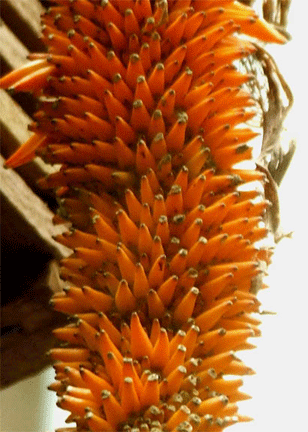 if you happen to be curious how an Anthurium as large as
Anthurium
pseudospectabile
can find its way onto the
branches of a tree, grow on a rock face, or survive without soil, the answer is simple. Many
birds and animals eat the fruit of an Anthurium as a part of
their diet. Those berries contain seeds
and once the bird or other animal leaves its droppings on a tree branch
or rock outcrop there is just enough nutrient surrounding the seed to allow it
to germinate.
if you happen to be curious how an Anthurium as large as
Anthurium
pseudospectabile
can find its way onto the
branches of a tree, grow on a rock face, or survive without soil, the answer is simple. Many
birds and animals eat the fruit of an Anthurium as a part of
their diet. Those berries contain seeds
and once the bird or other animal leaves its droppings on a tree branch
or rock outcrop there is just enough nutrient surrounding the seed to allow it
to germinate.
In a few years a very large Anthurium will dangle its leaves and roots from the branches or the rock while gathering all its moisture and nutrients directly from the air. Anthurium and other epiphytic species are able to be self sustaining due to an effect sometimes called the "trash basket effect". The leaves and roots gather falling debris such as dead leaves or animal debris as they fall past a specimen. As those leaves and debris decay they supply the plant with natural fertilizer as well as a means of storing water. The plant has no need for soil. The long roots that hang from the specimen are very efficient at retaining water. An epiphyte is a plant that draws nothing from the host but survives only as a plant growing on another plant.
Our hybrid specimen is growing epiphytically in a large 30cm (12 inch) wooden orchid basket packed with sphagnum moss and no soil. The moss is kept constantly damp.
Being a mountain species, Anthurium pseudospectabile prefers slightly cooler growing conditions (not cold) which makes it ideal for our Arkansas "rain forest". To successfully grow a specimen keep it in a humid area with a high moisture level in bright but indirect light.The source for the information on this page is the Annals of the Missouri Botanical Garden 1991, Volume 78, #3 by Dr. Thomas B. Croat as well as personal email exchanges with Dr. Croat and Neil Carroll. The scientific description of Anthurium pseudospectabile is found on page 709. Copies are available from the Missouri Botanical Garden in St. Louis, MO.
To see the rain forest region surrounding Fortuna Dam, Panama, visit the Smithsonian Tropical Research Institute: http://striweb.si.edu/fortuna_plants/description.php
Aroid Pollination!
As
it occurs in nature and by any horticulturist
Want to see Anthurium spectabile? Click this link.
Looking for a specimen? Contact
http:///
Natural Selections Exotics at

Need more information on Anthurium species? Click this link.
Join the International Aroid Society: http://www.exoticrainforest.com/Join%20IAS.html
If you are seeking information on
other rare species, click on "Aroids and other genera in the Collection" at the top
and look for the
