
Aroids and other genera in the Collection
Take the Tour Now?
Orchids
The
Exotic Rainforest
Plants in
the Exotic Rainforest Collection
The images on this website are copyright protected. Please contact us before any reuse.
Detailed information on Growing Anthurium Species
Click this Link
The Exotic Rainforest is a private botanical garden.
Within our collection we have many species of Anthurium. If you are seeking other photos, click this link:
Anthurium schlechtendalii Kunth
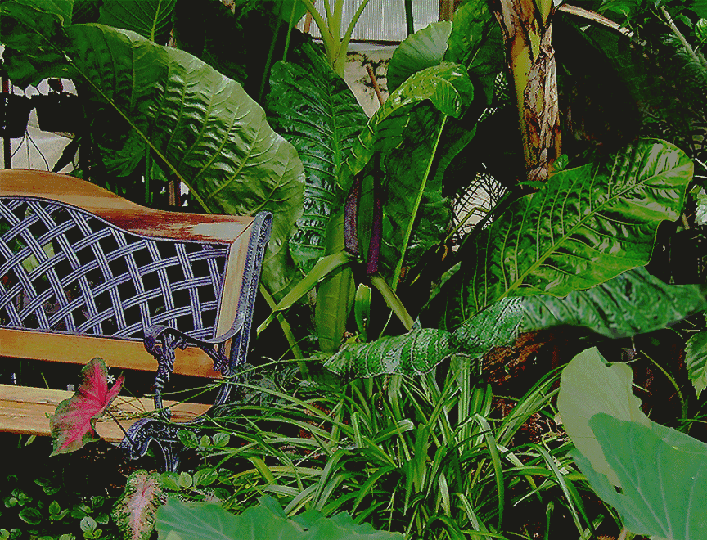
|
Anthurium schlechtendalii
Kunth
Synonyms: Anthurium brachygonatum, Anthurium fortinense, Anthurium kunthianum, Anthurium mexicanum, Anthurium tikalense, Anthurium tetragonum, Anthurium jimenezii Some websites state that Anthurium schlechtendalii is a synonym of Anthurium jimenezii Anthurium jimenezii is the synonym of A. schlechtendalii which is the accepted scientific name.
A member of
Anthurium section Pachyneurium
After Years
Our Previously Unidentified Giant Anthurium is
finally Identified by
aroid
botanist Dr. Thomas B. Croat
Ph.D., P.A. Schulze Curator of Botany
of the Missouri Botanical
Garden in St. Louis, MO.
Anthurium schlechtendalii is one of the most difficult to identify of all Central American Anthurium species. This species takes on many forms in nature and grows as an epiphyte (ep-a-FIT), as a terrestrial, and even on rocks. This is the story of how we finally were able to put a name on our specimen.
Anthurium species are known to be
highly variable and not every leaf of every specimen will always
appear the same. This link explains in non-technical language natural
variation and morphogenesis within aroid species. Morphing is very commonly
seen in Anthurium which is why there are so many synonym
names (same plant, other name) for Anthurium
schlechtendalii.
Click here. In the summer of 1998 I happened upon a scraggly plant with ragged leaves at a nursery that was closing shop in Miami, FL. For a large leaf Anthurium sp., the plant was small, perhaps with 2 foot (60cm) leaf blades. But I bought it anyway thinking the shiny and reflective new leaves were interesting. One important note before you read this page: Anthurium species are known to be highly variable and not every leaf of every specimen will always appear the same. Not every leaf of every species will appear the same! This link explains in greater detail the scientific principle of natural variation within species as well as morphogenesis. Click here. After several years of growing, that "scraggly" plant turned out to be the biggest plant mystery in my atrium. Thanks to the assistance of a number of plant enthusiasts, along with the input of Dr. Tom Croat of the Missouri Botanical Garden in St. Louis, we thought we had solved the mystery and the plant could possibly be a variation of Anthurium plowmanii known as 'Fruffles' (or as Dr. Croat called it in a recent email, "Ruffles". Other than scientific texts, little information is available regarding Anthurium plowmanii and even less regarding var. 'Fruffles'. But the information written by botanist Dr. Croat in his journal Annals of the Missouri Botanical Garden 1991, volume 78, number 3, confirms the color of my plant's seed berries and the leaf size somewhat matches this unusual variation. A description of Anthurium plowmanii can now be found on the ExoticRainforest here: Anthurium plowmanii Croat. Dr. Croat is the botanist who originally identified the species Anthurium plowmanii and is my personal mentor. But another noted botanist, Dr. Eduardo Gonçalves (gon-ZAL-vas) of the Universidade Catolica de Brasilia (Brazil) noted in a personal email, after viewing photos of my plant, the spathe and the plant's base: "It is a big one, in fact! I have seen very few A. plowmanii as big as that one you have, but they do exist. However, there is a doubt: Is the peduncle short or long? Your picture of the inflorescence is edited, so I can't see the size of the peduncle. If it is shorter than the spadix, it may be A. plowmanii... If it is long, it can be another thing." So, I went back and measured the length of
both peduncles (the shaft that supports the
spathe and spadix) and both of the plant's two
spadices. The largest peduncle measured 22 ½
inches (57cm) from the base to the
With leaf blades approximately 24 inches (61cm) wide, the thick coriaceous (leather-like) blades feel and crackle something like thin cardboard. The plant's leaves have ruffled edges and the blades of our mature plant grow from the base to their full size in just 5 weeks! When the new leaves first emerge they are very shiny and reflect the sunlight almost like a mirror. But as the leaf matures the shiny effect subsides. An aroid, all
Anthurium species reproduce via the production of an
inflorescence. When an Anthurium is "in flower" the
reference is to the tiny bisexual male and female flowers that grow on the
spadix at the center of the inflorescence. The spathe is not a
"flower" but instead is simply a
modified leaf. The spadix at its center vaguely resembles an
elongated pine cone. The
spadix is a spike on a thickened fleshy axis
which can produce tiny flowers.
Once the female flowers on the spadix have
been fertilized by an insect, normally a beetle, they produce
berries. The colorful red berries of our species are then eaten by birds
and other rain forest animal species that spread them among the
branches of the trees in their droppings. For many years we believed the
plant to be Anthurium salviniae and
some Anthurium experts still believe it to be
possibly a hybrid of that species. The red seed
berries do resemble those of A.
salviniae. However, a photo of
Anthurium salviniae, as ID'd by the staff
of Fairchild Tropical Botanic Garden, was forwarded to
me from Miami in the summer of 2006 and the
leaves did not match. Also, according to Dr.
Croat's scientific description of that plant, the
base of our plant does not have the fist-shaped cucullate (having the shape of a cowl or hood)
cataphylls at the base. Dr. Croat verified it
is not A. salviniae after viewing a
photo of the plant's base.
If you
check our plant against numerous large
Anthurium species you'll see the leaves do
not perfectly match any. That is possibly
due to our specimen being a variation.
Variations within species are not uncommon in nature and
are often the cause of great debate amongst
botanists and serious plant enthusiasts.
But now there is a new possibility. Dr.
Croat has made a new suggestion. In a
personal email he wrote, "Anthurium schlechtendalii has red berries, is highly
variable and has sort of trapezoidal
petioles."
He then suggested I do more
research on that species. Photos I've
checked thus far of the spadix looked
promising. But then Dr. Croat asked for
another photo of the plant's base. After
examining it he came back with this
response, "Based on the petiole
cross-sectional shape as I interpret it, it
probably is not A. schlechtendalii
Kunth
but the cataphyll is definitely
lanceolate."
So, again, we're back to
square one and have no idea what species the
big anthurium may actually be.
Certainly a member of Section Pachyneurium
(Anthurium sp. which include the Bird's Nest types)
the beauty of our plant, which in its prime
spreads almost 8 feet from tip to tip, has been
the source of intense curiosity on my part since
the day I first brought the specimen home. This
specimen is certainly one of the largest of all
the Anthurium species.
My sincere
thanks to Enid Offolter of Natural Selections
Exotics in Fort Lauderdale who originally put me
on the track of a possible name for this plant
as well as Julius Boos and Dr. Ron Kaufmann for
their help in attempting to track this plant's
identification. And, as always, my deep
appreciation to Dr. Eduardo Gonçalves for the
input he so freely provides. But my deepest
thanks go to Dr. Tom Croat for giving us the
his time and finally solving the mystery as well as
answering my unending questions!
|
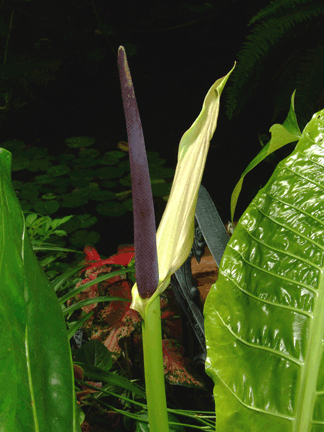 bottom of the
spadix with a 12 ½ inch (32cm) spadix. The
second peduncle measured 17 inches (43cm) with a
12 inch (30.5cm) spadix. So they are both
longer than the spadix. Based on Dr. Gonçalves'
observation this plant cannot be A.
plowmanii. That was confirmed later by Dr.
Croat when he wrote in a separate personal email :
"I don't think that your plant is in any way
related to Anthurium plowmanii".
Interestingly, the larger spadix suddenly
shriveled and died in late August, 2006. But
almost at the same time a new spathe and spadix
began to form with the spathe hanging downwards
(pendently) as in previous years.
bottom of the
spadix with a 12 ½ inch (32cm) spadix. The
second peduncle measured 17 inches (43cm) with a
12 inch (30.5cm) spadix. So they are both
longer than the spadix. Based on Dr. Gonçalves'
observation this plant cannot be A.
plowmanii. That was confirmed later by Dr.
Croat when he wrote in a separate personal email :
"I don't think that your plant is in any way
related to Anthurium plowmanii".
Interestingly, the larger spadix suddenly
shriveled and died in late August, 2006. But
almost at the same time a new spathe and spadix
began to form with the spathe hanging downwards
(pendently) as in previous years.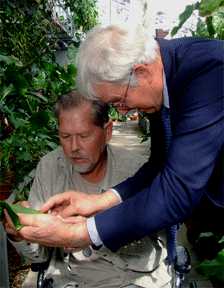 After
reading and rereading piles of technical
materials I still had no clue
as to what the
plant may actually be. Fortunately, after
taking parts of the specimen to Dr. Croat in St.
Louis he was
able to identify the species! After examining a
full leaf blade and a complete inflorescence at
the Missouri Botanical Garden,
Dr. Croat stated the petiole had an unusual form
which is shaped like a capital letter "D" and is not
normal for
Anthurium
schlechtendalii.
The
plant has also produced spathes which are odd
shaped for the plant but within accepted
ranges. And it is much larger than found in the
wild! That is likely due to good growing
conditions in
the atrium as well as the use of fertilizer. He stated the
plant could become even larger with age. But
after counting leaf veins and examining a
variety of photos he declared the plant to be
without a doubt
Anthurium schelectendalii,
a native of Mexico. So our 8 year search for a
name finally ends.
After
reading and rereading piles of technical
materials I still had no clue
as to what the
plant may actually be. Fortunately, after
taking parts of the specimen to Dr. Croat in St.
Louis he was
able to identify the species! After examining a
full leaf blade and a complete inflorescence at
the Missouri Botanical Garden,
Dr. Croat stated the petiole had an unusual form
which is shaped like a capital letter "D" and is not
normal for
Anthurium
schlechtendalii.
The
plant has also produced spathes which are odd
shaped for the plant but within accepted
ranges. And it is much larger than found in the
wild! That is likely due to good growing
conditions in
the atrium as well as the use of fertilizer. He stated the
plant could become even larger with age. But
after counting leaf veins and examining a
variety of photos he declared the plant to be
without a doubt
Anthurium schelectendalii,
a native of Mexico. So our 8 year search for a
name finally ends.