
Aroids and other genera in the Collection
Take the Tour Now?
Orchids
The
Exotic Rainforest
Plants in
the Exotic Rainforest Collection
The images on this website are copyright protected. Please contact us before any reuse.
Detailed information on Growing Anthurium Species
Click this Link
Within our collection we have many species of Anthurium. If you are seeking other photos, click this link:
Anthurium plowmanii
Croat

Anthurium
plowmanii
Croat
Common names: Anthurium Plowmanii Ruffles, Anthurium 'Fruffles'
Named in honor of botanist Timothy
Plowman (1944-1989), Dr. Plowman completed his graduate work in botany at
Harvard University resulting in a doctorate in 1974. My
friend and aroid expert Leland Miyano from Hawaii offered these comments
regarding Dr. Plowman, "I would like to to
promote the life and times of Timothy Plowman. I grow several plants
named for, or collected by Dr. Plowman and I am sure many others out there
do also. I think it should be mandatory reading for enthusiasts of
Amazonian plants to read ONE RIVER by Dr. Wade Davis. It is an epic
narrative whose primary protagonists are the ethnobotanists, Richard Evans
Schultes and Timothy Plowman. If the readers are willing to put up
with high adventure and discovery....after approximately 500 pages of text,
one will get a better appreciation of the dedication and sacrifice of these
rare individuals. It will enlighten the reader to the importance of species
and the true lack of knowledge that we currently possess about so many
things. You will receive treasure in return."
 Anthurium
plowmanii ranges from western and northern Brazil into Peru, Bolivia
and Paraguay. The species is found in Brazil in the Amazonas region and
in Peru at elevations ranging from 50 to 900 meters (165 to almost 3,000
feet). In Bolivia the species is reported to be found from near sea
level to 500 meters (approximately 1,650 feet). A. plowmanii is commonly found in dry forest life zones.
In the text Aroids, Plants of the Arum Family by Deni Bown, Deni
summarizes a message from botanist
Dr. Eduardo Gonçalves (gon-ZAL-vas)
of the Universidade Catolica de Brasilia in
Brazil. in the message Dr. Gonçalves explained Anthurium plowmanii
grows in extremely dry conditions and is often the only evergreen plant in
some areas during the dry season.
Dr. Croat's type specimen used for the original study of the species was
collected in Brazil in the Amazonas region near Manaus, Chacaras de Taruma.
Anthurium
plowmanii ranges from western and northern Brazil into Peru, Bolivia
and Paraguay. The species is found in Brazil in the Amazonas region and
in Peru at elevations ranging from 50 to 900 meters (165 to almost 3,000
feet). In Bolivia the species is reported to be found from near sea
level to 500 meters (approximately 1,650 feet). A. plowmanii is commonly found in dry forest life zones.
In the text Aroids, Plants of the Arum Family by Deni Bown, Deni
summarizes a message from botanist
Dr. Eduardo Gonçalves (gon-ZAL-vas)
of the Universidade Catolica de Brasilia in
Brazil. in the message Dr. Gonçalves explained Anthurium plowmanii
grows in extremely dry conditions and is often the only evergreen plant in
some areas during the dry season.
Dr. Croat's type specimen used for the original study of the species was
collected in Brazil in the Amazonas region near Manaus, Chacaras de Taruma.
 The
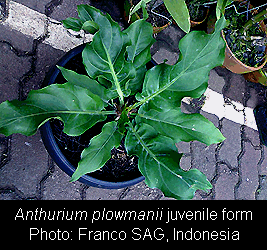
photo (left) is a juvenile specimen of Anthurium plowmanii.
The leaf blades can grow as long as 2 meters (6.5 feet) and as
noted above the petioles will
have the shape of either a "U" or a "C"
when cut as a cross section. The leaves stand erect but may also spread
laterally in a rosette fashion. The petioles are typically 10 to 40cm
long (roughly 4 to 15.75 inches) but may grow as long as 50cm (19.7
inches). The geniculum (a bump in the petiole just beneath the leaf
blade) is thicker than the petiole and becomes fissured with age. Aroid
expert Julius Boos explains further regarding the purpose of the
geniculum,
"
the geniculum acts
like a
''wrist'', and actually allows the leaf blade to turn or rotate to align
itself with the light source and occurs only on some
aroid genera
including Anthurium and Spathiphyllum but not on others."
The
photo (left) is a juvenile specimen of Anthurium plowmanii.
The leaf blades can grow as long as 2 meters (6.5 feet) and as
noted above the petioles will
have the shape of either a "U" or a "C"
when cut as a cross section. The leaves stand erect but may also spread
laterally in a rosette fashion. The petioles are typically 10 to 40cm
long (roughly 4 to 15.75 inches) but may grow as long as 50cm (19.7
inches). The geniculum (a bump in the petiole just beneath the leaf
blade) is thicker than the petiole and becomes fissured with age. Aroid
expert Julius Boos explains further regarding the purpose of the
geniculum,
"
the geniculum acts
like a
''wrist'', and actually allows the leaf blade to turn or rotate to align
itself with the light source and occurs only on some
aroid genera
including Anthurium and Spathiphyllum but not on others."
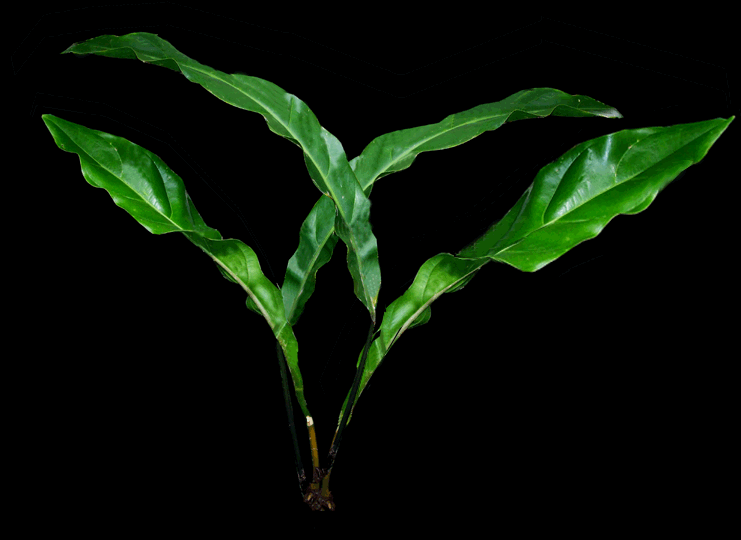
The leaf blade is coriaceous (leathery) and typically measures from 20 to 56cm (7.9 to approximately 22 inches) wide. The blades are always broadest near the center.Capable of growing on the branch of a tree, on rock, or in soil, Anthurium plowmanii is a large epiphytic or epilithic species and placed in Anthurium section Pachyneurium The species is unusual in that section. The unusual features include a spadix, which is commonly longer than the peduncle. The peduncle is the plant organ that supports the inflorescence and the spadix is a portion of the inflorescence. This feature is shared only with Anthurium solomonii. An additional distinctive feature is the either "C" or "U" shaped petioles. The petiole is the portion of the leaf that supports each leaf. For those unfamiliar with botanical terms, an epiphyte is a plant that normally grows attached to another plant, in this case on the branches of a tree. An epilithic species is one capable of growing attached to stone.
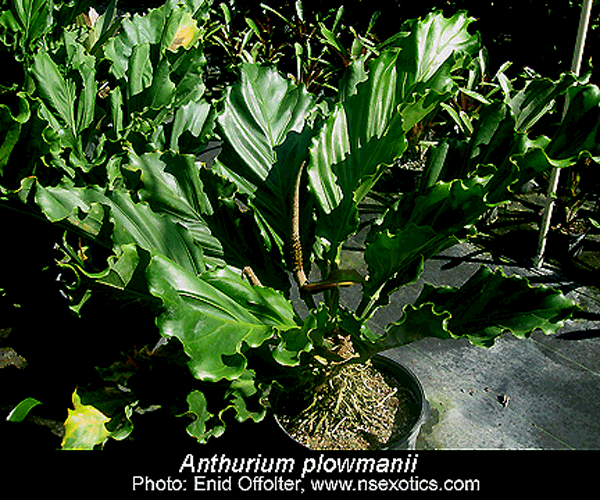
The blades of Anthurium plowmanii are distinctive in that they possess an undulated appearance (wavy) near the blades' edges. The upper surface of the leaf should be matte to semi-glossy in appearance but have been reported to be slightly glossy. Although a variable species with a variety of forms, the blade should be dark green in color with the underside appearing matte to only slightly glossy. Anthurium species are known to be highly variable and not every leaf of every specimen will always appear the same.
Anthurium plowmanii has many known forms. This link explains natural variation and morphogenesis. Click here.
 All Anthurium
species are aroids. An aroid is a
plant that reproduces by producing an inflorescence in aroids is known to science
as a spathe and spadix. Most people believe the spathe is a
"flower" which is incorrect. The spathe is a modified leaf
whose purpose is to protect the spadix at the center of the
inflorescence. On the spadix there can be found very tiny
flowers when the plant is ready to be pollinated and is at female
anthesis (sexual reproduction).
All Anthurium
species are aroids. An aroid is a
plant that reproduces by producing an inflorescence in aroids is known to science
as a spathe and spadix. Most people believe the spathe is a
"flower" which is incorrect. The spathe is a modified leaf
whose purpose is to protect the spadix at the center of the
inflorescence. On the spadix there can be found very tiny
flowers when the plant is ready to be pollinated and is at female
anthesis (sexual reproduction).
Anthurium differ from Philodendron species since all Anthurium produce perfect flowers containing both male and female organs while Philodendron produce imperfect flowers containing only a single sex. When an Anthurium is "in flower" the reference is to the tiny flowers containing both male and female sexual parts that grow on the spadix at the center of the inflorescence. To help prevent self pollination nature has designed the female flowers to be receptive before the male portion of the flower produce their pollen so in most cases an insect must bring pollen from another plant.
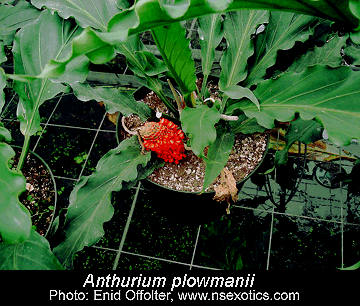
When ready to reproduce the spadix produces these perfect flowers which also contain sterile flowers. If the female flower portion is pollinated by an appropriate insect (normally a beetle from the genus Cyclocephala) which carries pollen from another specimen at male anthesis, the spadix will begin to grow berries. The inflorescence of Anthurium plowmanii stands erect but may also be slightly spreading in appearance. The peduncle which is the stalk that supports the inflorescence typically measures 6 to 32cm (2.35 to 12.6 inches) but may be shorter on plants just reaching maturity.
The spathe is often reflexed (turned backwards) but may also be rolled. The coloration of the spathe is violet purple or green tinged with purple and the shape is similar to a spear, known to a botanist as lanceolate. Typically the spathe will measure from 5 to 26cm (2 to 10.25 inches) but can grow to as long as 29cm (11.4 inches) in length. Once pollinated the berries produced on the spadix are red and are oblong to obovoid while slightly rounded at apex in shape. Each berry will produce 1 to 2 seeds.
Being commonly considered a "birds nest" form, Anthurium plowmanii is a member of Anthurium section Pachyneurium and is easy to culture. The species grows well in collections provided it is protected from temperatures that never drop below freezing and preferably not below 12.75 C 55 degrees F). In cold climates the species must be grown in a greenhouse. Anthurium plowmanii is a variable species and may produce leaf blades with widely varying forms. Dr. Croat has identified certain forms of the plant as a ruffled margined form of Anthurium plowmanii. It is important to remember Anthurium plowmanii is a "variable" species capable of producing more than one leaf form. Variableness is not uncommon within aroid species.
There is also a variation commonly sold as Anthurium plowmanii 'Fruffles'. In a note to aroid expert Julius Boos, Dr. Tom Croat of the Missouri Botanical Garden in St. Louis had these comments about that particular variation, "I used to have it but am not sure what I have now. That form, so far as I know, was collected by Fred Fuchs in Bolivia. I remember that Tom Fennell was interested in culturing it and I believe that I gave them material to carry this out but I don't know if they did or not."
Anthurium plowmanii is not difficult to grow provided you have the space. The species can become quite large. We have our two specimens planted in very loose soil that is kept constantly moist. The mixture is composed of good soil, peat, Perlite™, and orchid potting media containing charcoal, bark and gravel. The plants are grown in diffused light and is allowed to ocassionally dry. The specimen show at the top of the page came directly from the collection of Dr. Tom Croat at MOBOT and was donated to the International Aroid Society for sale at the 2007 Aroid Show in Miami, FL. Our specimen does not demonstrate adult characteristics at this time (February, 2008).
My thanks to Enid Offolter for the use of her photo.
Aroid Pollination!
As
it occurs in nature and by any horticulturist
All information in this article was extracted from Dr. Croat's journal, Annals of the Missouri Botanical Garden 1991, Volume 78, #3. We strongly urge anyone interested in Anthurium species belonging to section Pachyneurium (birds nest forms) to a copy directly from MOBOT or the International Aroid Society.

Join the International Aroid Society: http://www.exoticrainforest.com/Join%20IAS.html
Need more information on Anthurium species?
Click this link.