Aroids and other genera in the Collection
Take the Tour Now?
Orchids
The
Exotic Rainforest
Plants in
the Exotic Rainforest Collection
The images on this website are copyright protected. Please contact us before any reuse.
Detailed information on Growing Anthurium Species
Click this Link
Within our collection we have many species of Anthurium. If you are seeking other photos, click this link:
New: Understanding, pronouncing and using Botanical terminology, a Glossary
Anthurium
jenmanii
Engl.
Many sellers sell Anthurium bonplandii subsp. guayanum and call it Anthurium jenmanii
The two species are very different species.
All technical data was taken from Dr. Thomas B. Croat's
journal
Annals of the Missouri Botanical Garden 1991,
Volume 78, #3 as well as from his field notes published on the Missouri Botanical Garden website
TROPICOS. For additional photos of Anthurium jenmanii see pages
803 and 804 of that journal. The scientific description of Anthurium jenmanii can be
found on page 662.
 A member of Anthurium
section Pachyneurium which contains the "birds nest" forms, Anthurium
jenmanii was first scientifically collected on the Caribbean island of Trinidad.
Even though collectors often believe Anthurium jenmanii is
rare in nature it is commonly
A member of Anthurium
section Pachyneurium which contains the "birds nest" forms, Anthurium
jenmanii was first scientifically collected on the Caribbean island of Trinidad.
Even though collectors often believe Anthurium jenmanii is
rare in nature it is commonly
 found on the windward islands of the
southeastern Caribbean including Tobago, St. Lucia, Martinique, Dominica,
St. Vincent, Montserrat, Antigua and Grenada. The species grows
either terrestrially, as an epiphyte (eip-FIT) on the branches of a tree or
as a lithophyte (litho-FIT) on stone.
found on the windward islands of the
southeastern Caribbean including Tobago, St. Lucia, Martinique, Dominica,
St. Vincent, Montserrat, Antigua and Grenada. The species grows
either terrestrially, as an epiphyte (eip-FIT) on the branches of a tree or
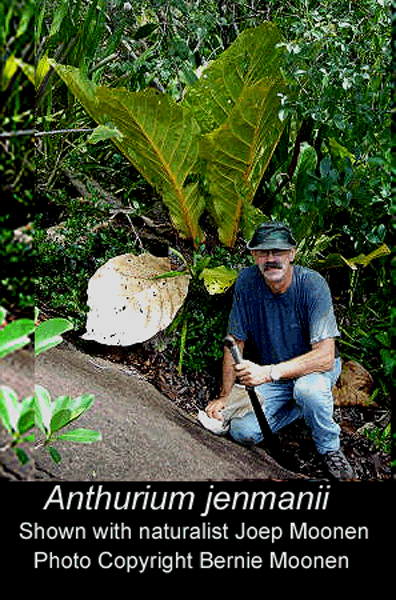
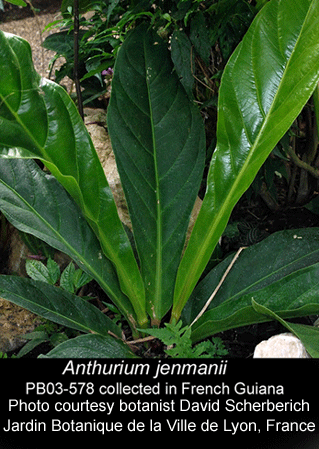
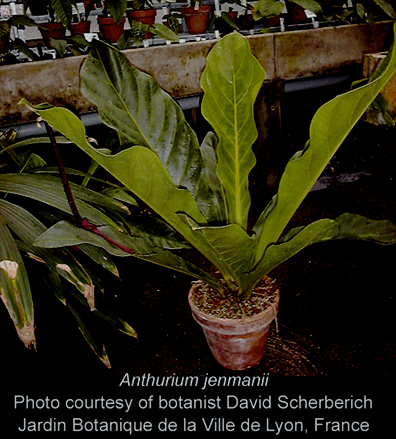
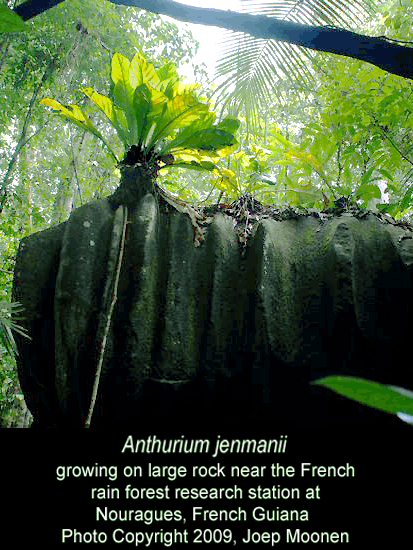
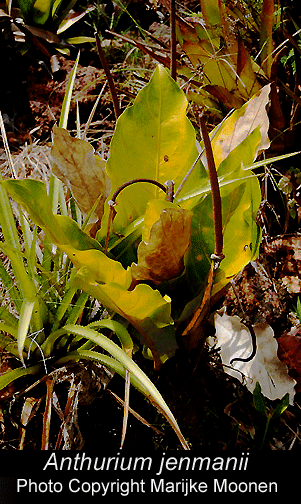
as a lithophyte (litho-FIT) on stone.The leaf blades of Anthurium jenmanii are coriaceous (leathery to the touch) and broadly oblanceolate to elliptic but are rarely ovate-elliptic. Any leaf blade that is oblanceolate is spear shaped but widest above the center of the blade and broadest near the middle or in the upper one fourth. The leaf blades near the base are obtuse (blunt) and rounded or may be slightly oval. The edges (margins) of the blades are moderately undulated (wavy). The upper blade surface (adaxial side) is semi-glossy to glossy and is a yellowish green. The lower leaf surface (abaxial side) is matte to only slightly glossy and is a bit paler in color. In regard to the color of the blades shown at right, below, Joep wrote, "Please notice the yellow leaves. This is normal in the dry season when they are exposed to a lot of light such as on inselbergs. I know one inselberg where there are hundreds if not a thousand A. jenmanii specimens but deep in the forest the species is a lot less common."
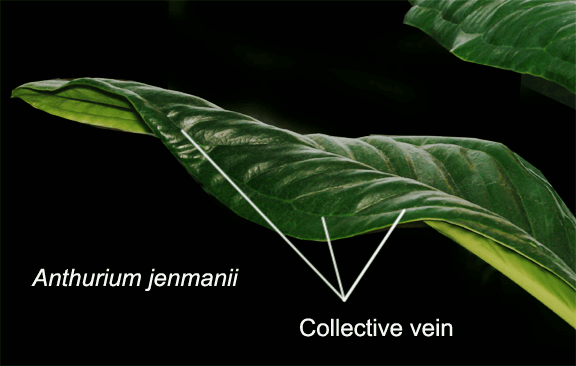
 There should be 5 to 13 primary
lateral veins on each side of any leaf of Anthurium jenmanii.
The veins near the top of the blade merge into the collective
vein The collective vein is a specialized vein which runs around the
circumference of an Anthurium's blade and is a primary characteristic
used to determine if a specimen is, or is not, an
Anthurium
species (see photo below). The lateral leaf veins are raised near the midrib (center of
the leaf) but are slightly sunken at the edges (margins). The
minor veins, known as the tertiary veins, are sunken on the upper surface
but are raised
on the leaf's underside.
There should be 5 to 13 primary
lateral veins on each side of any leaf of Anthurium jenmanii.
The veins near the top of the blade merge into the collective
vein The collective vein is a specialized vein which runs around the
circumference of an Anthurium's blade and is a primary characteristic
used to determine if a specimen is, or is not, an
Anthurium
species (see photo below). The lateral leaf veins are raised near the midrib (center of
the leaf) but are slightly sunken at the edges (margins). The
minor veins, known as the tertiary veins, are sunken on the upper surface
but are raised
on the leaf's underside.
 The lower surface (abaxial)
of the leaf blade is substantially less glossy than the upper (adaxial)
blade surface. The leaves of Anthurium
jenmanii are often both large and coriaceous to moderately coriaceous.
The term "coriaceous" simply means leathery to the touch.
The upper blade's surface is semi-glossy as well as moderately bicolorous (dual colored). The midrib is convex (pushes upwards) on both
the upper and lower surfaces while the tertiary (lesser) veins are sunken on the upper
surface but raised on the lower surface.
The lower surface (abaxial)
of the leaf blade is substantially less glossy than the upper (adaxial)
blade surface. The leaves of Anthurium
jenmanii are often both large and coriaceous to moderately coriaceous.
The term "coriaceous" simply means leathery to the touch.
The upper blade's surface is semi-glossy as well as moderately bicolorous (dual colored). The midrib is convex (pushes upwards) on both
the upper and lower surfaces while the tertiary (lesser) veins are sunken on the upper
surface but raised on the lower surface.
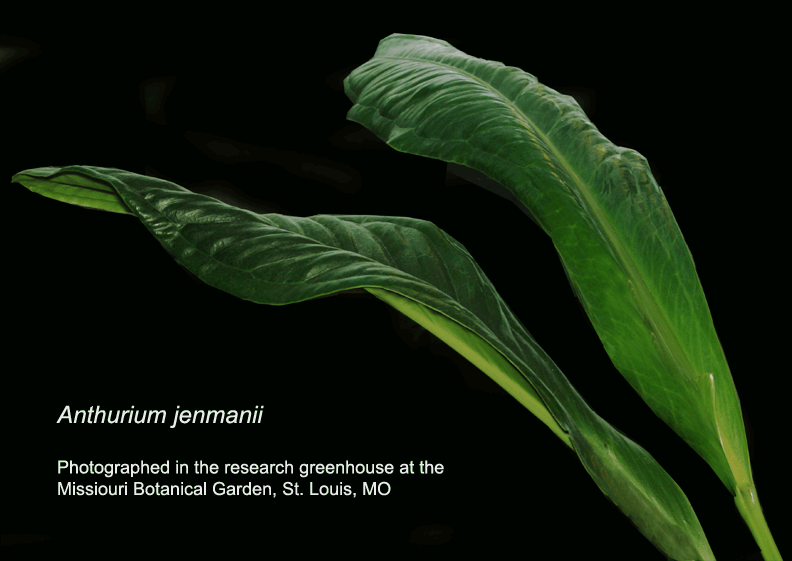
Anthurium jenmanii is known to be variable having multiple leaf forms throughout its native range. This link offers a more complete explanation of natural variation within aroid and other plant species. Click here.
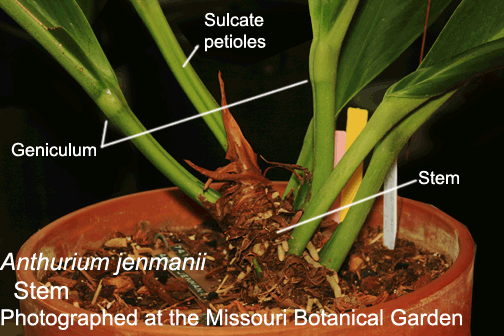 The petioles of Anthurium jenmanii support the blades are described in
the journals of aroid botanist Dr. Thomas B. Croat
Ph.D., P.A. Schulze Curator of Botany
at the Missouri
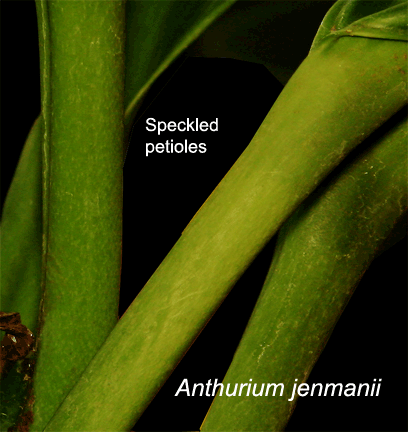
Botanical Garden in St. Louis as being sharply to slightly "D" shaped
but are flattened to slightly convex on the upper surface while rounded on the underside. The surface of
Anthurium jenmanii's petiole is
slightly speckled.
The "D" shape is a reference to the appearance of the petiole when cut and
viewed as a cross section (cut in half). However, due to natural
variation
in the species Anthurium jenmanii may also be sulcate which
The petioles of Anthurium jenmanii support the blades are described in
the journals of aroid botanist Dr. Thomas B. Croat
Ph.D., P.A. Schulze Curator of Botany
at the Missouri
Botanical Garden in St. Louis as being sharply to slightly "D" shaped
but are flattened to slightly convex on the upper surface while rounded on the underside. The surface of
Anthurium jenmanii's petiole is
slightly speckled.
The "D" shape is a reference to the appearance of the petiole when cut and
viewed as a cross section (cut in half). However, due to natural
variation
in the species Anthurium jenmanii may also be sulcate which
 indicates
a depression (C shaped) in the stem (see photo right taken in the greenhouse of the
Missouri Botanical Garden collection). The petiole is
scientifically a stalk to which the lamina of the leaf blade is attached. The petiole is often referred to by collectors as the
"stem"
but correctly the stem is at the base of the plant.
indicates
a depression (C shaped) in the stem (see photo right taken in the greenhouse of the
Missouri Botanical Garden collection). The petiole is
scientifically a stalk to which the lamina of the leaf blade is attached. The petiole is often referred to by collectors as the
"stem"
but correctly the stem is at the base of the plant.
At the top of any Anthurium species' petiole you will find the geniculum (see photo right, above) which is slightly larger than the petiole in size. The geniculum allows the leaf blade to rotate much like an elbow or a knee in order to orient itself to find a brighter source of light. The geniculum of Anthurium jenmanii is slightly paler and only moderately thicker than petiole. Anthurium jenmanii has short internodes on the stem. An internode is a segment of stem between two nodes and the node is where a leaf may emerge.
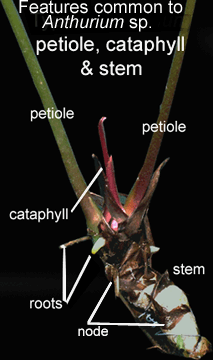 Once a new leaf is
produced, it is surrounded by a sheath-like structure known to a botanist as the cataphyll.
The cataphylls of Anthurium jenmanii are lanceolate (lance shaped) and sometimes purple.
A
cataphyll is a bract- like modified leaves that surround any new
leaf and whose purpose is to protect the emerging leaves
as they develop. On a specimen of Anthurium jenmanii
the cataphylls remain after drying as a fibrous material
similar to coconut husk.
Once a new leaf is
produced, it is surrounded by a sheath-like structure known to a botanist as the cataphyll.
The cataphylls of Anthurium jenmanii are lanceolate (lance shaped) and sometimes purple.
A
cataphyll is a bract- like modified leaves that surround any new
leaf and whose purpose is to protect the emerging leaves
as they develop. On a specimen of Anthurium jenmanii
the cataphylls remain after drying as a fibrous material
similar to coconut husk.
During the year 2007 aroid collectors from Indonesia were paying phenomenal prices for a single specimen of various plants being sold as "Anthurium jenmanii". More than a few specimens were hybrids of other plant species, not the actual species known to science as Anthurium jenmanii. One principal reason collectors in Indonesia were seeking what they thought to be "Anthurium jenmanii" was they believed the species produced a juvenile bright burgundy to red leaf. Anthurium jenmanii does not produce a red leaf according to botanical experts including aroid botanist Dr. Croat. My friend Joep made this comment in a personal email, "I have never seen a red jenmanii but that does not say much since they have a big distribution and there might be mutations as well". As a result it is likely that 95% of the photos labeled "Anthurium jenmanii" on Google images are not Anthurium jenmanii but instead are a hybrid of Anthurium bonplandii subspecies guayanum. All the photos labeles as Anthurium jenmanii on this page were taken either in the wild or are from the vouchered botanical collections of either the Missouri Botanical Garden in St. Louis, MO or the Jardin Botanique de la Villa in France.
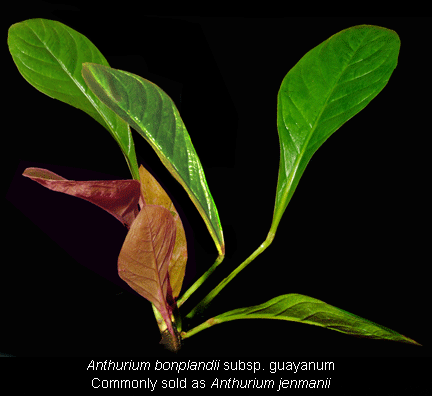 Based
on
an exchange of personal email with Dr.
Croat in 2007 the plant often being sold as Anthurium jenmanii
on eBay and
in
Indonesia is unlikely to be that species.
Dr. Croat sent this response to an Indonesian collector when asked if a
specimen similar to the one at the right was truly Anthurium jenmanii,
Dr. Croat wrote,
"Your
plant is what I treated as Anthurium bonplandii Bunting var. guayanum
(Bunting) Croat. Some still call this Anthurium guayanum but I
chose to consider it a variety of A. bonplandii owing to the immense
variation in both species. Anthurium jenmanii Engl. is very different,
having a spathe that soon falls off and also by lacking the dark
punctuation on the lower blade surface."
The glandular punctations of
Anthurium bonplandii subsp. guayanum can be seen here:
Click
this link
Based
on
an exchange of personal email with Dr.
Croat in 2007 the plant often being sold as Anthurium jenmanii
on eBay and
in
Indonesia is unlikely to be that species.
Dr. Croat sent this response to an Indonesian collector when asked if a
specimen similar to the one at the right was truly Anthurium jenmanii,
Dr. Croat wrote,
"Your
plant is what I treated as Anthurium bonplandii Bunting var. guayanum
(Bunting) Croat. Some still call this Anthurium guayanum but I
chose to consider it a variety of A. bonplandii owing to the immense
variation in both species. Anthurium jenmanii Engl. is very different,
having a spathe that soon falls off and also by lacking the dark
punctuation on the lower blade surface."
The glandular punctations of
Anthurium bonplandii subsp. guayanum can be seen here:
Click
this link
In a message to expert aroid grower Denis Rotolante who with his son
Bill own Silver Krome Gardens in Homestead, FL, Dr. Croat
wrote:
"There
has not been anything published since I published my revision of
Anthurium sect. Pachyneurium in the Annals of the Missouri Botanical
Garden 78(3): 539-855.1991. The attractive, coriaceous bird's nest
sometimes called "jenmanii" sometimes A. bonplandii guayanum,
sometimes as A. guayanum had the young leave reddish on the lower
surface when young. I treated this as Anthurium
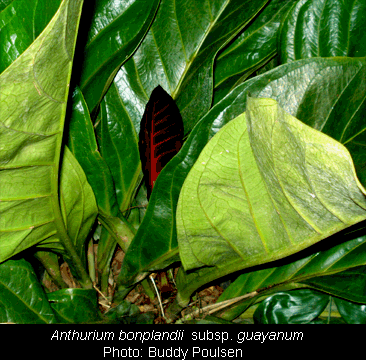 bonplandii ssp.
guayanum but it might just as easily be considered a distinct species
as was treated by George Bunting. It is just
that there is so much
variation in all of those taxa that I could not find clear
separation in them. Certainly this plant did not have anything
really in common with A. jenmanii, a species which has a spathe
that soon withers and falls off. "
According to Dr. Croat the
species that produces the purple-red leaf is not Anthurium jenmanii
but instead is Anthurium bonplandii
subsp. guayanum.
bonplandii ssp.
guayanum but it might just as easily be considered a distinct species
as was treated by George Bunting. It is just
that there is so much
variation in all of those taxa that I could not find clear
separation in them. Certainly this plant did not have anything
really in common with A. jenmanii, a species which has a spathe
that soon withers and falls off. "
According to Dr. Croat the
species that produces the purple-red leaf is not Anthurium jenmanii
but instead is Anthurium bonplandii
subsp. guayanum.
Specimens bearing the name "Anthurium
jenmanii" are often
either hybridized forms (not pure
species) or plants that may be erroneously using the name. As an example, the plant sold
in Indonesia as Anthurium jenmanii
Cobra is a hybrid form with an unknown parentage. Although
a beautiful specimen, it is not
 representative of the species known to
science as
Anthurium jenmanii.
representative of the species known to
science as
Anthurium jenmanii.
Too often growers elect to use a scientific name on the specimens they sell without regard to the botanical characteristics of the species. Just because the seller's tag says "Anthurium jenmanii" does not mean the plant is truly Anthurium jenmanii. The difference between horticultural names and botanical science is vast. The true Anthurium jenmanii does not produce the purple/red leaf blade when young while Anthurium bonplandii guayanum does.
An examination of the photos included on this page shows the obvious differences in the two species but there are also technical scientific differences (read the text just above). Anthurium bonplandii subsp. guayanum also has a cataphyll that does not persist as fibers. Very importantly the species Anthurium bonplandii subsp. guayanum has blackish dots on the abaxial (underside) of the leaf blade known as glandular punctates while Anthurium jenmanii does not. You can read about and see the glandular punctates of Anthurium bonplandii subsp. guayanum here.
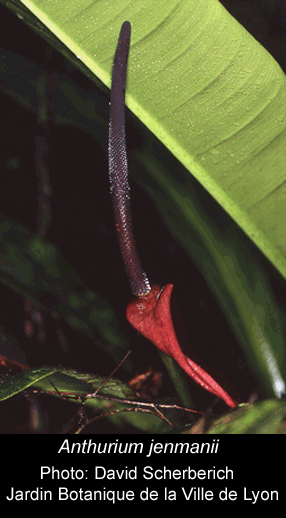
Since Anthurium species are unisexual and produce both sexes on a single flower it is possible for the plant to be self pollinated (see the very tiny seeds of Anthurium jenmanii below, left). The production of an inflorescence on Anthurium jenmanii is not uncommon and both the spathe and spadix are purple in color. The spathe may be a lighter color on the upper surface due to natural variation. Dr. Croat noted the spathe is both spreading and reflexed (turned backwards as in the photo right).
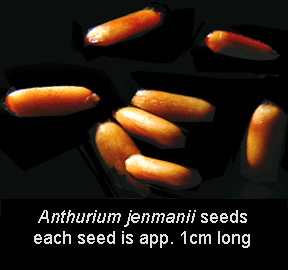 fading to whitish
at the base. However the shape is different. Anthurium jenmanii : oval
like an egg, Anthurium bonplandii:
shorter seeds, they look triangular to trapezium
from the side."
fading to whitish
at the base. However the shape is different. Anthurium jenmanii : oval
like an egg, Anthurium bonplandii:
shorter seeds, they look triangular to trapezium
from the side." 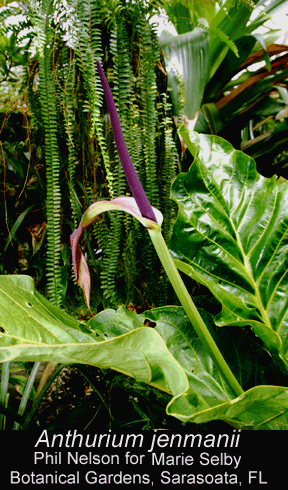 Aroid expert Leland Miyano in Hawaii offered
this opinion after reviewing the material on this page,
"I have grown what I believed to be
Anthurium jenmanii for years. At this point in time, I am not so
sure. My plants under this name were supposedly collected in
Trinidad by Richard Sheffer many years ago but the plants do not
conform to all the characters of the description in Dr. Croat's
revision of section Pachyneurium. This species is rather plastic
from the description and I would accept the opinion of Dr. Croat,
Joep Moonen, and David Scherberich, who have these species and have
seen them in habitat."
Aroid expert Leland Miyano in Hawaii offered
this opinion after reviewing the material on this page,
"I have grown what I believed to be
Anthurium jenmanii for years. At this point in time, I am not so
sure. My plants under this name were supposedly collected in
Trinidad by Richard Sheffer many years ago but the plants do not
conform to all the characters of the description in Dr. Croat's
revision of section Pachyneurium. This species is rather plastic
from the description and I would accept the opinion of Dr. Croat,
Joep Moonen, and David Scherberich, who have these species and have
seen them in habitat."Despite common misconceptions, species within the Neotropical genus Anthurium are not found naturally in Asia or the Pacific region but that does not mean they are not grown all over the world! People obviously grow Anthurium species in many countries, but Anthurium are not naturally found in the Pacific basin or Asia and are strictly found naturally within Mexico, Central America, South America, and the West Indies.
My thanks to Dr. Croat for his input and the use of his published material. Thanks also to botanist David Scherberich, Jardin Botanique de la Ville de Lyon, Parc de la Tete d'Or, France for the use of his photographs of Anthurium jenmanii as to to Phil Nelson and Harry Luther at the Marie Selby Botanical Gardens in Sarasota, FL. Also my sincere thanks to Emily Colletti who is the chief aroid greenhouse keeper at the Missouri Botanical Garden in St. Louis, MO for her assistance in photographing a specimen of Anthuiurm jenmanii in the garden's collection and finally to my friends Joep Moonen, Bill Rotolante and aroid expert Leland Miyano for their assistance.
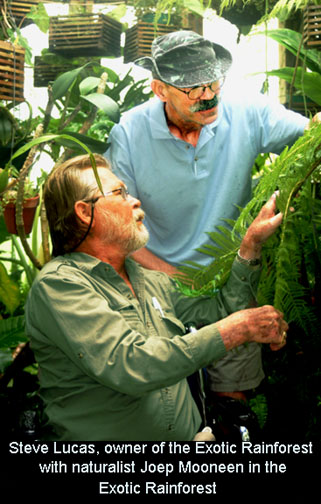
 Joep Moonen
along with his wife Marijke and son Bernie live and work at their
Emerald Jungle Village in the rain forests of French Guiana. A Dutch
naturalist who regularly takes botanists and scientists into the rain
forests of the Guiana Shield to search for new and undiscovered animal
and plant specimens, Joep has been honored by having several species including Anthurium moonenii,
Philodendron moonenii
and others named to science in his honor.
If you enjoy spending time in a rain forest
filled with exotic creatures and extremely rare exotic plant species
Joep Moonen will enjoy introducing you to the rain
forests of northeast South America.
Joep Moonen
along with his wife Marijke and son Bernie live and work at their
Emerald Jungle Village in the rain forests of French Guiana. A Dutch
naturalist who regularly takes botanists and scientists into the rain
forests of the Guiana Shield to search for new and undiscovered animal
and plant specimens, Joep has been honored by having several species including Anthurium moonenii,
Philodendron moonenii
and others named to science in his honor.
If you enjoy spending time in a rain forest
filled with exotic creatures and extremely rare exotic plant species
Joep Moonen will enjoy introducing you to the rain
forests of northeast South America. The Emerald Jungle Village website can be found at http://home.planet.nl/~gumamaus/
Additional photographs by botanist David Scherberich can be seen here: http://www.aroidpictures.fr/GENRES/anthuriuma-l.html