
Aroids and other genera in the Collection
Take the Tour Now?
Orchids
The
Exotic Rainforest
Plants in
the Exotic Rainforest Collection
The images on this website are copyright protected. Please contact us before any reuse.
Detailed information on Growing Anthurium Species
Click this Link
The Exotic Rainforest is a private botanical garden.
Within our collection we have many species of Anthurium. If you are seeking other photos, click this link:
New: Understanding, pronouncing and using Botanical terminology, a Glossary
Anthurium bonplandii subsp. guayanum (G.S. Bunting) CroatA subspecies of Anthurium bonplandii
See Anthurium jenmanii here: http://www.exoticrainforest.com/Anthurium%20jenmanii%20pc.html

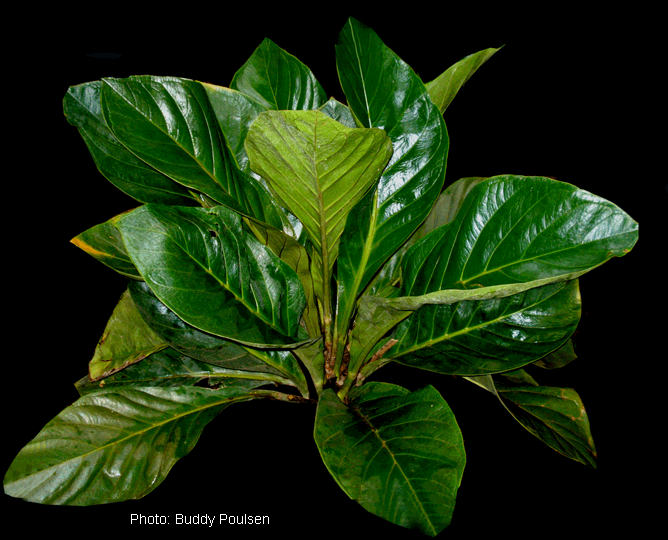
Anthurium bonplandii subspecies guayanum
Additional Anthurium bonplandii subspecies: Anthurium bonplandii subspecies cuatrecasii,
Anthurium bonplandii subspecies bonplandii
A. bonplandii subsp guayanum is confused with Anthurium jenmanii but does not appear the same.
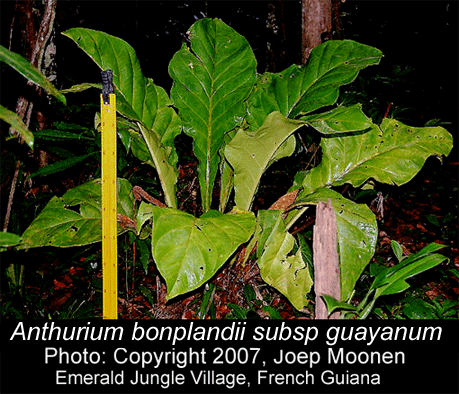 A member of Anthurium section
Pachyneurium which contains all the
birds nest forms,
Anthurium bonplandii was described to science by George Bunting in 1975 from a specimen observed in the Amazon
region of Venezuela near Río Orinoco. Anthurium
bonplandii subsp. guayanum is a unique subspecies of
Anthurium bonplandii that has been further described by Dr. Tom Croat.
Anthurium bonplandii has been divided into several subspecies although
all are considered to be Anthurium bonplandii. However, Anthurium
bonplandii subsp. guayanum is distinctive. According to
personal communication with Dr. Croat Anthurium bonplandii
subsp. guayanum
is likely to be the plant often incorrectly sold on internet auctions as Anthurium jenmanii.
A member of Anthurium section
Pachyneurium which contains all the
birds nest forms,
Anthurium bonplandii was described to science by George Bunting in 1975 from a specimen observed in the Amazon
region of Venezuela near Río Orinoco. Anthurium
bonplandii subsp. guayanum is a unique subspecies of
Anthurium bonplandii that has been further described by Dr. Tom Croat.
Anthurium bonplandii has been divided into several subspecies although
all are considered to be Anthurium bonplandii. However, Anthurium
bonplandii subsp. guayanum is distinctive. According to
personal communication with Dr. Croat Anthurium bonplandii
subsp. guayanum
is likely to be the plant often incorrectly sold on internet auctions as Anthurium jenmanii.
Anthurium bonplandii subsp. guayanum is found in Bolivar state in the Guiana highlands of Venezuela but is also found in Guiana, northern Brazil and Suriname. Since Anthurium bonplandii is variable the various subspecies including Anthurium bonplandii subsp. bonplandii, Anthurium bonplandii subsp. cuatrecasii, Anthurium bonplandii subsp. guayanum and Anthurium bonplandii subsp. rionegrense may be easily confused in regions where their ranges overlap.
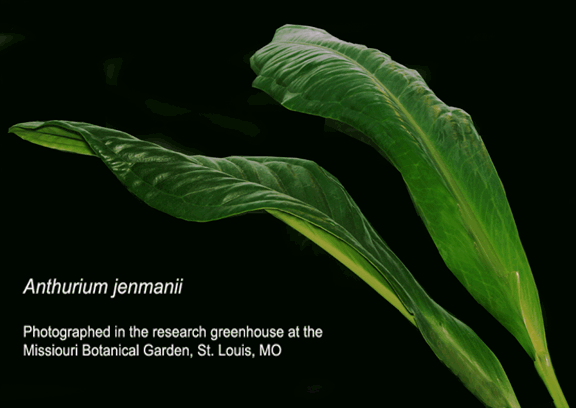 In the year 2007 Anthurium
bonplandii subsp. guayanum may have become one of the most confusing
Anthurium species in the world. According to email
exchanges as well as personal conversations in his office, aroid botanist Dr. Thomas B. Croat
Ph.D., P.A. Schulze Curator of Botany
of the Missouri
Botanical Garden in St. Louis explained the plant sold most often in
Indonesia and on eBay as Anthurium jenmanii, is not likely that species.
In the year 2007 Anthurium
bonplandii subsp. guayanum may have become one of the most confusing
Anthurium species in the world. According to email
exchanges as well as personal conversations in his office, aroid botanist Dr. Thomas B. Croat
Ph.D., P.A. Schulze Curator of Botany
of the Missouri
Botanical Garden in St. Louis explained the plant sold most often in
Indonesia and on eBay as Anthurium jenmanii, is not likely that species.
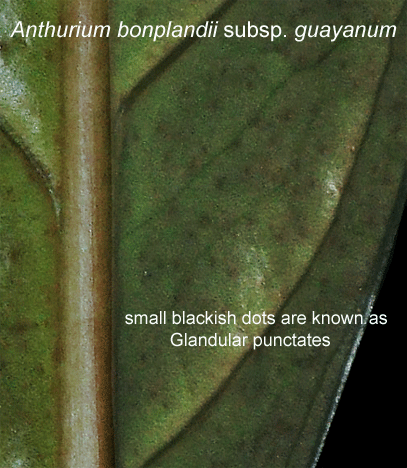
When asked by an Indonesian collector for an opinion of whether or not a specimen in that collector's possession was Anthurium jenmanii or Anthurium bonplandii subsp. guayanum, Dr. Croat wrote: "Your plant is what I treated as Anthurium bonplandii Bunting var. guayanum (Bunting) Croat. Some still call this Anthurium guayanum but I chose to consider it a variety of A. bonplandii owing to the immense variation in both species. Anthurium jenmanii Engl. is very different, having a spathe that soon falls off and also by lacking the dark punctuation on the lower blade surface." (Please see photo left)
 Anthurium bonplandii subsp. guayanum occurs in the Guiana Shield
in the highlands of
Venezuela, Brazil, Guyana, and Suriname with the majority of specimens
seen in Venezuela's Bolivar
State. Found at elevations ranging from as low as
near sea level to 100 meters (300 feet), the average elevation is 400 to 1,500 meters
1,300 to 4,900 feet) on sandstone outcroppings and
growing on sandstone boulders. Anthurium bonplandii subsp.
guayanum can sometimes be observed growing in white sand in both the open
sun and in
partial shade. A variable Anthurium subspecies, Anthurium
bonplandii subsp. guayanum occurs in pre-mountainous
moist and wet rain forests as well as tropical wet forest zones.
Anthurium bonplandii subsp. guayanum occurs in the Guiana Shield
in the highlands of
Venezuela, Brazil, Guyana, and Suriname with the majority of specimens
seen in Venezuela's Bolivar
State. Found at elevations ranging from as low as
near sea level to 100 meters (300 feet), the average elevation is 400 to 1,500 meters
1,300 to 4,900 feet) on sandstone outcroppings and
growing on sandstone boulders. Anthurium bonplandii subsp.
guayanum can sometimes be observed growing in white sand in both the open
sun and in
partial shade. A variable Anthurium subspecies, Anthurium
bonplandii subsp. guayanum occurs in pre-mountainous
moist and wet rain forests as well as tropical wet forest zones.
A. bonplandii subsp. guayanum is primarily terrestrial and is found less frequently as an epiphyte (ep-a-FIT) growing on trees. Within the rain forest it is not uncommon to see very large Anthurium specimens residing high on a tree branch. The species was reported by Bunting to be a favorite place for ants to build a colony at its base. Plants which attract ants are known as myrmecophytes.
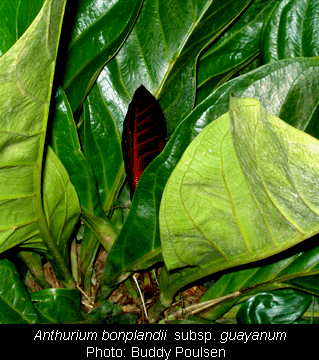
The message below was sent to
Denis Rotolante who with his son Bill are owners of Silver Krome Gardens in
Homestead, FL. Dr. Croat wrote, "There
has not been anything published since I
published my revision of
Anthurium sect. Pachyneurium in the Annals of the Missouri Botanical
Garden 78(3): 539-855.1991. The attractive, coriaceous bird's nest
sometimes called "jenmanii" sometimes A. bonplandii guayanum,
sometimes as A. guayanum had the young leave reddish on the lower
surface when young. I treated this as Anthurium bonplandii ssp.
guayanum but it might just as easily be considered a distinct species
as was treated by George Bunting. It is just that there is so much
variation in all of those taxa that I could not find clear
separation in them. Certainly this
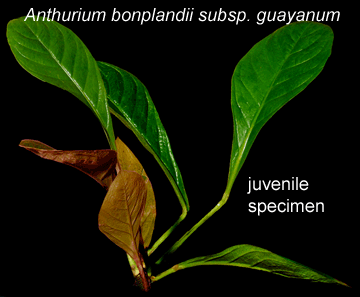 plant did not have anything
really in common with A. jenmanii, a species which has a spathe
that soon withers and falls off. "
Within his message Dr,
Croat was referring to his journal, Annals of the Missouri Botanical
Garden 1991, A Division of Anthurium Section Pachyneurium, Volume
78, #3. According to Tom and the information specified in that
journal regarding both Anthurium jenmanii and Anthurium bonplandii
subsp. guayanum the species that produces the purple/red
leaf is not Anthurium jenmanii but
Instead is Anthurium
bonplandii subsp. guayanum.
plant did not have anything
really in common with A. jenmanii, a species which has a spathe
that soon withers and falls off. "
Within his message Dr,
Croat was referring to his journal, Annals of the Missouri Botanical
Garden 1991, A Division of Anthurium Section Pachyneurium, Volume
78, #3. According to Tom and the information specified in that
journal regarding both Anthurium jenmanii and Anthurium bonplandii
subsp. guayanum the species that produces the purple/red
leaf is not Anthurium jenmanii but
Instead is Anthurium
bonplandii subsp. guayanum.
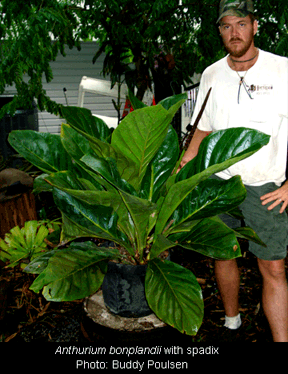
Anthurium bonplandii subsp. guayanum can be recognized by
usually large and frequently broad leaf blades as well as by possessing thick
leathery (coriaceous) leaves. The species has conspicuous dark
glandular punctations (dots) on the abaxial (lower) leaf surface.
As opposed to Anthurium bonplandii subsp. bonplandii, Anthurium
bonplandii subsp. guayanum possesses oblanceolate to obovate (both
oblong and lance shaped but wider near the tip or oblong
and widest at
the center) leaf blades while Anthurium bonplandii subsp. bonplandii
produces largely an elliptic leaf
 shape.
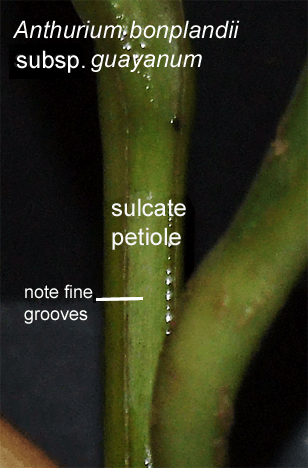
The blades Anthurium bonplandii subsp. guayanum are oblanceolate to obovate in shape, The adaxial (upper) surface of the leaf blades are dark and semi-glossy. One notable feature to Anthurium bonplandii subsp. guayanum is the midrib is broadly sulcate at the base. Sulcate indicates either a canal known as a sulcus or having numerous fine parallel grooves which may require a magnifying glass to be clearly observed. The primary leaf veins are raised while the tertiary (minor) veins are sunken. The underside of the leaf blade is slightly paler in color and is semi-glossy to matte in its sheen. On the underside of the leaf the tertiary veins are raised. As an adult, the leaf blades of Anthurium bonplandii subsp. guayanum are arching and stand erect
The blades are supported by the petioles
which collectors frequently refer to as "the stems". In
science the
stem is at the base of the plant and the leaves grow from the nodes
along that stem (see photo below, left). The petioles are the stalk that supports a leaf
and attaches the blade to the stem. The petioles of Anthurium
bonplandii subsp. guayanum are "C" shaped but may also be
sharply "D" shaped when cut and viewed as
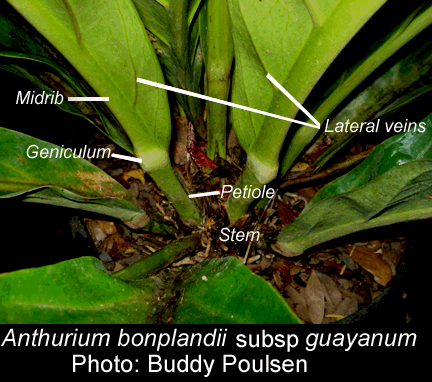 a cross section. The petioles are also sulcate.
Again, the term "sulcate" means scored or grooved
in a parallel fashion (see photo right).
The internodes of
Anthurium bonplandii subsp. guayanum are short. An internode
is a segment of the stem between two nodes on that stem and the node
is where a leaf may emerge.
a cross section. The petioles are also sulcate.
Again, the term "sulcate" means scored or grooved
in a parallel fashion (see photo right).
The internodes of
Anthurium bonplandii subsp. guayanum are short. An internode
is a segment of the stem between two nodes on that stem and the node
is where a leaf may emerge.
 Once a new leaf is produced, it is
surrounded by a sheath-like structure known to as the
cataphyll.
The
cataphylls are bract like modified leaves that surround any new
leaf and whose purpose is to protect the emerging leaves
as they develop.
The
cataphylls of
Anthurium bonplandii subsp. guayanum are sub-coriaceous (less
than leathery to the touch) and are lanceolate as well as tinged
reddish.
Once a new leaf is produced, it is
surrounded by a sheath-like structure known to as the
cataphyll.
The
cataphylls are bract like modified leaves that surround any new
leaf and whose purpose is to protect the emerging leaves
as they develop.
The
cataphylls of
Anthurium bonplandii subsp. guayanum are sub-coriaceous (less
than leathery to the touch) and are lanceolate as well as tinged
reddish.
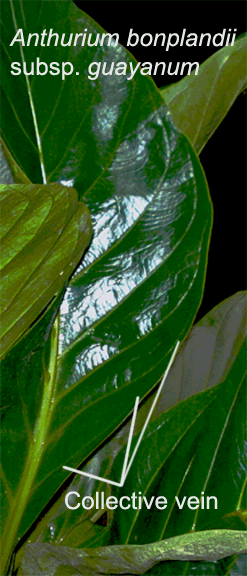
All Anthurium possess a collective vein which runs near the edge of the leaf blade. The collective vein is a specialized vein and often runs around the entire circumference of an Anthurium's blade (not always) and is a primary characteristic used to determine if a specimen is, or is not, an Anthurium.
An aroid, all Anthurium species reproduce via the production an inflorescence. The stalk that supports the entire inflorescence is the peduncle. When an Anthurium is "in flower" the reference is to the tiny flowers containing both male and female sexual parts that grow on the spadix at the center of the inflorescence. Unlike Philodendron species which contain imperfect flowers having only a single sex Anthurium possess perfect flowers containing both sexes. To help prevent self pollination nature has designed the female flowers to be receptive before the male portion of a flower produces pollen so in most cases an insect must bring pollen from another plant.
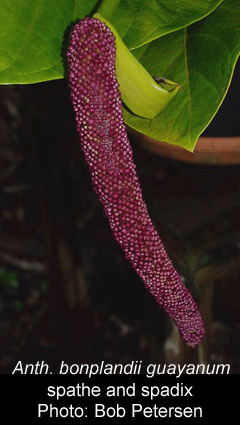 The spathe and spadix
make up the
reproductive portions of the plant and the spathe is sometimes incorrectly called a
"flower". Rather than a flower the spathe is a modified leaf. The
spathe of Anthurium bonplandii guayanum is green
and is reflexed (turned back) while the spadix at its center hangs pendently (downward) and vaguely
resembles an elongated pine cone. The spadix is a spike on a
thickened fleshy axis which can produce tiny flowers. The spadix may be reddish
to purple to purple/brown at anthesis and is ready to be pollinated.
The spathe and spadix
make up the
reproductive portions of the plant and the spathe is sometimes incorrectly called a
"flower". Rather than a flower the spathe is a modified leaf. The
spathe of Anthurium bonplandii guayanum is green
and is reflexed (turned back) while the spadix at its center hangs pendently (downward) and vaguely
resembles an elongated pine cone. The spadix is a spike on a
thickened fleshy axis which can produce tiny flowers. The spadix may be reddish
to purple to purple/brown at anthesis and is ready to be pollinated.
Once the female flowers on the spadix
have been fertilized by a
Cyclocephala
beetle they produce berries which are reddish purple as well as obovoid
(oval and oblong). When "in fruit", those berries contain
the seeds of the aroid and the entire structure is known as an
infructesence.
Joep Moonen made this
observation regarding berry coloration and seed shape.
"The berries and
seeds from both species have the same color: purple-red, fading to whitish
at the base. However the shape is different. A. jenmannii: oval
like an egg, A. bonplandii: shorter seeds, they look triangular to trapezium
from the side."
You can see a photograph of the
seeds of Anthurium jenmanii here:
Anthurium
jenmanii
The beetle genus Cyclocephala is thought to contain close to 900 species of which approximately one half have been identified to science. Each Cyclocephala species appears to have been "assigned" by nature to pollinate only a few species of aroids. A link can be found at the end of this article which explains more about the pollination of aroids.
 French
Guiana that are now in my collection that are likely A. bonplandii but I
call them A. guayanum. Very nice plants. I find the leaf form much
prettier than A. jenmanii and they resist many more leaf eating insects
than A. jenmannii. Mine flower regularly and produce seeds a few times
each year. Obviously, they are rare. I know them only from one
mountain about 85 km's from my home."
In a separate email message he asked that I add,
"Anthurium bonplandii seems to prefer more shady places. In my
only location they grow on rocks and the forest floor as well as on
fallen logs."
French
Guiana that are now in my collection that are likely A. bonplandii but I
call them A. guayanum. Very nice plants. I find the leaf form much
prettier than A. jenmanii and they resist many more leaf eating insects
than A. jenmannii. Mine flower regularly and produce seeds a few times
each year. Obviously, they are rare. I know them only from one
mountain about 85 km's from my home."
In a separate email message he asked that I add,
"Anthurium bonplandii seems to prefer more shady places. In my
only location they grow on rocks and the forest floor as well as on
fallen logs." Joep Moonen is a noted Dutch
naturalist who regularly takes botanists and scientists into the rain
forests of the Guiana Shield to search for new and undiscovered animal
and plant specimens. Several species including Anthurium moonenii
have been named by botanical scientists in his honor.
If you enjoy spending time in a rain forest
filled with exotic creatures and extremely rare exotic plant species
Joep Moonen enjoys introducing you to the rain
forests of northeast South America. The Emerald Jungle Village
website can be found at
http://home.planet.nl/~gumamaus/
Joep Moonen is a noted Dutch
naturalist who regularly takes botanists and scientists into the rain
forests of the Guiana Shield to search for new and undiscovered animal
and plant specimens. Several species including Anthurium moonenii
have been named by botanical scientists in his honor.
If you enjoy spending time in a rain forest
filled with exotic creatures and extremely rare exotic plant species
Joep Moonen enjoys introducing you to the rain
forests of northeast South America. The Emerald Jungle Village
website can be found at
http://home.planet.nl/~gumamaus/My thanks to Joep Moonen, Denis Rotolante and botanist David Scherberich, Jardin Botanique de la Ville de Lyon in France for reviewing this text. My thanks also to Buddy Poulsen for the use of his photographs as well as the gift of two specimens.
