
Aroids and other genera in the Collection
Take the Tour Now?
Orchids
The
Exotic Rainforest
Plants in
the Exotic Rainforest Collection
The images on this website are copyright protected. Please contact us before any reuse.
Detailed information on Growing Anthurium Species
Click this Link
Within our collection we have many species of Anthurium. If you are seeking other photos, click this link:
New: Understanding, pronouncing and using Botanical terminology, a Glossary
Why are Anthurium seeds sometimes difficult to buy and ship?
A select number of wild collected South American Anthurium seeds (including Anthurium jenmanii) can be purchased from my friend Joep Moonen in French Guiana. You can contact Joep (yupe) at this address: EmeraldJungleVillage@wanadoo.fr
Below are alternate links that may help you find an answer to your query. We strive to keep all our articles "user friendly" but still based in science. We also do our best to make these pages understandable and many students use them for class room answers. Please let us know if we can help you find information more easily. Our email address is Steve@ExoticRainforest.com
Click any of these links:
Interested in
learning how to grow Anthurium.
Do you wish to learn about pollination and
how to cause an Anthurium to produce seeds?
Do you find the leaf shapes of
Anthurium plants confusing?
Interested only in the beautiful little Anthurium plant with the
colorful "flower"?
Locate many articles on
plant species on the home page of this website.
Click this link, scroll down the
page and watch the columns on the right!
The information below was posted in mid 2007 due to a dramatic price increase in Anthurium plants in SE Asia. The prices in Asia have now dramatically been reduced especially on sites such as eBay. This newspaper article explains more: http://old.thejakartapost.com/detailcity.asp?fileid=20090124.T04&irec=3
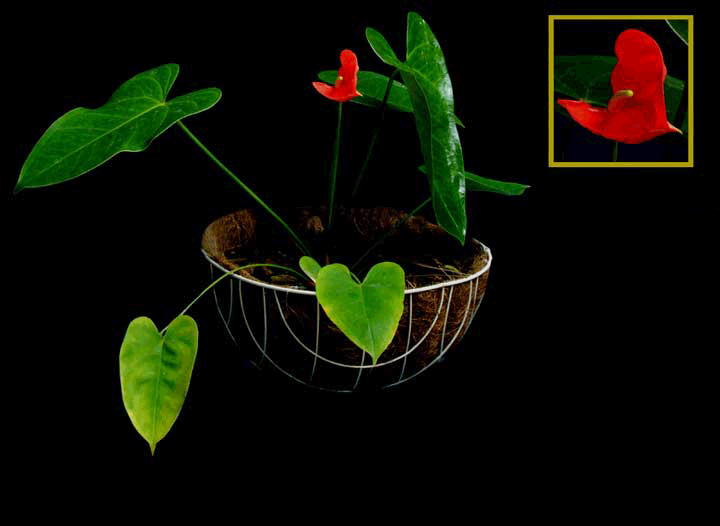 Aroids in the genus
Anthurium are strictly a Neotropical plant group found naturally only in
Mexico, Central America,
South America and the West Indies. There are currently approximately
1000 species known to science and many are not
common plant species.
Growers do grow Anthurium, especially hybrid variations, all over the
world, but the true species are not easily found, nor are they common outside
their native range. Anthurium have recently become a large cash
crop in the country of India and have been grown for many years in Hawaii.
From questions asked on the internet some people appear to believe
Anthurium species commonly grow naturally in Hawaii, on Pacific
islands, and Asia. They do not. Only imported species can be found in
those islands and on any continent other than South America as well as
Central America. After you read this page, and
please finish since you may learn something important about how to buy
Anthurium species, read this page:
http://www.alsgh.com/blog/
If you haven't figured it out already,
Anthurium seeds are not easy to find! This article attempts to
explain why.
Aroids in the genus
Anthurium are strictly a Neotropical plant group found naturally only in
Mexico, Central America,
South America and the West Indies. There are currently approximately
1000 species known to science and many are not
common plant species.
Growers do grow Anthurium, especially hybrid variations, all over the
world, but the true species are not easily found, nor are they common outside
their native range. Anthurium have recently become a large cash
crop in the country of India and have been grown for many years in Hawaii.
From questions asked on the internet some people appear to believe
Anthurium species commonly grow naturally in Hawaii, on Pacific
islands, and Asia. They do not. Only imported species can be found in
those islands and on any continent other than South America as well as
Central America. After you read this page, and
please finish since you may learn something important about how to buy
Anthurium species, read this page:
http://www.alsgh.com/blog/
If you haven't figured it out already,
Anthurium seeds are not easy to find! This article attempts to
explain why.
The ExoticRainforest is a private botanical garden and is not a retail nursery. We do not sell Anthurium seed or specimens. We offer information regarding tropical species but we don't offer plants for sale. At least a portion of the information you are looking to find, including how to find Anthurium for sale is found within this text.
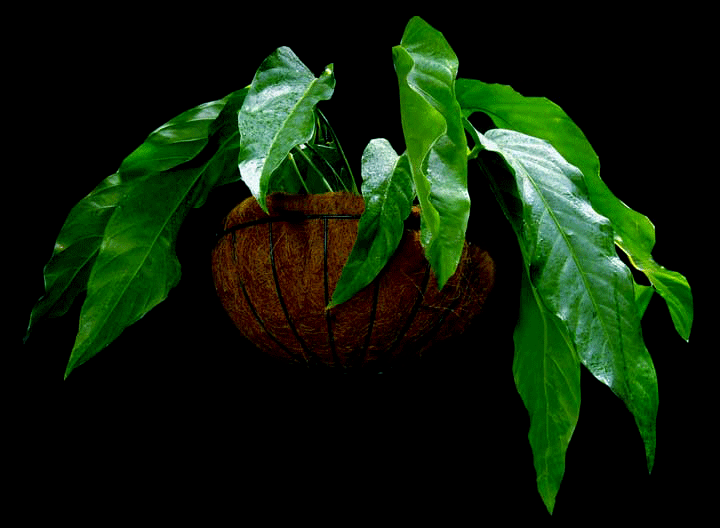 Many
people want to a handful of seeds for just a dollar or two. Some
offer substantially more, but one naturalist in South America told me that
no price was worth the effort to go out and collect the seeds! I've
received requests for up to 10,000 seeds at one time! That number
would be virtually impossible to find in North America.
The life expectancy (viability) of Anthurium seed is short. If
they die in transit the buyer is going to want their money back!
That alone makes the effort not worthwhile. If not packed
perfectly, they will likely produce nothing in only a few weeks. I'm
not sure if the people who make these kinds of requests truly understand how
short the seed viability actually is as well as how long and
difficult it is to grow, clean and collect a small bag of seeds.
Many
people want to a handful of seeds for just a dollar or two. Some
offer substantially more, but one naturalist in South America told me that
no price was worth the effort to go out and collect the seeds! I've
received requests for up to 10,000 seeds at one time! That number
would be virtually impossible to find in North America.
The life expectancy (viability) of Anthurium seed is short. If
they die in transit the buyer is going to want their money back!
That alone makes the effort not worthwhile. If not packed
perfectly, they will likely produce nothing in only a few weeks. I'm
not sure if the people who make these kinds of requests truly understand how
short the seed viability actually is as well as how long and
difficult it is to grow, clean and collect a small bag of seeds.
Even though I grow many rare
Anthurium species, and do sometimes grow seeds, those seeds are not
readily available. And if they were, the seeds of the rarer species
are valuable! Some, very valuable. Most growers who manage to
produce and harvest seed just don't wish to sell them. And there is a very
good reason.
If a grower floods the market with too many Anthurium plants he/she
can easily destroy their own market. This has been proven over and over again with
species such as
Anthurium veitchii and more recently with Anthurium jenmanii,
or at least a plant everyone thought was Anthurium jenmanii. Just a few years ago a small specimen of
Anthurium veitchii could demand a price of $100.00. Today, most growers
can't sell that species for prices as low as $5.00 or $6.00! And there
are other species that have suffered the same fate. Although
beautiful, Anthurium veitchii makes a less-than-perfect
house plant. An Anthurium grower
in the United States who controls their market can easily demand $20 to $100
for a
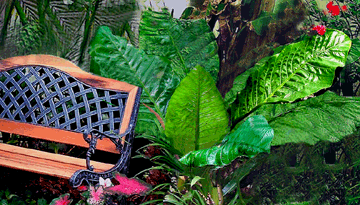 nice small
Anthurium specimen depending on the rarity of the species. If one
is lucky enough to produce seeds the grower would rarely be willing to sell them
when they can grow a few of the plants themselves and then sell those plants
in a few years at a substantially higher price. When I purchased
my first
Anthurium regale I paid $130 for a small specimen. Today you
can sometimes find one for $30. The more plants that are offered, the lower the
prices fall. Were anyone to obtain 10,000 seeds of a rare species the price
of that specimen would drop to a very low price. It is called "price
and demand". Just ask the growers in Indonesia who now find the prices
in their country have dropped so low few growers can make a good profit. Too many plants
offered for sale results in much lower
prices.
nice small
Anthurium specimen depending on the rarity of the species. If one
is lucky enough to produce seeds the grower would rarely be willing to sell them
when they can grow a few of the plants themselves and then sell those plants
in a few years at a substantially higher price. When I purchased
my first
Anthurium regale I paid $130 for a small specimen. Today you
can sometimes find one for $30. The more plants that are offered, the lower the
prices fall. Were anyone to obtain 10,000 seeds of a rare species the price
of that specimen would drop to a very low price. It is called "price
and demand". Just ask the growers in Indonesia who now find the prices
in their country have dropped so low few growers can make a good profit. Too many plants
offered for sale results in much lower
prices.
The current motivation in SE Asia appears to be the magnificent size of some Anthurium specimens. Anthurium schlechtendalii (photo above right) can grow to be immense. These are known as "birds nest" forms and are members of Anthurium Section Pachyneurium. But those specimens take a lot of space to grow! In Florida, an acre of good land can cost $1,000,000 or more not counting building structures so a grower with only four or five acres can invest a large amount of money. Those who grow these plants have made substantial investments in their businesses and do not wish to destroy that investment by having the price of the product drop to near zero. There are growers in Florida that often do grow Anthurium for either retail or wholesale purposes, but even they often control the number of specimens they will grow.
I suspect the real reason so many growers, especially in SE Asia, want to large quantities of seed is they think they can get rich quick! During the summer of 2007 they saw common plants sell on eBay for upwards of $500 to as high as $900 each and everyone wanted to cash in. But they do so without realizing they are affecting the law of "price and demand". And on eBay, the demand has dropped so low that the prices are now also low! They hope to sell the plants at a substantial profit and hope growers in the United States will sell the seeds for a low price. But if 10,000 specimens of a previously rare plant suddenly hit the market the price would plummet from perhaps $100 per plant to a few dollars per plant! And that quickly destroys the market.
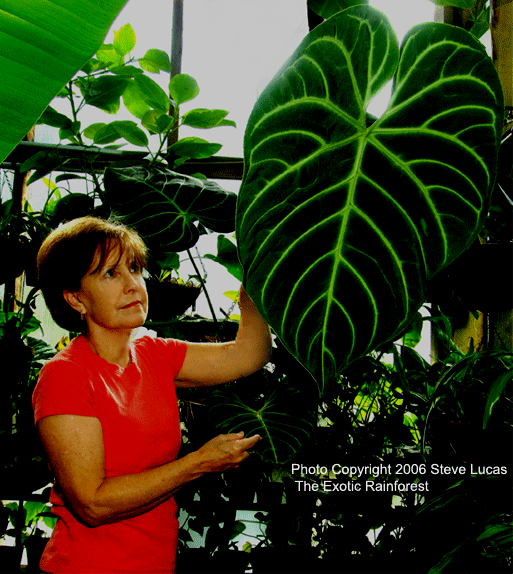 After I declined a recent offer
one Indonesian grower then sent back an email saying he could demand up to
$100,000 for a single plant. Perhaps, but you can't sell 1000 plants
for that price! Why? People will only pay a high price if
the plant is very difficult to obtain! If you have 10,000 of
those plants to sell, how much can you ask for a specimen? He was
also hoping someone would sell him the often difficult to obtain seeds for
just a few cents each. There are growers in some areas of the United States
that do harvest seeds, but I promise it is highly unlikely they will
even answer an email from anyone wishing to buy those seeds. They prefer to
grow just enough of them to keep the market healthy and then sell the
plants.
After I declined a recent offer
one Indonesian grower then sent back an email saying he could demand up to
$100,000 for a single plant. Perhaps, but you can't sell 1000 plants
for that price! Why? People will only pay a high price if
the plant is very difficult to obtain! If you have 10,000 of
those plants to sell, how much can you ask for a specimen? He was
also hoping someone would sell him the often difficult to obtain seeds for
just a few cents each. There are growers in some areas of the United States
that do harvest seeds, but I promise it is highly unlikely they will
even answer an email from anyone wishing to buy those seeds. They prefer to
grow just enough of them to keep the market healthy and then sell the
plants.
Despite
what many appear to believe, growers in the United States do not have yards
filled with adult Anthurium specimens! The seeds are often
quite rare. Most people do not realize the life cycle of an
Anthurium species is complicated. Anthurium species possess
one of nature's most interesting forms of plant reproduction. First
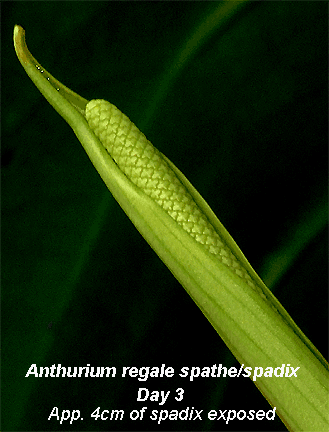
the plant has to produce an inflorescence. That inflorescence is
composed of many parts, but the principal ones are the spathe and spadix and
may take months to develop. The spathe looks like a "flower"
but is not! The spathe is simply a specially adapted leaf. At the
center of the spathe is an elongated portion known as the spadix. The
true flowers, both male and female, form on the spadix, but are extremely
small. That too can take months.
Species require a natural
insect pollinator to pollinate the spadix and that insect is almost always a
beetle from the genus Cyclocephala. And that
insect is "assigned" to pollinate a specific species and does not live in North America. When ready to
reproduce, the plant emits a "perfume" known as a pheromone that one
particular species of male beetle which lives where the Anthurium grows naturally can
detect. The spadix can be pollinated by humans using a very light
camel hair brush, but it is difficult to time perfectly and requires
expertise. In most cases you can't just remove the pollen from
the spadix and apply it to the female flowers of the same spadix since the
male flowers which produce pollen form after the receptive female flowers
are spent. You
must collect and freeze the pollen when it is produced and save it in a
special freezer container until the next time the plant produces a spathe
and spadix. Only
then can you apply it, and even that is difficult. The total time can
easily be well over one year. Why? Read this page:
More
information on Anthurium species? Click this
link.
The
male, female and sterile flowers of Anthurium species are produced along the spadix at the
center of the inflorescence and are very tiny. You need a very good
magnifying tool to even see them. Some species allow the male and female
flowers to grow together up
and down the length of the spadix but many of
the rarer species do not. The female and male flowers are intentionally
divided by a sterile zone to prevent self pollination. Nature is very
clever! The female
 flowers become "receptive" first and that can be
detected only when the spadix begins to produce pheromones (scent, or
perfume) and a light liquid. Frequently you can smell the perfume
several feet away but you must be observant! If you miss
it your opportunity has passed for perhaps another year.
flowers become "receptive" first and that can be
detected only when the spadix begins to produce pheromones (scent, or
perfume) and a light liquid. Frequently you can smell the perfume
several feet away but you must be observant! If you miss
it your opportunity has passed for perhaps another year.
If a beetle that is appropriate for that species is present, and picks up
pollen from a separate plant already at male anthesis the female flowers may then be pollinated.
BUT, the male flowers often do not begin to produce pollen until well after
the female flowers are spent. So unless you have already collected
pollen and stored it in a freezer under special conditions there is none
available for you to use to pollinate the plant. Only a few collectors
will have two or more plants of the same species so it is highly unlikely,
even if you do have multiple specimens, to have both come into fertility at
precisely the right time when one is producing male flowers and the other is
producing female flowers. It almost never happens in a
collection. If you want to know more about aroid pollination read this
page:
Natural pollination in aroid species
The pollen is also extremely fine and difficult to collect correctly.
It must be totally free of moisture and stored in a frozen sealed tube until
you are ready to use it. Few serious collectors will take the time to
collect it and wait 7 months or more for another spadix to develop, then
apply. And if they do, it is highly unlikely they will sell those
seeds for a fraction of their worth.
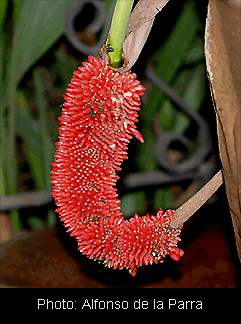
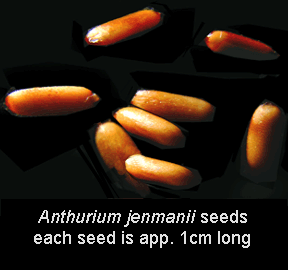 Once pollinated, the spadix will
produce berries in approximately the next three months and those berries
contain the seeds, normally two seeds per berry. As a result, seeds
are rare in a collector's growing situation! Especially in the rarer
species that most of the folks in Indonesia and southeast Asia are trying to
! There are a few species that will self pollinate, but only a few.
In the genus Anthurium there are some species which produce ripe
fruit with viable seed without pollination. This phenomenon is known to a
botanist as the species being apomictic.
Once pollinated, the spadix will
produce berries in approximately the next three months and those berries
contain the seeds, normally two seeds per berry. As a result, seeds
are rare in a collector's growing situation! Especially in the rarer
species that most of the folks in Indonesia and southeast Asia are trying to
! There are a few species that will self pollinate, but only a few.
In the genus Anthurium there are some species which produce ripe
fruit with viable seed without pollination. This phenomenon is known to a
botanist as the species being apomictic.
Anthurium species are
known to be highly variable and not every leaf of every specimen will always
appear the same. This link explains in greater detail the scientific
principle of natural variation and morphogenesis.
Click here.
Sorry, we don't sell
Anthurium
seeds!
Specimens may be available
from
Brian's Botanicals
http://www.briansbotanicals.net/


If you are seeking information on rare species, click on "Aroids and other genera in the Collection"
at the top of this page and look for the
