
Aroids and other genera in the Collection
Take the Tour Now?
Orchids
The
Exotic Rainforest
Plants in
the Exotic Rainforest Collection
Images on this website are copyright protected. Contact us before
attempting to reuse.
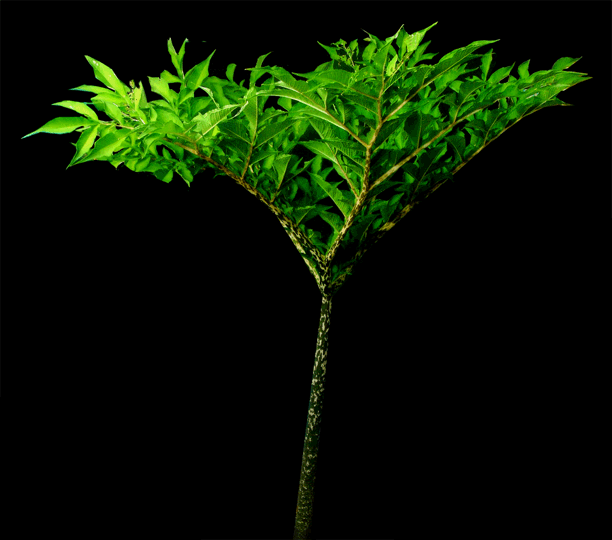
Synonyms: Amorphophallus rivieri Durieu ex Carrière 1869
Amorphophallus mairei H. Lév. 1914
Amorphophallus konjac K. Koch ex Matsum. & Hayata 1906
Amorphophallus konjac K. Koch ex N.E. Br. 1903
Sometimes known as: Devil's Tongue, Snake Palm, Konnyaku, Pinyin, Konjaku, and Elephant Yam
 Although this
species is sometimes sold as
Amorphophallus rivieri
the accepted scientific name is Amorphophallus konjac since that
was the first name under which it was published in 1858.
Although this
species is sometimes sold as
Amorphophallus rivieri
the accepted scientific name is Amorphophallus konjac since that
was the first name under which it was published in 1858.
Amorphophallus konjac receives one of its common names, "Snake Plant", from the pattern on its petiole (stem). This unusual aroid is grown in many Eastern Asian countries as a food crop and is extremely popular in Japan as a supplement in soups and stews.
Aroid botanist Dr. Eduardo Gonçalves noted when asked where the name "konjac" originated, "As far as I know, its name came from the Japanese konnyaku, that is a jelly food made with konjac´s special sugars (glucomannans) that is usually eaten with soy or fish sauce."
Amorphophallus konjac is found in nature from China and Vietnam and has been grown as a crop in southern China since the Tang Dynasty (AD 608-907. In China and Japan, Amorphophallus konjac is cultivated as a source of flour and other uses, often as a source of food. To prepare it for cooking it is reduced to a block with a gelatin appearance and sold like tofu in many stores. Purportedly it will help clean toxins from the body. Studies have indicated the plant is useful in weight control as well as having medicinal properties for the control of constipation , high blood pressure, hypoglycemia and other conditions. (Doi et al., 1979; Misra & Sriram, 2002).
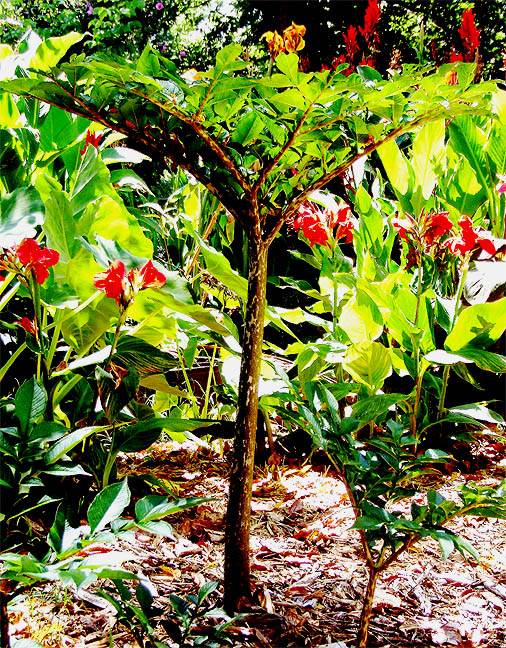
The plant's average height (see the specimen in our garden, right) is about 4 feet (120cm), but the species can grow taller if planted in too deep shade since it may reach for the light. A friend in Florida once had several reach close to twice that height when he didn't realize the tubers were left in the ground next to some very tall plants.
A. konjac produces a large divided leaf (its big brother is Amorphophallus titanum which can get more than 20 feet (6 meters) tall and the leaf is said to grow up to 8 feet (2.5 meters) wide. Although the single leaf may appear to be a bunch of leaves, the smaller divisions are correctly known as leaflets which are supported by a rachis that extends from the petiole.
The plants grow from a tuber which is similar to the plant form most
people call a bulb but a bulb is scientifically very different.
Plants such as Amorphophallus species have
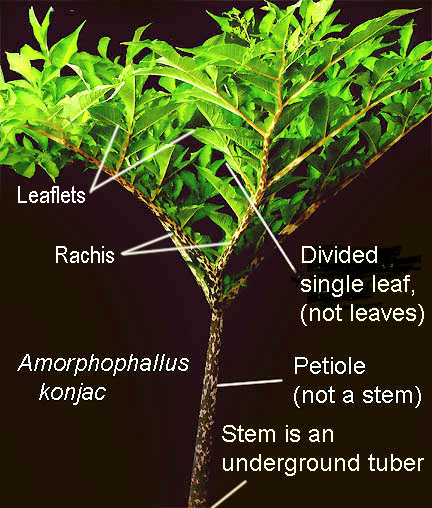 their stem (tuber) growing underground.
A stem is
not the support for a leaf but instead is a plant's main support, base or
central axis and its roots anchor the plant
either to the ground as in the case of Amorphophallus species but in some
other aroid genera to a tree or to a rock.
This link offers more information on stems and
tubers.
their stem (tuber) growing underground.
A stem is
not the support for a leaf but instead is a plant's main support, base or
central axis and its roots anchor the plant
either to the ground as in the case of Amorphophallus species but in some
other aroid genera to a tree or to a rock.
This link offers more information on stems and
tubers.
With only a few exceptions in Amorphophallus species that tuber produces a single petiole that supports the single divided leaf. Even though we correctly call the stem of the genus a tuber it is still just a stem that produces a single petiole which supports a single leaf. Botanist Dr. Wilbert Hetterscheid is the world authority in the genus Amorphophallus and explains, "The tuber is indeed the strongly condensed underground stem consisting in most species of only one node being renewed every year with few exceptions existing."
Once mature, the plant will produce a wildly beautiful inflorescence with a spathe which is a deep burgundy looking almost plastic and quite exquisite. However, this is one of the "stinky" plants and when it does bloom you will want to get it out in the yard and well away from your home! The inflorescence is not a flower but is instead a group of tiny flowers growing upon the spadix which is at the center of the spathe.
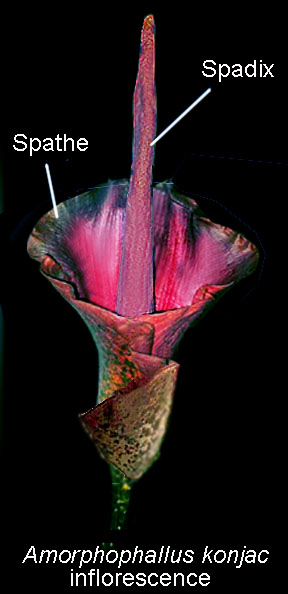 All aroids produce an inflorescence.
In a fully mature plant the colorful inflorescence has been reported
to grow as large as 1 meter (three feet) tall. The inflorescence of an
Amorphophallus species is known as being unisexual in which the
spathe consists of two sections, both wrapped around the spadix
with a constriction separating the two sections. The upper portion
of the spathe is called the limb or blade while the lower is a
convolute tube or chamber. Although the spathe of the
inflorescence may have the appearance of a "flower", it does not
scientifically qualify as one since it is a modified leaf
surrounding a spadix.
All aroids produce an inflorescence.
In a fully mature plant the colorful inflorescence has been reported
to grow as large as 1 meter (three feet) tall. The inflorescence of an
Amorphophallus species is known as being unisexual in which the
spathe consists of two sections, both wrapped around the spadix
with a constriction separating the two sections. The upper portion
of the spathe is called the limb or blade while the lower is a
convolute tube or chamber. Although the spathe of the
inflorescence may have the appearance of a "flower", it does not
scientifically qualify as one since it is a modified leaf
surrounding a spadix.
On the spadix the tiny male and female flowers occur in separate regions or zones. The zone of female flowers occurs at the very bottom of the spadix hidden within the lowest portion of the spathe known as the spathe tube or floral chamber.
On Amorphophallus konjac the sterile flowers produce a pungent pheromone (odor) which attracts insect pollinators in exactly the same fashion as bisexual species. Although not terribly foul, the odor can last one to two days. Within the upper spathes blade or limb, occurs the zone of fertile male flowers. The female floral chamber of some species is often constricted. More on the pollination of aroid speces can be found at this link.
You should expect a specimen to go underground during much of the winter months. Many growers grow them in large pots with well draining soil. A plant should be watered often in the summer but only occasionally in the winter. If you are a cold weather grower, this plant is cold hardy and will survive the winters outdoors as far north as Kansas City, possibly further north.
In an article by Amorphophallus experts Dr. Wilbert Hetterscheid and Stephen Ittenbach found in Aroideana, Volume 19, 1996 entitled Everything you Always Wanted to Know about Amorphophallus, but Were Afraid To Stick Your Nose Into!!!!!, the authors state Amorphophallus konjac appears to thrive best at temperatures between 20° and 25°C. (68 to 77 degrees F). Aroideana is the annual journal of the International Aroid Society www.Aroid.org
The plant at the top right of this page is close to 5 feet (150cm). We now have a total of over 40 specimens planted in our NW Arkansas garden. The specimens multiply annually and continue to survive every winter. Make sure the tuber is planted deep enough to ensure the plant is safe from the cold and will support its own weight when not dormant, no less than 6 inches (15 cm), some deeper is even better. Keep it well mulched in winter.
Our largest specimen was a gift from our friend Robert Black and his wife Donna. Robert is the President of 'Spartanburg Angels' www.spartanburgangels.com The plant in our photo at the top of this page was approximately 4 feet (120cm) tall with a 3 foot (90cm) spread and has produced an inflorescence twice. The photo of the large inflorescence was provided from Asia.
Aroid Pollination!
As
it occurs in nature and by any horticulturist
Join the
International Aroid Society:
http://www.exoticrainforest.com/Join%20IAS.html