
Aroids and other genera in the Collection
Take the Tour Now?
Orchids
The
Exotic Rainforest
The images on this website are copyright protected. Please contact us before any reuse.
"Much of what we believe is
based on what we have yet to be taught. Listen to Mother Nature. Her advice
is best."
New:
Understanding, pronouncing and using
Botanical terminology, a Glossary
Caring
for Spathiphyllum
Species and hybrids
Growing a "Peace Lily"
Compare what Mother Nature has chosen to do versus everything you've
been told!
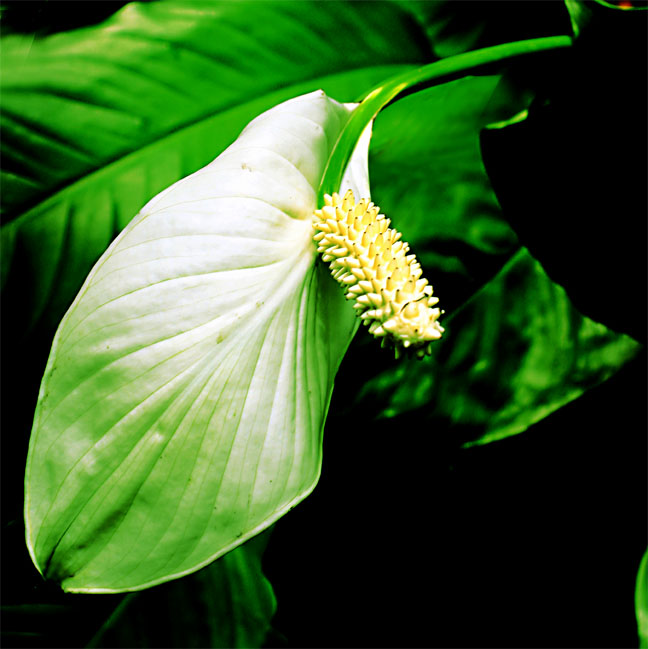
Common names: Spath, Spathe, "Peace Lily", Snow Flower
Don't be afraid to water
your "Peace Lily". They grow naturally in water!
Just pot it correctly!
Looking for specific information? Please scroll down through the
topics discussed below
If you already doubt this plant
likes water since you have seen one appear to die from water please at least scroll
down and read the paragraphs on Fermentation and Saprophytes. That was
likely the cause your plant died!
This text is not complicated to read
but it does set out to explain where these plants are found in nature
and how Mother Nature grows these species.
For reasons not fully understood, many growers refuse to accept Nature's
advice and as a result many specimens needlessly die. Nothing explained in
this article will cause you to have to do excessive work, only
to modify the way you pot and treat a specimen in your home.
The Kemper Center, Missouri Botanical Garden:
"Spathiphyllum is Greek for leaf-spathe, referring to the character of the spathe, which is the bract or leaf surrounding or subtending a thick protruding flower cluster."
All Peace Lily plants are
members of the genus Spathiphyllum. Many of us commonly grow
a Peace Lily in our
 homes
and regardless of the hybrid or species you grow the majority originated
when collectors
went to South America in the 1800’s seeking new and interesting “house plants” for European growers. Although
there are quite a few species, only a few have been grown from the few
species that originated in Asia.
All Spathiphyllum species, as well as all the hundreds of hybrids
and cultivars are
members of the larger plant family known as Araceae, commonly called an
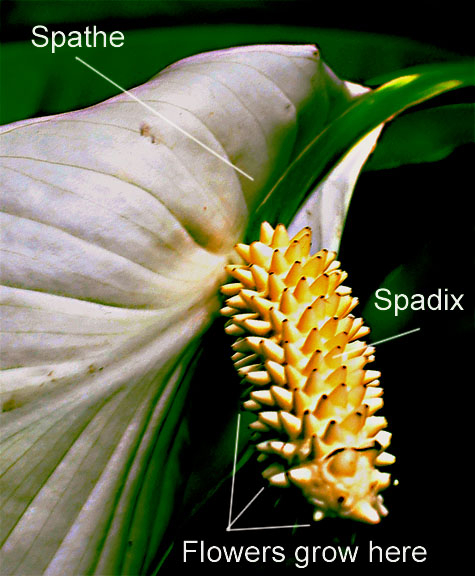
aroid. Aroids are easily recognized by the spathe and spadix
produced by these plants that is incorrectly called a flower.
homes
and regardless of the hybrid or species you grow the majority originated
when collectors
went to South America in the 1800’s seeking new and interesting “house plants” for European growers. Although
there are quite a few species, only a few have been grown from the few
species that originated in Asia.
All Spathiphyllum species, as well as all the hundreds of hybrids
and cultivars are
members of the larger plant family known as Araceae, commonly called an
aroid. Aroids are easily recognized by the spathe and spadix
produced by these plants that is incorrectly called a flower.
The Spathe
or "Peace Lily" can be an excellent houseplant.
Some species and hybrids have often small, narrow lanceolate (lance shaped) leaves while others
have much larger and broader leaf blades. Some produce small
inflorescences while others produce a spathe and spadix that is quite
large. Not all wild Spathiphyllum species are suitable as house
plants but a large number of these white cup shaped spathe bearing
plants are sold as hybridized "Peace Lilies". Virtually none of the
commonly available plants are species but instead are hybrids.
Correctly the term is spathe, not "spath".
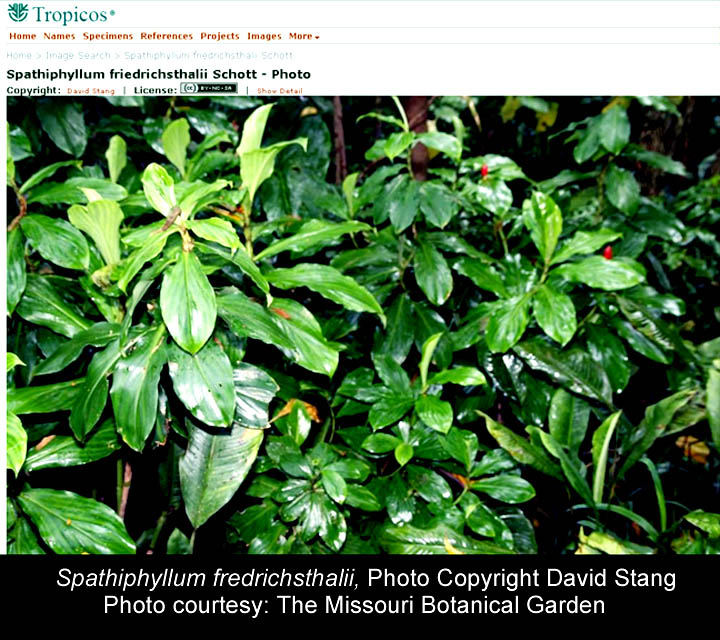
Dr. Nancy Greig PhD, Curator of Entomology at the Houston Museum of Natural Science recently wrote to us and stated, "I am very familiar with Spathiphyllum friedrichsthalii in Costa Rica. It grows in open areas (large rainforest gaps and in swampy fields) in full sunlight, and usually in several inches of water. If you do a Google image search for Spathiphyllum friedrichsthalii you will see a “flickr” photo – that photo is of the “swamp” at La Selva Biological Station La Selva Biological Station in the Atlantic lowlands of Costa Rica (ne quadrant). The people in the photo are standing on the boardwalk that leads through the swamp, which is flooded with several inches of water for most of the year, except at the height of the dry season The dominant plant in the swamp, as you’ll see in the photo is S. friedrichsthalii. S. friedrichsthalii is common in the deforested fields throughout the area."
 For
those that don't believe the plants in this genus love water please take
a moment to look at one single photo. The photo of the plants Dr.
Nancy was referring to as standing in water can be seen here:
http://www.flickr.com/photos/codiferous/417124810/
For
those that don't believe the plants in this genus love water please take
a moment to look at one single photo. The photo of the plants Dr.
Nancy was referring to as standing in water can be seen here:
http://www.flickr.com/photos/codiferous/417124810/
A good deal of the information below was derived from the scientific paper the SYNOPSIS OF THE GENUS SPATHIPHYLLUM (ARACEAE) IN COLOMBIA by Felipe Cardona as well as many other scientific documents along with personal communication with the authors noted.
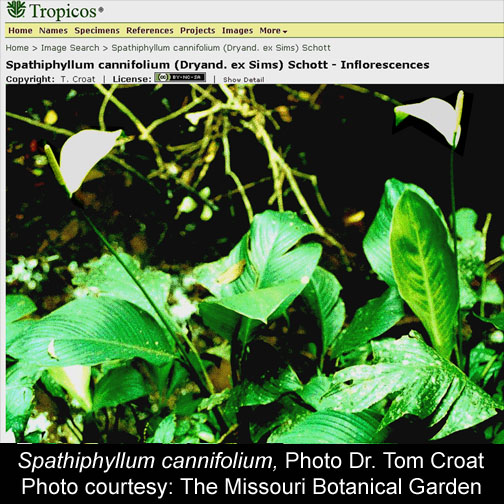
The most likely used species to create the hybrids we grow appears to be one of several including Spathiphyllum wallisii , Spathiphyllum floribundum, Spathiphyllum friedrichsthalii or Spathiphyllum cannifolium which are among the most widespread species in Colombia and some other portions of South America. It is certainly possible Spathiphyllum friedrichsthalii , which is common to Costa Rica has also been used to create some hybrids. The spathe (flower) of Spathiphyllum floribundum and Spathiphyllum cannifolium are close matches to the spathe we observe on many of our hybrid houseplants. Spathiphyllum cannifolium appears restricted to the Amazon basin where it is known from practically all major tributaries of the Amazon basin, at least in Colombia. Within Colombia, Spathiphyllum cannifolium occurs at 200 to 1000 meters (660 feet to to 3,280 feet) in elevation, in tropical wet forest life zones and produces an inflorescence almost any time of the year.
Spathiphyllum minor
is found in tropical wet rain forest at 200 to 300 meters elevation but
normally flowers only in
 January. March. July, and September. At
the same time Spathiphyllum perezii is a tropical wet rain forest
species found at roughly the same elevation as Spathiphyllum
cannifolium but blooms in May, July, and September.
Spathiphyllum silvicola is found in both rain forests and
tropical wet rain forests but blooms more
erratically in January,
February, July, September, October and December. Spathiphyllum
lancaefolium grows in wet rain forest and produces inflorescences
from July through October. As you can see, there is no set season
of the year for a specific plant, especially a hybrid to bloom! All of this will
be put into perspective as our discussion of the production of
inflorescences continues.
Please read once again where and how these species commonly grow in nature.
January. March. July, and September. At
the same time Spathiphyllum perezii is a tropical wet rain forest
species found at roughly the same elevation as Spathiphyllum
cannifolium but blooms in May, July, and September.
Spathiphyllum silvicola is found in both rain forests and
tropical wet rain forests but blooms more
erratically in January,
February, July, September, October and December. Spathiphyllum
lancaefolium grows in wet rain forest and produces inflorescences
from July through October. As you can see, there is no set season
of the year for a specific plant, especially a hybrid to bloom! All of this will
be put into perspective as our discussion of the production of
inflorescences continues.
Please read once again where and how these species commonly grow in nature.
A complete list of all the accepted species of Spathiphyllum can be found near the bottom of this page. If a particular name is not on this list it is likely either a hybrid or a plant that has been reduced to a synonym of one of the accepted species' names.
Wet, damp or
dry?
What is the natural
growth of the "Peace Lily" and what does Mother Nature appear
to recommend?
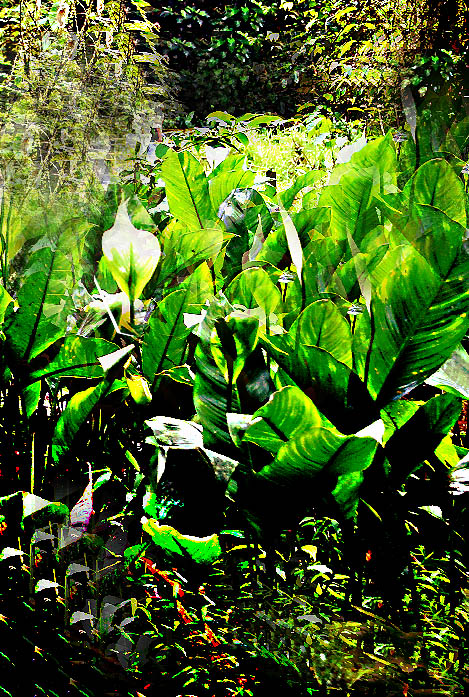 The "Peace Lily" can be found in many leaf blade shapes and sizes.
According to George Bunting’s
A Revision of the Genus
Spathiphyllum
the largest species,
Spathiphyllum commutatum
from Malaysia, the Solomon Islands and parts of Asia, grows to 85 cm (33.4
inches) long and the species
Spathiphyllum cochlearispathum
from Mexico can grow to 80 cm (31.5 inches) long.
Of all the species found in the genus
Spathiphyllum,
all but three are found only in the New World Neotropics. Those three
species are found in the Philippine and Molucca Islands, New Guinea, Palau,
New Britain, and Solomon Islands while all the rest are found from tropical
Mexico through Central and South America.
The "Peace Lily" can be found in many leaf blade shapes and sizes.
According to George Bunting’s
A Revision of the Genus
Spathiphyllum
the largest species,
Spathiphyllum commutatum
from Malaysia, the Solomon Islands and parts of Asia, grows to 85 cm (33.4
inches) long and the species
Spathiphyllum cochlearispathum
from Mexico can grow to 80 cm (31.5 inches) long.
Of all the species found in the genus
Spathiphyllum,
all but three are found only in the New World Neotropics. Those three
species are found in the Philippine and Molucca Islands, New Guinea, Palau,
New Britain, and Solomon Islands while all the rest are found from tropical
Mexico through Central and South America.
The next time someone tells you your "Peace Lily" doesn't like water and should only be given a "drink" when it begins to "beg" suggest they take a trip to Ecuador where they commonly live in streams. I always advocate to "listen to Mother Nature, since her advice is best" and Mother Nature's advice is to keep your Spathiphyllum slightly damp at all times and grow it in bright light. However, it is very true that excess water in the soil can quickly cause the leaves to blacken, especially from the edges before they die. The cause and cure are explained below but be aware the same can happen when a plant is kept far too dry. These plants are water members of a genus that love water since they grow in a rain forest as well as in and along the margins of streams and rivers as can be seen in the photo (left).
The genus is well represented in the South American country of Colombia and is found from near sea level to approximately 1300 meters (4,200 plus feet). The genus is most common in lowland primary forests and is commonly associated with water and streams growing in large colonies that are interconnected by their rhizomes. The genus Spathiphyllum also grows in partially or periodically flooded forests sometimes in sites with relatively low light intensities. However, the assumption these plants will always prosper in low light needs further consideration and explanation. Consider all the scientific evidence as this article progresses.
An explanation of the terms rhizome, petiole and stem are in order since the terms also tells us something about how to plants survive and reproduce in nature.
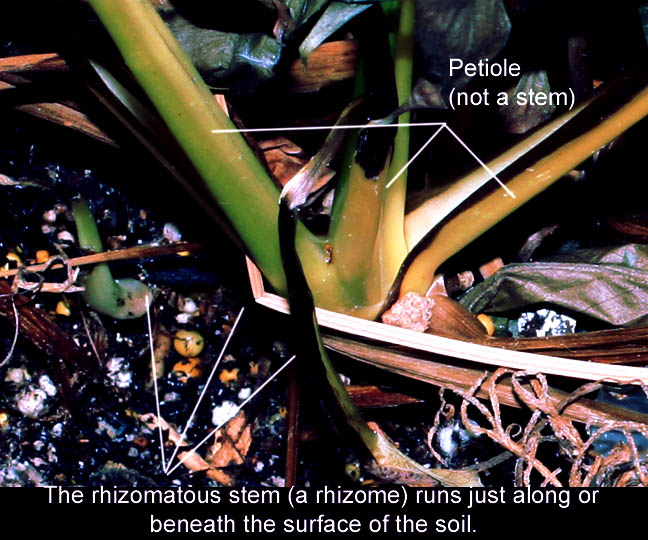
 A rhizome is
simply a stem that runs across the surface of the ground and serves as the
primary support or central axis of the plant (photo below). All or most of the
plants in a colony are connected to some degree via their rhizomes.
The terms stem and rhizome are poorly understood by plant growers so it is
important you understand we are not discussing the support of any single
leaf, correctly known as a petiole. Growers are commonly mislead into
believing a leaf is supported by a "stem" but that assumption is incorrect.
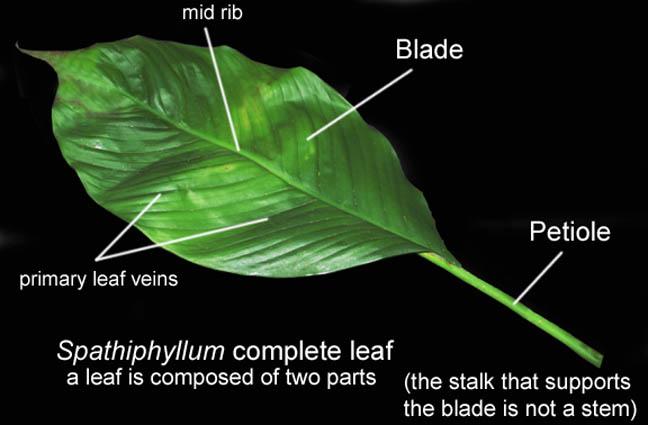
Leaves are divided into two primary parts and the two parts growing together are
defined as a "leaf". The two parts are the petiole and the blade.
A rhizome is
simply a stem that runs across the surface of the ground and serves as the
primary support or central axis of the plant (photo below). All or most of the
plants in a colony are connected to some degree via their rhizomes.
The terms stem and rhizome are poorly understood by plant growers so it is
important you understand we are not discussing the support of any single
leaf, correctly known as a petiole. Growers are commonly mislead into
believing a leaf is supported by a "stem" but that assumption is incorrect.
Leaves are divided into two primary parts and the two parts growing together are
defined as a "leaf". The two parts are the petiole and the blade.
The stem is
the base, central axis and main support of a plant normally divided into
nodes and internodes. The nodes often produce roots, leaves its axils, and
the interesting spathe "flower) which is supported on a stalk known as a
peduncle. A node is the point
where the plant produces its roots and hold buds which may also grow into shoots of
various forms. The stem's roots then anchor the plant either to the
ground, a tree or to a rock depending on the species and genus. In the case of the genus
Spathiphyllum a stem may even spread as a repent rhizome creeping across
the soil but is often just beneath the surface. Stems may either
grow above ground, underground or partially above the soil.
According to Dr. Thomas B. Croat who is the Curator of Botany at the Missouri Botanical Garden in St. Louis, MO, in a 1988 paper he stated the species of this genus are found in wet to swampy areas of forests. Additionally, they are found growing along streams or in open swampy areas and live primarily as terrestrial plants. However, they may be hemiepiphytic or even epilithic. An epilithic plant is one that is attached to rock or stone while a hemiepiphyte is a plant that normally begins life on the ground and then climbs a tree. However, if it looses its root connection to the soil it then becomes a epiphyte which is not described in this genus. There are other forms of hemiepiphytes as well but a discussion not appropriate at this point.
Unless you have observed these species in nature and are scientifically qualified to say conclusively that Spathiphyllum species don't like water, we would suggest you may want read more in an effort to learn why there are so many myths about these plants found on the internet. This article also attempts to explain why so many house plant growers have freely accepted these common myths. If you do have scientific credentials and differ we would love to have your detailed explanation so we can share it with the scientists quoted on this page.
In the text the SYNOPSIS OF THE GENUS SPATHIPHYLLUM (ARACEAE) IN COLOMBIA, eighteen species of Spathiphyllum are known to exist in Colombia. Of those, Spathiphyllum cannifolium is “likely the most widespread species of the genus in Colombia. Spathiphyllum cannifolium appears restricted to the Amazon basin, where it is known from primarily all major tributaries of the Amazonas, Cacquetá, Vichada. Apaproris, and Guayabero Rivers. A large gap in distribution exists, however, in ihe central portion of the Colombian Orinoco and Caquetá valleys, likely due to poor collecting in the area. In Colombia, Spathiphyllum cannifolium occurs at 200 to 1000 meters elevation, in tropical wet forest life zones, and flowers all year round.”
 On page 50 in his 1978 article
published in the scientific journal Aroideana entitled The Genera of
Araceae in the
Northern Andes
by Dr. Michael Madison formerly of the
Marie Selby Botanical Gardens he states,
"Spathiphyllum
includes 40 species of terrestrial herbs which usually are found in wet
habitats."
Since the date his article was published several new species have been
described to science but the plants we normally grow are rarely species
plants. The number of species has since been revised.
On page 50 in his 1978 article
published in the scientific journal Aroideana entitled The Genera of
Araceae in the
Northern Andes
by Dr. Michael Madison formerly of the
Marie Selby Botanical Gardens he states,
"Spathiphyllum
includes 40 species of terrestrial herbs which usually are found in wet
habitats."
Since the date his article was published several new species have been
described to science but the plants we normally grow are rarely species
plants. The number of species has since been revised.
Again in Aroideana Volume 5, page 117 in an article by Robert White on West Panama he writes, "As we left the area we stopped at a sunny stream and found growing along its banks a small Spathiphyllum sp. with very dark green leathery leaves. The outside of its spathe was dark green and the inside was white, cut with fine lines of green." Aroideana is the journal of the International Aroid Society.
Practical experience quickly teaches a grower Spathiphyllum species and hybrids do best if kept slightly damp in fast draining soil. Not wet. Never dry. The explanation follows,
An important definition you need to understand: Autotrophic
Chlorophyll is the green pigment in every plant that captures sunlight to produce photosynthesis. Plants survive due to photosynthesis Plants draw in carbon dioxide through their leaves and utilizing a process known as being an autotroph they combine CO2 with water that enters the cells of the leaf as a result of rainfall. Autotrophs including Spathiphyllum create their own food by utilizing photosynthesis. If kept in very dim light you are deliberately starving the plants from the ability to produce their own natural sources of food. The process is also known in science as CO2 Fixation or the PCR Cycle (Photosynthetic Carbon Reduction) and in excessively dim light the process of photosynthesis can be switched off.
The process is completed through reduction (stripping away) of carbon dioxide by adding the hydrogen component of water (H2O) to create organic compounds. In biology the term reduction indicates the hydrogen is removed from the oxygen by specialized cells in the leaves. In green plants an autotroph converts physical energy from sun light into carbohydrates in the form of sugars. They may also form chemical energy by synthesizing complex organic compounds from simple inorganic materials in order to produce fats and proteins from light.
The products of photosynthesis produced in the leaf are both sugar and oxygen and the oxygen is given back to the environment while the carbohydrates are used to feed the plant's own growth. Home growers often recommend a Spathiphyllum for this very reason since they feel it will improve the oxygen level in a room.
Although home growers rarely understand or just ignore the need for brighter light and high humidity to grow their plants, stronger light and misting are important to healthy growth. The next time anyone tells you dim light helps this plant or misting is not important since the water evaporates too quickly, recommend they read up on "autotrophic" growth and photosynthesis. It should also be understood plants also need oxygen and draw it in through their roots as will be explained later in this article. For a detailed explanation of the process of CO2 reduction seek a copy of Photobiology of Higher Plants by Maurice S. McDonald in your local library.
Why doesn't
my Peace Lily plant bloom all the time?
There is several reasons and you are not likely the cause!
I recently read a post where a grower indicated if their new plant
didn't produce blooms as she expected it to do she
 would "beat it into
submission". Regrettably, that is the way far too many of us think
about our tropical plants.
Although we tend to think of the Spathiphyllum plant always being
filled with inflorescences, in South an Central America is is far more
common to find them "in bloom" from May through November. (Baker
and Burger, Spathiphyllum in Costa Rica, 1976), but many species
commonly have shorter periods of bloom time. Go back up and read
the explanations of the flowering of Spathiphyllum cannifolium,
Spathiphyllum minor, Spathiphyllum silvicola, and
Spathiphyllum perezii. Every species has a bloom period
assigned by Mother Nature.
would "beat it into
submission". Regrettably, that is the way far too many of us think
about our tropical plants.
Although we tend to think of the Spathiphyllum plant always being
filled with inflorescences, in South an Central America is is far more
common to find them "in bloom" from May through November. (Baker
and Burger, Spathiphyllum in Costa Rica, 1976), but many species
commonly have shorter periods of bloom time. Go back up and read
the explanations of the flowering of Spathiphyllum cannifolium,
Spathiphyllum minor, Spathiphyllum silvicola, and
Spathiphyllum perezii. Every species has a bloom period
assigned by Mother Nature.
True, there are species such as Spathiphyllum cannifolium and Spathiphyllum floribundum that commonly produce inflorescences but there is no way to know for certain if the plant you are growing was bred from those species. The chances are high your plant was produced in a chemical soup and its parents were interbreed with many parent species. You are highly unlikely to be growing a true species. Breeders attempt to inbreed plants that tend to produce inflorescences more frequently but in time the plants often return to their in-built DNA coding and produce only on their specific natural schedule. When a breeder is trying to produce plants with spectacular leaves combined with frequent flowering, something has to be given up its natural genetic sequence. Many plants will forever attempt to return to the DNA of their natural parentage.
If you wish to make a specimen
thrive and grow in your home a specimen prefers high humidity
and constant moisture. A specimen should be kept in bright light
but out of direct sunlight
with a tray of pebbles filled with water beneath the pot to provide
some humidity. Although few wild species produce an
inflorescence year round if you
wish
 to keep it producing inflorescences the plant should also be misted
frequently. But there may be both a natural and a chemical cause once your plant
begins to refuse to "bloom".
to keep it producing inflorescences the plant should also be misted
frequently. But there may be both a natural and a chemical cause once your plant
begins to refuse to "bloom".
On a visit to the Missouri Botanical Garden research greenhouse in December 2009 not one of the specimen plants of true Spathiphyllum species was producing an inflorescence! These species often bloom seasonally and December was not a part of their bloom season,
Hybridized Spathiphyllum commonly sold in garden and discount
centers can be seen with a cluster of open inflorescence virtually any
month of the year. Commercial growers use a chemical known as
gibberellic acid often sold as GA3 to induce the plants to produce
inflorescences in order to make them more saleable. Gibberellic acid is
a natural plant hormone and is used in agriculture to stimulate both
cell division and cell elongation that affects the leaves as well as the
stems of a plant.
 Gibberellic acid is used commercially to make all the plants in one
group bloom at the same time. Through repeated use these large growers
force the growth of a spathe and spadix regardless of season. They have
calculated the quantity to be used and know how much gibberellic acid to
apply to any particular species but these formulations are often guarded
secrets. The next time you buy a beautiful Spathiphyllum at
a discount store and find it begins to produce few or odd shaped leaves
and spathes there may be a reason. The specimen has likely been fed
gibberellic acid since it was nearing sexual maturity to force it to
bloom. Without the constant use of the hormone the specimen cannot get
its "fix" and as a result may rarely bloom again since it has been
"hooked" on the chemical!
Gibberellic acid is used commercially to make all the plants in one
group bloom at the same time. Through repeated use these large growers
force the growth of a spathe and spadix regardless of season. They have
calculated the quantity to be used and know how much gibberellic acid to
apply to any particular species but these formulations are often guarded
secrets. The next time you buy a beautiful Spathiphyllum at
a discount store and find it begins to produce few or odd shaped leaves
and spathes there may be a reason. The specimen has likely been fed
gibberellic acid since it was nearing sexual maturity to force it to
bloom. Without the constant use of the hormone the specimen cannot get
its "fix" and as a result may rarely bloom again since it has been
"hooked" on the chemical!
Although GA3 can be purchased, the use of the chemical can be hazardous to the plant if you don't know the exact dose to use. In that case you must resort to the use of a good fertilizer but never use one in excess.
Are you
growing a species or a hybrid?
Often given as a funeral plant, the "Peace Lily" is a member of the
larger plant family Araceae commonly called an aroid.
The Spathiphyllum hybrid is one of the more commonly
available plants sold in discount stores, nurseries and floral
stores.
True species plants are a very rare
find in the home since almost all available for sale were created by hybridizers.
Even in the wild some species are also quite rare. Almost
all the plants available for purchase were not grown from seed but were
grown in a test tube as a chemically created tissue cultured or cloned
plant. Although I had at one time been led to believe the cloned
variations were "designed" to need little water, that is nothing more
than a myth. The plants can naturally withstand
 abuse since they
must live through the dry season in their native habitat which at times
requires them to survive when little water is available but they do have
limitations and cannot withstand perpetual abuse and neglect in a home.
abuse since they
must live through the dry season in their native habitat which at times
requires them to survive when little water is available but they do have
limitations and cannot withstand perpetual abuse and neglect in a home.
One of the more recent additions to the market include a "variegated" form of Spathiphyllum. Variegation is not a common event for these species in nature and is being created in the tissue culture laboratory by injecting a harmless virus known as the Colour Break Virus into the tissue culture mixture. In almost all cases the plant will eventually outgrow the injected virus and will return to the normal green form. This virus is the cause of all variegated plants and is now commonly in use since buyers will often pay extra for a variegated specimen without realizing the variegated colors will likely soon be lost.
Once you read what I attempt to explain
about the "Peace Lily" some will undoubtedly want to say the plants
in our homes are very different from the plants in the rain forest since
they are “house plants” and not wild. Some of literally attempted
to "laugh my explanations on this subject off internet plant discussion
sites". I don't wish to be unkind but all
house plants had to originate somewhere in the wild and just because you
move it into a home does not mean you have changed its genetic makeup!
Your "Peace Lily" house plant may be a hybridized form of a wild plant but the DNA
came from a wild specimen somewhere in the world almost certainly
Central or South America. That plant “remembers”
how it grows in nature and craves for those conditions. When we kill
these plants it is highly likely they died because we fail to treat them the
way their DNA code expects to be treated. If the plant can't get what it
needs including high humidity, at least moderately bright light and
adequate water its response is often to just give up and die. You can easily
avoid that eventuality by giving the plant what it needs! You can
take the plant out of the rain forest but you can't change it into
something that is not already embedded in the DNA coding.
Soil in the rain forest versus the soil you buy
Some years ago I coined a slogan for use in our atrium which you may have read at various places on the internet, "Much of what we believe is based on what we have yet to be taught. Listen to Mother Nature. Her advice is best." I trust you will read everything on this page with that in mind. People believe what they do about growing Spathiphyllum because someone that did not do good scientific research on the topic stated it somewhere and it has since been accepted by the majority of growers. Many growers prefer to do what is easiest for them, not what is best for the plant. As a result, many growers will defend what they have been taught without ever doing one bit of real research other than to accept commonly held beliefs on the internet.
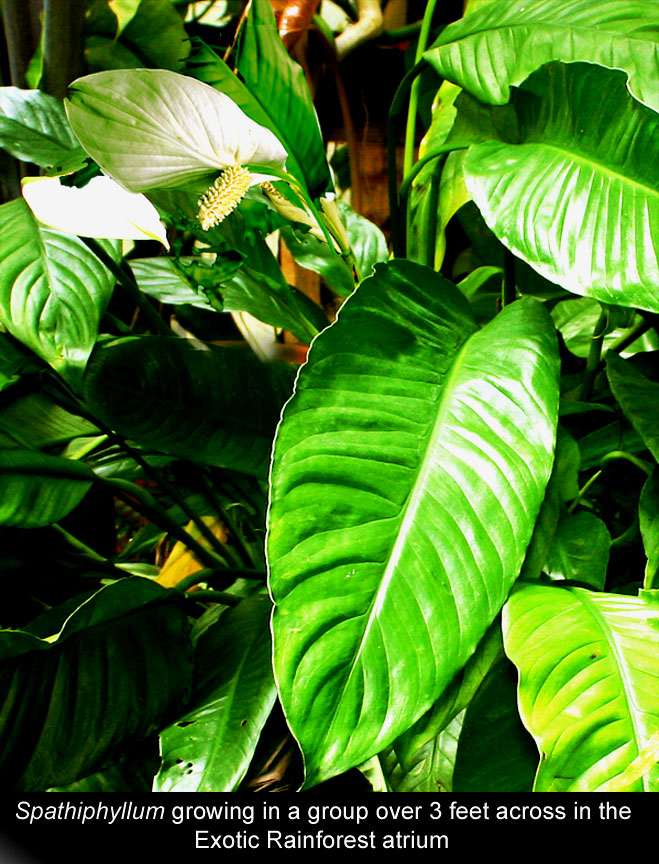
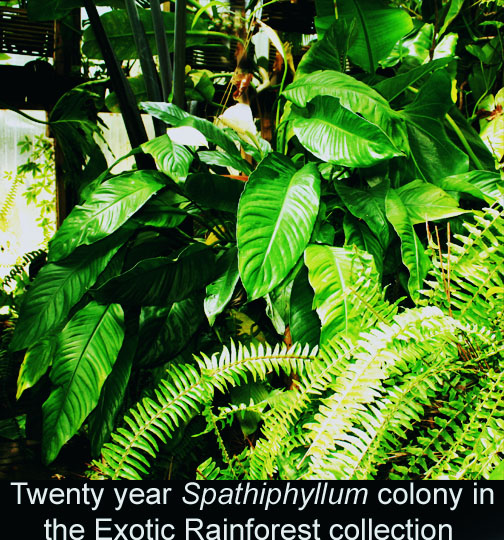
Have you ever walked into a beautiful botanical garden and said to yourself you’d love to be able to grow plants this way in your home? The truth is you can easily do so provided you are willing to learn how they grow in nature and follow Mother Nature’s lead and that does not need to be difficult. Botanical garden staff members rely on botanists that have observed the same specimens in the wild to tell them what each species needs in order to prosper. At the same time, we typically want only one set of very simple rules requiring that we do little. The two photos just below are of our own Exotic Rainforest private garden in Northwest Arkansas. We have a motto which controls the way every plant is grown, "Listen to Mother Nature, her advice is best".
Advice given on the internet is often not based in science but in assumption. Although you are often told on internet discussion sites to water sparingly and buy a “rich” soil for your tropical plants the soil in the tropical rain forests are typically very nutrient poor and it rains often.
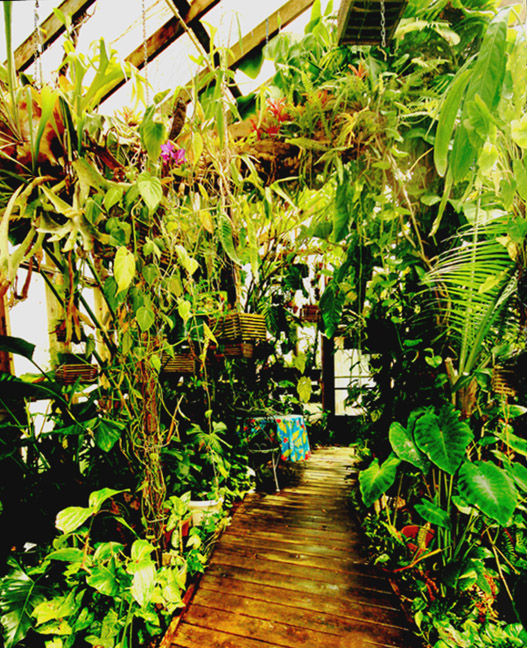 A
great deal of litter falls to the ground where it is quickly broken down
through natural decomposition via earthworms, insects including termites
and fungi. Although we grow our plants in air-conditioned living rooms
where there is little humidity,
in the forest the heat and humidity encourage the further decomposition
of the rain forest leaf litter. The shallow roots of very large trees
then rapidly absorb almost all of this organic matter.
As a result, most of
the nutrients are contained in the trees rather than in the soil.
A
great deal of litter falls to the ground where it is quickly broken down
through natural decomposition via earthworms, insects including termites
and fungi. Although we grow our plants in air-conditioned living rooms
where there is little humidity,
in the forest the heat and humidity encourage the further decomposition
of the rain forest leaf litter. The shallow roots of very large trees
then rapidly absorb almost all of this organic matter.
As a result, most of
the nutrients are contained in the trees rather than in the soil.
Most nutrients that manage to be absorbed into the soil are leached out by the frequent rainfall which leaves the soil infertile and acidic. Trees in the rain forest rarely grow deep roots as is common in North America. It is not uncommon for very large trees to fall in a storm but all the seedlings waiting for the patch of light that is left when a giant falls quickly replace them.
The topsoil layers may be only one to two inches (often less than centimeters) deep but provides only a limited amount of nutrition to the plants. The plant life is lush since the plants store the nutrients inside their own cells as well as produce them via photosynthesis rather than gathering them from the soil. Were you to step into a living rain forest you will find far more plants dangling from the trees than you will ever find growing in the soil. Plants in the forest have adapted to utilize the nutrients from their “brethren” in order to flourish and survive.
When plants decay, others rapidly absorb the nutrients left behind from the dead vegetative matter and reuse all of them. At the same time, we tend to “clean up” our plants and just throw the dead leaves in the trash rather than returning them to our compost for our soil mixtures! The fain forest is naturally poor in soil nutrition which is exactly why farmers that regularly destroy thousands and millions of rain forest acres can only use the rain forest soil for one or two years. Man often does not think things through logically and just reacts to opportunity. I fear that far too many plants end up in the trash for the same reasons rain forest farmers continue to destroy the plants in nature. We make too many "assumptions" and do little actual research, we just willingly believe what we are told and if the bad information is challenged some choose only to try to discredit the source rather than consider the science.
The rain forest soil is infertile because it averages eons in development and requires constantly being both replenished while those nutrients are quickly used again. Even in the forest there is not enough vegetative material falling to the ground or trees falling, burning and decomposing to make the soil rich enough to grow a crop! The constant rain washes minerals out of the soil that flows down the numerous rivers leaving soil both acidic and nutrient poor. When the soil is exposed to the heat and sunlight it is often turned into red clay in which little can grow. Many of the remaining minerals cannot be utilized so they become useless to plants. There are occasional fertile patches of soil in the rain forest, but they are rarely compacted and often scattered throughout the thick vegetation. It is a completely viable train of thought to believe species such as Spathiphyllum have been caused by their DNA to seek out streams and pools of water since the concentration of useable nutrition is found in the water as a result of decomposition and frequent rain!
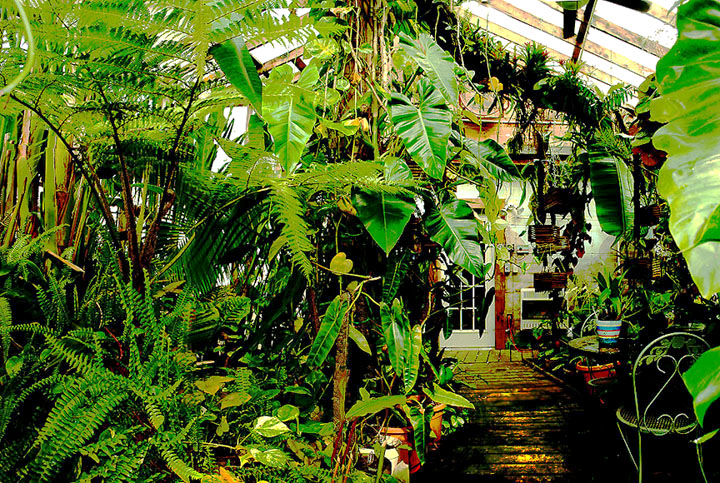 The hot and humid
conditions of the forest cause tropical rain forests to be an ideal
environment for bacteria and other microorganisms and since they remain
active throughout the year they quickly decompose matter on the forest
floor. Yet, despite countless years of developing her plants to live
with specific soil, rain and water conditions we want any plant we buy
to suddenly ignore their DNA and yield to our demands for simple care by
simply buying a “bag of soil” without regard to its contents and dumping it into a pot. These are rain
forest plants and they love water! We must learn to adapt our growing
style to meet our plant's needs, not ours.
The hot and humid
conditions of the forest cause tropical rain forests to be an ideal
environment for bacteria and other microorganisms and since they remain
active throughout the year they quickly decompose matter on the forest
floor. Yet, despite countless years of developing her plants to live
with specific soil, rain and water conditions we want any plant we buy
to suddenly ignore their DNA and yield to our demands for simple care by
simply buying a “bag of soil” without regard to its contents and dumping it into a pot. These are rain
forest plants and they love water! We must learn to adapt our growing
style to meet our plant's needs, not ours.
However, as will soon be explained it is neither difficult nor expensive to create a rough duplication of the fast draining soil Nature creates for her plants.
So, what is the problem that causes our plants to die?
It isn't excess water that kills "Peace Lilies" in homes. The
cause of their demise is almost always poor soil that is kept soggy,
poor light conditions, near constant neglect,
lack of nutrients and even more importantly poor soil conditions!
Since these plants grow in areas where heavy rain waters drain the soil
is nutrient rich. All the decayed vegetation releases nitrogen and other
nutrient rich matter into the water. The water then carries those
nutrients to pools of water as
well as creeks and streams. The decayed vegetation causes most of this
water to be low in pH as well as very soft and those pools are filled with a rich
humus of decaying leaves, branches, animal droppings and other sources
of minerals and nutrients that serve as food for the plants.
Spathiphyllum species love food and I'd bet the majority of growers
that lose these plants have either never fed their plants or at
have tried to feed them to death! Over feeding is just as bad as never
feeding. Good soil mixes are discussed later in this article as
are the reasons most of these plants actually die.
Some try to explain this simple method of growing the Peace Lily on plant forums but they are sometimes all but "laughed" off the page. I am unsure if people don't wish to believe what science explains or have simply made up their mind and don't want to learn anything other that what a friend or family member has regrettably explained incorrectly. Simply because a grower tells you they "know someone" that lost a beautiful Spathiphyllum due to too much light or over watering that does not indicate the plant actually died of too much water and light! Do your own research and don't restrict yourself to plant growing forums! We list many sources you can read on this page.
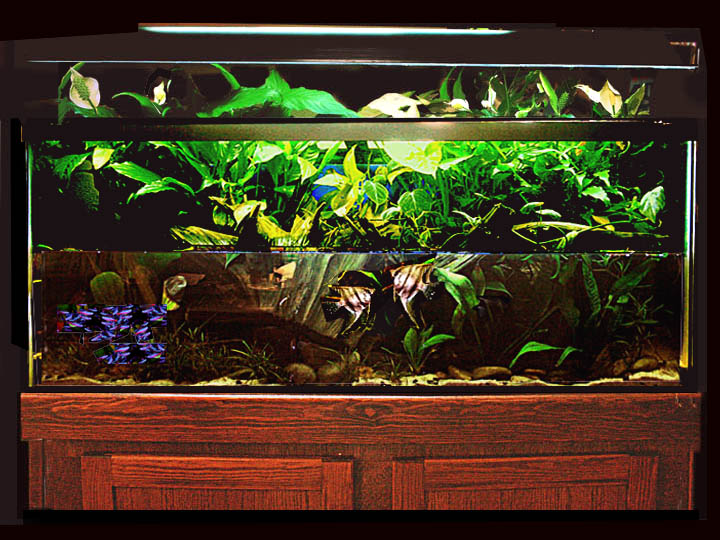
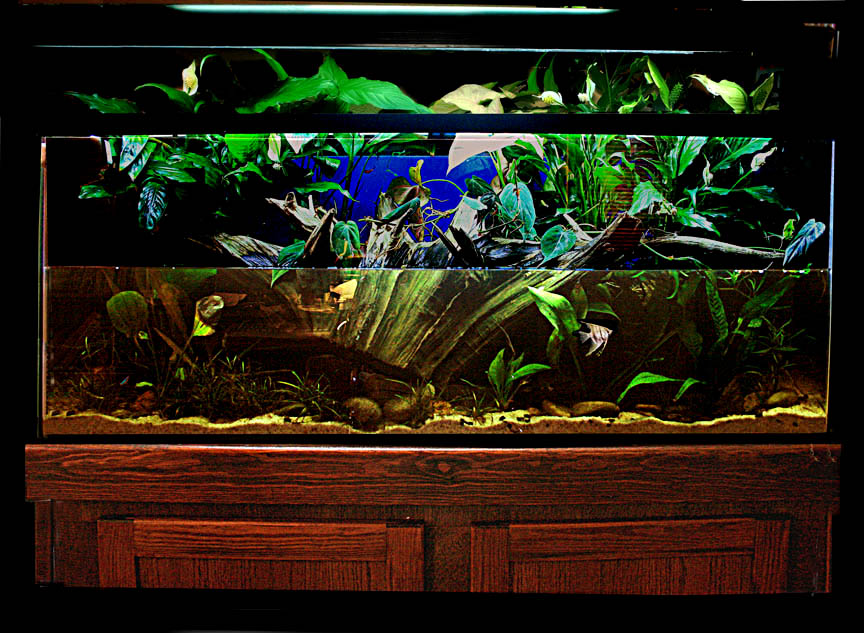
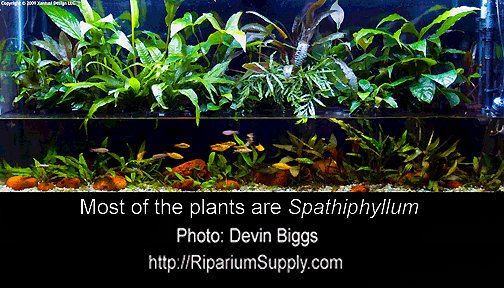
Long held beliefs are common in home horticulture and some become "old wife's tales that simply will not die. The photo near the top of this page is our artificial Ecuadorian river and almost all the plants along the back are Spathiphyllum. The top is filled with plants that grow along the banks of streams and rivers in South America as well as in shallow water while the plants at the bottom are all aquatic. Although difficult to see the tank contains two mated Angelfish and almost four dozen Neon Tetras.
No Tricks. Just Mother
Nature's Method
(and you don't need to
buy an aquarium.)
For those tempted to say we must be using some "trick", some of the plants have been in our collection for five years or more and others were bought at a local home supply store. All the soil was removed and the plants are "potted" bare root in plastic boxes with suction cups holding them to the back of the aquarium, The boxes have numerous holes to allow the water to freely flow through the roots and the "medium" is nothing more than orchid bark along with fine pieces of charcoal. All the boxes now have roots hanging out the holes reaching the sand on the bottom of the tank.
According to
the Royal Botanic Garden Kew (London) scientific website CATE Araceae, there are
forty five natural species (excluding natural variations)
http://www.cate-araceae.org/Spathiphyllum
However, other
qualified sources offer other numbers for the total species that exist.
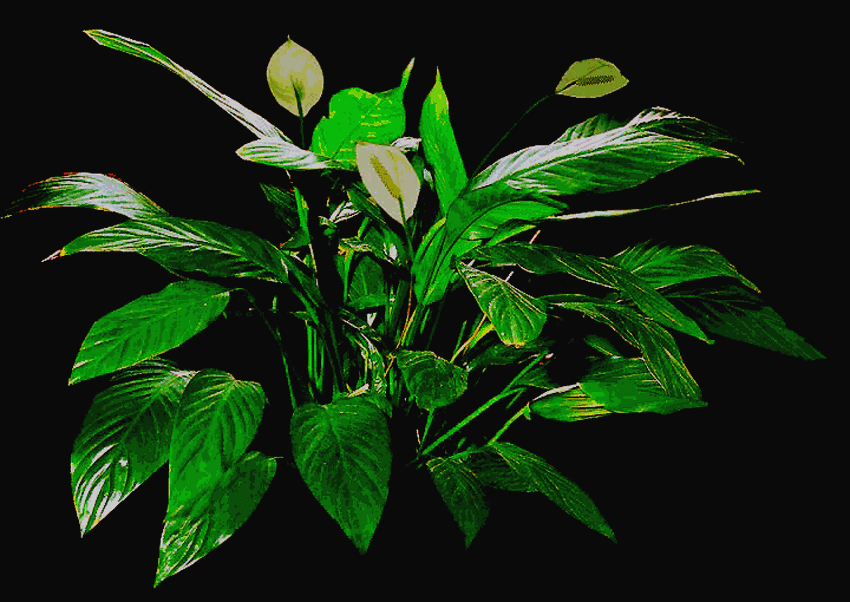 Science is constantly changing.
On top of that there are well over 200 hybridized varieties created by the hand of man, many sold as Spathiphyllum
'Clevelandii' or other made-up names. Like many others, Spathiphyllum 'Clevelandii' is a trade name
and not a species name. As a result it is almost impossible
to look at any specimen and accurately determine what the parent species
may have been.
You can see a complete list of species near the bottom of this page but
you can also see a list of all the names species as well as synonym
names of Spathiphyllum on
the Missouri Botanical Garden website TROPICOS. Please be aware
that many of these scientific names have been sunk into synonym with
other previously described species and are no longer valid. A synonym is a plant that was
described to science after the accepted species name
was described and
has proven to be the same species. During the 19th century this
practice was common since botanists did not possess the scientific
information available today and were not aware of natural variations in
species:
Spathiphyllum species
Light.
Literally the
difference between life and death to a plant.
Spathiphyllum specimens are sometimes known by home growers for
their presumed ability to tolerate low light conditions. As a
result, many home growers expect them to
"tolerate" those conditions for an eternity. Most plant
sellers have little or no training in the science of plants, only the
business of selling them so it is not uncommon to receive poor advice
when you buy one.
 For
those that have already drawn the conclusion I am attempting to prove
these species cannot live in shade, please read ths quote from
the
SYNOPSIS OF THE GENUS SPATHIPHYLLUM (ARACEAE) IN COLOMBIA,
"Spathiphyllum
species occur along river banks, on loose clay or sandy soils in shady
areas. Such habitats are more common in the interAndean valleys below
13(K) m than on the rocky river banks of the Chocri region. More
research on the ecology of the species and more extensive collecting,
nevertheless, are necessary before a solid hypothesis can he formulated
to explain the distribution of the genus in Colombia."
For
those that have already drawn the conclusion I am attempting to prove
these species cannot live in shade, please read ths quote from
the
SYNOPSIS OF THE GENUS SPATHIPHYLLUM (ARACEAE) IN COLOMBIA,
"Spathiphyllum
species occur along river banks, on loose clay or sandy soils in shady
areas. Such habitats are more common in the interAndean valleys below
13(K) m than on the rocky river banks of the Chocri region. More
research on the ecology of the species and more extensive collecting,
nevertheless, are necessary before a solid hypothesis can he formulated
to explain the distribution of the genus in Colombia."
Obviously, these species can live in shade. Even though Spathiphyllum can and do tolerate poor conditions does not mean they prefer them. In nature it appears they prefer medium or bright indirect to direct light as well as adequate water and food. However, the genus is sometimes found in full shade as was also described by Dr. Croat in one of his treatments on the species Spathiphyllum dressleri. "Spathiphyllum dressleri ranges from Panama to Colombia and occurs in moist to wet forest, at 50 to 700 meters. The species is rare and is found in full shade in areas of tropical wet forest." Be sure and pay attention to the part about "moist to wet forest".
Full shade does not indicate a plant should be eternally stuck in a darkened corner of a room either. In the forest tropical plants are living beings that are capable of slowly transporting their colony to better conditions when their current placement becomes inhospitable. Those that can climb trees just climb higher but Spathiphyllum must use another method.
It is not uncommon for the forest canopy to encroach on bright to moderately bright light to the point the understory plants that live on the ground cannot gather enough light to survive. Since Spathiphyllum species spread as they reproduce and grow they simply begin to reproduce themselves away from the shade and each new growth shares its stored sunlight with neighboring plants via their underground connections. A colony of wild Spathiphyllum is one single giant organism composed of many individual plants.
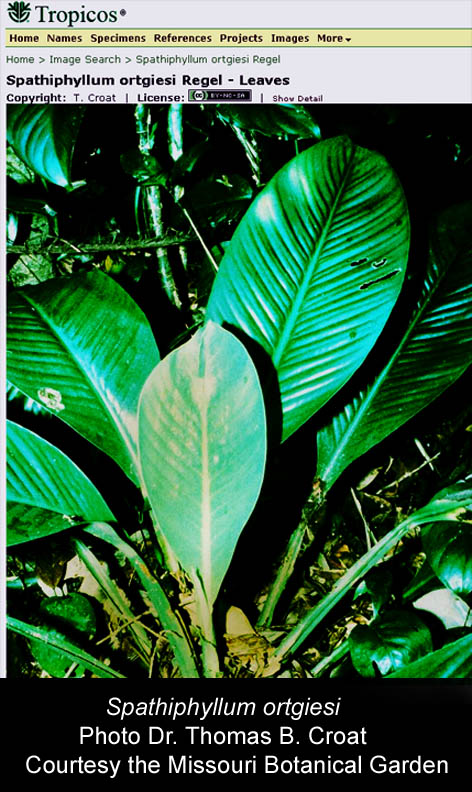 If
your plant is stuck in a dark corner it stays there until you choose to
move it! The plant has no natural way to correct its poor growing
conditions and once the light level is intolerably inadequate for the
production of sufficient sugars in order to feed itself the plant simply
runs out of options and cease to survive thus providing more compost to
the forest floor to feed all the remaining plants. It happens all
the time in nature, and too often in homes.
If
your plant is stuck in a dark corner it stays there until you choose to
move it! The plant has no natural way to correct its poor growing
conditions and once the light level is intolerably inadequate for the
production of sufficient sugars in order to feed itself the plant simply
runs out of options and cease to survive thus providing more compost to
the forest floor to feed all the remaining plants. It happens all
the time in nature, and too often in homes.
How do
plants such as a Spathiphyllum know to seek brighter light, quite
simply their own DNA points them in that direction and in the case of
many climbing species towards a tree to climb. Many rain forest
plants need a tall tree tree so they can begin their climb toward the
light in order to attain adulthood and nature provides with with a
unique tool known as scotopism to seek dark shade in order to climb a
tree to brighter light. However, in the case of the "Peace Lily", the
species is a water loving terrestrial species and is rarely found
growing in trees.
Once the plant realizes it has insufficient light to produce adequate
food its own DNA tells the group of plants it is time to move in order
to find more "food" in the form of light. Plants need brighter light
source in order to produce more chlorophyll and thus more sugar.
Chlorophyll is the green pigment in every plant that captures sunlight
to produce photosynthesis. Plants draw in oxygen through their roots and
carbon dioxide through the leaf blades. As explained earlier, the carbon dioxide (CO2)
combines with water that enters the cells of the leaf in the form
of humidity and rain. The oxygen is given back to
the environment for all living beings to breathe and the sugar is used
in the form of carbohydrates to feed and nourish the plant's own growth.
Stronger light is essential to the healthy growth of every
Spathiphyllum plant in the same way it is essential to all others.
Plants don't truly "make" oxygen, they simply release it through
photosynthesis.
Were you to borrow a very good light meter from a trained professional photographer and do the math you would learn the light level in a darkened corner of a living room is less than 5% (perhaps lower) than the bright light these species enjoy in nature. Ask a good photographer to help you understand the concept of light reduction when using a camera. Assuming a good camera has f/stops ranging from f/22 down to f/2.8 (a normal 6 f/stop range), every time you make a one stop adjustment you have lost 50% of the previous amount of measured light. If you have to use the f/22 reading in the sun which would be normal in most situations but must also use the f/2.8 setting in the living room (again normal), you have just lost more than 95% of the available light!
Should I
really water the plant or let is stay dry most of the time?
I
frequently read posts on garden forums asking why a “Peace Lily” is
about to die and how to save the plant. Almost
without exception the principal responses given are to slow down on the
water and/or move it to an area of dimmer light. This advice is exactly the
opposite of what nature provides naturally!
 I'm not certain where
such advice on the the "Peace Lily" originated but if you
missed all the opening remarks in this article you should be aware this plant commonly grows
either in water or on the edges of pools of water in moderately bright
light in the native habitat. If a grower moves the plant into dim light the
eventual result mayt be the demise of the plant since it can no longer
complete its natural photosynthesis. Photosynthesis is a
requirement of the plant to keep it alive and healthy!
I'm not certain where
such advice on the the "Peace Lily" originated but if you
missed all the opening remarks in this article you should be aware this plant commonly grows
either in water or on the edges of pools of water in moderately bright
light in the native habitat. If a grower moves the plant into dim light the
eventual result mayt be the demise of the plant since it can no longer
complete its natural photosynthesis. Photosynthesis is a
requirement of the plant to keep it alive and healthy!
Although these plants are tolerant of neglect they can't survive
forever if not allowed to live as they were intended to live and grow. A
great rule to follow is "Listen to Mother Nature since her advice is
best" and Mother Nature gives the plant adequate light, food and water.
One of the most brilliant friends I have is aroid botanist Dr. Tom Croat. Tom has personally collected more than 100,000 living specimens n
the wild and granted scientific names to more aroid species than any
other living human on this Earth. Tom has often called Spathiphyllum
species “water hogs”!
Despite the fact people are constantly advised to grow these plants dry
and in dim light I've spoken with aroid botanists including Tom that
have seen these plants growing in very bright light away from the edges
of the canopy shade. The wild “Peace Lily” often stands in water.
My friend and naturalist Joep Moonen who lives in French Guiana which is
an extremely tropical nation in the northeastern corner of South
America. Joep (pronounced "yupe") recently wrote,
"We have
Spathiphyllum humboldtii growing in French Guiana but it is very rare.
It grows in gravel on creek banks and in the rain season grows partly
under water."
That
beautiful spathe. Is it really a flower?
Spathiphyllum species are common to much of Central and South
America as well as s few species in Southeast Asia. Although it is commonly called a “Peace Lily” the plant is in
the family Araceae. Plants are divided into
classes, subclasses, orders, families, genera (genus) and species. The
family which is at the top of the list for Araceae is Liliopsida.
Spathiphyllum species are not in the family Liliaceae which contains
most of the lily species although both Liliaceae and Liliopsida are
related Monocots so the common name is somewhat misleading. The common
name “Spath” comes from the spathe the plant produces which is one of
the major parts of the inflorescence used for reproduction.
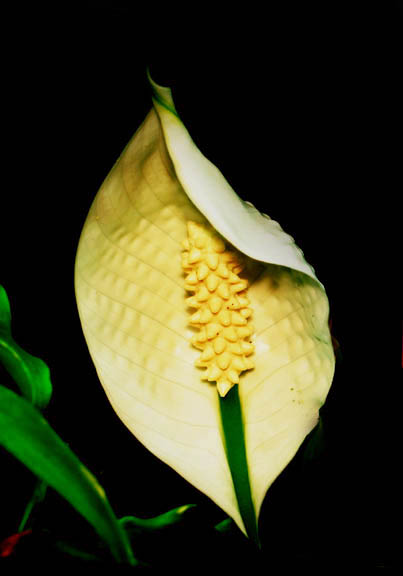
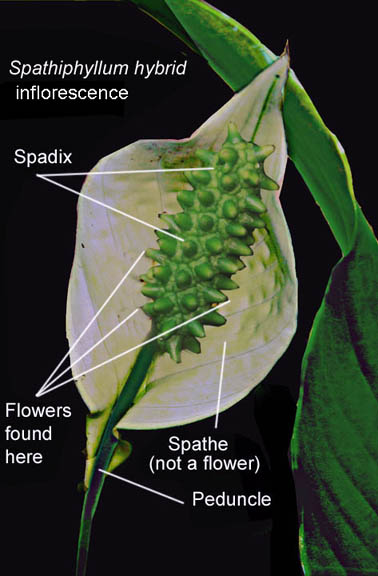
Aroids are characterized by the growth the inflorescence known to
science as a spathe surrounding a spadix. Despite being called a "flower"
the spathe is not a flower and is simply a modified leaf
which appears in the shape of a hood. The spadix is located at the
center of the inflorescence and is a spike on a thickened fleshy
axis which is supported on a stalk known as a peduncle.
When a “Peace Lily” is referred to as "flowering" the reference is truly
to the very small flowers (near microscopic) which are produced along
the spadix and have nothing to do with the spathe. The only connection is
both are produced during the plants sexual reproduction known as
anthesis. The spathes of different species do not look
alike and some look nothing like the common plant found in a home. Each species has a unique inflorescence which is one of the
main characteristics used to determine the species. Since the
majority of plants sold in the U.S. are hybrids the characteristics of
the inflorescence is likely a combination of both parent species.
 The pollination of a Spathiphyllum specimen appears relatively
simple in nature and includes a long flowering cycle.
While aroid
species such as Philodendron are unisexual and possess imperfect
flowers with the female flowers found in a female
floral chamber to hold the female
flowers Spathiphyllum species
possess perfect flowers.
Bisexual
inflorescences possess perfect flowers containing both male and female
sexual organs throughout
the length of the spadix without any distinctive zones.
The pollination of a Spathiphyllum specimen appears relatively
simple in nature and includes a long flowering cycle.
While aroid
species such as Philodendron are unisexual and possess imperfect
flowers with the female flowers found in a female
floral chamber to hold the female
flowers Spathiphyllum species
possess perfect flowers.
Bisexual
inflorescences possess perfect flowers containing both male and female
sexual organs throughout
the length of the spadix without any distinctive zones.
Within the
bisexual inflorescence each tiny section which can be observed on the
spadix with a good magnifying glass is an individual flower consisting
of a central female structure with a stigma at its center and several
male flowers surrounding that stigma. These male flowers are
difficult to observe except during male anthesis when they are actually
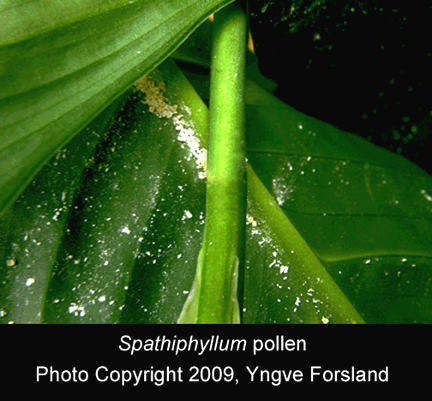
producing pollen. The pollinator
of these species is thought be a small bee active only during daylight
hours but the thermogenesis of the species has never been documented.
Thermogenesis is a heat rise produced by the inflorescence that is used
to disperse a perfume-like pheromone in order to attract the pollinating
insect. Insects can also "see" the heat as a result of
infrared heat.
If you'd like to know more about thermogenesis and are interested to learn how aroids are
pollinated please click on this link.
Natural pollination in aroids
Solving the
problem of keeping your Peach Lily happy!
It really isn't hard
but the method won't be popular with some of your friends.
Although it is acceptable to allow a Spathiphyllum to become
slightly root bound, despite commonly given advice, aroids don't like to have their roots
constantly restricted in a tight pot! They need room to easily spread and
grow. Have you ever visited a rain forest and dug up a plant?
You won't find a root ball since there are not pots in the forest! The advice to keep a plant with the roots tightly restricted is based on
a nurseryman's need to have the roots quickly fill the pot in order to
encourage the above soil growth. By continuing to restrict them
into a tight ball you do not allow them to freely grow and stretch as
they would in nature. As a result, after observing many aroids
being repotted by professional growers at major botanical institutions we always loosen the root
system
and use pots that are several inches larger when repotting our aroid
specimens. All are repotted regularly on an approximately every
two year cycle to renew the soil.
So why is the soil mixture important? If the roots of Spathiphyllum
species or hybrids don't have the ability to stretch, grow and move
freely in their soil they will rot. These plants need very loose porous
soil and you aren't ever going to find that in an off the shelf potting
mix. It isn't the water that causes the roots to rot it is the soggy,
sticky, thick, gummy soil growers normally plant them in!
The only way to allow the roots to absorb nutrients, breathe and poke
around easily in the soil is to make it possess a very porous
consistency with lots of easily reached regions that are never tightly
compacted. In the compost-filled silt of a Central American or tropical South American
stream or pond of standing water these plants can run their roots all
over the place. You can often reach into the water and feel only very loose
compost rather than thick gooey mud. For some reason people believe they
can just go buy "potting soil" and anything should grow in it but that
may well be the kiss of death to many tropical plants!
Potting mix companies make it the way they do since they know most people are
going to fail to water their plants properly. Instead of following the
lead of the companies that sell this thick “mud” we need to pot our
plants correctly unless you are willing to constantly sacrifice
specimens and pay good money to a plant retailer for a replacement.
We have kept Peace Lilies alive and well for over 20 years in loose
compost filled soil!
Just as you wouldn't plant a cactus in soggy soil you shouldn't plant a
Spathiphyllum in incorrect soil. Cacti like sandy soil and
Spathiphyllum prefer loose soil that is filled with natural food
(decaying vegetation). We are quick to go out and buy the
right mix for a succulent but never consider doing the same for an aroid
species including a Philodendron or Anthurium even though they also need
a special mixture to prosper.
Once a home grower sees their plant begin to decline the first reaction
after posting or reading a few comments on a garden site is to slow down on the water
without bothering to learn how these plants grow in the wild. Not long
after they come back and post their plant died anyway.
Remember, these are rain forest plant species and they live in an
extremely wet environment. For 6 to 8 months a year it rains much of the
day! Rather than trying to force the plant to do what we want it to do
we need to learn what the plant needs.
I find it regrettable that many home growers are just down right lazy
when it comes to taking care of their plants and use what I believe is
an excuse to make themselves feel better. It sure doesn't make the plant
feel better. If you went out and bought a dog you'd feed and treat it
the way it needs to be fed and treated. Why won't we do that with a
plant?
Good growers mix their soil for each plant to match what the plant needs
in order to make the plant prosper. These species need extremely porous
soil and moderately bright light or their roots may eventually rot. But it isn't
watering that causes the rot and eventual death of the plant. It is the
soil quality, low light which starves the plant of needed chemical
reactions and neglect!
Here is the
secret most serious aroid growers already know!
Here's how to mix your soil for your "Peace Lily" . The more
porous the soil the better! You're going to make up a special soil mixture
using only some off the
shelf soil. If you make your own compost start with that for about 1/3
the total mix and modify the rest of the ingredients. Begin by making
a mixture of about 20% potting soil, 30% peat moss, roughly 20% Perlite, and 30% orchid potting
mix which contains cedar wood chips, charcoal and gravel. To that add
any good compost, a few cups of finely cut pieces of sphagnum moss and
some cypress mulch. If you have some Vermiculite throw that in as well.
This formula isn't critical, just keep it very loose. Mix all of this thoroughly and keep it
constantly damp (never dry)once you pot your plant. Enough ingredients to pot a
large plant shouldn't cost more than $15 and the chances are high you'll
have enough mix left over to plant one or two more plants.
Many
commercial growers really don't care if you kill your plant since you'll
probably go buy another one and that makes
them money. I have large
Spathiphyllum specimens that are almost 20 years old and my atrium is
watered daily to every other day depending on the season of the year.
Only during the middle of winter do we slow down to 2 or 3 days per week. During the summer my plants receive
6 to 8 minutes of
water per per day. I also grown these plants in water and I have
friends that grow them in aquariums. You can even buy them as aquarium
plants in many pet stores and in an article published in Aroideana
volume 3, #4 entitled AROIDS IN THE PUBLIC AQUARIUM, author Craig
Phillips who at the time was the Director of the National Aquarium in
Washington, D.C. described how Spathiphyllum species were used in
some of their aquarium displays.
Although giving the plant enough light to allow it to create its own
food, here's another important factor to keep these plants healthy! Give
your plants a regular dose (follow the instructions, use every three
months) of a 13-13-13 or
14-14-14 palletized fertilizer to keep them producing
inflorescences. Osmoscote is a pelletized fertilzer given once every
three months and available at garden centers. Commercial aroid
growers have learned the mixture works best for aroids.
Fertilizers with lower numbers will not do as well but you may need to
search for the correct mixes! They are not always easily
available.
Growers need to pay attention to what the plant wants and needs
naturally or should not even buy one if they aren't going to treat it
right. Water it but pot it right first. Remember, keep the plant in
bright indirect light, keep the soil evenly damp and feed it! And I'm
sorry if some are offended, but ignore the old wives' tales!
On the internet, people give advice based on what is best for themselves
and not necessarily for the plant. If you want to grow them
successsfully you will need to be wiling to do more than what is easiest
for you.
Healthy growth is about the fast flow of water through the soil. The lack thereof causes a lack of oxygen, anerobic fermentation and saprophytes that turn into pathogens. Saprophytes are organisms including fungus or bacteria that grow on and draw nourishment from dead or decaying organic matter that often includes soggy wet soil. The pathogens attack the roots and cause them to rot so all of the advice to "slow down on the water" is really about how to control the pathogens.
Anoxia, fermentation
and saprophytes
The reason many
house plants die!
Fermentation and saprophytes often occur in muddy soil that will not
not allow the roots to breathe but they don't
necessarily occur in water which is why we can cause a plant that is
about to die to grow new roots in clean water.
As a result, it is necessary to use soil mixes that allow the roots
to breathe and will not remain soggy. I've attempted in
many plant forum threads to explain the necessity of mixing proper soil for
plants but the advice is often ignored since it requires some "work"
on the part of the plant's keeper. The reason plants rot is not the
amount of water given to the plant! These are rain forest plants and
are literally drowned for months at a time! They die due to
anoxia in a pot.
If you could visit a rain forest you would quickly learn the soil is
composed of leaf litter, decaying wood, compost, animal droppings
and the charcoal left behind when a part of the forest burns. If
we'll just listen to Mother Nature we can all make our plants grow
as they do in nature. That is precisely what I attempt to explain
when I recommend mixing soil, not
just buying a bag at the store.
Over time we've arrived at a soil mixture for most of our aroid
species which duplicates the rain forest. We use this mixture on the
advice of the aroid keepers at the Missouri Botanical Garden in St.
Louis. The goal of this mix is to allow the roots to freely find
places to extend and grow without constantly finding wet places
where they will rot. This mix will remain damp but drain quickly.
The common advice on most garden websites is to allow a plant to dry between watering, however that is often not good advice. Here's why.
Anyone that has asthma knows the difficulty of getting air out and then drawing fresh oxygen back in. Even though plants release oxygen into the air through their leaves they draw fresh oxygen into the plant through their roots. A potted plant is much like your lungs and if you can't bring in fresh oxygen you will soon cease to live. Mud blocks the flow of oxygen. So you ask, how do these plants survive in the rain forest where some are observed growing in fairly rich boggy soil on the edges of rivers and streams? There are apparently an almost imperceptible water flow through the roots caused by the water flow of the stream. If you read earlier how jungle soil is made up, you also understand it is very porous and this allows the oxygen to still reach the roots. Mother Nature knows "tricks" we have yet to discover in our homes so we need to play close attention to what she does and duplicate her "style" as best possible.
As a result the top layer of a potted plant's soil should not be allowed to completely dry since that dry soil prevents the intake of fresh air! Remember, unlike jungle soil your pot is solid and no oxygen can enter though the walls as it would with only a tiny amount of water flow in th forest. Once the soil in a pot dries it creates a "blanket effect" to hold in the stale moisture and keep out fresh oxygen. Once the top layer dries the moist layer below cannot easily breathe in order to re-oxygenate the soil so it is possible to soon become anoxic (the lack of oxygen). Anoxia encourages saprophytic growth and leads to root rot,
The dry upper layer surrounded by very solid pot walls actually prevents the capillary effect of the wet surface evaporation when damp soil is exposed to air. When you pour water in the air inside the soil is displaced so the oxygenated air inside has left the pot. If the upper soil layer completely dries the "lungs" of the pot cannot work and can no longer continue to draw in another breath of fresh air including needed oxygen.
The entirety of the soil needs to remain evenly damp so the roots of the plant can continue to draw in fresh oxygen. Otherwise, root rot is likely to begin. Since most people don't want to bother with ever watering their plants, many people go into a garden store and purchase a very rich potting soil that stays soggy all the time. Despite the belief they are giving the plant a "rich" soil to make it thrive they may be dooming their Spathiphyllum specimen to death in anoxic mud. Plant species can literally drown in mucky soil with no air or water motion due to a lack of oxygen that leads to saprophytic growth!
Rather than using a soggy soil and watering only once a week (or less), use a soil that holds moisture well but drains quickly. With the help of botanical garden researchers we've learn to develop a soil mixture for most of our aroid species that works great. People who visit our artificial rain forest are often amazed at the size of many of our specimens that grow much faster and larger than they often do in a home since we water frequently.
A very interesting point was raised a few years ago by my friend Julius Boos (1946 to 2010) from Trinidad. Julius was known widely as an expert in aroid species having published many articles in scientific publications and journals such as Aroideana. Aroideana is the official publication of the International Aroid Society. You may find his quote of interest, "The blooms of Spathiphyllum cannifolium are reportedly used and cooked as an ingredient in curries in Surinam and northern South America. I got a recent record of the blooms and young leaves of Caladium bicolor being cooked and used as a food in Aruba and N. W. Trinidad, W.I. and the name used for them there was 'ca-chew'." So at least some of these plants are used for more purposes than simply as a house plant! Spathiphyllum cannifolium is a unique species of Spathiphyllum.
The hybridized Spathiphyllum ("Peace Lily") is tolerant of a fairly wide range of conditions and abuse for moderately long periods of time but if not potted properly as well as given adequate light will eventually simply give up and die. Even near death, the plant often recovers with little more than a regular watering and a pruning to remove the dead leaves and spathes provided it is given a minimal dose of fertilizer and good light. Although it will be close to dehydration and starvation the plant will tell you when it wants to be watered by beginning to droop its leaves.
If fertilized moderately and treated well a large number of very exquisite green spathes of the Spathiphyllum that is capable of turning white will grow. The lance shaped leaves normally reach 20 to 40cm (8 to 16 inches) in length and grow directly from the soil via the support of their petiole. However, there are numerous hybrids that can grow larger. All plants in the genus prefer medium to moderately bright light so long as it is near a window but protect it from cold and drafts! Spathiphyllum grows nicely under average room temperatures and can easily be propagated by dividing a few of the plant's rhizome clumps as a specimen begins to outgrow the pot.
On the subject of colored spathes, or supposed plants that produce a colorful spathe other than white I asked Dr. Croat on August 15, 2010 to comment. He responded, "Most species actually produce green spathes. Rather few are actually white but no other colors are involved." Just another myth to chalk up to all the others that can read on the internet.
Aroideana is the scientific journal of the International Aroid Society. http://www.aroid.org/
For
information on natural variation in aroid and other plant species please
visit this page:
Natural variation
My thanks to Devin Biggs for the use of his photos. Many aroids can be
grown as semi-aquatic plants under proper conditions. See this website
for information:
http://ripariumsupply.com/
The currently accepted list of
Spathiphyllum species.
Click the species name for additional information.

Spathiphyllum atrovirens Schott, Oesterr. Bot. Z. 8: 179 (1858).
Spathiphyllum barbourii Croat, Rodriguésia 56: 117 (2005).
Spathiphyllum bariense G.S.Bunting, Phytologia 64: 480 (1988).
Spathiphyllum blandum Schott, Oesterr. Bot. Wochenbl. 7: 159 (1857).
Spathiphyllum brent-berlinii Croat, Rodriguésia 56: 118 (2005).
Spathiphyllum brevirostre (Liebm.) Schott, Aroideae 1: 2 (1853).
Spathiphyllum buntingianum Croat, Rodriguésia 56: 120 (2005).
Spathiphyllum cannifolium (Dryand. ex Sims) Schott, Aroideae 1: 1 (1853).
Spathiphyllum commutatum Schott, Oesterr. Bot. Wochenbl. 7: 158 (1857).
Spathiphyllum cuspidatum Schott, Oesterr. Bot. Wochenbl. 7: 158 (1857).
Spathiphyllum diazii Croat, Rodriguésia 56: 121 (2005).
Spathiphyllum dressleri Croat & F.Cardona, Aroideana 27: 139 (2004).
Spathiphyllum floribundum (Linden & André) N.E.Br., Gard. Chron., n.s., 1878(2): 783 (1878).
Spathiphyllum friedrichsthalii Schott, Aroideae 1: 2 (1853).
Spathiphyllum fulvovirens Schott, Oesterr. Bot. Z. 8: 179 (1858).
Spathiphyllum gardneri Schott, Aroideae 1: 2 (1853).
Spathiphyllum gracile G.S.Bunting, Mem. New York Bot. Gard. 10(3): 32 (1960).
Spathiphyllum grandifolium Engl., Bot. Jahrb. Syst. 37: 119 (1905).
Spathiphyllum grazielae L.B.Sm., Fl. Braz. For.: t. 31 (1968).
Spathiphyllum humboldtii Schott, Aroideae 1: 2 (1853).
Spathiphyllum jejunum G.S.Bunting, Mem. New York Bot. Gard. 10(3): 23 (1960).
Spathiphyllum juninense K.Krause, Notizbl. Bot. Gart. Berlin-Dahlem 11: 615 (1932).
Spathiphyllum kalbreyeri G.S.Bunting, Mem. New York Bot. Gard. 10(3): 21 (1960).
Spathiphyllum kochii Engl. & K.Krause in H.G.A.Engler, Pflanzenr., IV, 23B: 123 (1908).
Spathiphyllum laeve Engl., Bot. Jahrb. Syst. 37: 120 (1905).
Spathiphyllum lanceifolium (Jacq.) Schott in H.W.Schott & S.L.Endlicher, Melet. Bot.: 22 (1832).
Spathiphyllum lechlerianum Schott, Prodr. Syst. Aroid.: 425 (1860).
Spathiphyllum maguirei G.S.Bunting, Mem. New York Bot. Gard. 10(3): 23 (1960).
Spathiphyllum matudae G.S.Bunting, Mem. New York Bot. Gard. 10(3): 38 (1960).
Spathiphyllum mawarinumae G.S.Bunting, Phytologia 64: 480 (1988).
Spathiphyllum minor G.S.Bunting, Mem. New York Bot. Gard. 10(3): 31 (1960).
Spathiphyllum monachinoi G.S.Bunting, Mem. New York Bot. Gard. 10(3): 19 (1960).
Spathiphyllum monachinoi var. monachinoi.
Spathiphyllum monachinoi var. perangustum G.S.Bunting, Phytologia 64: 482 (1988).
Spathiphyllum montanum (R.A.Baker) Grayum, Phytologia 82: 50 (1997).
Spathiphyllum neblinae G.S.Bunting, Mem. New York Bot. Gard. 10(3): 25 (1960).
Spathiphyllum ortgiesii Regel, Gartenflora 19: 39 (1870).
Spathiphyllum patinii (R.Hogg) N.E.Br., Gard. Chron., n.s., 1878(2): 783 (1878).
Spathiphyllum patulinervum G.S.Bunting, Mem. New York Bot. Gard. 10(3): 32 (1960).
Spathiphyllum perezii G.S.Bunting, Acta Bot. Venez. 10: 321 (1975).
Spathiphyllum phryniifolium Schott, Oesterr. Bot. Wochenbl. 7: 159 (1857).
Spathiphyllum quindiuense Engl., Bot. Jahrb. Syst. 37: 120 (1905).
Spathiphyllum schlechteri (Engl. & K.Krause) Nicolson, Blumea 16: 120 (1968).
Spathiphyllum schomburgkii Schott, Oesterr. Bot. Wochenbl. 7: 158 (1857).
Spathiphyllum silvicola R.A.Baker, Phytologia 33: 448 (1976).
Spathiphyllum solomonense Nicolson, Amer. Journ. Bot. liv. 496 (1967). 54: 496 (1967).
Spathiphyllum tenerum Engl., Bot. Jahrb. Syst. 37: 120 (1905).
Spathiphyllum uspanapaensis Matuda, Cact. Suc. Mex. 21: 74 (1976).
Spathiphyllum wallisii Regel, Gartenflora 26: 323 (1877).
Spathiphyllum wendlandii Schott, Oesterr. Bot. Z. 8: 179 (1858).