
Aroids and other genera in the Collection
Take the Tour Now?
Orchids
The
Exotic Rainforest
Plants in
the Exotic Rainforest Collection
The images on this website are copyright protected. Please contact us before any reuse.
Detailed information on Growing Anthurium
Species Click this Link
Within our collection we have many species of Anthurium. If you are seeking other photos, click this link:
Anthurium veitchii
Mast.
A naturally variable
Anthurium species.
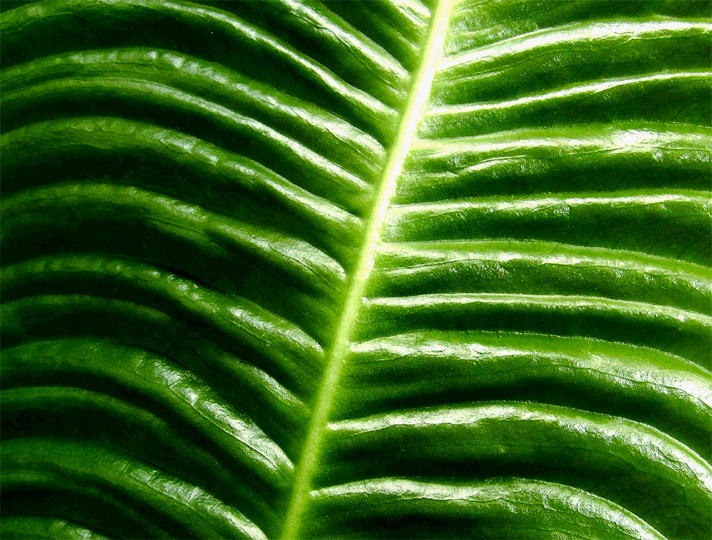
The Queen Anthurium? The King Anthurium? It just depends on the material you read!
 Once rare, Anthurium
veitchii
is now commonly sold. The
introduction of tissue cultured specimens has dramatically reduced the plant's
value but made it widely available to collectors. Endemic to
(exclusively found in) the South American rain forests of Colombia, the "Queen Anthurium" (see
note at bottom of page), is one of the largest and most spectacularly beautiful epiphytic (plants that grow on
plants) Anthurium sp. of them all. A variable epiphyte
(ep-a-FIT),
Anthurium veitchii is a
specimen that grows from the branches of a tree rather than in the
soil. And despite common belief, the leaves of this species do
not always appear alike! The veins can be close together or
more widely spaced. Natural variation within species is one of
the most commonly misunderstood concepts among collectors, but not
every leaf of every plant has to look alike to be the same species!
Once rare, Anthurium
veitchii
is now commonly sold. The
introduction of tissue cultured specimens has dramatically reduced the plant's
value but made it widely available to collectors. Endemic to
(exclusively found in) the South American rain forests of Colombia, the "Queen Anthurium" (see
note at bottom of page), is one of the largest and most spectacularly beautiful epiphytic (plants that grow on
plants) Anthurium sp. of them all. A variable epiphyte
(ep-a-FIT),
Anthurium veitchii is a
specimen that grows from the branches of a tree rather than in the
soil. And despite common belief, the leaves of this species do
not always appear alike! The veins can be close together or
more widely spaced. Natural variation within species is one of
the most commonly misunderstood concepts among collectors, but not
every leaf of every plant has to look alike to be the same species!
Originally identified in 1876, under ideal growing conditions the coriacious (leathery) lanceolate (spear shaped) leaves can reach 2 meters (6 feet)! As they grow, the numerous lateral veins become more pronounced and begin to turn silver/white making for a stunning appearance against the corrugated and elongated deep green blades. A member of Anthurium section Calomystrium, when young, the leaves of A. veitchii (VEET-chee-eye) are easily damaged and will never heal. If you are growing one as a collector's specimen protect it from wind, insects, fungus and other predators which may damage the otherwise incredible foliage. Once mature, the leaves of Anthurium veitchii are thick with an undulating appearance. Although according to expert growers direct sunlight should be avoided, A. veitchii appreciates fairly bright filtered light since it normally grows well off the ground and nearer brighter light.
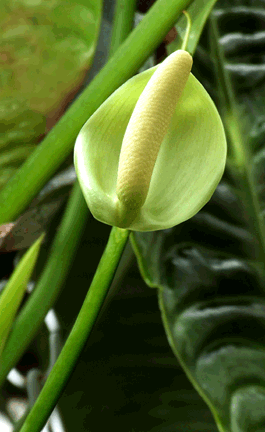 All Anthurium
species are aroids. An aroid is a
plant that reproduces by growing an inflorescence which in aroids is known to science
as a spathe and spadix supported by a stalk known as a peduncle. Most people believe the spathe is a
"flower" which is incorrect. The spathe is a modified leaf
whose purpose is to offer protection to the spadix at the center of the
inflorescence.
All Anthurium
species are aroids. An aroid is a
plant that reproduces by growing an inflorescence which in aroids is known to science
as a spathe and spadix supported by a stalk known as a peduncle. Most people believe the spathe is a
"flower" which is incorrect. The spathe is a modified leaf
whose purpose is to offer protection to the spadix at the center of the
inflorescence.
During sexual anthesis you can find very tiny flowers on the spadix when the plant is ready to produce seeds. Anthurium differ from Philodendron species since all Anthurium produce bisexual perfect flowers containing both male and female organs while Philodendron produce unisexual imperfect flowers containing only a single sex. At sexual anthesis all Anthurium produce an inflorescence which contains both a spathe and a spadix. The spadix is only a modified leaf and not a flower which surrounds the fleshy spike known as the spadix. When an Anthurium is "in flower" the reference is to the tiny flowers containing both male and female sexual parts that grow on the spadix at the center of the inflorescence. To help prevent self pollination nature has designed the female flowers to be receptive before the male portion of the flower produce their pollen so in most cases an insect must bring pollen from another plant.
When ready to reproduce the spadix produces female which include sterile male flowers. The sterile male flowers exude a pheromone or perfume like scent used to attract pollinating insects and are eaten by the pollinators due to their high protein content. In order to produce seeds the female flower parts must first be pollinated as they reach their own sexual anthesis. The male flower portion produces pollen after the female flowers are receptive in an effort to reduce the frequency of self pollination. If the female flowers are pollinated by an appropriate beetle from the genus Cyclocephala which carries pollen from another Anthurium veitchii specimen already at male anthesis those female flowers will be pollinated and the spadix will begin to grow whitish green berries containing 1 to 2 seeds. Both the spathe and spadix are greenish white.
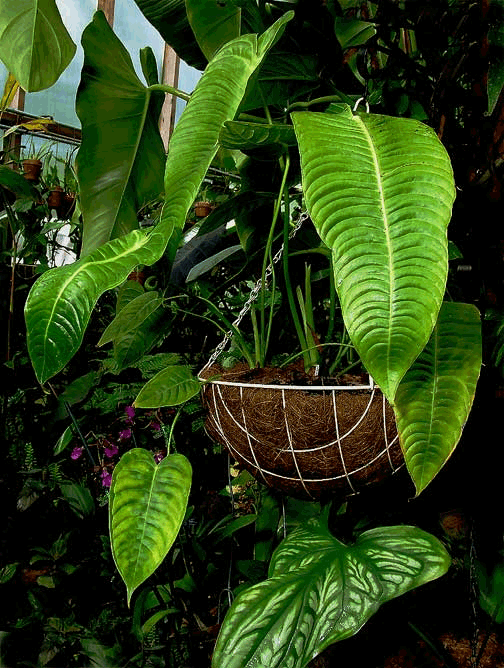
Our three specimens of Anthurium veitchii currently (October 2007) have leaf blades up to 90cm (3 feet) after only 27 months of growth! All have produced many new leaves since the photo above was taken (see inset, right). Our Anthurium veitchii were originally potted in a mixture of good rich soil with extra pure peat, Perlite™, orchid potting mix and crushed volcanic rock. The orchid mix was added to simulate the bark of a tree to which the plant's roots can attach and the other ingredients allow for fast drainage, minerals, and moisture retention. Once the plants were well established we moved them into a 30cm (12 inch) square wooden orchid basket packed with sphagnum moss mixed with orchid charcoal. The roots with attached materials were not disturbed. The wooden basket offers even better drainage and provides the plants with a firm support to which they can attach their roots. Just after the first of the year (2007) two plants produced spathes and spadices. We are in hopes of gathering pollen from one to pollinate a second plant. Interestingly, one plant produced both a spathe and a new leaf at the same time as can be seen in the lower center photograph above. Although A. veitchii can certainly be grown in the ground, the sheer length of the blades do not allow the plant to be well presented. Presenting the plant in its natural epiphytic form, such as in a basket, allows the specimen to be more fully appreciated for its incredible natural beauty.
The majority of
Anthurium sp. prefer extremely high humidity. Our Exotic
Rainforest atrium was built around a 2500 gallon pond which, through
natural evaporation and frequent watering, insures high humidity in the building at all
times. We make it a practice to heavily mist all of our Anthurium
species daily during the heat of summer (often twice each day) and an
average of 3 to 4 days a week the balance of the year.
However, since our Anthurium veitchii
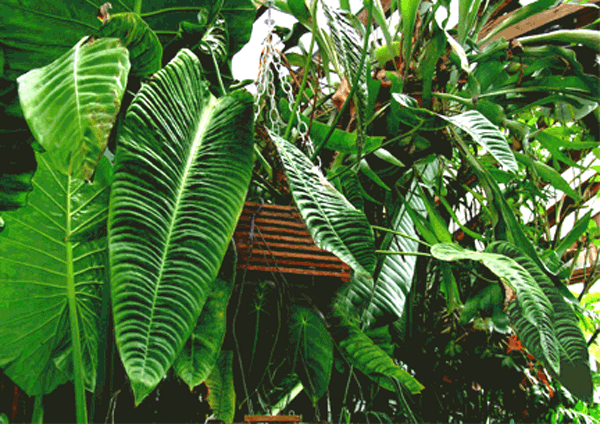 specimens are growing epiphytically, they are watered more
frequently. Still,
since they naturally grow in a "rain forest" we water virtually all
of our aroids in the same way.
specimens are growing epiphytically, they are watered more
frequently. Still,
since they naturally grow in a "rain forest" we water virtually all
of our aroids in the same way.
Anthurium veitchii appears to prefer cooler temperatures in the 15.5 to 26.5 C (60 to 80 degree F) range making it ideal for our Arkansas rain forest. Anthurium veitchii does not tolerate temps below 12.75 C (55 degrees F) well. Although the plant is said by experts to not appreciate the heat, our specimens have shown no ill effects when the summer temps get quite high. They have added a large number of new leaves during that period and the roots are now poking through the bottom of the orchid basket. Anthurium do however appear to grow faster during cooler months.
The photo (right, October, 2007) shows the spectacular growth of our specimens since the top right photo was taken approximately one year earlier. The orchid basket is 30cm (12 inches) square. There are an equal number of leaf blades not visible at the rear of the basket. Two of our plant specimens were started from naturally grown seed but the last is a tissue cultured specimen. You can now find very small specimens available from tissue cultured (cloned) material available on the internet for very low prices. These plants are often near identical to the naturally grown specimens but may sometimes prove to be less beautiful. They are simply created in a lab. However, many growers have noted that tissue cultured specimens often do not attain the large leaf blades found in a seed grown specimen. Apparently, the chemicals used in the tissue culture process have the potential to inhibit natural growth.
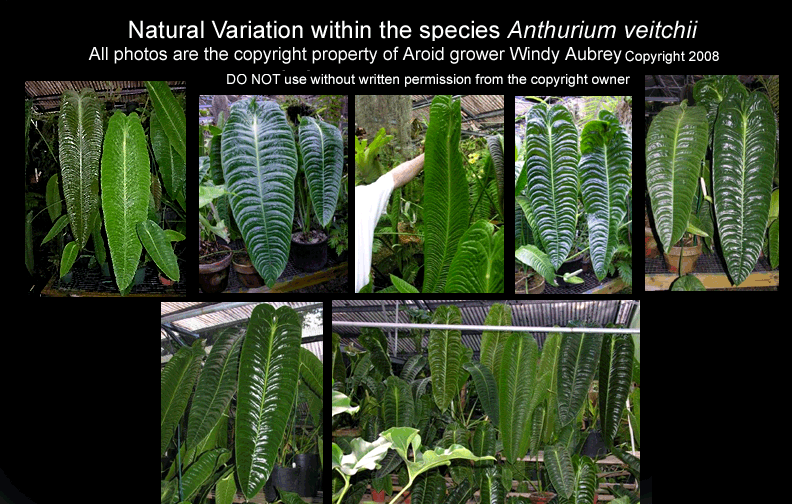
Collectors have recently been asking if the plant's variations are actually different species. Some A. veitchii have the veins growing much closer together than other specimens. Variations are common in all Anthurium species and these are simply natural variations \within the same species and are not an indication of a different species.
You will note I didn't called Anthurium veitchii the king or the queen Anthurium. The word "queen is almost spelled out in the scientific name Anthurium warocqueanum which is commonly accepted as the Queen Anthurium. There appears to be some debate on the web about which plant is the King or Queen as the result of a passage by author Deni Bown who wrote Aroids, Plants of the Arum Family, a principal reference on aroids. Check page 312 of her book. She names Anthurium veitchii as the "Queen". The majority of collectors accept Anthurium warocqueanum as the queen and Anthurium veitchii as the "King".
Still unsure what natural variation within a species looks like. Take a look at just some of the forms of Anthurium veitchii grown by aroid grower Windy Aubrey in Hawaii. In nature, variation is even more widely seen! And once you examine her photos read the link for a better explanation of what botanists have known for years to be natural variation within a species. Every leaf does not have to look alike!
This link will give you more information: Click Here
Looking for a specimen? Contact
http:///

Aroid Pollination!
As
it occurs in nature and by any horticulturist
Need more information on Anthurium species? Click this link.
Join the International Aroid Society: http://www.exoticrainforest.com/Join%20IAS.html
If you
are seeking information on other rare species, click on "Aroids and other genera in the Collection" at the top and look for the
