
Aroids and other genera in the Collection
Take the Tour Now?
Orchids
The
Exotic Rainforest
Plants in
the Exotic Rainforest Collection
The images on this website are copyright protected. Please contact us before any reuse.
Detailed information on Growing Anthurium Species
Click this Link
The Exotic Rainforest is a private botanical garden.
Within our collection we have many species of Anthurium. If you are seeking other photos, click this link:
New: Understanding, pronouncing and using Botanical terminology, a Glossary
Anthurium
pendulifolium
N.E. Br.

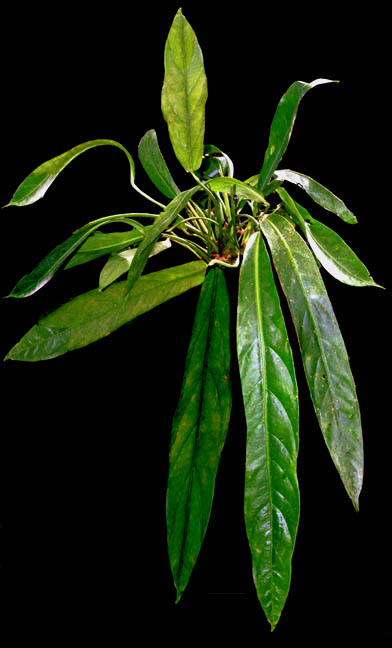
Anthurium
pendulifolium
N.E. Br.
South American
common names: "yakiya sugkip", "kakur
nuka" and "meko uko"
The technical data in this article was extracted from the published work of my mentor aroid botanist Dr. Thomas B. Croat Ph.D., P.A. Schulze Curator of Botany of the Missouri Botanical Garden in St. Louis, MO. The original information can be found on page 699 of Dr. Croat's scientific journal Annals of the Missouri Botanical Garden 1991, Volume 78, #3. This data is provided so any collector may be able to compare the features indicated to their own specimen in order to determine if that plant is the true species.
 Described to science in 1904, Anthurium pendulifolium
(PEN-dul-i-fol-i-um) is found in nature from
southwestern to
southeastern Colombia, in eastern
and northeastern Ecuador and into both northern and east central Peru.
Anthurium pendulifolium is an epiphyte (ep-a-FIT) (a plant that grows upon another plant,
(normally a tree)
with leaf blades that hang pendently from the host.
Living in tropical moist and tropical wet rain forests Anthurium
pendulifolium is rarely found as a terrestrial species growing in soil.
Anthurium pendulifolium is observed at elevations ranging from 100 to
440 meters (330 to 1445 feet) above sea level. Since the species
grows at lower elevations it becomes a relatively ideal
specimen to be grown within an aroid collection.
Described to science in 1904, Anthurium pendulifolium
(PEN-dul-i-fol-i-um) is found in nature from
southwestern to
southeastern Colombia, in eastern
and northeastern Ecuador and into both northern and east central Peru.
Anthurium pendulifolium is an epiphyte (ep-a-FIT) (a plant that grows upon another plant,
(normally a tree)
with leaf blades that hang pendently from the host.
Living in tropical moist and tropical wet rain forests Anthurium
pendulifolium is rarely found as a terrestrial species growing in soil.
Anthurium pendulifolium is observed at elevations ranging from 100 to
440 meters (330 to 1445 feet) above sea level. Since the species
grows at lower elevations it becomes a relatively ideal
specimen to be grown within an aroid collection.
As you read this text
please refer to the photos in order to better understand the
botanical characteristics of the plant and terminology used.
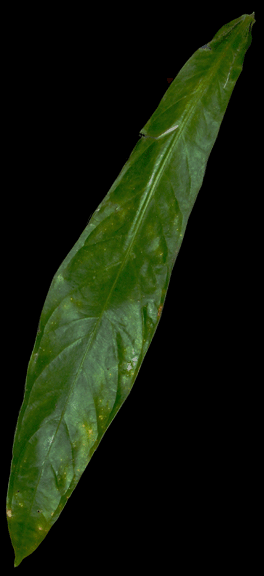
A member of Anthurium section Pachyneurium which contains all the "birds nest forms", all the species in this section require a period of dryness during the year in order to prosper. With its slender lanceolate (lance shaped) slightly glossy to matte blades hanging downward (pendently), the leaves are coriaceous to moderately coriaceous or leathery to the touch. The blades and are dark green on the adaxial blade surface (upper) as well as being glossy to semi-glossy. The upper surface may be either concolorous (one color) or slightly bicolorous (two colored). If the abaxial, or underside, of a blade is observed it will be found to be matte and the color beneath the blade should be slightly paler than that on the upper surface.
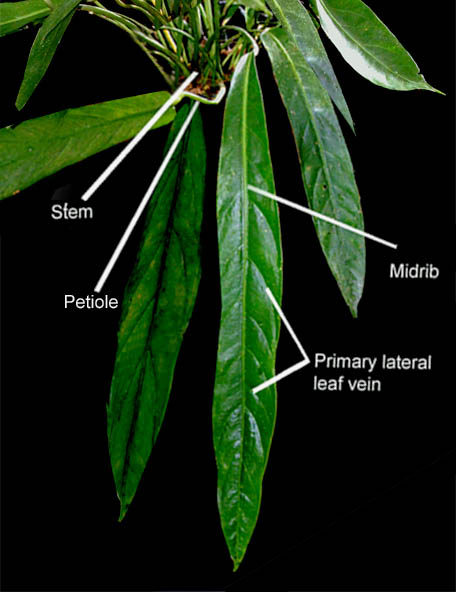
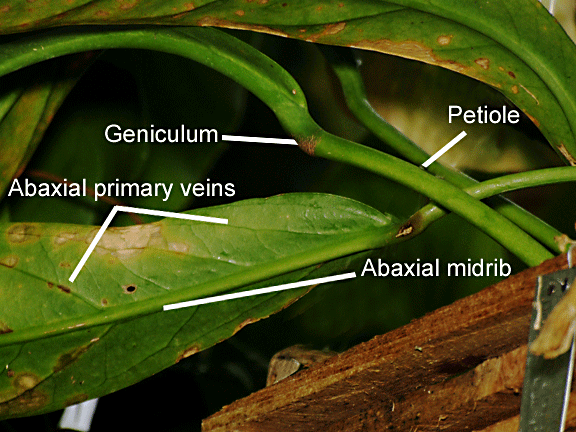
The midrib (see illustration left) at the center of the leaf is convex on the upper surface and is paler in color than the the balance of the leaf blade. The midrib is more prominently raised on the underside than on the upper surface and is slightly rounded (see illustration below, left). The primary lateral leaf veins should be sunken on the upper surface but in some specimens may also be slightly raised on the upper blade.
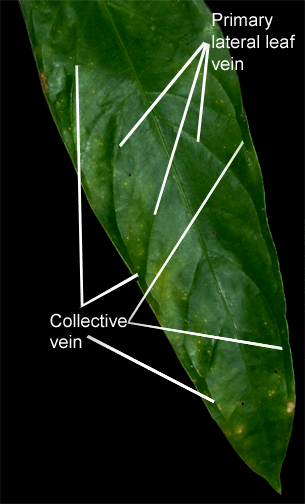 The primary veins are weakly raised
on the underside of the leaf blade
while the tertiary or minor veins are also slightly raised.
There should be 11 to 15 primary lateral
leaf veins on each side of the blade but occasionally as few as
8 primaries
may be observed. The primary veins depart from the midrib at
roughly a 45 degree angle as they grow towards the blade's margin.
The primary veins are weakly raised
on the underside of the leaf blade
while the tertiary or minor veins are also slightly raised.
There should be 11 to 15 primary lateral
leaf veins on each side of the blade but occasionally as few as
8 primaries
may be observed. The primary veins depart from the midrib at
roughly a 45 degree angle as they grow towards the blade's margin.
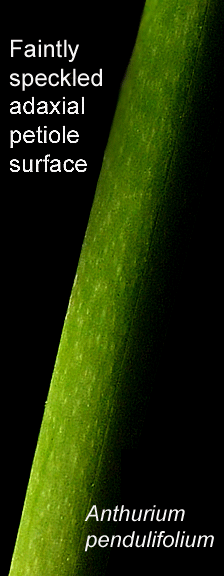
The petioles which support the
leaves
are commonly one half the
length of the blade but have been observed at up to 1.5 times the
blade's length. The petioles are faintly speckled (see photo below,
right) as well as terete to subterete
(round to just less than round). The petioles may be slightly flattened (obtuse
or bluntly rounded as well as thicker than broad) on the adaxial
or upper side.
The petiole is not the "stem" which is a term commonly used incorrectly by collectors but instead is the stalk which connects the leaf blade to the stem. In botanical science the stem is at the base of the plant and the petioles with their new leaves grow from the nodes along the stem. Within Anthurium pendulifolium the stem is pendent and hangs downward. Between each node is a segment of stem known as an internode and the internodes of Anthurium pendulifolium are short in length. The roots of Anthurium species also emerge from the stem and within Anthurium pendulifolium are moderately dense hanging downward and brown in color.
All Anthurium
species possess two unique features. The first is an organ known
to as the geniculum. The geniculum is
found at the top of the
petiole (see photo right) and normally appears to be a slightly
swollen gland. The purpose of the geniculum is to
permit the leaf to rotate its orientation in order to better collect light.
Another
unique feature of all
 Anthurium species is the
collective vein. The collective vein often completely encircles
the leaf just
a centimeter or so from the edge of the leaf. However,
in some species the collective vein only partially encircles the blade.
The collective vein of Anthurium pendulifolium arises in the middle to the
lower third of the blade and is less prominent than the species' primary
veins. The collective vein should appear approximately 7 to 14 mm (1/4
to 1/2 inch) from
blade's edge (margin).
Anthurium species is the
collective vein. The collective vein often completely encircles
the leaf just
a centimeter or so from the edge of the leaf. However,
in some species the collective vein only partially encircles the blade.
The collective vein of Anthurium pendulifolium arises in the middle to the
lower third of the blade and is less prominent than the species' primary
veins. The collective vein should appear approximately 7 to 14 mm (1/4
to 1/2 inch) from
blade's edge (margin).
The cataphylls of Anthurium pendulifolium (and other aroid species) are a bract-like modified leaf that surrounds any newly emerging leaf blade. The purpose of the cataphyll is to protect that new leaf blade as it develops. The cataphylls of Anthurium pendulifolium are green and lanceolate (lance shaped) in appearance. The cataphylls persist once dried and remain semi-intact at the upper nodes appearing to be a cluster of coarse fibers.
 All Anthurium
species are members of the larger
family Araceae and are known as aroids. An aroid is a
plant that reproduces by producing an inflorescence known to science
as a spathe and spadix. Most people believe the spathe is a
"flower" which is scientifically incorrect. The spathe is a modified leaf
whose purpose is to protect
the spadix at the center of the
inflorescence.
All Anthurium
species are members of the larger
family Araceae and are known as aroids. An aroid is a
plant that reproduces by producing an inflorescence known to science
as a spathe and spadix. Most people believe the spathe is a
"flower" which is scientifically incorrect. The spathe is a modified leaf
whose purpose is to protect
the spadix at the center of the
inflorescence.
All Anthurium species reproduce via the production an inflorescence. The stalk that supports the entire inflorescence is the peduncle and the spathe which surrounds the spadix is not a flower. When an Anthurium is "in flower" the reference is to the tiny flowers containing both male and female sexual parts that grow on the spadix at the center of the inflorescence. Unlike plants in the genus Philodendron which contain imperfect flowers having only a single sex Anthurium possess perfect flowers containing both sexes. To help prevent self pollination nature has designed the female flowers to be receptive before the male portion of the flower produce their pollen so in most cases an insect must bring pollen from another plant.
On the spadix there can be observed
these very tiny
flowers when the plant is ready to be pollinated and is at female
anthesis (sexual reproduction). When ready to reproduce the
spadix produces perfect flowers which also contain sterile
male flowers. The purpose of the sterile flowers is to produce a
perfume-like scent known as a pheromone to attract the appropriate insect
pollinator and also serve as a
 source
of food for those insects. If the
female flowers are pollinated by an appropriate insect (normally a
beetle from the genus
Cyclocephala) which carries
pollen from another specimen at male anthesis, the spadix will begin to
grow berries containing seeds. The
berries are then eaten by birds, rain forest animals and sometimes by bats
or carried away by ants. As a result, new plants find their way into
the canopy in the droppings of those animals. Once the seeds germinate
on the tree branch a new plant is formed and spends its entire life growing
well away from the soil.
source
of food for those insects. If the
female flowers are pollinated by an appropriate insect (normally a
beetle from the genus
Cyclocephala) which carries
pollen from another specimen at male anthesis, the spadix will begin to
grow berries containing seeds. The
berries are then eaten by birds, rain forest animals and sometimes by bats
or carried away by ants. As a result, new plants find their way into
the canopy in the droppings of those animals. Once the seeds germinate
on the tree branch a new plant is formed and spends its entire life growing
well away from the soil.
For additional information on aroid reproduction
please read this link.
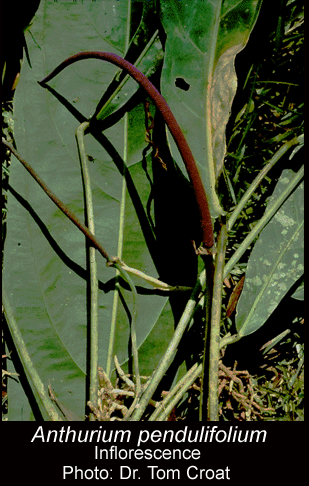
The inflorescence of Anthurium pendulifolium
normally
hangs pendently (downwards) on a stalk known as a peduncle. The spathe
is
relatively thick as well as pale green to a
creamy white in color with a tinge of violet/purple near the base.
The spathe is reflexed or turned backwards as well as twisted. The spadix
too is violet/purple to reddish purple in color. If pollinated the
berries are lavender becoming white as they fully mature.
The native tribes of Ecuador
have numerous "common" names for Anthurium pendulifolium
which include "yakiya sugkip", "kakur nuka" and "meko uko".
Those Indian tribes use the plant medicinally making a bath from boiled
leaves which is used to treat bone aches as well as rheumatism.
If you're
one of those plant growers who
 prefer to use common names rather than a
scientific name try one of those since Anthurium pendulifolium has no
common name.
prefer to use common names rather than a
scientific name try one of those since Anthurium pendulifolium has no
common name.
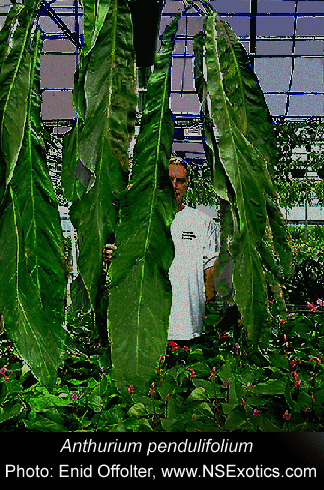
The most often seen photo on the internet of Anthurium pendulifolium was taken by Enid Offolter at Natural Selections Exotics in Fort Lauderdale, FL (photo left) of a plant owned and grown by Bill and Denis Rotolante at Silver Krome Nursery south of Miami. That specimen is much larger than the average Anthurium pendulifolium but was grown from a seedling provided by Dr. Croat before 1998. Our specimen in the photos above was grown from a seed produced by this plant.
One important note on growing any Anthurium from section Pachyneurium, the bird's nest forms. Plants within this section need a dry period each year and are not naturally found in extremely wet forest zones. Do no attempt to grow them in a soggy wet environment year round if you want to experience the maximum growth and health of your specimen.
Anthurium species
are known to be highly variable and not every leaf of every specimen will
always appear the same. This link explains in greater detail the
scientific principle of natural variation and morphogenesis.
Click here.
Looking for a specimen? Contact
http:///

Aroid Pollination!
As
it occurs in nature
Want to learn more? Join the International Aroid Society: http://www.exoticrainforest.com/Join%20IAS.html
Need more information on Anthurium species? Click this link.
