
Aroids and other genera in the Collection
Take the Tour Now?
Orchids
The
Exotic Rainforest
Plants in
the Exotic Rainforest Collection
The images on this website are copyright protected. Please contact us before any reuse.
Detailed information on Growing Anthurium Species
Click this Link
Within our collection we have many species of Anthurium. If you are seeking other photos, click this link:
New: Understanding, pronouncing and using Botanical terminology, a Glossary
Anthurium
longipeltatum
Matuda
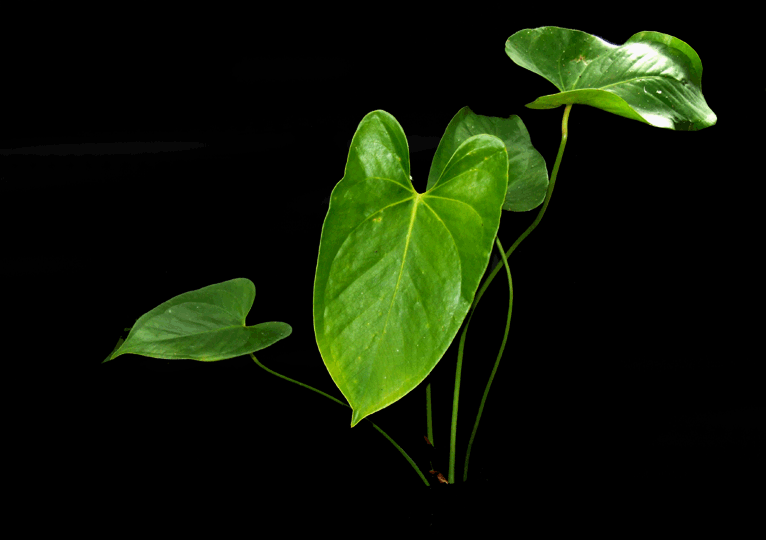
Described to science in 1967, the type specimen of Anthurium longipeltatum was found in far south central Mexico in the state of Oaxaca. Anthurium longipeltatum can be found in nature growing as either a terrestrial species or an epiphyte (ep-a-FIT) on the branches of a host tree. The species occurs in the northern portion of Oaxaca, near Orizaba, and is suspected to occur in nearby Puebia in tropical wet rain forest at an elevation ranging from 600 to 1,500 meters (1,970 to 4,900 feet). The species is a member of Anthurium section Cordatopunctatum (formerly section Belolonchium). Anthurium longipeltatum is often confused with Anthurium verapazense which is a species found from Belize to Honduras but not found naturally in Mexico. One difference in the species is Anthurium verapazense has a violet/purple spadix at the center of its inflorescence while the spathe of Anthurium longipeltatum is green faintly tinged with purple.
 The leaf blades of
Anthurium longipeltatum stand erect on petioles that measure 29
to 56cm (11.4 to 22 inches) in length. The petioles which support each
leaf measure 5 to 7mm (.2 to .275 inches) in diameter and are terete.
The botanical term terete simply describes a petiole (stem) that is
round.
The leaf blades of
Anthurium longipeltatum stand erect on petioles that measure 29
to 56cm (11.4 to 22 inches) in length. The petioles which support each
leaf measure 5 to 7mm (.2 to .275 inches) in diameter and are terete.
The botanical term terete simply describes a petiole (stem) that is
round.
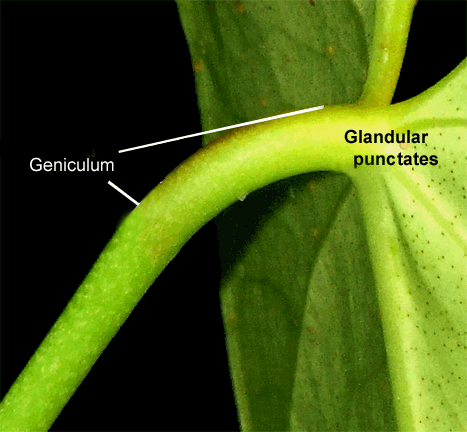
All Anthurium species possess an organ known as a geniculum. The geniculum is found at the top of the petiole (see photo below) and normally appears to be a slightly swollen gland on the petiole. The purpose of the geniculum is to permit the leaf to rotate its orientation in to better collect light. In the majority of Anthurium species the geniculum is easily observed, but in immature Anthurium longipeltatum specimens the geniculum may be somewhat difficult to see. If you look closely at the photo of our specimen below, which is still juvenile, the geniculum is only a very slight bit larger than the petiole. Still, if you feel the petiole with your fingers you can discern its position. If you grow Anthurium species examine the top of each petiole and you'll find the geniculum which is a unique feature of the genus Anthurium and a very few other aroid genera.
 The
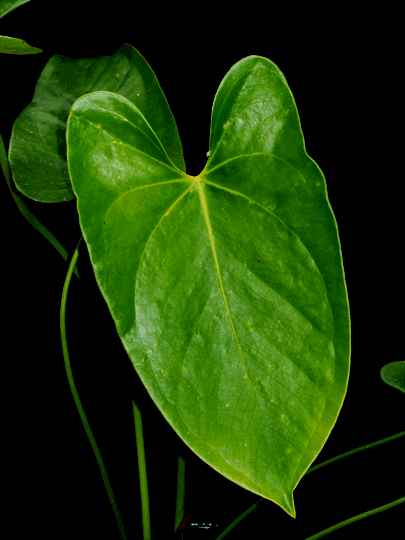
leaf blades of Anthurium longipeltatum are oblanceolate to
oblong-ovate. The scientific term oblanceolate describes a leaf blade
that is both oblong
and lance shaped but wider near the tip or oblong and widest near the
center of the blade
as well as spear shaped. The blades are moderately thick (coriaceous),
measuring 33 to 56cm (13 to 22 inches) in length and 14 to 28cm (5.5 to
11 inches) wide. The leaf is broadest just beneath the center of the
blade. The sinus, which is the space between the upper lobes, can be
parabolic (bowl like) to triangular in shape and it is not uncommon for
the lobes to overlap. The upper leaf surface is semi-glossy to glossy
while the underside of the blade is semi-glossy.
The
leaf blades of Anthurium longipeltatum are oblanceolate to
oblong-ovate. The scientific term oblanceolate describes a leaf blade
that is both oblong
and lance shaped but wider near the tip or oblong and widest near the
center of the blade
as well as spear shaped. The blades are moderately thick (coriaceous),
measuring 33 to 56cm (13 to 22 inches) in length and 14 to 28cm (5.5 to
11 inches) wide. The leaf is broadest just beneath the center of the
blade. The sinus, which is the space between the upper lobes, can be
parabolic (bowl like) to triangular in shape and it is not uncommon for
the lobes to overlap. The upper leaf surface is semi-glossy to glossy
while the underside of the blade is semi-glossy.
When a new leaf blade forms the leaf is protected by a structure known as the cataphylls. In the case of Anthurium longipeltatum the cataphyll is coriaceous (leathery) and measures 6.5 to 15cm (2.65 to 5.9 inches) long. Once the leaf has fully emerged the cataphylls dry to a dark brown splitting at base.
Of major note, if you observe the underside of the leaf blade closely the species can be positively identified by conspicuous glandular punctates (see photo right). A glandular punctate can best be described as small black dots on the underside of the leaf. Another prominent feature can be found by observing the midrib of the leaf. The midrib is convex (curving outward) on the upper side and significantly raised on the underside.
Another
unique feature of Anthurium longipeltatum is the
collective vein. All Anthurium species possess a collective
vein which often completely encircles the leaf just a centimeter or so
from the edge of the leaf. In the case of Anthurium
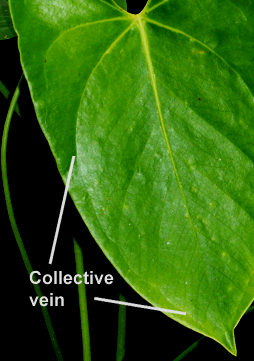 longipeltatum
the collective vein only partially encircles the blade but can still be
found along the edges of the lower portion of the leaf approximately 5
to 10mm (.2 to .4 inches) from the leaf margin (edge). See
the photo left for the position. Anthurium species are
known to be highly variable and not every leaf of every specimen will
always appear the same. This link explains in greater detail the
scientific principle of natural variation and morphogenesis.
Click here.
longipeltatum
the collective vein only partially encircles the blade but can still be
found along the edges of the lower portion of the leaf approximately 5
to 10mm (.2 to .4 inches) from the leaf margin (edge). See
the photo left for the position. Anthurium species are
known to be highly variable and not every leaf of every specimen will
always appear the same. This link explains in greater detail the
scientific principle of natural variation and morphogenesis.
Click here.
Our specimen was a gift and came without any identification. When I set out to find the species I was confused by the fact I could not see a collective vein encircling the leaf nor a clearly defined geniculum at the top of the petioles. As a result, I was not certain the plant was even an Anthurium. When I posted a group of photos on Aroid l, an internet discussion group monitored by some of the world's best aroid botanists and aroid experts, Leland Miyano from Hawaii who is an expert in aroids, palms and cycads made this observation, "this is an Anthurium...I can see both a geniculum on the petiole and collective vein on the leaf blade. The collective vein does not always go around the entire blade. Sometimes it does not include the back or posterior lobes."
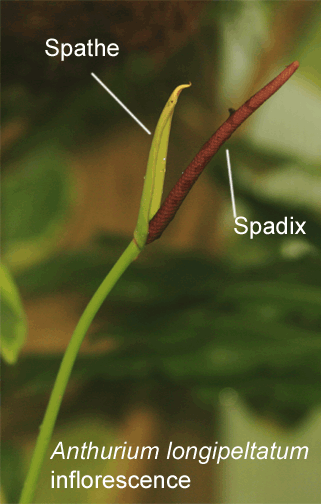 All aroids reproductive
a reproductive organ known as an inflorescence. The
inflorescence of any aroid is composed primarily of a spathe and spadix
with the spathe often referred to as a "flower" by
collectors. The spathe
is not a flower but is simply a specially modified leaf.
An aroid, all Anthurium
species reproduce via the production an inflorescence. The stalk
that supports the entire inflorescence is the peduncle. When an
Anthurium is "in flower" the reference is to the tiny flowers
containing both male and female sexual parts that grow on the spadix at
the center of the inflorescence. Unlike plants in the genus
Philodendron which contain imperfect flowers having only a single
sex Anthurium possess perfect flowers containing both sexes. To
help prevent self pollination nature has designed the female flowers to
be receptive before the male portion of the flower produce their pollen
so in most cases an insect must bring pollen from another plant.
All aroids reproductive
a reproductive organ known as an inflorescence. The
inflorescence of any aroid is composed primarily of a spathe and spadix
with the spathe often referred to as a "flower" by
collectors. The spathe
is not a flower but is simply a specially modified leaf.
An aroid, all Anthurium
species reproduce via the production an inflorescence. The stalk
that supports the entire inflorescence is the peduncle. When an
Anthurium is "in flower" the reference is to the tiny flowers
containing both male and female sexual parts that grow on the spadix at
the center of the inflorescence. Unlike plants in the genus
Philodendron which contain imperfect flowers having only a single
sex Anthurium possess perfect flowers containing both sexes. To
help prevent self pollination nature has designed the female flowers to
be receptive before the male portion of the flower produce their pollen
so in most cases an insect must bring pollen from another plant.
At the center of the inflorescence
is the spadix on which the true flowers form.
The spadix stands erect on a peduncle that is longer than the specimen's leaves
and is terete (round). The spadix begins as an olive green
turning yellow green but normally turns dark purple as it matures.
The entire inflorescence
of Anthurium longipeltatum is supported by a stalk known as
the peduncle. The peduncle of Anthurium longipeltatum
normally measures 30 to 80cm (11.8 to 31.5 inches) long.
The spathe is subcoriaceous (less than leathery) and is green in color
but can also be faintly tinged with purple. Once pollinated by an
appropriate insect the infructescence hangs pendently (downward) and the
spathe soon withers and falls away. The berries produced on the spadix
once pollinated are obovoid and are red/orange in color.
The largest leaf of our specimen currently measure 25.4cm (10 inches). The specimen is grown in a very fast draining soil mix in diffused light and is kept damp at all times.
Aroid Pollination!
As
it occurs in nature and by any horticulturist
Join the International Aroid Society: http://www.exoticrainforest.com/Join%20IAS.html
Need more information on Anthurium species?
Click this link.
If you are seeking information on other rare
species, click on "Aroids and other genera in the Collection" at the top and look for
the
Looking for a specimen? Contact
http:///

