
Aroids and other genera in the Collection
Take the Tour Now?
Orchids
The
Exotic Rainforest
Plants in
the Exotic Rainforest Collection
The images on this website are copyright protected. Please contact us before any reuse.
Detailed information on Growing Anthurium Species
Click this Link
The Exotic Rainforest is a private botanical garden.
New: Understanding, pronouncing and using Botanical terminology, a Glossary
Anthurium cubense
.Engl.


The photograph of
Anthurium cubense
by aroid botanist Dr. Thomas B. Croat Ph.D., P.A. Schulze Curator of Botany
of the Missouri Botanical Garden
is used with permission.
This article uses scientific terminology but an explanation of the terms is given. Please do not exit this page simply because of terminolgy, you may learn something new that will help you understand your plant better.
Anthurium cubense is found in Cuba and drier parts of eastern Guatemala and Yucatan on the Atlantic slope, and in Nicaragua, Costa Rica, and Panama on the Pacific slope. In South America, it extends along the Caribbean coast from western Venezuela to Colombia, with one outlying collection known from the Rio Patia in southern Colombia. It occurs in tropical dry forest, drier parts of tropical moist forest, and premontane (pre-mountainous) wet forest from sea level to 700 m. It is most common in Cuba and Nicaragua.
 Based
on information from the Royal Botanic Garden Kew in London's CATE
Araceae Project, this species is recognized by its short petioles,
short inflorescences (much shorter than the leaves), its stubby,
purplish to pale violet-purple spadix that is tapered toward the
apex (or sometimes toward both ends), and by its bright red berries.
However, before declaring your specimen to be this species you
should also compare the characteristics described below. If you believe you are growing a specimen of Anthurium cubense
check the detail photos closely against the structure of your
specimen and
follow this article closely since you may learn you are instead growing
an Anthurium hybrid or a totally different species. The
information in this article was taken from Dr. Croat's journal
Annals of the Missouri Botanical Garden 1991, Volume 78, #3 and the
scientific treatment can be found on page 637.
Based
on information from the Royal Botanic Garden Kew in London's CATE
Araceae Project, this species is recognized by its short petioles,
short inflorescences (much shorter than the leaves), its stubby,
purplish to pale violet-purple spadix that is tapered toward the
apex (or sometimes toward both ends), and by its bright red berries.
However, before declaring your specimen to be this species you
should also compare the characteristics described below. If you believe you are growing a specimen of Anthurium cubense
check the detail photos closely against the structure of your
specimen and
follow this article closely since you may learn you are instead growing
an Anthurium hybrid or a totally different species. The
information in this article was taken from Dr. Croat's journal
Annals of the Missouri Botanical Garden 1991, Volume 78, #3 and the
scientific treatment can be found on page 637.
Anthurium species are placed in sections based on the particular characteristics of that species. Anthurium cubense is a member of Anthurium section Pachyneurium which contains all the birds nest forms. Anthurium cubense has a rosulate form (similar to the arrangement of the petals of a rose) and was originally collected in Cuba in 1898. Anthurium cubense is most commonly found in Cuba or along the drier portions of Mexico's Yucatan peninsula is also found in Guatemala on the Atlantic side and in Nicaragua, Costa Rica and Panama on the Pacific mountain slope. Anthurium cubense has also been collected in South America in western Venezuela and Colombia near the Caribbean up to 700 meters (2,300 feet) in elevation. According to information found in Dr. Croat's journals (see his scientific credentials above), the species is rare in nature with the exception of in Nicaragua. Dr. Croat writes, "The species is apparently rare except in Nicaragua where it is locally common. Anthurium cubense is placed in section Pachyneurium and is recognized by its short petioles, short inflorescences (much shorter than the leaves; the peduncle as short as or only slightly longer than the spadix."
Anthurium cubense
can grow as either an epiphytic or terrestrial specimen. An
epiphyte (ep-a-FIT) is a plant that grows upon
another plant, normally a tree,
and the seeds find their way onto the branches of that tree in the
animal droppings of birds
 and rain forest animals that eat the
berries produced on the aroid's inflorescence which will soon be
described.
and rain forest animals that eat the
berries produced on the aroid's inflorescence which will soon be
described.
The leaves of Anthurium cubense are normally oblanceolate to elliptic in shape and are sub-coriaceous (less than leathery to the touch). The term oblanceolate refers to a blade that is somewhat lance shaped but also oblong. The blades may also sometimes be slightly purplish in coloration. The adaxial (or upper) blade surface is semi-glossy and can grow approximately 26 to 83cm (.85 to 2.7 feet) in length but has been recorded to be substantially larger in either cultivated or very old specimens. The blade is broadest at or very near the middle of the blade. The blades possess an undulated appearance at the margins (edges).
One very important method of determining the species Anthurium cubense is to count the primary lateral veins found on the leaf surface. According to a personal communication from Dr. Croat, Anthurium cubense possesses 6 to 11 primary lateral veins on each side of the leaf blade instead of the numerous lateral veins often seen in plants sold on internet websites incorrectly using the scientific name Anthurium cubense. As new leaves develop they are en-sheathed by a protective cataphyll. A cataphyll is a bract- like modified leaves that surrounds any new leaf and whose purpose is to protect the emerging leaves as they develop.
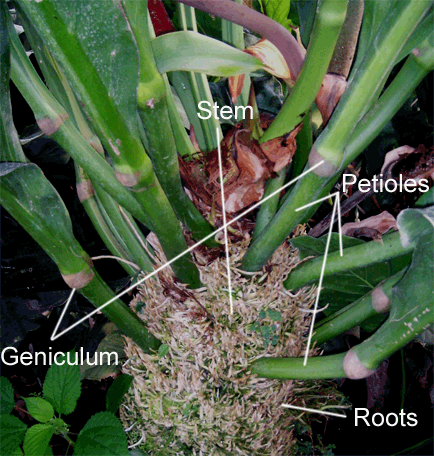
The stalk that supports each leaf blade is known as a petiole. Although some collectors try to call the petioles the "stems" the stem is truly the central axis that supports the plant and is found at the base of the plant. The petioles of Anthurium cubense are short as well as possess the shape of a "C" or a "D" if cut as a cross section. The petioles of Anthurium cubense are sulcate on the upper (adaxial) surface as well as flat on the underside (abaxial surface). In the case of Anthurium cubense the term sulcate indicates the petioles possess a canal (also known as canaliculate) but sulcate may also indicate fine parallel grooves on the surface of the petiole or other plant surface.
 At the
apex (upper end) of the petiole can be observed the geniculum. All
Anthurium species possess a geniculum (see photo right,
below) which is slightly larger than the petiole in size. The
geniculum allows the leaf blade to rotate much like an elbow or a
knee in order to orient itself to find a brighter source of light.
At the
apex (upper end) of the petiole can be observed the geniculum. All
Anthurium species possess a geniculum (see photo right,
below) which is slightly larger than the petiole in size. The
geniculum allows the leaf blade to rotate much like an elbow or a
knee in order to orient itself to find a brighter source of light.
The stem at the base of the plant is short as well as green in color when young but turns gray as it ages. Anthurium cubense possesses the additional unique feature of often having pubescence near the base. Pubescence is a scientific term that refers to a hair like feature.
An aroid, all Anthurium species reproduces via the production of an inflorescence. That inflorescence is supported by a stalk known as the peduncle. When an Anthurium is "in flower" the reference is to the tiny flowers containing both male and female sexual parts that grow on the spadix at the center of the inflorescence. Unlike plants in the genus Philodendron which contain imperfect flowers having only a single sex Anthurium possess perfect flowers containing both sexes. To help prevent self pollination nature has designed the female flowers to be receptive before the male portion of the flower produce their pollen so in most cases an insect must bring pollen from another plant.
The spathe of an aroid is not a "flower" but instead is a modified leaf that somewhat resembles a hood. In Anthurium cubense the spathe is green. The spadix at center of the inflorescence vaguely resembles an elongated pine cone. The spadix is a spike on a thickened fleshy axis which can produce tiny flowers.
Once the female portions of the flowers on the spadix are ready to reproduce during anthesis (sexual reproduction) they must be pollinated by a beetle that is a member of the genus Cyclocephala. The beetle transfers pollen from another specimen currently at male anthesis to a specimen that is receptive at female anthesis however self pollination is possible in Anthurium species. A link to information from aroid expert Julius Boos can be found near the bottom of this page if you wish to learn how aroids are pollinated in nature. If pollinated the flowers will produce berries containing seeds. The berries are then eaten by birds and other rain forest animal species that spread them among the forest in their droppings.
The inflorescence of Anthurium cubense is erect and the spathe is reflexed (turned back). The spadix is purple to pale violet purple and once fruit is formed the inflorescence is then known as an infructescence. The berries of Anthurium cubense are bright red once mature. However, red berries alone do not indicate a specimen that is truly Anthurium cubense since red berries are common in many Anthurium species.
Of significance (as
pointed out by Dr. Croat in one of his personal emails) when attempting to identify the species,
both
the petioles and inflorescences of Anthurium
cubense are short. As a result, Dr.
Croat also points out Anthurium
cubense is not easily confused
with any other species. He does also write there is one species with which
Anthurium
 cubense has been confused when he wrote,
"Engler
(1905) also recognized material of this species under the name A.
recussatum Schott from Cuba. That name, however, has been misapplied
and actually refers to A. hookeri Kunth from the lesser Antilles and
northeastern South America. Anthurium hookeri is not related to A.
cubense."
The true
Anthurium hookeri
produces white berries instead of red
and is not a member of section Pachyneurium despite common
misconceptions. At the present time, Dr. Croat considers
Anthurium hookeri unique and
in a section all its own. Based on his information,
virtually all the plants sold in Florida as a landscape plant are
not the species Anthurium hookeri
but instead are some hybrid Anthurium
form.
You
can see a botanical photos of
Anthurium hookeri
along with botanically accurate information provided by Dr. Croat
and French botanist David Scherberich by clicking this link.
cubense has been confused when he wrote,
"Engler
(1905) also recognized material of this species under the name A.
recussatum Schott from Cuba. That name, however, has been misapplied
and actually refers to A. hookeri Kunth from the lesser Antilles and
northeastern South America. Anthurium hookeri is not related to A.
cubense."
The true
Anthurium hookeri
produces white berries instead of red
and is not a member of section Pachyneurium despite common
misconceptions. At the present time, Dr. Croat considers
Anthurium hookeri unique and
in a section all its own. Based on his information,
virtually all the plants sold in Florida as a landscape plant are
not the species Anthurium hookeri
but instead are some hybrid Anthurium
form.
You
can see a botanical photos of
Anthurium hookeri
along with botanically accurate information provided by Dr. Croat
and French botanist David Scherberich by clicking this link.
According to private emails along with the published from Dr. Croat, manyf photos on the internet plant discussion groups claiming to be Anthurium cubense are not the species and in many cases are simply hybrids of unknown parentage.
Look closely at Dr. Croat's photograph above and you can clearly see the space between the veins and the limited number of lateral veins (6 to 11) on each side of a blade.
More Anthurium cubense photos and scientific information can be found here: http://www.cybertruffle.org.uk/vinales/eng/anthurium_cubense.htm
Anthurium species are known to be highly variable and not every leaf of every specimen will always appear the same, especially when in the juvenile stages. This link explains natural variation and morphogenesis within aroids and other plants. Click here.
Aroid Pollination!
As it occurs in nature and
by any horticulturist

Distinguishing Features
Epiphytic or terrestrial; stem short, to 3 cm diam.; roots dense, ascending, green when young, becoming gray, pubescent at base, becoming smooth, tapered or ending abruptly, ca. 5-10 cm long, 3-5(8) mm diam.; cataphylls subcoriaceous, lanceolate, (4)l0-22 cm long, narrowly acuminate at apex, drying reddish brown (B & K yellow-red 4/10), persisting ± intact, weathering into coarse linear fibers and persisting around stem. LEAVES erect; petioles (4)6-16(36) cm long, (2)5-12 mm diam., C-shaped to D-shaped, broadly sulcate adaxially, rounded to obscurely flattened abaxially; geniculum slightly thicker than petiole, 0.5-1.5 cm long; sheath (l)3-8 cm long; blades subcoriaceous, usually oblanceolate-elliptic, sometimes ± elliptic, short to long-acuminate at apex, usually obtuse at base, sometimes acute or weakly rounded, (20)33- 95 cm long, (5.5)13-38 cm wide, broadest at or near the middle, the margins conspicuously undulate; upper surface semiglossy, medium green (B & K green 5/2.5), lower surface matte, slightly paler, both drying grayish; midrib flat to convexly raised at base, becoming obtusely raised toward the apex above, broadly angular to 3-ribbed below; primary lateral veins 6-11 per side, departing midrib at 30-50° angle, ± straight to the margin, convexly raised above and below, slightly paler than surface; tertiary veins obscure, weakly raised to prominulous when dried; reticulate veins visible, darker than surface, obscure when dried; collective vein arising in the upper ? to upper ¼ of the blade or absent, equally as prominent as primary lateral veins when present. INFLORESCENCES erect, rarely spreading, usually several at different stages of development per plant; peduncle (5.5)8-33 cm long, (2)5-10 mm diam., 0.4-1.2 x as long as petiole, green tinged violet, terete; spathe reflexed at anthesis, rarely recurled, subcoriaceous, green tinged with violet-purple, ovate to lanceolate, (2.5)5-16 cm long, (0.6)l-5 cm wide, broadest near the base, acute to acuminate at apex, rounded at base; stipe to 2 cm long in front, to 1 cm long in back; spadix purplish (B & K purple 4/5) to pale violet-purple (B & K purple 6/7.5), cylindroid, slightly tapered toward both ends, (2.5)8-19 cm long, (4)6-10 mm diam. near base, (3)5-9 mm diam. near apex; flowers rhombic to 4-lobed, (1.3)2.1-2.6 mm long, (1.7)2-2.6 mm wide, the sides weakly sigmoid, sometimes straight; 9-12 flowers visible in principal spiral, (9)14-16 in alternate spiral; tepals matte, pale punctate, slightly roughened; lateral tepals 0.7-1.4 mm wide, the inner margins straight to weakly convex, the outer margins 2-sided; pistils weakly raised, greenish, darker than tepals; stigma linear, 0.4 mm long; stamens emerging in a scattered pattern through out the spadix, laterals emerging almost to apex before alternate emerge, held just above tepals and against pistil, obscuring the latter at anthesis; anthers white tinged with red-violet; thecae oblong, not divaricate; pollen white. INFRUCTESCENCE spreading or erect; spathe persisting, brown; spadix ca. 14-27 cm long, 2-2.5 cm diam. (not including exserted berries), with the berries scattered throughout; berries orange-red (B & K yellow-red 5/2.5), ellipsoid, subtruncate and subapiculate at apex, 9-14 mm long, 4.5-6 mm diam.; mesocarp juicy; usually 1, sometimes 2 seeds per berry, yellow (B & K yellow 9/5), oblong to ellipsoid, 5-7 mm long, 3-3.4 mm diam., with a gelatinous, sticky, transparent appendage.