
Aroids and other genera in the Collection
Take the Tour Now?
Orchids
The
Exotic Rainforest
Plants in
the Exotic Rainforest Collection
The images on this website are copyright protected. Please contact us before any reuse.
Detailed information on Growing Anthurium Species
Click this Link
Within our collection we have many species of Anthurium.
If you are seeking other photos,
click this link:
New: Understanding, pronouncing and using Botanical terminology, a Glossary
Anthurium colonicum .K. Krause

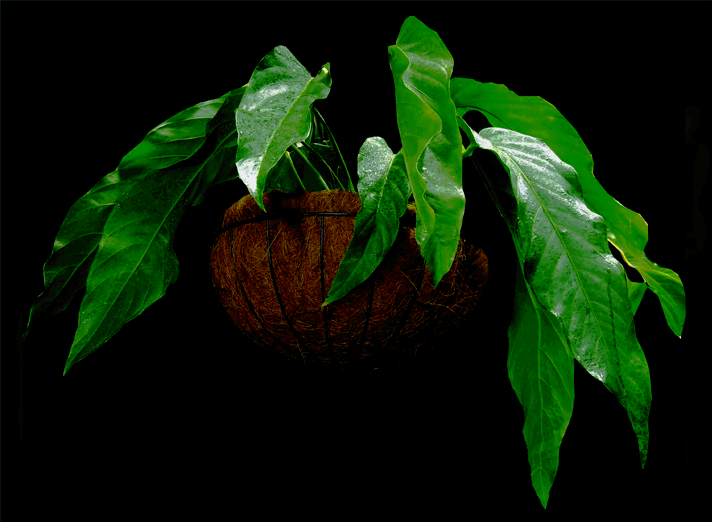
Anthurium colonicum has lobed leaf blades that are ovate/triangular and grow to 120cm (4 feet) with an average width of 13 to 39cm (5.2 to 15.35 inches). The term ovate/triangular
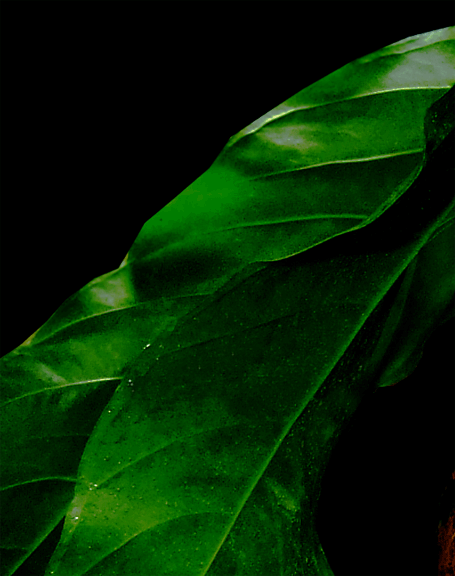 refers
to a leaf that appears to be a combination of oval and triangular at
the same time. An epiphyte (ep-a-FIT) grows on trees, Anthurium
colonicum is recognized by its elongated leaf blades with
lightly ruffled edges.
refers
to a leaf that appears to be a combination of oval and triangular at
the same time. An epiphyte (ep-a-FIT) grows on trees, Anthurium
colonicum is recognized by its elongated leaf blades with
lightly ruffled edges.
The leaf blades are coriacious
(leathery) weakly glossy and bi-colorous. The midrib of the blade
is convex on the adaxial (upper) surface. The primary lateral veins are
convex on each side but are clearly visible on the abaxial surface (underside) of the
blade. The petioles which support each leaf are sub-terete (just
less than round) and are narrowly canaliculate (grooved) and measure
26 to 90cm (10.25 to 35.4 inches) long. The cataphylls which are a
modified leaf that surrounds each new leaf as it emerges dry to
fibers and are persistent on the specimen. The cataphylls are
coriaceous growing to 20 to 25cm (7.9 to 9.85 inches) in length and
sometimes become deciduous falling from the plant.
Anthurium colonicum is similar in appearance and most
closely related to the rare Panamanian species Anthurium
nervatum which has similar veiny leaf blades, a similarly
reflexed purplish spathe, and orange berries. Anthurium
nervatum has more lateral leaf veins numbering 12 to 30 while
Anthurium colonicum possesses 7 primary veins.
An aroid, all Anthurium species reproduce via the production an inflorescence. The stalk that supports the entire inflorescence is the peduncle. When an Anthurium is "in flower" the reference is to the tiny flowers containing both male and female sexual parts that grow on the spadix at the center of the inflorescence. Unlike plants in the genus Philodendron which contain imperfect flowers having only a single sex Anthurium possess perfect flowers containing both sexes. To help prevent self pollination nature has designed the female flowers to be receptive before the male portion of the flower produce their pollen so in most cases an insect must bring pollen from another plant.
Once the female portion of the flowers on the spadix have been fertilized by an insect, normally a beetle, they produce berries. The colorful berries are then eaten by birds and other rain forest animal species that spread them among the branches of the trees in their droppings. As a result, Anthurium colonicum does not need to have its roots in soil but simply dangle in the air. Nourishment is supplied by falling debris from the branches above the specimen as well as by the frequent rains.
Anthurium species are
known to be highly variable and not every leaf of every specimen
will always appear the same. This link explains in non-technical
language natural variation and morphogenesis within aroids and other
species.
Click here.

