
Aroids and other genera in the Collection
Take the Tour Now?
Orchids
The
Exotic Rainforest
Plants in
the Exotic Rainforest Collection
The images on this website are copyright protected. Please contact us before any reuse.
Detailed information on Growing Anthurium Species
Click this Link
The
Exotic Rainforest is a private botanical garden.
Within our collection we have many species of Anthurium. If you are seeking other photos, click this link:
New: Understanding, pronouncing and using Botanical terminology, a Glossary
Anthurium balaoanum
Engl.
Often sold as
Anthurium guildingii
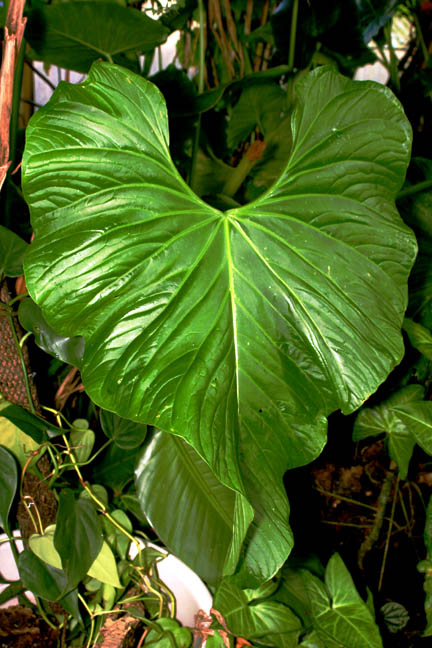
Anthurium balaoanum
Engl.
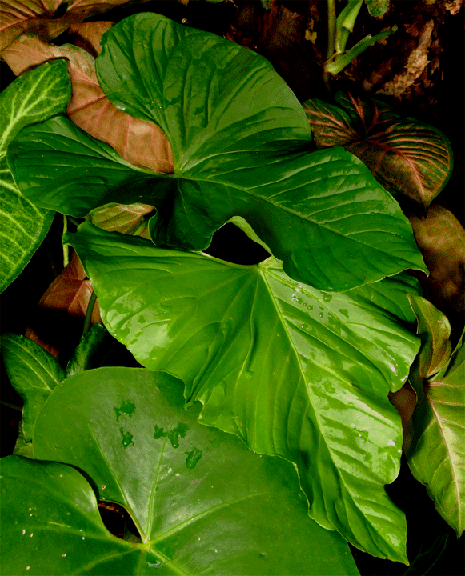 A beautifully
large Anthurium from Ecuador, many photos
on the internet supposedly of Anthurium guildingii are truly Anthurium balaoanum
A beautifully
large Anthurium from Ecuador, many photos
on the internet supposedly of Anthurium guildingii are truly Anthurium balaoanum
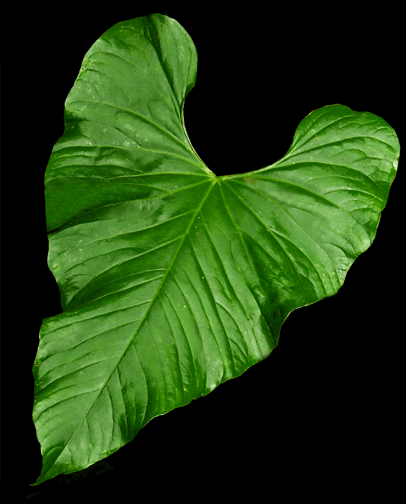 Anthurium species
are known to be highly variable and not every leaf of every specimen will
always appear the same. Anthurium specimens often morph as they
grow so they do not always produce leaves that are identical. This link explains in
non-scientific language the
science of natural variation and morphogenesis.
Anthurium species
are known to be highly variable and not every leaf of every specimen will
always appear the same. Anthurium specimens often morph as they
grow so they do not always produce leaves that are identical. This link explains in
non-scientific language the
science of natural variation and morphogenesis.
Click here.
Looking for a specimen? Contact
http:///
Often sold
as
Anthurium guildingii
Sometimes confused with Anthurium dolichostachyum
Synonym
Anthurium latifolium
A beautifully
large Anthurium from Ecuador, many photos
on the internet supposedly of Anthurium guildingii are truly Anthurium balaoanum according to information from aroid botanist
Dr. Thomas B. Croat
Ph.D., P.A. Schulze Curator of Botany
of the
Missouri Botanical Garden in St. Louis, MO.
Dr. Croat is the top expert in Araceae
(aroids) in North America. In regard to the real Anthurium guildingii Dr.
Croat states that species "has narrowly cordate
blades which are moderately coriaceous and have the collective
veins arising from the first basal veins and rather remote from the
margins." The technical definition of
"cordate" is "the leaf is rather wide and heart-shaped." Coriaceous
indicates the leaf has
the feel of leather.
I often
learn from Dr. Croat that plants are not what I believe, or other
collectors
indicate what they may be! Until Dr. Croat made the information
available I believed our specimen matched
the general description of Anthurium guildingii until I looked up the
description of several important features. This
specimen does have moderately coriaceous leaf blades that are "cordate",
but if
you dig deeper it does not match the scientific description of A.
guildingii even though several
tropical plant growers sell specimens using that name.
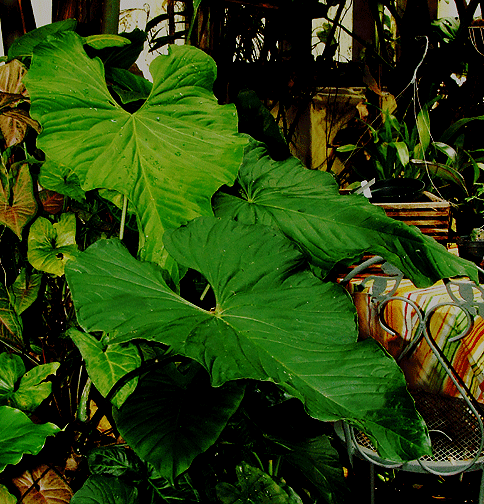
Our plant (the photo of which as well as a
 plant sample has been seen by Dr.
Croat) is Anthurium balaoanum
and even though it does have moderately leathery
leaves, much of the leaf structure is wrong. (i.e.
collective veins arising from the first
basal veins).
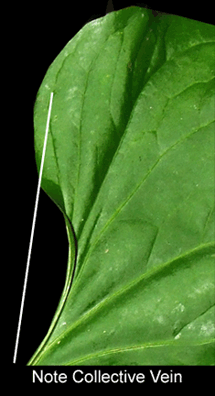
The collective vein can be seen in the photo (left, below) as a thin line running around
the leaf blade near the edge of the leaf. As a result,
our specimen cannot be A. guildingii.
plant sample has been seen by Dr.
Croat) is Anthurium balaoanum
and even though it does have moderately leathery
leaves, much of the leaf structure is wrong. (i.e.
collective veins arising from the first
basal veins).
The collective vein can be seen in the photo (left, below) as a thin line running around
the leaf blade near the edge of the leaf. As a result,
our specimen cannot be A. guildingii.
plant sample has been seen by Dr.
Croat) is Anthurium balaoanum
and even though it does have moderately leathery
leaves, much of the leaf structure is wrong. (i.e.
collective veins arising from the first
basal veins).
The collective vein can be seen in the photo (left, below) as a thin line running around
the leaf blade near the edge of the leaf. As a result,
our specimen cannot be A. guildingii. An aroid, all
Anthurium species reproduce via the production an
inflorescence. The
stalk that supports the entire inflorescence is the peduncle. When an
Anthurium is
"in flower" the reference is to the tiny flowers
containing both male and female sexual parts that grow on the spadix at the center of the inflorescence.
Unlike plants in the genus Philodendron which contain imperfect flowers
having only a single sex Anthurium possess perfect flowers
containing both sexes. To help prevent self pollination nature has
designed the female flowers to be receptive before the male portion of
the flower
produce their pollen so in most cases an insect must bring pollen from
another plant.
The spadix at
its center vaguely resembles an elongated pine
cone and is a spike on a thickened fleshy axis which
can produce tiny flowers. Once the female portion of the flowers on the spadix are ready to reproduce during
anthesis (sexual reproduction) they must be pollinated by an insect,
normally a beetle. If pollinated they will produce berries
with each berry containing one to two seeds. The
colorful berries are then eaten by birds and other rain forest animal
species that spread them among the forest in their droppings.
The spathe of Anthurium balaoanum is green to yellow/green
turning brown and is reflexed (turning backwards). The spadix is
maroon turning brown.
Anthurium balaoanum has been in the
Exotic Rainforest atrium since 2003 and has yet to produce an inflorescence.
To date we have propagated 4 new specimens from cuttings of the original and
given away many cuttings.
Anthurium species
are known to be highly variable and not every leaf of every specimen will
always appear the same. Anthurium specimens often morph as they
grow so they do not always produce leaves that are identical. This link explains in
non-scientific language the
science of natural variation and morphogenesis. Click here.
Anthurium balaoanum is often confused with another
Anthurium from
Ecuador, Anthurium dolichostachyum. Dr. Croat notes that A.
dolichostachyum occurs in wetter habitats.
Looking for a specimen? Contact
http:///


If you are seeking information on other rare
species, click on "Aroids and other genera in the Collection" at the top and look for
the
