
Aroids and other genera in the Collection
Take the Tour Now?
Orchids
The
Exotic Rainforest
Plants in
the Exotic Rainforest Collection
Images on this website are copyright protected. Please
contact us before any reuse.
New: Understanding, pronouncing and using Botanical terminology, a Glossary
Synonym Arum cucullatum
Chinese Taro, Buddha's Palm
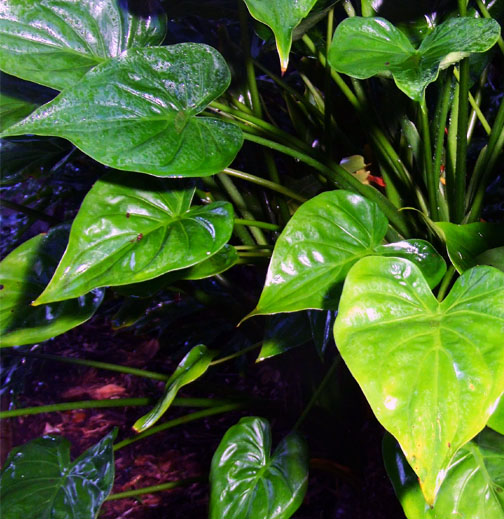
Alocasia cucullata, or Chinese Taro, is a small leafed Alocasia sp. known to be from China. Although commonly called "Buddha's Palm, this species is not related to any palm species and is not a palm. According some sources Alocasia cucullata is claimed to be common to most of Central America, Colombia, Venezuela and parts of Ecuador. It may certainly have been imported into those countries but is not a native species. Consultation with experts including botanist Peter Boyce in Singapore indicates Alocasia cucullata is known for certain to have been introduced into numerous Pacific Islands, including Hawaii and now commonly grows in the Caribbean. But the origin is China or nearby SE Asian countries. But the true origin of this species has been in question.
 As I
often do, my curious mind made me want to know where
Alocasia cucullata
truly
originated. So I sent an email to
aroid botanist Pete
Boyce. Pete came back with this enlightening
response,
"Alocasia
cucullata is widespread in SE China (Yunnan, Guagxi, Guangdong), N
Vietnam, Laos, N. Thailand. It is never found away from human
disturbance and is most often encountered as a planting around temples
where is is meant to bring good luck. It is very possible that it is a
stabilized cultigen of A. odora selected for 'magical' properties by
animistic hill tribes and now much planted to protect Buddhist temples."
As I
often do, my curious mind made me want to know where
Alocasia cucullata
truly
originated. So I sent an email to
aroid botanist Pete
Boyce. Pete came back with this enlightening
response,
"Alocasia
cucullata is widespread in SE China (Yunnan, Guagxi, Guangdong), N
Vietnam, Laos, N. Thailand. It is never found away from human
disturbance and is most often encountered as a planting around temples
where is is meant to bring good luck. It is very possible that it is a
stabilized cultigen of A. odora selected for 'magical' properties by
animistic hill tribes and now much planted to protect Buddhist temples."
Alocasia cucullata
is not found in Central or South America as a natural species. It has
simply been imported. It also appears, based on Peter's research and observations,
the species is likely a cultivar (hybrid) and does not occur naturally
even in its natural range. This little Alocasia was
likely created by man and as a result would be variable.
Alocasia species are
known to be highly variable and not every leaf of every specimen
will always appear the same. This link explains in greater
detail the scientific principle of natural variation and
morphogenesis.
Click
here.
With
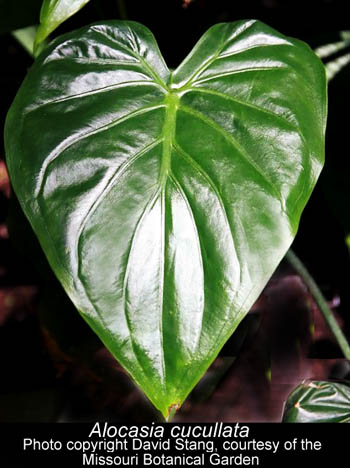
roughly 7 to 8 inch (18cm to 20cm.) leaves Alocasia cucullata grows in
clumps and is sometimes called an "Elephant Ear". It appreciates near full sun
to partial shade and is extremely easy to grow as long as you keep it's
"feet damp". We found our specimen on a roadside in
Homestead, FL in 1999. Some entrepreneurial spirit had set up
a "nursery" in the back of his pick-up on the side of US 1 and offered
Chinese Taro and numerous other Alocasia sp. for $5 per large
pot. I've given away quite a number of Alocasia cucullata
and have never run out. They replace themselves
quickly.
And this one is not a palm as is implied by one common name!
The photo to the right was taken at Fairchild Tropical Botanic Garden in
Miami, FL.
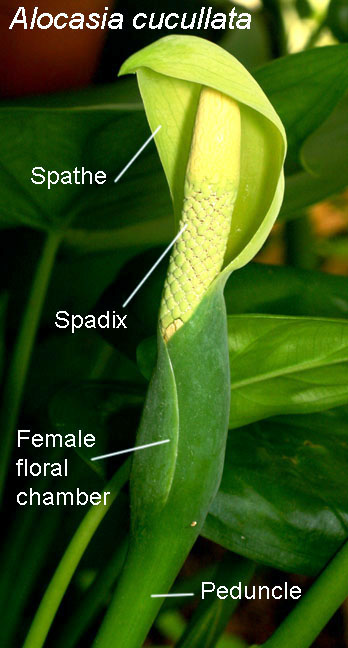 All
Alocasia species
are aroids. An aroid is a plant that reproduces via the production of
an inflorescence known to science as a spathe and spadix. Most people
think the spathe is a "flower" which it is
not. The spathe,
which in the case of Alocasia cucullata is pale
yellow, is only a
modified leaf. The
inflorescence, which is shaped like a tube does contain flowers that are
near microscopic in size. The portion that appears to most growers
to be the "flower" is the spathe and
inside that is the spadix which somewhat resembles an elongated pine
cone. The spadix
is simply a spike on a thickened fleshy axis which can produces the tiny flowers.
All
Alocasia species
are aroids. An aroid is a plant that reproduces via the production of
an inflorescence known to science as a spathe and spadix. Most people
think the spathe is a "flower" which it is
not. The spathe,
which in the case of Alocasia cucullata is pale
yellow, is only a
modified leaf. The
inflorescence, which is shaped like a tube does contain flowers that are
near microscopic in size. The portion that appears to most growers
to be the "flower" is the spathe and
inside that is the spadix which somewhat resembles an elongated pine
cone. The spadix
is simply a spike on a thickened fleshy axis which can produces the tiny flowers.
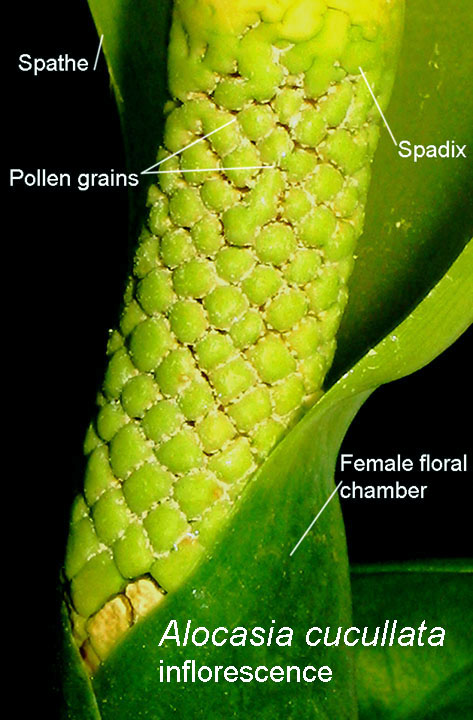
If you explore the inflorescence with a magnifying glass when it is ready to be pollinated there are very tiny male flowers found on the exposed spadix while there are sterile male and female flowers found inside the female floral chamber at the base of the spadix. The female flowers develop and become receptive first followed by the male flowers which then produce pollen. The job of the sterile male flowers is to produce a pheromone or perfume used to attract a pollinating insect.
When ready to reproduce the spadix produces the flowers unisexually. A unisexual flower is one that has only one sex and is known as being imperfect. A perfect flower which is found on some aroid species including Anthurium and Monstera include both sexual parts. The tiny male flowers produce pollen and the tiny female flowers are designed to be receptive to pollen. In the case of Alocasia cucullata the plant is capable of self pollination when an insect carries pollen from a male flower to a female flower hidden inside the covering of the floral chamber. When the plant is pollinated berries will grow with seeds inside. You can see the pollen of Alocasia cucullata in the photo below.
Although sometimes called a small "Elephant Ear", that is a poor common name or term to use to describe any plant species. That term is used to describe plants from numerous genus including Alocasia, Xanthosoma, Philodendron, Anthurium, Caladium, Colocasia and others Those groups represent thousands of plants! So when someone describes an "Elephant Ear", the first question would be, which one of the 3.000 species would you like to know about? Just call it an Alocasia! That description, even as a common name, is far more descriptive and accurate.
As always, my sincere appreciation to Peter Boyce for his input.
Aroid Pollination!
As
it occurs in nature and by any horticulturist
Join the International Aroid Society: http://www.exoticrainforest.com/Join%20IAS.html