
Aroids and other genera in the Collection
Take the Tour Now?
Orchids
The
Exotic Rainforest
The images on this website are copyright protected. Please contact us before any reuse.
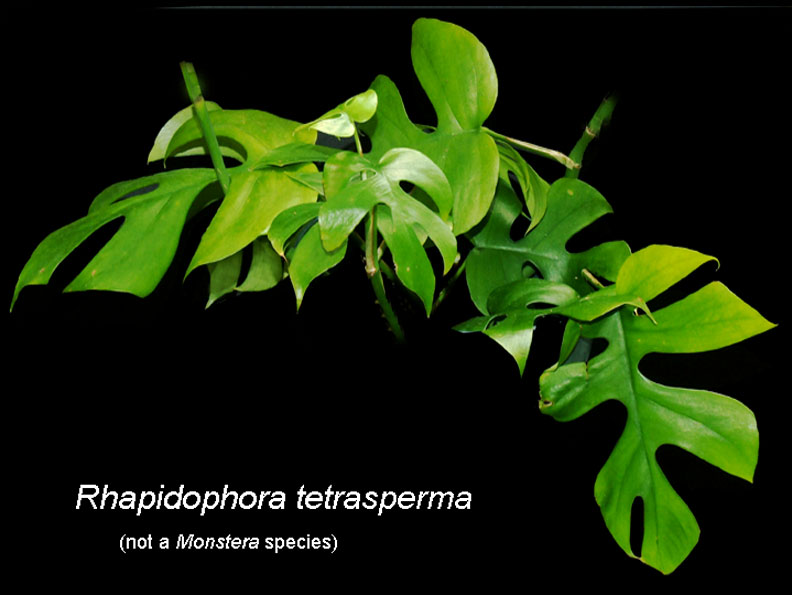
Rhaphidophora
tetrasperma Hook. f.
 T
T
Incorrectly as Amydrium tetrasperma
Common names: Amydrium 'Ginnie', Philodendron "Ginny", Mini monstera,
Miniature monstera, Philodendron imbe Ginny, Epipremnum "Ginny"
Mini split-leaf Philodendron
Neither Philodendron nor Monstera species are found naturally outside Central America, Mexico, South America and the Caribbean since they are NeoTropical species. The NeoTropics is defined as Mexico, Central America, South America, the Caribbean and the southern tip of Florida. The genus Rhaphidophora is not found naturally in North or South America but would then be a SE Asian equivalent with three Asian relatives including members of the genera Epipremnum, Amydrium, and Scindapsus.
Postings can be found on the internet as well as in the offerings of internet plant sellers identifying this species as Amydrium tetrasperma, Amydrium 'Ginnie', Philodendron "Ginnie", Philodendron imbe "Ginny", and Epipremnum "Ginny". All are scientifically incorrect. The use of single quotes implies a registered cultivar which also appears to be incorrect. Numerous discussions have been held on aroid forums regarding some of these names, and they are still commonly used on sites such as eBay. A variegated form is commonly available but the variegation is not natural in this species and is reported to have been induced by a chemical process during the tissue culture process. (see photo, below) Growers have reported the variegations vanishes as the plant grows since the chemicals eventually wear off.
Tissue culture (known as TC) is the asexual propagation of fragments of a suitable parent plant in order to produce identical clones of it in large quantity. In the cells of the parent are grown in a laboratory in nutrient solutions until they form a mass of tissue. These tissues then get different chemicals to induce roots and leaves. Once developed the tiny plants are transplanted into a potting medium and finally grown by the commercial plant growing industry.
On several of the popular garden websites
plant collectors repeatedly refer to R.
tetrasperma as a miniature
form, or "mini" Monstera deliciosa
while others continue to insist it is a form of Epipremnum.
This note from expert aroid grower
Michael Mattlage appears to sum up the correct conclusion,
"I
know there was some debate a while back on whether the plant labeled
Amydrium, Philodendron, etc. etc. 'Ginny' was either a form of the
variable Epipremnum pinnatum or Rhaphidophora tetrasperma. The
experts finally agreed with the later."
As indicated by Michael,
the species does also appear similar to the
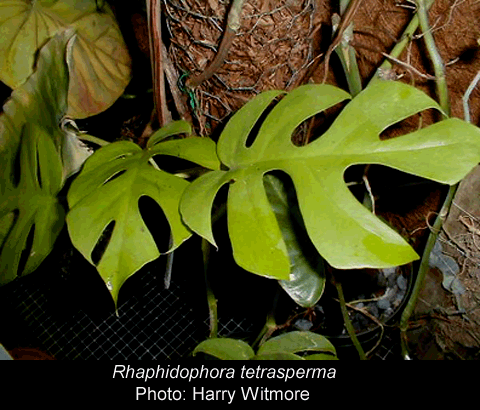 adult form of
Epipremnum pinnatum,
but is only a related species.
adult form of
Epipremnum pinnatum,
but is only a related species.
Rhaphidophora tetrasperma is not a miniature form of Monstera and in February, 2007 aroid botanist Peter Boyce responded with this answer to a question posted regarding the "miniature Monstera deliciosa" theory on the forum Aroid l, "In the 90s while working on Rhaphidophora I investigated the so-called miniature form of M. deliciosa in cultivation in Europe and as named in Birdsey's Cultivated Aroids as 'Dwarf Ceriman' and these plants were without exception Rhaphidophora tetrasperma from peninsular Malaysia and southern Thailand. At the time Josef (Bogner) had a large one flowering in Munich and it was from here that I obtained inflorescences to confirm the generic Id. Material from this clone was later used by one of my students Tam Shey May for molecular work on the Monstereae and embedded in the Rhaphidophora clade as sister to R. nicolsonii from Pen. Malaysia while M. deliciosa remained clustered with Stenopsermation and a Rhodospatha. Thus morphologically (ovules, seeds) and on the molecular European 'Dwarf' Deliciosa' is a Rhaphidophora."
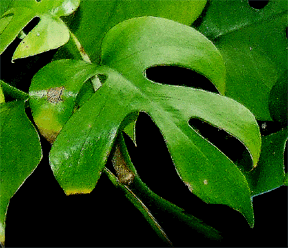
Rhaphidophora tetrasperma is scientifically described as being a "small to medium sized" heterophyllous aroid. A heterophyllous species is one that is capable of having very dissimilar leaves on the same specimen. A deeply pinnatifid aroid, R. tetrasperma is easily confused with a small Monstera deliciosa, but solely by appearance. As Julius explained, scientifically they are not closely related.
Rather than
being stiff and leathery (coriaceous) as are the leaves of
Monstera deliciosa, the leaves are relatively thin and
flexible. Pinnatified species are
those that produce leaves somewhat similar in shape to a feather or
a palm frond.
 This species is not related to any
palm. The juvenile form of Rhaphidophora tetrasperma is
a shingling plant similar in appearance to Rhaphidophora
korthalsii as well as Rhaphidophora nicolsonii but may
be distinguished by a knowledgeable observer based on the petiole
sheath and leaf lamina characteristics.
This species is not related to any
palm. The juvenile form of Rhaphidophora tetrasperma is
a shingling plant similar in appearance to Rhaphidophora
korthalsii as well as Rhaphidophora nicolsonii but may
be distinguished by a knowledgeable observer based on the petiole
sheath and leaf lamina characteristics.
Plants that begin their growth appressed are found growing in a heteroblastic growth form known as "shingling" since they have the vague appearance of the shingles or tiles on a roof. The juvenile leaves have this appearance due to very short petioles. Heteroblasty is the progressive change in growth from the juvenile shingle leaf to the intermediate adult and finally into the adult form that stand away from the host as a result of longer petioles and exhibit extreme changes in shape along the way. Shinglers grow extremely close to their host tree as appressed epiphytes. Appressed is "to press".
Rhaphidophora tetrasperma is quoted on the International Aroid Society website as being rare in nature and is restricted to only a few sites on the Malaysian peninsula near Kelantan and Perak as well as southern Thailand. Very little has been published regarding this species in either scientific or commercially available literature. In the rain forest of SE Asia the plant is a vine (liane) on the trees growing to a height of 5 meters (16 feet). The plant is said to very rarely grow as a terrestrial species preferring to climb.
Rhaphidophora tetrasperma clings to its host with a sparse quantity of clasping roots from the nodes and internodes. The leaves can be ovate to a combination of oval and lanceolate. A lanceolate leaf blade is one that is spear shaped. The blades are not heavily coriaceous (leathery) and measure from 10 to 34cm (4 to 13.3 inches). Since it is known to be a heterophyllus species, leaf variation should be expected. Heterophylly just means a plant can have very different appearing leaves on a single specimen.
Regardless of the common belief a species is determined by the shape of the leaf, that factor is rarely the final determination, especially in aroids. Leaf variation among aroid species is extremely common and the shape of a leaf alone cannot be used to accurately determine a species. An examination of the petiole supporting the leaf (commonly called the stem) will show it has a shallow groove. In its natural range the species is found in dry to moist or wet forest as well as on sandstone and granite to an elevation of 190 to 760 meters (625 to 2500 feet). The maximum leaf blade of our specimen in the photo above measures 16.5cm (6.5 inches).
Rhaphidophora tetrasperma is now commonly sold on eBay as a miniature variegated Monstera, but most sellers have simply been mislead into believing the plant they sell is something other than its true identity. In a recent conversation with one eBay seller I pointed out the variegated form does not appear to be natural and was likely induced with chemicals during the tissue culture process. Tissue culture is where the DNA of a parent plant is extracted and prepared in a laboratory and eventually grown into tissue that can be potted eventually producing an artificially cloned specimen.
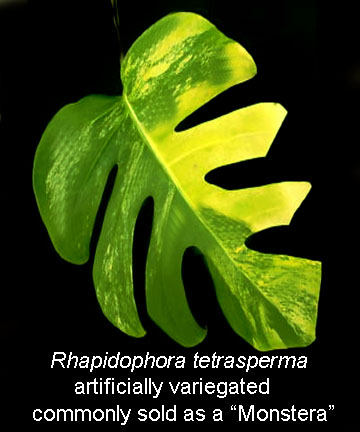 Since
other sellers had told him he was foolish for accepting my opinion I
recommended we ask aroid botanist Peter Boyce in Malaysia for his
opinion whether or not the plant was a Rhaphidophora or a
Monstera. Pete is the recognized authority on the aroids
of Malaysia and Southeast Asia. This is Pete's response once
he was shown the photo to the right,
"this
is 100% Rhaphidophora tetrasperma Hook.f., a species indigenous to
Peninsular Malaysia and the far south of the Thai peninsula and with
which I am very familiar. This species in its green (wild) form has
been in cultivation at least since 1950 and is mentioned (but not
illustrated) in Birdsey’s ‘The Cultivated Aroids’. By the way
I have seen exactly the same variegated form of this plant for sale
in Bangkok; talking to the Thai growers they also agree that it is a
somatic mutation induced in tissue culture. Similar mutations are
being generated in tissue culture with Spathiphyllum, Homalomena,
and Philodendron and usually involve the introduction of benign
colour-breaking virus."
Since
other sellers had told him he was foolish for accepting my opinion I
recommended we ask aroid botanist Peter Boyce in Malaysia for his
opinion whether or not the plant was a Rhaphidophora or a
Monstera. Pete is the recognized authority on the aroids
of Malaysia and Southeast Asia. This is Pete's response once
he was shown the photo to the right,
"this
is 100% Rhaphidophora tetrasperma Hook.f., a species indigenous to
Peninsular Malaysia and the far south of the Thai peninsula and with
which I am very familiar. This species in its green (wild) form has
been in cultivation at least since 1950 and is mentioned (but not
illustrated) in Birdsey’s ‘The Cultivated Aroids’. By the way
I have seen exactly the same variegated form of this plant for sale
in Bangkok; talking to the Thai growers they also agree that it is a
somatic mutation induced in tissue culture. Similar mutations are
being generated in tissue culture with Spathiphyllum, Homalomena,
and Philodendron and usually involve the introduction of benign
colour-breaking virus."
Just because you find a plant that has a beautiful variegated coloration does not mean it is natural. Worse, once the plant matures the variegation will likely begin to slowly vanish since it was purposely infected with a harmless virus to induce the coloration as Pete explained in his response..
As an aroid, Rhaphidophora tetrasperma produces a small inflorescence with a spathe that is described as "canoe-shaped" measuring to 3.5cm (1.4 inches). The spathe is scientifically described as "stiffly fleshy" and drops from the spadix rapidly. The fruit that forms on the spadix of Rhaphidophora species each contain a number of small ellipsoid seeds.
Within the genera that form the tribe Monstereae, seed characteristics are frequently the only way a botanist can discern which genus any species may properly belong. Monstereae includes the genera Amydrium, Rhaphidophora, Epipremnum, Scindapsus, Monstera, Alloschemone, Rhodospatha, and Stenospermation. According to the excellent aroid text Aroids, Plants of the Arum Family by author Deni Bown, "Rhaph has many small oblong seeds; Amydrium has globose to heart-shape Epipremnum has a few large, kidney-shaped seeds; and Scindapsus has rounded to slightly kidney-shaped seed." Some of the genera are so closely related the only way to divide them is by the number of seeds produced. Within the genus Rhaphidophora there are approximately 100 known species.
The genus Rhaphidophora is found from the island of Borneo, SE Asia through India and into Africa, however the species Rhaphidophora tetrasperma has a very limited natural range in only Malaysia and parts of Thailand. The term "British India" used in the scientific description is not referring to what we now know as the country of India.
Our specimen was a gift from collector Bryan Stover and is potted in extremely porous soil containing orchid potting bark and charcoal. The mixture is kept constantly damp in mottled light. A word of caution, if you like this species, control where it grows! One very knowledgeable grower warned the species can become invasive in a greenhouse. Easily cultivated, the species can be very invasive despite the fact it is considered moderately rare in nature.
My thanks also to Pete who often provides assistance to collectors and growers as well as information to this author.
Join the
International Aroid Society:
http://www.exoticrainforest.com/Join%20IAS.html
The scientific description of
Rhapidophora tetrasperma
15. Rhaphidophora tetrasperma Hook.f.
Rhaphidophora tetrasperma
Hook.f., Fl. Brit. India 6 (1893) 548; Ridl., Mat. Fl.
Malay.Malay Penins. 3 (1907) 44--45; Engl. & K. Krause in Engl.,
Pflanzenr. 37 (IV.23B) (1908) 48; Ridl., Fl. Malay.Malay Penins.
5 (1925) 124 - Type: Malaysia, Perak, Scortechini 169b (K, holo).
Distribution: Peninsular
Malaysia (Kelantan, Perak). Also), distributed in and southern
Thailand.
Small to medium-sized, rather
slender, semi-pachycaul, heterophyllous liane to 5 m; seedling
stage a non-skototropic shingling juvenile shoot; pre-adult
plants very rarely forming terrestrial colonies; adult shoot
architecture comprised of elongated, weakly clinging,
physiognomically monopodial, flexuous, moderately leafy,
non-flowering stems and weakly adherent or, more commonly, free
lateral flowering stems; stems smooth, without prophyll,
cataphyll and petiolar sheath fibre, internodes to 14 x 1 cm,
separated by prominent straight leaf scars; flagellate foraging
stems not observed; clasping roots sparsely produced from nodes
and internodes; feeding roots stout, produced singly or in pairs
from most nodes of free shoots; leaves weakly spiral-distichous;
cataphylls and prophylls membranous, soon drying and falling;
petiole shallowly grooved, 10--34 x 0.2--0.4 cm, smooth, apical
and basal genicula slightly prominent; petiolar sheath
prominent, extending to base of apical geniculum, soon falling
to leave a prominent, slightly corky scar; lamina sparsely to +
entirely deeply pinnatipartite to nearly pinnatisect,
occasionally with large rhombic perforations adjacent to
mid-rib, 12--42 x 9.5--38 cm, broadly ovate to ovate-lanceolate,
thinly coriaceous, base truncate or very weakly cordate, apex
acute to acuminate, individual pinnae up to 6 cm wide; mid-rib
prominently raised abaxially, slightly sunken adaxially; primary
venation pinnate, raised abaxially, slightly impressed adaxially;
interprimaries diverging from primaries, much less prominent,
slightly raised abaxially, very slightly impressed adaxially;
secondary venation weakly reticulate, very slightly raised;
tertiary venation barely visible; inflorescence few together,
subtended by two prominent cataphylls, these soon falling;
peduncle terete, 2--2.5 x 0.3--0.4 cm; spathe canoe-shaped,
3--3.5 x 0.8--1.5 cm, stiffly fleshy, apparently falling
swiftly, white with adherent black cataphyll remnants; spadix
cylindrical, sessile, inserted slightly decurrently on peduncle,
3--3.5 x 0.75 - 1 cm, white; stylar region well developed,
mostly rhombohexagonal, c.c. 2 x 2 mm, truncate, margins
deflexed; stigma elliptic, longitudinally orientated, c.c. 1 x
0.2 mm; anthers exserted at anthesis; infructescence not
observed.
Habitat: Disturbed rather dry
to moist or wet forest on sandstone and granite. 190--760 m
altitude.
Notes: As noted under above, R.
tetrasperma most closely resembles R. nicolsonii but may be
distinguished readily on petiole sheath and leaf lamina
characters.
Other specimens seen:
PENINSULAR MALAYSIA: Kelantan, Tanah Merah, Pergau Dam site,
logging road to Sg Long Intake 1, Boyce 652 (K, KEP); Perak,
Bidor Corner SFN s.n. (SING).