
Aroids and other genera in the Collection
Take the Tour Now?
Orchids
The
Exotic Rainforest
Plants in
the Exotic Rainforest Collection
Images on this website are copyright protected. Contact us before
attempting to reuse.
Microsorum musifolium Copel.
Synonym: Polypodium musifolium
Incorrectly Microsorium musifolium
Sold as Microsorium 'Crocodylus' (not a botanical name)
Read text for comments
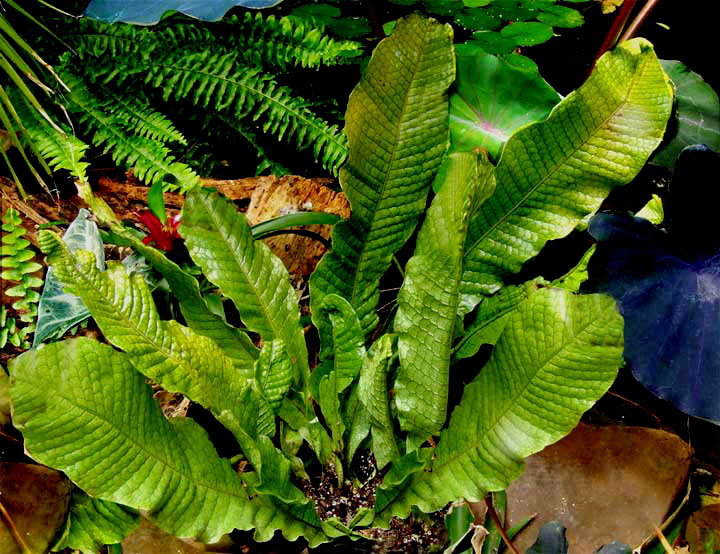
Microsorum or Microsorium? If you located this plant on many websites you may have been confused by the name spelling. After a good deal of searching plant literature we've discovered (January, 2007) the correct genus spelling is "Microsorum". With the assistance of the editors of the University of British Colombia plant web site (UBC) we were directed to the Australian Plant Names Index (APNI). On that site a quote from a Mr. Bosman clarifies the conflict. The genus Microsorum was originally published in 1833. Botanist Dr. Link went on to publish papers in 1841 using both the spelling Microsorum and Microsorium (with an "i") in the same paper. Since that time both spellings have been used by botanists to describe the same genus. Since you can find both spellings on numerous scientific sites (TROPICOS, IPNI, ePIC and others) apparently either is acceptable. But, in the purely technical sense, Microsorum is the correct genus spelling (first publication takes precedence). Two separate genus do not exist. In this instance, the International Plant Names Index (IPNI) uses only Microsorium musifolium so we have left the spelling as published.
Known as one of the the "Wart Ferns", the genus Microsorum Link consists of approximately 50 species found worldwide. The genus Microsorum is a part of the family Polypodiaceae. The species is epiphytic (grows on trees) but has been observed growing attached to stone. The species was earlier known as Polypodium musifolium but was correctly changed to Microsorum musifolium in 1929 when it was discovered the species did not fit the definitions required to be placed in the genus Polypodium. Microsorum musifolium was also at one time incorrectly treated as a synonym of Microsorum punctatum (L.) Copel. despite at least eight major differences in the characteristics of the two species, primarily the rhizome surfaces. The rhizome surface of Microsorum musifolium is not waxy while the rhizome of Microsorum punctatum is often waxy.
 We are often hesitant to use the term "rare"
when describing many plants. A rare plant is one that is
scarce in nature or somewhat
difficult to obtain, not one you can buy on eBay for under $10 almost any
day of the year. When there is evidence a plant is rare we include a
"Rare Plant" icon
We are often hesitant to use the term "rare"
when describing many plants. A rare plant is one that is
scarce in nature or somewhat
difficult to obtain, not one you can buy on eBay for under $10 almost any
day of the year. When there is evidence a plant is rare we include a
"Rare Plant" icon
 . There are however a large number of formerly truly "rare" plants that are now being tissue cultured (cloned) and
which can be
honestly called at least "semi-rare". Sellers on the web, especially eBay, claim in bold letters Microsorium musifolium
(mew-sih-FOH-lee-um) or
Microsorium 'Crocodylus'
as sellers love to call it is both new and rare. Unusual, certainly.
Rare? Maybe when it was wild in its native rainforest before it was commonly cloned. But now?
The species is extremely common as a result of the production of
hundreds of thousands of specimens in tissue cultuture laboratories. You
can find Microsorum musifolium for sale effortlessly on a dozen
websites. Some sources offer small plants for just a few dollars.
Rare? No. New? Hardly. The species was described to
science in 1929.
. There are however a large number of formerly truly "rare" plants that are now being tissue cultured (cloned) and
which can be
honestly called at least "semi-rare". Sellers on the web, especially eBay, claim in bold letters Microsorium musifolium
(mew-sih-FOH-lee-um) or
Microsorium 'Crocodylus'
as sellers love to call it is both new and rare. Unusual, certainly.
Rare? Maybe when it was wild in its native rainforest before it was commonly cloned. But now?
The species is extremely common as a result of the production of
hundreds of thousands of specimens in tissue cultuture laboratories. You
can find Microsorum musifolium for sale effortlessly on a dozen
websites. Some sources offer small plants for just a few dollars.
Rare? No. New? Hardly. The species was described to
science in 1929.
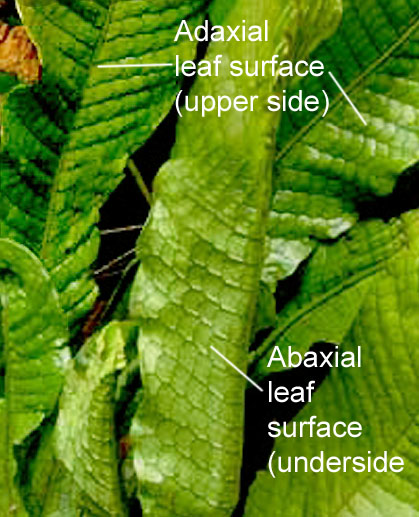
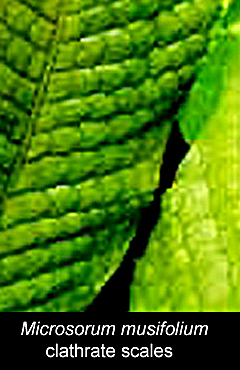 Microsorum
musifolium is said
by some to be
a "hardy" fern whose fronds contain a labyrinth of darkly pigmented veins
which become more conspicuous as the plant ages. The fern grows from
a moderately long creeping rhizome that is capable of climbing. The frond collects humus,
has a thin blade texture, and produces numerous small sori (spore
cases) scattered all over the underside of the frond along the veins. The plant is a native of
southern
Myanmar, peninsular Malaysia, Sumatra, Indonesia, Borneo, Philippines,
New Guinea, Thailand and a rainforest valley
near Cairns, Australia
Microsorum
musifolium is said
by some to be
a "hardy" fern whose fronds contain a labyrinth of darkly pigmented veins
which become more conspicuous as the plant ages. The fern grows from
a moderately long creeping rhizome that is capable of climbing. The frond collects humus,
has a thin blade texture, and produces numerous small sori (spore
cases) scattered all over the underside of the frond along the veins. The plant is a native of
southern
Myanmar, peninsular Malaysia, Sumatra, Indonesia, Borneo, Philippines,
New Guinea, Thailand and a rainforest valley
near Cairns, Australia