
Aroids and other genera in the Collection
Take the Tour Now?
Orchids
The
Exotic Rainforest
Plants in
the Exotic Rainforest Collection
The images on this website are copyright protected. Please contact us before any reuse.
Detailed information on Growing Anthurium Species
Click this Link
Within our collection we have many species of Anthurium. If you are seeking other photos, click this link:
Anthurium rugulosum
Sodiro

Listed as
a RED LINE Species
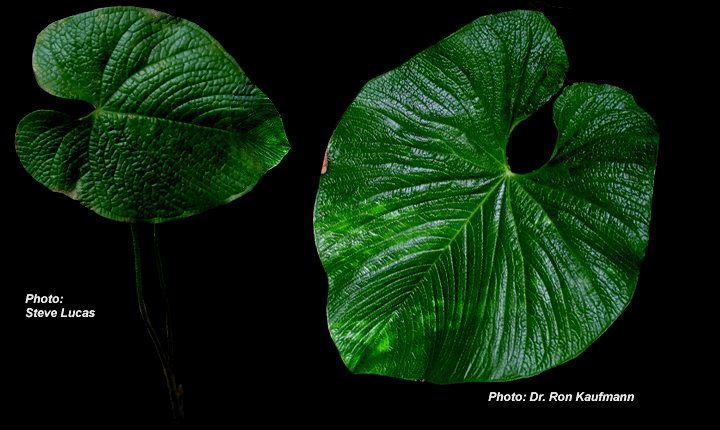
Anthurium rugulosum Sodiro
We do not recommend anyone other than a botanical garden with adequate facilities attempting to grow this species. It must be kept damp and cool at all times. Read the story to learn why.
A tree dwelling epiphytic Anthurium, this species is endemic (exclusively found) in Ecuador. Growing in the cool, high Andes Mountains, it is both rare and officially near endangered. Known from only 13 population groups known as "subpopulations", the species is sparsely scattered across the eastern side of the Andes range. According to America's top aroid botanist, Dr. Tom Croat of the Missouri Botanical Garden, the less than common species is known only from Ecuador even though a few references claim it has been found in Colombia. Although the plant will not survive extreme cold, several extinct and often snow covered volcanoes are found in the region where this plant is found. This species loves to be kept cool! Very cool!
TROPICOS, a service of the Missouri Botanical Garden, lists Anthurium rugulosum as a "red-lined" species. That designation is one step before becoming officially an endangered species. A. rugulosum is found at an elevation of 1150 to 2800 meters (roughly 3500 to 8500 feet) in mountainous moist to wet forests. The exquisite plant is an inhabitant of the high cloud forest where it is almost always damp. That makes it one of the more difficult species to maintain in private cultivation! The type specimen was described in the Anales de la Universidad Central del Ecuador in 1901 by Luis Sodiro. Sodiro worked in Ecuador at the turn of the century in the late 1800's and early 1900's and described 281 taxa of Ecuadorian araceae, mostly Anthurium species. He was the first botanist specializing in aroids who could truly be considered a field botanist and spent most of his career in the Ecuadorian tropics. A Jesuit born in Italy, Sodiro served in Ecuador until the time of his death.
In Ecuador the
beautifully patterned Anthurium rugulosum has been confirmed to
grow inside the Parque Nacional Podocarpus and is likely present
in other large protected areas in that region. The species is now
near endangered primarily due to habitat destruction, the only known threat
to it's survival other than heat. According to Dr. Croat, the specimens from Napo
Province seem to be the same as the populations in the south of Ecuador
in Morona-Santiago and Zamora-Chinchipe but no detailed studies have
been made. Leaf blades typically measure 30 to 40cm (12 to 16
inches). Dr. Croat describes Anthurium
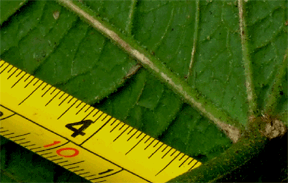
rugulosum as having dense short granular pubescence (hair) on the
veins of the lower blade surface. The "hairs" are known
scientifically as trichomes. According to
Dr. Croat the pubescence "is critical because most aroids have no
pubescence at all."
Sodiro also described a similar
plant identified
 as Anthurium papillosum.
Again, according to Dr.
Croat, "Anthurium papillosum is a confusing species because there is
no known type specimen". Sodiro describes that plant as
not having pubescence, instead being glabrous (devoid of hair).
A. papillsum has yet to be located by
modern science. Dr. Croat continued saying, "Whether the
species is ever rediscovered or better defined or not it is clearly
related to Anthurium rugulosum Sodiro".
as Anthurium papillosum.
Again, according to Dr.
Croat, "Anthurium papillosum is a confusing species because there is
no known type specimen". Sodiro describes that plant as
not having pubescence, instead being glabrous (devoid of hair).
A. papillsum has yet to be located by
modern science. Dr. Croat continued saying, "Whether the
species is ever rediscovered or better defined or not it is clearly
related to Anthurium rugulosum Sodiro".
The spadices of A. rugulosum are cylindrical. Also according to Dr. Croat, Sodiro reported the species was almost an intermediate between A. pulverulentum and A. dictyophyllum (now considered to be a synonym of Anthurium corrugatum) which are species found on the opposite western slope of the Andes. The leaf blade of A. pulverulentum is substantially larger. Click the photo to the right for an enlarged view and explanation.
Anthurium rugulosum is notoriously difficult to grow due to where it is found in Ecuador's high, cool, often wet rain forests. Very few botanical institutions have a specimen on display. Those growing conditions are quite different than the average hot greenhouse! In an email in early 2007 I asked Dr. Croat about the reported difficulty growing the species. He answered, "Did you not read where it grows? You would have to grow it in a refrigerated cloud forest." In a separate email Dr. Croat commented, "It is a neat species but no one should lust after it because there is no way it could ever be cultivated for more than a few months." Well, I make no claim to being a world class grower but I am sometimes a "glutton for punishment" so we gave the species a try. Since the specimen was acquired in late 2006 it added three new leaves, but interestingly, each new leaf was smaller than the previous one. Other growers have reported the same condition and one noted Florida grower refers to the plant as the "incredible shrinking Anthurium".
Experienced Anthurium grower Denis Rotolante explains why tropical plants that are used to cool nights on the side of a mountain in a cloud forest don't do well at sea level, "These plants may respire and burn more sugars on a warm night than they produce in photosynthesizing in the day light This causes a shortage of stored carbohydrates needed for growth and flowering. This contributes to a lack of vigor and produces weak, disease prone plants which do not flower, fruit or thrive."
Anthurium differ from Philodendron species since all Anthurium produce perfect flowers containing both male and female organs while Philodendron produce imperfect flowers containing only a single sex. When an Anthurium is "in flower" the reference is to the tiny flowers containing both male and female sexual parts that grow on the spadix at the center of the inflorescence. To help prevent self pollination nature has designed the female flowers to be receptive before the male portion of the flower produce their pollen so in most cases an insect must bring pollen from another plant. The spathe surrounding the spadix is not a flower but is only a modified leaf.
We elected to grow our specimen in a large wooden orchid basket with the root system packed with orchid moss. The moss was kept damp at all times. We were hopeful the plant would do well in our artificial rain forest since winters in Arkansas are quite cool and as a result the atrium is cooler than most tropical greenhouses. Anthurium rugulosum is said to require high humidity which is not a major problem in our atrium. The Exotic Rainforest atrium stays at 85% humidity or above at all times with water dripping from the ceiling much of the day.
The specimen above right is from the collection of Dr. Ron Kaufmann. The specimen above left is in the Exotic Rainforest collection. Our specimen finally grew three blades, the largest of which was 15cm (6 inches) wide. Our specimen came from Dr. Kaufmann and was a seedling grown from a specimen collected along the Baeza Road in Ecuador. Plants from the Baeza-El Chaco region have shorter pubescence than those found further to the south. Those in the south have pubescence that is both longer and more spreading. However, Anthurium species are known to be highly variable and not every leaf of every specimen will always appear the same. This link explains in greater detail the scientific principle of natural variation and morphogenesis. Click here.
Some sellers on eBay are selling this near endangered species at prices that often bid up to very high amounts. Please note this warning.
Our specimen did OK until the summer of 2007 when it began to decline in the heat. In August of 2007 the specimen died. Dr. Croat was quite right! If you elect to pay a high price for an Anthurium rugulosum, photograph it often! The photographs are likely all you will have to enjoy the next time any heat arrives in your area! The vast majority of growers have reported the same results. Our specimen did not last the first year. This Anthurium is best left in the Ecuadorian rain forest.
My thanks to MOBOT's Dr. Tom Croat for the numerous email exchanges and his gracious scientific input into this description as well as to Dr. Ron Kaufmann for the use of his photograph.
Need more information on Anthurium species? Click this link.
Join the
International Aroid Society:
http://www.exoticrainforest.com/Join%20IAS.html
